


Archery and Judo
Both Archery and Judo are accessible and well-established sports for individuals who are blind or have visual impairments in South Africa.
These sports are offered at social, club, and provincial levels, with structured pathways leading to national and international competition, including participation in the Paralympic Games.
Each sport has been specifically adapted to ensure fair and safe participation for athletes with visual impairments. In archery, athletes rely on tactile and auditory guidance rather than sight, while in judo, competitors begin in physical contact, removing the disadvantage of visual limitation and placing emphasis on balance, technique, and control.
Whether pursued recreationally or competitively, both sports offer meaningful and empowering ways for visually impaired individuals to stay active and engaged.
What assistance are you looking for?
A. Archery
i. About Archery
ii. Classification
iii. World Archery
iv. Rules
v. Get Involved
B. Judo
i. About Judo
ii. Judo in South Africa
iii. Rules
iv. Benefits of Judo
Archery
Archery is a sport of accuracy, strength, focus, and control that can be effectively adapted for athletes who are blind or visually impaired. In visually impaired archery, specialised techniques and equipment are used to ensure safe and meaningful participation. These include tactile sighting devices, audible or verbal guidance, and the assistance of a coach or trained sighted assistant to help the archer orient themselves, align correctly, and score arrows. As a result, archery is accessible both as a recreational activity and as a structured competitive sport for persons with visual impairments.
Competitive archery includes both individual and team events. Athletes shoot arrows at a standard target marked with ten scoring zones, from a specified distance, with the objective of achieving the highest possible score. While the fundamental rules of archery remain the same, athletes with visual impairments may use approved assistive devices in accordance with classification rules.
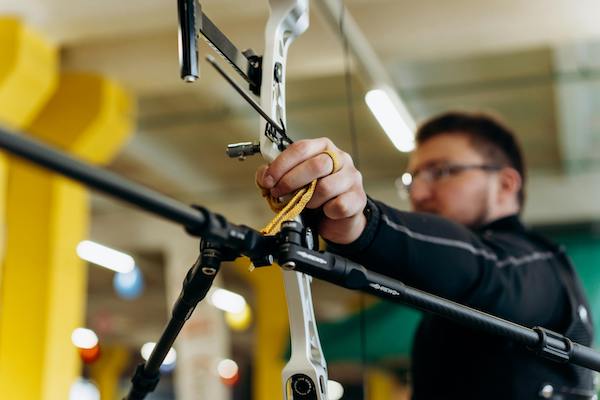
Visually impaired archers compete in dedicated visual impairment classifications (commonly referred to as B1, B2, and B3, or VI1–VI3), depending on the level of vision loss. Athletes in the most severe category are required to wear a blindfold or blackout glasses to ensure fairness and must use a tactile sighting device rather than a conventional bow sight. A sighted assistant is permitted to provide support with positioning, safety, and scoring, but may not influence performance.
While para archery is an official Paralympic sport, visually impaired archery is not currently included in the Paralympic Games programme. However, visually impaired archers do compete at national and international level, including World Archery Para events and World Championships, under recognised World Archery rules and visual impairment-specific regulations.
This structure ensures that athletes who are blind or visually impaired can participate in archery on an equal and competitive basis, while also enjoying the physical, mental, and social benefits the sport offers.
Classification
To ensure fair and meaningful competition, visually impaired archers are classified into divisions based on the severity of visual impairment. This is separate from the physical classification system (e.g., recurve open, compound open, or W1 wheelchair categories) used for other para archers
Any archer can apply to be classified at the international level through their national governing body. A classification does not necessarily make an athlete eligible to compete in a para archery division, but may make them eligible to compete with an assistive device.
Classification for international competition requires formal assessment by classifiers appointed through the International Blind Sports Association (IBSA) or World Archery’s classification panels, including verified measures of visual acuity and functional ability
Para archery competition classifications currently consist of open, W1 and visually impaired categories. Only a thorough classification examination may determine whether an athlete can compete in any category.
Visual impairment classifications include:
VI1 – Archers with the most severe visual impairment.
These athletes must wear blindfolds or black-out glasses while shooting to standardise reduced vision across the category.
VI2/VI3 – Archers with low vision but not total blindness.
These athletes do not wear blindfolds but still use tactile sights and other adaptations.
In both VI1 and VI2/VI3 categories, visually impaired athletes may use a tactile sighting device and are permitted an assistant who may help with arrow loading, safety, and scoring during competition.
World Archery
Archery is governed by the World Archery Federation and Olympic rules are derived from the World Archery rules. World Archery is the International Olympic Committee’s (IOC) recognised governing body for all of archery and the South African National Archery Association (SANAA) is a member in good standing of the World Archery Federation. The governing body is World Archery (WA), in relation with the International Paralympic Committee (IPC). Para-archery competitions follow the WA Rules. Presently 54 countries compete but the number is still growing.
Paralympic Archery is governed by the South African National Archery Association (SANAA) in terms of the President exercising his right under Article 12 of the Constitution which allows the formation of Sub-Committees, with specific assignments.
Rules
Visually impaired archers compete under the same target archery formats used internationally — shooting arrows at a marked target with concentric scoring rings — but with specific adaptations for classification and assistance. The underlying rules for target distance, timing, scoring, equipment, and field layout follow World Archery’s Target Archery Rules (Book 3), with amendments for visually impaired competition
Distance and target: Visually impaired archers typically shoot at a standard distance of 30 metres using a full-size 80 cm target face.
Tactile sights: These are physical references that touch the archer’s hand or bow, enabling aiming through touch rather than sight.
Assistants: An approved assistant may be positioned behind the shooting line to help relay information about target placement, score arrows, and safety.
Blindfolds: Required for VI1 competitors to ensure fair competition across differing degrees of residual vision.
For full details on rules and classification procedures, refer to the World Archery Target Archery Rule Book (Book 3, Chapter 21, Visually Impaired Rules)
Pathway to Particpation
For individuals with visual impairments interested in archery: Contact your local archery club or provincial archery association.
Archery is both a recreational and competitive sport, and clubs often support participation for those new to shooting as well as experienced archers seeking competition. Contact SANAA | SA National Archery Association for introductory coaching and equipment guidance.
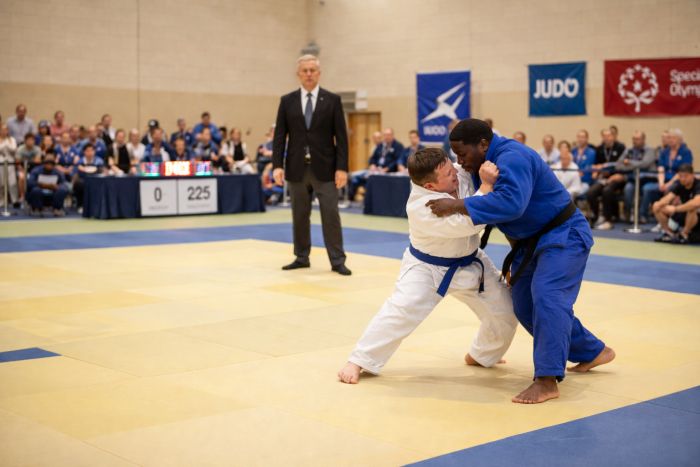
Judo is a sport demanding physical capabilities along with discipline.
Every athlete aims to prevail over the opponent by using special techniques, in the standing position by grappling his uniform (Judo Gi), trying to throw him down, and in the ground position by trying to pin him down for a certain time, or by applying chocks or arm locks.
The objective is to take an opponent to the ground, immobilize or subdue an opponent with a pin, or force an opponent to submit with a joint lock or a choke.
Strikes and thrusts by hands and feet as well as weapons defenses are a part of judo, but only in pre-arranged forms and are not allowed in judo competition or free practice.
Judo was created in Japan, in 1882. It is generally categorized as a modern martial art which later evolved into a combat and Olympic sport.
It is open to several weight categories and demands a physical and strategic performance, testing the qualities of strength, touch, balance and sensitivity.
Judo is available for athletes who are visually impaired at the Paralympics, it was added to the Paralympics programme in 1988. The ATHENS 2004 Paralympics was the first time that women’s weight categories were offered in Judo.
Judo in South Africa
SASAPD is an organisation in South Africa that focuses on the development and promotion of the sporting codes offered at Paralympic level for athletes with physical disabilities, visual impairment and blindness. This includes Judo for the Blind.
SASAPD was established in 1962 and offers pathways through affiliations with international bodies, such as IBSA, IWAS and CPISRA and the annual Nedbank National Championships for Physically Disabled, as recognised steps towards the Paralympic Games qualification across a variety of sports. They work and are an affiliate member of SASCOC as well as being associated members of a number of other national sporting federations.
Judo is mostly active in Western Province and in Gauteng. The convenor is Lorraine Job, she can be contacted at: mikjob@netactive.co.za
Rules
There are some rule differences for the B3 classification in competition that are sport specific. In judo, all three blind sport classes compete against each other, with competitors classified by weight for the purposes of competition. Weight classes use the international standards used in the Olympics. In judo, B1 classified competitors have a red dot on their kit to let others know they are completely blind.
The IBSA Judo Committee has released updated rules, effective as of February 2017. Visit the Judo page on the official Paralympics Web Site at: https://www.paralympic.org/judo or click here to download the rules.
Benefits of Judo
For blind persons and those with low vision, Judo can be instrumental in (re)attaining independence of movement and in developing physical capacities which permit better adaptation to everyday life. It represents for them, a means of escape from a sometimes sedentary existence and from the isolation often imposed by a disability.
Judo can contribute to these objectives in three sectors: motor, psychological and social.