


Scuba Diving
Adaptive scuba diving opens the underwater world to people with a wide range of disabilities, offering a unique sense of freedom, weightlessness, and adventure.
With specialised training, modified techniques, and supportive dive teams, scuba becomes fully accessible to individuals with physical, sensory, and certain cognitive impairments. In the water, many mobility limitations disappear, allowing divers to move with ease, build confidence, and explore vibrant marine environments.
In South Africa, adaptive scuba is growing in popularity, providing safe, supervised opportunities for discovery, personal challenge, and unforgettable experiences beneath the surface.
What Assistance are you Looking for?
1. About Scuba Diving
2. Handicapped Scuba Association | HSA
3. Benefits of Adaptive Scuba Diving
4. Adaptive Scuba Diving in South Africa
– Handicapped Scuba Crew
5. Accessible Scuba Sites in South Africa

1. About Scuba Diving
Scuba Diving is a very popular recreational activity for both able bodied persons and persons with disabilities across the world.
Persons with Mobility Impairments who love the weightless feeling that they get when swimming, will enjoy Scuba Diving.
The Handicapped Scuba Association promotes Scuba Diving around the world. Each year they plan Scuba Diving trips to exotic locations led by specially trained Scuba Divers and persons who use wheelchairs, ensuring that you have a safe and comfortable Scuba Diving experience.
2. The Handicapped Scuba Association (HSA)
The HSA was founded in 1981 by Jim Gatacre and is now the world’s leading authority on recreational Scuba Diving for persons with disabilities.
The HSA had its’ genesis in 1975 at the University of California-Irvine (UCI) as a research pilot program.
The program looked at the self-image benefits of Scuba Diving on students ‘with disabilities’ as they learned together with students ‘without disabilities’.
“The results were amazing! Everyone, with and without disabilities, grew in ways we could not measure and went on to more full and exciting lives.”
Gatacre, who had sustained an injury in 1972 that left his right arm with an impairment, was the prime motivation for the program.
Learning to Scuba dive had such a powerful rehabilitative effect on Gatacre, that he wanted to share it with others.
In 1981 he realized his dream and founded the Handicapped Scuba Association.
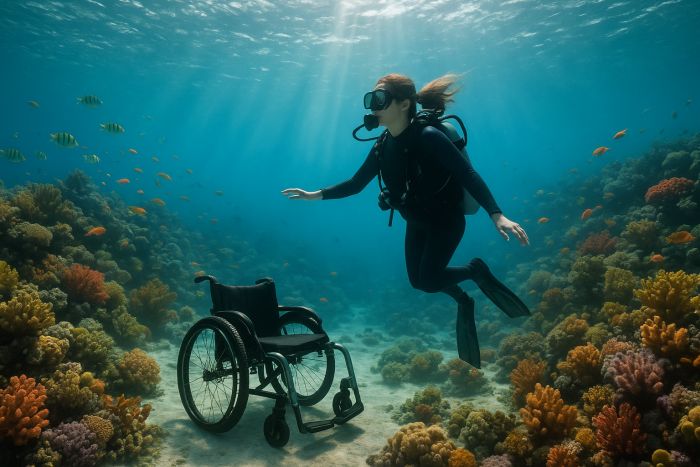
The Handicapped Scuba Association has it’s headquarters in California, but extends it’s underwater educational programs worldwide. It is dedicated to improving the physical and social well-being of persons with disabilities through the sport of scuba diving.
The Handicapped Scuba Association is made up of over 4000 underwater educators, Scuba Divers with disabilities and supporting members which are located in over 45 countries. They are dedicated to assuring that persons with disabilities are given the same opportunity to receive quality training, certification and dive adventures as the able bodied population.
The HSA operates as an independent diver training and certifying agency.
“Our prestigious diver education programs and Instructor Training Course (ITC) are internationally recognized and unequaled by any other programs in the industry.
Additionally we provide a variety of support services, such as Resort Evaluations and Accessible Dive Vacations.
Our training materials have been translated into 10 languages, and the HSA has brought the first recreational activity of any kind for persons with disabilities to countries such as the Ukraine.” [ Read More ]
The HSA is dedicated to improving the physical and social well-being of persons with disabilities through the sport of scuba diving
Through Scuba Diving the Handicapped Scuba Association is able to:
– Improve the health and fitness of persons with disabilities by challenging their physical abilities and endurance;
– Improve the quality of life of persons with disabilities by providing opportunities to actively participate in a mainstream sport;
– “Level the playing field” between persons with disabilities and their able bodied peers by facilitating access to a sport that they thought was not possible;
– Profile the abilities and potential of persons with disabilities to mainstream society.
– Motivate persons with disabilities to pursue other life challenges incl. education, employment, travel and sports. If you can do this, you can anything.
3. Benefits of Adaptive Scuba Diving
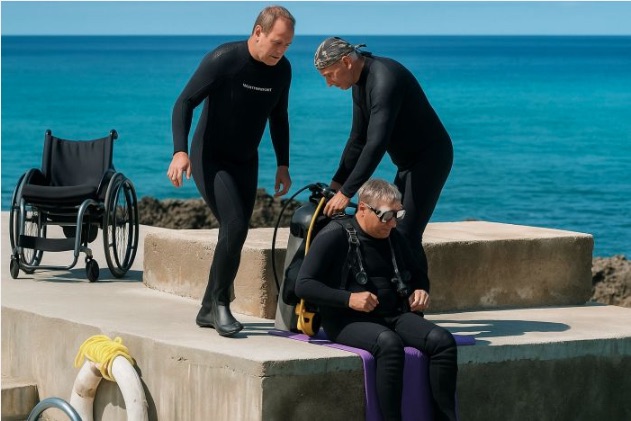
Adaptive scuba diving offers transformative physical, emotional, and social benefits for people with disabilities.
Physically, the weightlessness of water reduces pressure on joints and limbs, allowing divers unmatched freedom of movement. This can help improve circulation, muscle strength, breathing control, and overall mobility.
Emotionally, scuba empowers divers with a sense of independence and accomplishment, often restoring confidence in ways that land-based activities cannot. The calm, immersive nature of the underwater environment is also known to reduce stress and enhance mental well-being.
Socially, adaptive scuba brings people into a supportive community of divers and instructors, fostering connection, teamwork, and shared adventure. For many, it becomes not just a sport, but a source of healing, empowerment, and personal discovery.
New medical studies confirm the therapeutic benefits of Scuba Diving
New medical studies confirm the therapeutic benefits of Scuba Diving. The Handicapped Scuba Crew have been recognised for the work that they are doing and the benefits of Scuba Diving for persons with disabilities. Dr Wilson has used the Handicapped Scuba Crew rehabilitation methods in her International Presentations and Netcare has recognised HSC as a valuable contributor to their patients and staff.
4. Adaptive Scuba Diving in South Africa
Handicapped Scuba Crew
In South Africa organisations such as the Handicapped Scuba Crew promote and offer Scuba Diving for persons with disabilities, as both an activity and a form of therapy. Adaptive techniques enable the organization to live by their ethos that everyone is equal – giving every person equal opportunity to experience all parts of the dives.
Handicapped Scuba Crew is a Nonprofit Organization (Registration No: NPO 240/281) based in Pretoria.
Its mission is to break down barriers with “Scubility” – They Use SCUBA as a tool for rehabilitation back into normal society and to make sure that persons with disabilities are given the same opportunities, receiving the same quality training, certification and dive adventures, as able-bodied divers. “We enhance the lives of all persons with disabilities and their families through the sport of SCUBA Diving. – We raise funds for all our activities.”
In one year the Handicapped Scuba Crew completes more than 400 Sea Dives – in Sodwana Bay; Aliwal Shoal; Ponta do Ouro Mozambique and the Red Sea. More than 1000 Pool Sessions and more than 40 x courses.
If you are interested in Scuba Diving, or would like to find out more about the Handicapped Scuba Crew and the events planned, please contact:
Dean: 083 6789 849 or via email: dean@scubacrew.co.za | Richard: 082 579 3732 or via email: info@scubacrew.co.za or
Sue: 064 545 1671 or via email: sue@scubacrew.co.za.
5. Accessible Scuba Sites in South Africa
There are a variety of accessible dive sites in and around South Africa, including for example The Miracle Waters Scuba Diving Site, which has become much more wheelchair accessible, with wheelchair accessible paths, a wheelchair accessible toilet, sink and shower.
The site is used by Handicapped Scuba Association and Visually Impaired diver Francois Neeting, diving along with sighted diver Braam Le Roux, they assist South Africans with disabilities to participate in Scuba Diving, training them and partnering them with dive buddies, thus providing opportunities to participate in open water diving.
Please contact the Handicapped Scuba Crew on 083 6789 849 |082 579 3732 for the recommended accessible dive sites they use.