Government Disability Grants

Welcome to the Disability Grants page. A Disability Grant (also known as a Government or SASSA Grant) is a Social Grant designed to provide financial assistance to families or individuals who struggle to support themselves as a result of a disability.
See Qualification Criteria for Disability Grants below.

In South Africa the unemployment rate for people with disabilities is estimated to be significantly higher than the national average, often exceeding 90%. In rural areas, this rate can approach 100%. This high rate of unemployment means that these people with disabilities cannot take care of themselves financially.

The South African Social Assistance Act, 2004 (Act 13 of 2004) was created to provide a framework for the national government to administer social assistance programs and services, including effective management, administration, and payment of social assistance. The Act aimed to ensure comprehensive social security services against vulnerability and poverty within the constitutional framework.

The Social Assistance Act, 2004 (Act No. 13 of 2004) defines disability as “a moderate to severe limitation of a person’s ability to function or perform daily activities as a result of a physical, sensory, communication, intellectual, or mental impairment, if the limitation has lasted or is likely to last for a period of at least 12 months.

What Are You Looking For?

1. Types of Disability Grants
– Disability Grants
– Grant-in Aid
– Care Dependency Grant
2. Applying for a Grant
3. Qualification Criteria for Disability Grants
4. SASSA Grant Submission Requirements
5. Frequently Asked Questions
– How much will I receive?
– How do I know if my application was successful?
– Can my grant lapse?
– Suspension of Grants
– How do I appeal a suspension
– What to do if you Grant is denied or stopped?
5. Find a SASSA Branch in your area?
Toll free: 0800 60 10 11
Website: www.sassa.gov.za
Online Applications: services.sassa.gov.za
Email: GrantEnquiries@sassa.gov.za
6. Free Health Care at Hospital Level

Types of Disability Grants

There are currently 3 types of Disability Grants available to assist persons with disabilities and the parents of children with disabilities.
These include The Disability Grant, Grant-in Aid and the Care Dependency Grant.

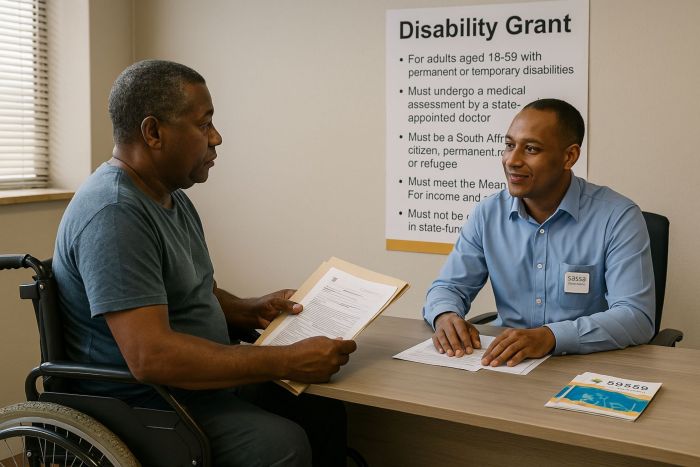
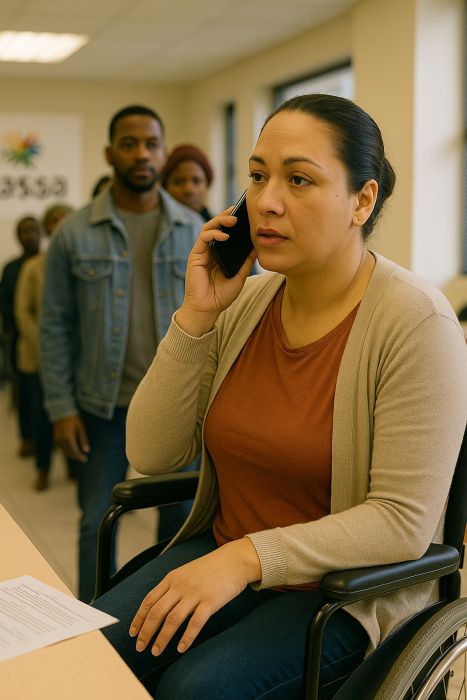
Middle age gentleman in a wheelchair applying for a disability grant.

1. Disability Grant

South African citizens with disabilities between 18 and 59 years old.

If you have a disability and struggle to support yourself financially, you can apply for a disability grant.

You get a permanent disability grant if your disability will continue for more than a year, or you get a temporary disability grant if your disability will last for a continuous period of not less than six months and not more than 12 months.

A permanent disability grant does not mean you will receive the grant for life, but it will continue for longer than 12 months.
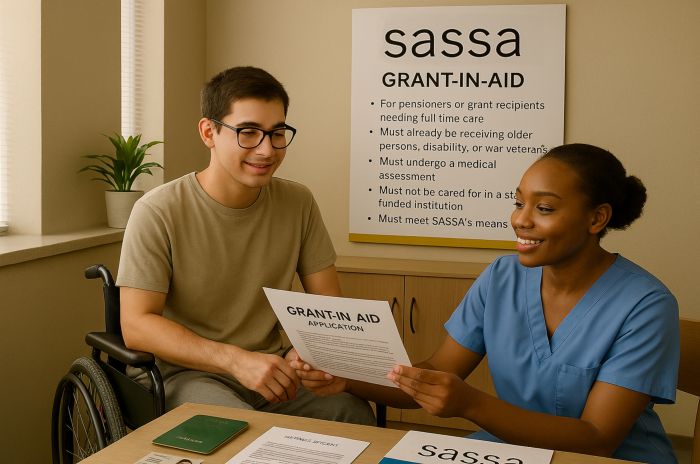
Young man in a wheelchair, assisted by a SASSA representative, to complete his application for applying for Grant In Aid

2. Grant-in Aid

Additional support for beneficiaries requiring full-time care:

To qualify, an applicant must:
i) Already receive an Older Persons Grant, Disability Grant, or War Veteran’s Grant.

ii) Require full-time care due to a physical or mental disability.

iii) Not be cared for in a State-funded institution

iv) Undergo a medical or functional assessment confirming the need for regular assistance
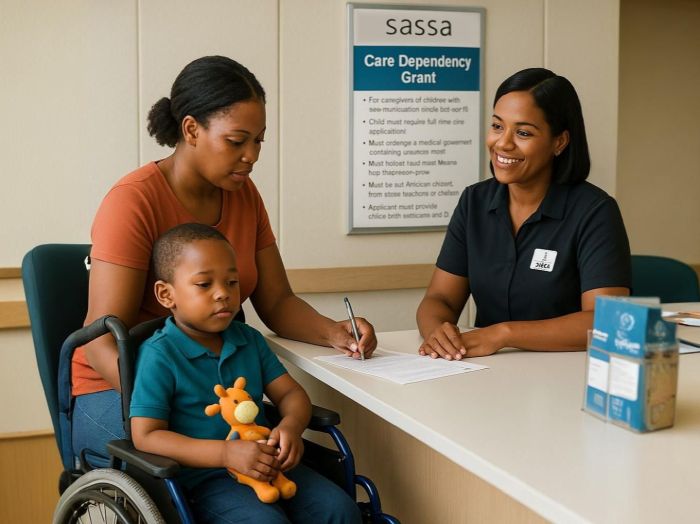
A mother, with a child, in a wheelchair, is being assisted to complete her Care Dependency Grant application

3. Care Dependency Grant

For children with severe disabilities requiring full-time care:

To qualify, an applicant must:
i) Be a South African citizen, permanent resident, or refugee and under 18

ii) Provide a medical report confirming the child’s disability.

iii) Meet the Means Test (except for foster parents).

iv) Be the parent, primary caregiver, or foster parent of a child with a disability.

v) The child must not be cared for in a State-funded institution

Applying For a Grant

All applications are made through SASSA – South African Social Security Agency Application forms are not available online, but you can get them from your nearest (SASSA) office. Families can apply at the government welfare offices or Department of Social Development offices.

If you are too old or sick to travel to the office to apply for a grant, then a family member or friend can apply on your behalf; with letter from you as applicant authorizing the application.

For more information about these grants, download the SASSA Disability Grants Guide below or Click here to find the contact details for your nearest provincial SASSA offices

How can we help you?

At Disability Info South Africa (DiSA), we are committed to breaking down barriers and creating a more inclusive society through our network of experts and the free Information Service that we provide.

Guidance and Support

We provide personalised guidance and practical support to help individuals with disabilities navigate accessibility challenges and available resources in South Africa, including a Step-by-step guidance on SASSA Disability Grant requirements.

Jobs and Learnerships

We can connect you with organisations and companies that specialise in Job and Learnership Recruitment of people with disabilities in South Africa, including Job Readiness Programs. 

Equipment that can assist you

We Connect individuals with the right companies and equipment that can help you to break free of the shackles of your disability. 
Advocacy and Resources

Do you have a problem? Contact DiSA, we connect individuals with the right legislation and support networks to help them on their journey. 

Do you have a Disability? Are you stuck, not sure what to do next?

DiSA provides Peer Support or can connect you with Life Coaches to guide you on your way. Get in touch with us today! 

You Don’t Have to Do It Alone

Let us support you in claiming your rights and live a life with dignity.

Qualification Criteria for Disability-related Grants
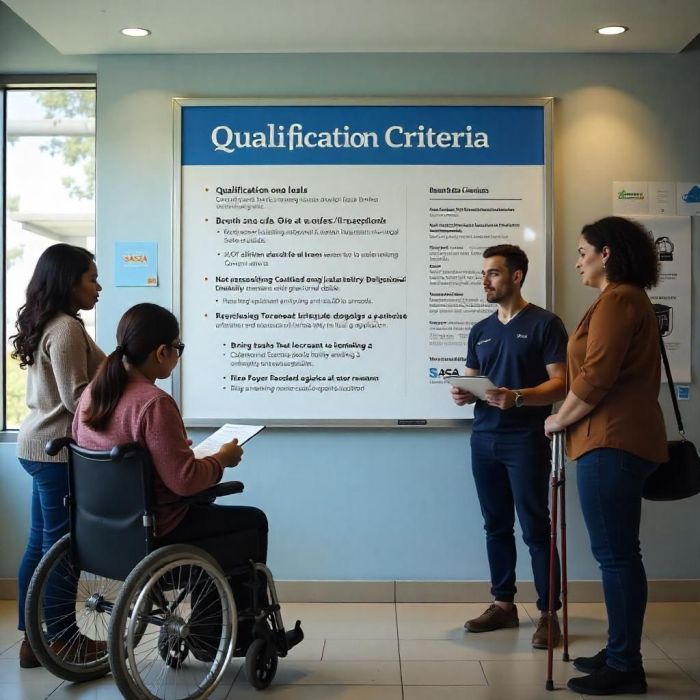
Disability Grant criteria - image of 4 people, 3 standing, 1 seated in wheelchair, in front a of a Disability Grants Criteria sign.
  • Is eligible in terms of section 6,7,8,9,10,11,12 or 13 of the government gazette June 2004
  • Subject to section 17, is resident in the Republic.
  • Is a South African citizen or is a member of a group or category of persons prescribed by the Minister, with the concurrence of the Minister of Finance, by notice of the Gazette;
  • – Eligibility for disability grants includes being a South African citizen, permanent resident, or refugee residing in South Africa.
    – Complies with any additional requirements prescribed in terms of subsection (2)
    – Applies for social assistance in accordance with section 14 (1).–
  • Applicants must be between 18 and 59 years old, and possess a 13-digit bar-coded ID.
  • If you are cared for in a state-funded institution, application can still be made, but the grant amount received would be reduced to 25% of the maximum amount.
  • Applicants must not receive another social grant in their own name and need to undergo a medical or functional assessment confirming their disability.
  • Applicants must meet the means test: income thresholds (not earning more than R101,640 if single or R203,280 if married) and asset limits (not having assets worth more than R990,000 if single or R1,980,000 if married).
  • Undergo a medical examination with a state appointed doctor to confirm disability and assess the degree of your disability
  • NOTE : The Minister may prescribe additional requirements or conditions in respect of:

    – income thresholds;
    – means testing;
    – age limits, disabilities and care dependency
    – forms, procedures and processes for applications and payments
    – measures to prevent fraud and abuse.
    – proof of and measures to establish or verify identity, gender, age, citizenship, family relationships, care dependency, disabilities, foster child and war veterans’ status

    You would need to bring along any previous medical records and reports when you make the application and when the assessment is done.
    The doctor will complete a medical report and will forward the report to South African Social Security Agency (SASSA). The report is valid for three months from the date you are assessed.

SASSA Grant Submission Requirements

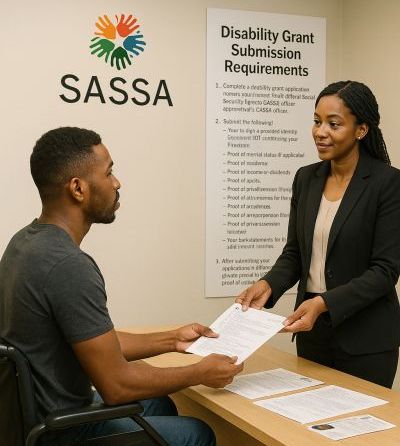
A young man in a wheelchair, is seated at a table, at SASSA, submitting his grant application documents to a SASSA employee

1. Complete a disability grant application form at your nearest South African Social Security Agency (SASSA) office in the presence of a SASSA officer.

2. Submit the following: 
– Your 13-digit bar-coded identity document (ID). 
– A medical report and functional assessment report confirming your disability.
– Proof of marital status (if applicable).
– Proof of residence.
– Proof of income or dividends (if any).
– Proof of assets, including the municipal value of your property.
– Proof of private pension (if any).
– Your bank statements for the past three months
– Refugee status permit and 13-digit refugee ID.
– UIF document or discharge certificate from your previous employer, if applicable.
– If you spouse died within the last 5 years, a copy of the will and the first and final liquidation and distribution accounts.

3. After submitting your application you will be given a receipt to keep as proof of application.

If you don’t have an ID:

– Complete an affidavit on a standard SASSA format in the presence of a Commissioner of Oaths
– Bring along a sworn statement signed by a reputable person who can verify your name and age.
– The SASSA official will take your fingerprints.
– While your application is processed, you will need to go to Home Affairs to apply for an ID
– If you don’t get an ID, your grant will be suspended.

Frequently Asked Questions
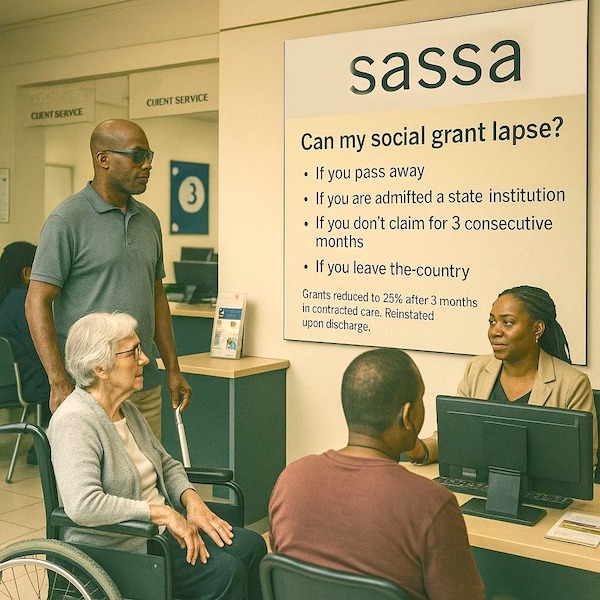
Three people seated at the desk of a SASSA employee - a blind gentleman standing, an older woman seated in a wheelchair and a younger man. The SASSA advisor, is explaining the conditions under which a SASSA grant can lapse.

The application process can take up to three months.
If your grant is approved, you will be paid from the day you applied.
The maximum is R2190.00 per month.

– The social security office will inform you in writing whether or not your application was successful.
– If unsuccessful, they will explain the reasons why. 
– You have 90 days to appeal the outcome of your application.
– Appeals are submitted in writing to the Minister of Social Development.

Main Reasons for Lapsing of Grants
– When the beneficiary or primary care giver dies.
– In respect of a child grant, when the child dies.
– Admission to a State institution.
– When the period of temporary disability has lapsed.
– You are absent from the Republic, for a period longer than 90 days.
– If the child for whom the grant is received, turns 18.
– If the grant was not collected for 3 consecutive months.

Please note: If you are admitted to an institution that has a contract with the state to care for you, the grant is reduced to 25% of the maximum amount of the grant. That will be done with effect from the 4th month following your admission to that institution. The reduced grant is re-instated immediately from the date you are discharged from the institution.

Every grant beneficiary has the responsibility to inform SASSA of any change in his/her circumstances – whether this is a change of address, change of marital status, change of financial position, or the child for whom he/she receives a grant is no longer in his/her care.

The following may result in the suspension of a grant:
– Changes in circumstances (financial and/or medical)
– Outcome of a review
– Failure to co-operate when a grant is reviewed
– Committing a fraudulent activity or misrepresentation.
– Where grant was approved in error.
– Failure to submit the required missing documents

Should a grant be suspended due to failure to collect for more than 3 consecutive months or due to failure to review, an application must be made for the restoration of that grant within 30 days of the suspension.

You have the right to appeal to the Department of Social Development within 90 days of being informed of the outcome.

How to appeal:
– Complete an appeal form (available from any SASSA office or online
– Attach supporting documents
(e.g. updated medical reports, proof of income/assets)
– Submit to the Minister of Social Development, care of your SASSA office

If your appeal is successful, the grant can be reinstated with back pay from the date it was stopped.

1. Request the Reason for Rejection or Suspension
SASSA must inform you in writing why your application was denied or why your grant was suspended. Common reasons include:
– Medical report does not confirm permanent disability
– Means test (income/assets) exceeds the qualifying threshold
– Missing or incorrect documents
– Administrative errors or failure to reapply after review

2. Appeal the Decision
You have the right to appeal to the Department of Social Development within 90 days of being informed of the outcome.

How to appeal:
– Complete an appeal form (available from any SASSA office or online)
– Attach supporting documents
(e.g. updated medical reports, proof of income/assets)
– Submit to the Minister of Social Development, care of your SASSA office

If your appeal is successful, the grant can be reinstated with back pay from the date it was stopped.

3. Get a New Medical Assessment
If your application was denied due to a medical issue, request a reassessment by an independent SASSA-appointed doctor. Make sure:
– Your condition is clearly documented
– You provide all functional assessments and hospital records

4. Review & Update Your Supporting Documents
Ensure that:
– Your ID, proof of residence, and financial documents are current
– You meet the means test criteria (low income, low asset value)
– Any refugee status permits or UIF/employment documents are up to date

5. Visit or Contact a SASSA Office
Sometimes grants are suspended due to admin errors. Visit your local SASSA office to clarify:
– If your reapplication or review is due
– If a temporary suspension can be reversed by providing updated paperwork

6. Get Support from Disability Organizations
Organisations like Disability Info South Africa (DiSA) who provide information, while Black Sash, and legal aid clinics can assist with appeals, legal advice, and documentation.

Tips to Avoid Suspension or Denial
– Respond to SASSA review notices on time
– Keep copies of all documents and receipts
– Inform SASSA if your address, income, or medical condition changes
– Renew medical assessments as required

Free Health Care for Persons with Disabilities at Hospital Level 

South Africa’s Constitution guarantees that everyone has access to healthcare services. This includes citizens, expats, refugees, and asylum seekers. Citizens can use both public and private healthcare. Public services are funded by the government while private care is accessible through insurance and direct payments.

Government-run clinics and hospitals provide a range of services, including primary care, antenatal care, and emergency services. In South Africa, accessing free healthcare generally involves visiting a public health facility.

All pregnant and breastfeeding women, and children under six, are entitled to free healthcare services at these facilities. Beyond pregnant and breastfeeding women and children under six, some individuals may be eligible for free or subsidised care based on a means test or other criteria determined by the Minister of Health.

The Minister of Health, in her budget speech, on 13 May 2003, indicated that free health care for people with disabilities would be implemented on 1 July 2005 services would include outpatient and inpatient hospital services.

However, the question comes into play as to how much Free Health Care is given.

SASSA Regional Offices
SASSA HOUSE
501 Prodinsa Building
Cnr Steve Biko & Pretorius
Pretoria
Private Bag X55662
Arcadia, Pretoria, 0083
Tel: 012 400 2000
Tel: 0800 60 1011
(Customer Care)
Eastern Cape
SASSA Office
BKB Building,
Cnr Fitzpatrick & Merino
Road Quigney, East London
Private Bag X9001
Chiselhurst, East London, 5200
Tel: 043 707 6300
Fax: 043 707 6481
Free State
Lustitia Building
Cnr St. Andrews Street &
Aliwal Street
Private Bag X20553
Bloemfontein, 9300
Tel: 051 410 8339
Western Cape
Golden Acre
Adderley Street
Cape Town, 8001
Private Bag X9189
Cape Town, 8000
Tel: 021 469 0200
Fax: 021 469 0260
Disclaimers and References

DiSA is committed to promoting the rights, dignity, and inclusion of persons with disabilities as outlined in the White Paper on the Rights of Persons with Disabilities. We strive to ensure that all content on our website reflects appropriate, respectful, and inclusive language in alignment with these principles.

However, we also provide a platform for companies and organisations to advertise their services and products. While we encourage advertisers to adhere to correct terminology and inclusive practices, DiSA cannot guarantee the accuracy or appropriateness of the language used by external parties in their content.

Please note: Any views, language, or terminology used in advertisements, promotional material, or external links do not necessarily represent the views of DiSA.

DiSA disclaims any responsibility for inaccuracies or language that may not align with the White Paper or best practices for disability terminology.

Should you however encounter language or content that you believe is inappropriate or offensive, we encourage you to contact us at info@disa.org.za, so that we can address the issue.

DiSA remains dedicated to fostering a respectful and inclusive environment for all individuals. We appreciate your understanding and collaboration in supporting our mission.


While we strive for accuracy and clarity, AI-generated visuals may not always reflect real-life conditions or representations.
In addition, we feature authentic images and videos of actual instances, events, circumstances that have occurred, as well as products and services supplied by companies who advertise with us.

These authentic visuals are intended to accurately depict our content or the offerings of our advertising partners.
If you have any questions or concerns about the content displayed on this site, please feel free to contact us.

DiSA provides a platform for companies and organisations to advertise their products and services to assist persons with disabilities and their families. While we make every effort to list reputable and credible service providers, the inclusion of any company, organisation, product, or service on our website does not constitute an endorsement or guarantee by DiSA.

Please note the following: DiSA is not involved in the delivery, quality control, or customer service of any product or service offered by advertisers listed on our platform.

Any agreements, purchases, or arrangements made between users of this website and advertisers are solely between those parties. DiSA is not responsible for the outcome of such interactions.

DiSA disclaims any liability for dissatisfaction, damages, or disputes arising from products or services supplied by companies or organisations listed on our website.

We encourage users to thoroughly research and verify any service provider or product before engaging with them. If you have concerns or encounter issues with an advertiser listed on our platform, please let us know at: info@disa.org.za. We value your feedback to help maintain the integrity of our platform.


While we strive for accuracy and clarity, AI-generated visuals may not always reflect real-life conditions or representations.
In addition, we feature authentic images and videos of actual instances, events, circumstances that have occurred, as well as products and services supplied by companies who advertise with us.

These authentic visuals are intended to accurately depict our content or the offerings of our advertising partners.
If you have any questions or concerns about the content displayed on this site, please feel free to contact us.

DiSA is committed to providing accurate and up-to-date information to assist persons with disabilities and their families. However, the nature of online content and external resources means that information can change frequently.

Please note the following: DiSA cannot guarantee the accuracy, completeness, or reliability of all information on our website, particularly information obtained from external sources or links to third-party websites.
External websites may update or remove content without notice, which can result in broken links or outdated information. DiSA is not responsible for the content, accessibility, or functionality of external websites.

While we make every effort to keep our information current, some content may become outdated over time.
We encourage users to verify information directly with the relevant third parties or organisations before making any decisions based on the information found on our platform.

If you encounter a broken link or outdated content, please notify us at: info@disa.org.za and we will address it as soon as possible.
Thank you for understanding and helping us maintain a reliable and accessible platform.


While we strive for accuracy and clarity, AI-generated visuals may not always reflect real-life conditions or representations.
In addition, we feature authentic images and videos of actual instances, events, circumstances that have occurred, as well as products and services supplied by companies who advertise with us.

These authentic visuals are intended to accurately depict our content or the offerings of our advertising partners.
If you have any questions or concerns about the content displayed on this site, please feel free to contact us.

The Information services and website that we offer free of charge, is privately run and funded and is not run or funded by the government. We rely on advertising, paid services and donations to supply and improve this Free information service that we do provide.

The Companies, Clubs, Schools and Organisations that are listed on this site, have advertised or made donations to the Website and have therefore assisted us be able to provide this free Service.
Please support them as they have supported Us and please contact us via info@disa.org.za, if you can advertise with us or would like to make a donation. Alternatively, visit our “Support Us” page to find out how you can support us or acquire our services. – Thank You.

If you encounter a broken link or outdated content, please notify us at: info@disa.org.za and we will address it as soon as possible.
Thank you for understanding and helping us maintain a reliable and accessible platform.

Please Note: We do assist with inquiries via email but may need to send or copy your details and inquiry to various other organisations, companies or government departments, that we sometimes consult, so that we can help you in the best way possible.
If you have any objection to us sharing your query or contact details, please notify us in your email. We will only share your information to assist you and will never sell or use your personal information for any other purposes.

DiSA waivers any liability for what happens if information is shared or used for marketing or other purposes by other organisations who do have consent to view such information.


While we strive for accuracy and clarity, AI-generated visuals may not always reflect real-life conditions or representations.
In addition, we feature authentic images and videos of actual instances, events, circumstances that have occurred, as well as products and services supplied by companies who advertise with us.

These authentic visuals are intended to accurately depict our content or the offerings of our advertising partners.
If you have any questions or concerns about the content displayed on this site, please feel free to contact us.

Please note that this website uses images and videos that are AI-generated and created to visually represent certain information, concepts or scenarios for illustrative purposes.


While we strive for accuracy and clarity, AI-generated visuals may not always reflect real-life conditions or representations.
In addition, we feature authentic images and videos of actual instances, events, circumstances that have occurred, as well as products and services supplied by companies who advertise with us.

These authentic visuals are intended to accurately depict our content or the offerings of our advertising partners.
If you have any questions or concerns about the content displayed on this site, please feel free to contact us.

Disability Info South Africa (DiSA) is committed to protecting your personal information in compliance with the Protection of Personal Information Act (POPIA), Act No. 4 of 2013. By using our free information service, you acknowledge and agree to the following:

Collection of Personal Information:
DiSA may collect and process your personal information (such as name, contact details, and inquiries) solely for the purpose of assisting you with your requests and providing relevant information or support.

Use and Storage:
Your personal information will only be used for the purpose it was collected for, we may need to send or copy your details and inquiry to various organisations, companies or government departments, that we sometimes consult, so that we can assist you in the best way possible.
If you have any objection to us sharing your query or contact details, please notify us in your email. We will only share your information to assist you and will never sell or use your personal information for any other purposes.
DiSA implements appropriate measures to secure your personal information against unauthorized access or loss.

Consent:
By submitting your details through our Contact Form, or contacting us via our email address, you consent to allow DiSA to process your information as outlined in this disclaimer. If you are not comfortable with DiSA sharing your information for the above purposes, please contact us directly at info@disa.org.za.

Access and Updates:
You have the right to request the deletion of your personal information at any time.
To do so, please contact us at: info@disa.org.za.

Third-Party Websites:
DiSA is not responsible for the privacy practices of external websites linked on our platform. Users are encouraged to review the privacy policies of third-party sites before sharing personal information.
For any queries or concerns regarding the handling of your personal information, please contact us at: info@disa.org.za.
Thank you for trusting DiSA to support you with accessible, inclusive, and reliable information.

1. SASSA – South African Social Security Agency: https://www.sassa.gov.za
2. Department of Social Development (DSD): https://www.dsd.gov.za
3. Black Sash – Social Justice Organisation: https://www.blacksash.org.za
4. Legal Aid South Africa: https://www.legal-aid.co.za
5. Social Assistance Act No. 13 of 2004: https://www.gov.za/documents/social-assistance-act
6. Disability support forums, community clinics, and case studies across South Africa
7. DiSA internal resources and partner input

Simplified Summary

Disability Grants in South Africa – What You Need to Know This page helps you understand how to get a Disability Grant from SASSA. What’s on the page: The different types of Disability Grants. How to apply for a grant. Who can get a Disability Grant. And what documents you need to apply.