Accessible Features

Persons with disabilities are often excluded from events, services, information, communication, products and venues because during the planning phases all users were not considered. This can be prevented by including a Universal Access Consultant, who will apply Universal Design Principals during the design phase.

Government Regulations have been put in place in South Africa and around the world to try to make public places more accessible to persons with disabilities, including persons with Sensory Impairments, which includes people with Visual Impairments and Hearing Impairments.

These government regulations are known as Accessible Features and they are meant to ensure that accommodation and transport is accessible and that equal opportunities and rights are available for persons with disabilities. By including Universal Access Consultants throughout the project as well as in the design phase, we can make sure that environments are truly accessible.

In the article below, we will discuss the Accessible Features that have been introduced in order to make public places more accessible to persons with Sensory Impairments, as well as the companies and organisations that can assist you to ensure that your business is accessible and safe, giving equal opportunities and equal rights for persons with disabilities.

Download The National Building Regulations and Building Standards Act here

Making Your Home/Office/Building Accessible: Who can Help?

There are now various Organisations and Companies that specialize in Universal Design and Access and can advise you on how to adapt your building and environment to make sure that persons with disabilities have equal rights and no loss of dignity.

These Organisations and Companies that specialize in Universal Design and Access will follow those standards set by  “The National Building Regulations and Building Standards Act” to make sure that persons with disabilities are not excluded from any events, services, information, communication, products and venues.
They include: National Council of and for Persons with Disabilities (NCPD)Bradshaw LeRoux ConsultingUniversal Access Collective and DiSA.

Logo for the National Council of Persons with Disabilities, an organisation which provides specialised services for persons with disabilities in South Africa

The National Council of and for Persons with Disabilities (NCPD) believe that this can be prevented by applying Universal Design Principals during the design phase and they therefor offer the following services to assist:

– Workshops for architects, developers and other building professionals to develop an understanding of universal design and access.
– Facilitating access audits for new or existing buildings; echo e-access for the natural and communication environment. Audits are followed by a report indicating shortfalls and recommendations.
– Marketing of facilities that are accessible to persons with disabilities

Contact: Fanie Swanepoel or Danie Marais
Tel: +27 11 452 2774
Email: fanies@ncpd.org.za or danie@ncpd.org.za
BradshawLeRoux - Disability Inclusion Specialists

Bradshaw LeRoux Consulting conduct Environmental Accessibility Audits designed to identify environmental barriers that could hinder access for Persons with a Disability. Our consultants will review your site, note potential barriers from a functional and safety perspective, and propose cost-effective solutions which can be actioned within short-, medium- and longer-term time frames.

Our reports are practical in nature, specific in the solutions offered, and allow for ease of use by all. Relevant to all environments, from corporate offices, manufacturing or industry sites, education facilities or hospitality environments, we can assist.
The Universal Access Collective

Turn accessibility challenges into opportunities with inclusive design that actually works.

Whether you’re a business owner, facility manager, or someone navigating personal accessibility needs, most environments still create barriers instead of being accessible and welcoming.

Universal Access Collective (UAC) solves the accessibility puzzle for businesses and individuals across Africa, turning compliance requirements and personal challenges into practical solutions that work.

For Businesses:  We assist to create a Universal Access environment including National Building regulations as well as International Best practices spaces that welcome more customers. Our built environment audits, digital accessibility reviews, and staff training don’t just tick boxes—they unlock new revenue streams and reduce liability risks.

For Families, Individuals and the Elderly: Adapting your home or navigating new accessibility needs shouldn’t feel overwhelming. Our coaching and universal design advisory services provide practical guidance that transforms challenges into confidence.

What makes us different? We’re a women-led consultancy combining technical expertise with lived experience. Mandy Latimore (globally recognised universal design specialist) brings both compliance knowledge and real-world understanding to every project.

Our comprehensive services include:
– Built environment and digital access audits
– Universal design advisory for residential and commercial spaces
– Family coaching and caregiver support
– Staff disability confidence training
– Inclusive communication and content development
– Assistive technology recommendations

Beyond consulting, we’re building a supportive community where businesses, families, and professionals share knowledge and drive change together.

Ready to transform accessibility from obstacle to opportunity? Contact us to discover how inclusive design creates better outcomes for everyone—and better business results for you.

You can contact Universal Access Collective:
Cell: +27 83 283 3370,
E mail: info@ua-collective.com,
Website: www.universalaccesscollective.com, LinkedIn: https://www.linkedin.com/company/universal-access-collective.
DiSA - Your One-Stop Access Solution

DiSA provides a One-Stop Access Solution to improve inclusivity by removing barriers to access in the built environment by referring Companies and Educational Facilities to various qualified Universal Access Consultants around the country. This includes Igor Rix, a qualified access consultant and co-founder of Disability Info South Africa (DiSA), who specialises in conducting Accessibility Audits and providing detailed reports on barriers within physical spaces and services.

Igor develops practical Implementation Plans to address these challenges, ensuring compliance with both national accessibility standards and international best practices. While focusing on fostering inclusivity for all individuals.
Ensuring all people of diverse needs and preferences, can fully participate and contribute to society in a meaningful way.

Read More about Igor Rix and the Accessibility Audits, Reporting and Implementation plans that he can provide.

1. Initiatives Introduced To Assist In Day To Day Activities

Wheelchair Parking is one of the many Accessible Features that the government has introduced along with certain regulations that state, how many of these Wheelchair Parking Bays must be available and the size of the Wheelchair Parking Bays.

The National Building Regulations state that where there is parking available for more than 50 motor vehicles, there must be parking facilities that accommodate disabled persons. There is also an obligation to ensure that persons with disabilities are provided with a suitable means of access from the parking area to the ground floor – or storey – of the building.

Unfortunately many buildings and businesses in South Africa still do not have adequate Disabled Parking Bays to accommodate wheelchair users. The owners of these buildings and businesses may therefore be challenged by the need to find suitable equipment, specialists and renovators familiar with accessible design issues in order to advise them and make there Parking areas accessible to persons with disabilities, especially those in wheelchairs. There are various Organizations and Companies that can assist with Universal Design and Access to make sure that persons with disabilities are not excluded from any events, services, information, communication, products and venues.

i. Money – Distinct Shapes & Raised Patterns

In South Africa and in many other countries around the world, both Coins and Bank Notes have been designed and made to include distinct features so that Persons who are Blind are able to tell the different coins and notes apart.

The South African National Council for the Blind was fully consulted by the South African Reserve Bank in the process for creating the new Mandela Series bank notes to ensure that the notes were made to be accessible to persons with Visual Impairments. A team from the Reserve Bank also held a workshop to ensure that all sectors of the visually impaired community received training and information regarding the new notes.

The new notes are the same size and colouring as the old notes (just brighter), so the Money Sticks which are used by some persons with Visual Impairments, will still work accurately:

Tactile shapes on notes and money templates

The South African Bank Notes are different lengths and have: one, two, three, four or five raised diamond shapes in the middle of the bottom half of the notes to enable blind people to identify them as R10, R20, R50, R100 and R200 respectively. For the benefit of the partially sighted, the Reserve Bank has also introduced geometric shapes on the front of the banknotes. The R10 note features a diamond, the R20 a square, the R50.00 a circle, the R100.00 a ‘flat’ hexagon and the R200.00 a ‘honeycomb’ hexagon.

For quick and easy reference money templates are also used to measure banknotes, these money templates come in various styles, including an aluminium device and a cardboard one, which can also be used to store the banknotes. Money templates are available to purchase from organizations such as the Guide Dogs Association of South African, Blind SA, or the South African National Council for the Blind. Contact them to receive a quote or visit Blind SA to see how to use the Cardboard Template.

A coin for example has six distinct features by which it can be identified. These include the: size; thickness; shape, as they are not all are entirely round; pattern of grooves round the edge; the sound it makes when dropped onto a table and the raised picture on the face.
We have 9 coins in South Africa:
The 1; 2; 5 and 10 Cents are almost never used now.
The 20 cent and 50 cents are all identifiable by continuous serration on the edges. These are called “copper” coins and have a different feel from the “silver rand value coins.
There are two types of 5 Rand coins, the latest and preferable one is unique in that it is thicker and has an interesting edging which includes complete serration as well as a groove running around it; it feels like two coins joined together.
The 1 Rand, 2 Rand and the old 5 Rand coins are distinguishable from Cent coins in that their serration around the edge is broken by smooth edging as well.
Size is also important:
The 10 Cent and 1 Cent are the smallest while the 5 Rand coin is the largest
The 50-cent coin is slightly larger than the 1 Rand but can easily be told apart by the difference in serration, which has been mentioned above.
Equipment is also available to help persons who are Blind to store their coins and distinguish between them, this equipment includes:
Plastic Coin Selectors: are also used for quick and easy reference, as the plastic unit has places for South African coins which enables you to handily store your coins in one unit. These plastic coin selectors are available from organizations such as South African National Council for the Blind. You can contact them to find out more or to receive a quote.

ii. Web Content Accessibility Guidelines

The internet and Websites can be very valuable, when websites and web tools are properly designed and coded, people with disabilities can use them, but currently many sites and tools are developed with accessibility barriers that make them difficult or impossible for some people to use, especially persons with disabilities. Making the web accessible benefits individuals, businesses, and society. International web standards define what is needed for accessibility.

The Web Content Accessibility Guidelines, often abbreviated to WCAG, are a series of guidelines for improving web accessibility. Produced by the World Wide Web Consortium (W3C), the WCAG are the best means of making your website useful to all of your users. The World Wide Web Consortium (W3C) develops international Web standards: HTML, CSS, and many more. W3C’s Web standards are called W3C Recommendations. All W3C standards are reviewed for accessibility support by the Accessible Platform Architectures (APA) Working Group. The W3C standards and Working Group Notes introduced below are particularly relevant to accessibility.

iii. Braille Atlas

The Department of Land Affairs has achieved yet another milestone in advancing the implementation of its disability strategy by producing the first ever Braille atlas of maps covering South Africa. The decision to produce the SA Braille Atlas was taken in terms of the departmental disability strategy and the constitutional right of access to information by disabled persons.

The Pioneer School for the Blind and the Pioneer Printing Works in Worcester played a key role in assisting the cartographers of CDSM during the preliminary stages of the atlas production. Many issues arose concerning the size and format of tactile maps and how the blind user is able to assimilate information. During the initial stages, interviews and workshops were held with pupils and teachers at the Pioneer School for the Blind and based on recommendations from them, it was decided to produce an atlas rather than a single map.

The blind user relies on variances in the texture of the tactile image. This atlas is primarily intended as an educational tool for blind persons who can read Braille. In terms of the Constitution and the right of access to information by people with disabilities, this publication will enable the blind in South Africa to be in touch with the world€.

The National Building Regulations and Tactile Paving
  • Persons with disabilities should be able to safely enter the building (Ramps) and be able to safely use all the facilities within it – specifically toilets. (Accessible Toilets)
  • Lifts in buildings must be able to serve the needs of disabled people. This includes ensuring that any commonly used “path of travel” MUST be free of any sort of obstacles that would limit, restrict or endanger people with disabilities who use that route. There must also be absolutely no obstacles that will prevent people with disabilities from accessing facilities within the building.
  • The National Building Regulations also state that where there is parking available for more than 50 motor vehicles, there must  be parking facilities that accommodate disabled persons. There is also an obligation to ensure that persons with disabilities are provided with a suitable means of access from the parking area to the ground floor – or storey – of the building. (Accessible Parking Bays)
  • There must be a means of access that is suitable for people with disabilities to use. In addition, access must be available from various approaches of the building via the main entrance and any secondary entrances, and should lead to the ground floor.
  • There must be a means of egress (a point of departure) that is suitable for people with disabilities to use in the event of any sort of emergency. This relates to any sort of emergency, but in addition, a further clause states that departure routes (or egress) must also be designed in accordance with Part T of the regulations, namely the section that relates to Fire Protection.
  • Buildings that incorporate halls or auditoriums for public use are obliged to ensure that a reasonable percentage of space is available for people in wheelchairs or other “assistive devices”. (Disabled Bays in Movie Theaters, Sports stadiums & Music Concerts)

Accessible Routes and Doorways

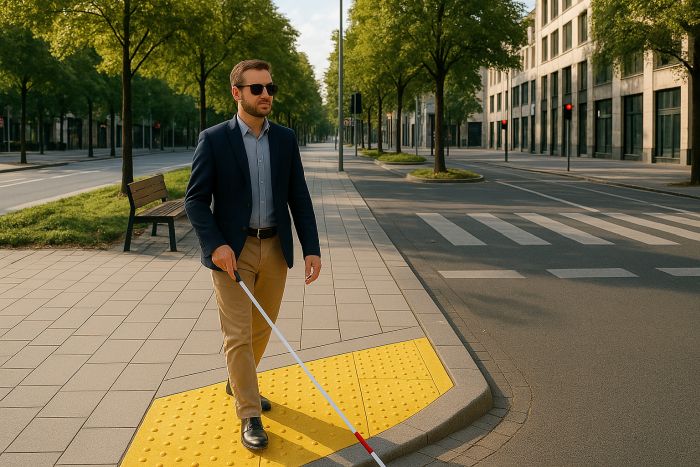
Man who is blind navigating along a pavement with a White Cane

An important part of accessibility is not only accessible parking spaces, passenger loading zones, ramps, Accessible Toilets and Lifts, etc but also insuring that there are various accessible routes from the public streets onto the pavements and to the accessible building entrance and to the facilities inside the building and visa versa. Appropriate accessible routes should also be made available for emergency exits. Accessible Routes include:

  • Ramps on and off the pavement
  • Wide enough walkways for a variety of size wheelchairs
  • No obstacles on these pathways
  • Wide doorways & turning areas, etc.

The South African Government through The South African National Standard for Building Regulations passes  laws that insure that new buildings and structures are designed and build with a certain regulations, which includes regulations on Accessible Routes.

There must be a means of access that is suitable for people with disabilities to use. In addition, access must be available from various approaches of the building via the main entrance and any secondary entrances, and should lead to the ground floor.

There must be a means of egress (a point of departure) that is suitable for people with disabilities to use in the event of any sort of emergency. This relates to any sort of emergency, but in addition, a further clause states that departure routes (or egress) must also be designed in accordance with Part T of the regulations, namely the section that relates to Fire Protection.

Tactile Paving is used in many cities around the world, including cities in and around South Africa. Tactile Paving (also called truncated domes) is a system of textured ground surface indicators found on footpaths, pavements, stairs and train station platforms to assist pedestrians who are blind or visually impaired to navigate cities and be more independent and mobile. Tactile paving units are like braille for pavements and was originally instituted at pedestrian crossings and other hazardous road situations by Japan, the United Kingdom, Australia and then United States in the early 1990s. Tactile Paving can now be found in many countries around the world and in most cities in South Africa, the paving is also available to purchase from various companies in South Africa.

These Tactile Pavings provide a distinctive surface pattern of truncated domes, cones or bars which are detectable by a long cane or underfoot, they are used to alert persons with Visually Impairments of approaching streets and a hazardous surface or grade changes. These raised bumps and ridges help guide people down sidewalks and across intersections, the raised ridges denote pathways (longer stretches between stops and changes), while raised domes are used to indicate a stop or change (e.g. the presence of an intersection or edge or a shift in direction).

In South Africa the use of Tactile Paving is recommended and specified in “The National Building Regulations and Building Standards Act” below:

4.4.3 Obstructions in the path of travel NOTE 2: The recommended surface between a pavement and roadway is a ramp fitted with tactile guidance surface indicators. This provides a safe and trafficable surface for wheelchair users, and a detectable surface to indicate to persons with visual impairments that they are leaving a pedestrian footpath and entering a traffic roadway.

In many cases Tactile Pavings work well and are very important tools to assist the Blind and persons with Visual Impairments, it is however very important that strict guidelines are met when installing this paving: Tactile Guidance on the use of Tactile Paving Surfaces but in some places where Tactile Pavings are not laid out correctly, they no longer provide assistance but instead become very hazardous.

How can we help you?

At Disability Info South Africa (DiSA), we are committed to breaking down barriers and creating a more inclusive society.
One of the most life-changing forms of support for individuals with disabilities is an Assistance Dog —a highly trained companion that provides mobility support, medical alerts, and emotional assistance. 

Guidance & Support

We provide information on eligibility, application processes, and legal rights regarding assistance dogs. 

Accessibility Audits

Ensuring businesses and public spaces are ‘assistance-dog friendly’ and compliant with accessibility standards. 

Disability Awareness Training

Educating organizations and individuals on the importance and rights of assistance dog users. 

Advocacy & Resources

Assistance Dogs Change Lives –
Let’s Make South Africa More Accessible

If you or someone you know could benefit from an assistance dog, or if you’re a business wanting to improve accessibility, get in touch with us today! 

Together, we can create a world where independence has no limits!

Disclaimers and References

DiSA is committed to promoting the rights, dignity, and inclusion of persons with disabilities as outlined in the White Paper on the Rights of Persons with Disabilities. We strive to ensure that all content on our website reflects appropriate, respectful, and inclusive language in alignment with these principles.

However, we also provide a platform for companies and organisations to advertise their services and products. While we encourage advertisers to adhere to correct terminology and inclusive practices, DiSA cannot guarantee the accuracy or appropriateness of the language used by external parties in their content.

Please note: Any views, language, or terminology used in advertisements, promotional material, or external links do not necessarily represent the views of DiSA.

DiSA disclaims any responsibility for inaccuracies or language that may not align with the White Paper or best practices for disability terminology.

Should you however encounter language or content that you believe is inappropriate or offensive, we encourage you to contact us at info@disa.org.za, so that we can address the issue.

DiSA remains dedicated to fostering a respectful and inclusive environment for all individuals. We appreciate your understanding and collaboration in supporting our mission.


While we strive for accuracy and clarity, AI-generated visuals may not always reflect real-life conditions or representations.
In addition, we feature authentic images and videos of actual instances, events, circumstances that have occurred, as well as products and services supplied by companies who advertise with us.

These authentic visuals are intended to accurately depict our content or the offerings of our advertising partners.
If you have any questions or concerns about the content displayed on this site, please feel free to contact us.

DiSA provides a platform for companies and organisations to advertise their products and services to assist persons with disabilities and their families. While we make every effort to list reputable and credible service providers, the inclusion of any company, organisation, product, or service on our website does not constitute an endorsement or guarantee by DiSA.

Please note the following: DiSA is not involved in the delivery, quality control, or customer service of any product or service offered by advertisers listed on our platform.

Any agreements, purchases, or arrangements made between users of this website and advertisers are solely between those parties. DiSA is not responsible for the outcome of such interactions.

DiSA disclaims any liability for dissatisfaction, damages, or disputes arising from products or services supplied by companies or organisations listed on our website.

We encourage users to thoroughly research and verify any service provider or product before engaging with them. If you have concerns or encounter issues with an advertiser listed on our platform, please let us know at: info@disa.org.za. We value your feedback to help maintain the integrity of our platform.


While we strive for accuracy and clarity, AI-generated visuals may not always reflect real-life conditions or representations.
In addition, we feature authentic images and videos of actual instances, events, circumstances that have occurred, as well as products and services supplied by companies who advertise with us.

These authentic visuals are intended to accurately depict our content or the offerings of our advertising partners.
If you have any questions or concerns about the content displayed on this site, please feel free to contact us.

DiSA is committed to providing accurate and up-to-date information to assist persons with disabilities and their families. However, the nature of online content and external resources means that information can change frequently.

Please note the following: DiSA cannot guarantee the accuracy, completeness, or reliability of all information on our website, particularly information obtained from external sources or links to third-party websites.
External websites may update or remove content without notice, which can result in broken links or outdated information. DiSA is not responsible for the content, accessibility, or functionality of external websites.

While we make every effort to keep our information current, some content may become outdated over time.
We encourage users to verify information directly with the relevant third parties or organisations before making any decisions based on the information found on our platform.

If you encounter a broken link or outdated content, please notify us at: info@disa.org.za and we will address it as soon as possible.
Thank you for understanding and helping us maintain a reliable and accessible platform.


While we strive for accuracy and clarity, AI-generated visuals may not always reflect real-life conditions or representations.
In addition, we feature authentic images and videos of actual instances, events, circumstances that have occurred, as well as products and services supplied by companies who advertise with us.

These authentic visuals are intended to accurately depict our content or the offerings of our advertising partners.
If you have any questions or concerns about the content displayed on this site, please feel free to contact us.

The Information services and website that we offer free of charge, is privately run and funded and is not run or funded by the government. We rely on advertising, paid services and donations to supply and improve this Free information service that we do provide.

The Companies, Clubs, Schools and Organisations that are listed on this site, have advertised or made donations to the Website and have therefore assisted us be able to provide this free Service.
Please support them as they have supported Us and please contact us via info@disa.org.za, if you can advertise with us or would like to make a donation. Alternatively, visit our “Support Us” page to find out how you can support us or acquire our services. – Thank You.

If you encounter a broken link or outdated content, please notify us at: info@disa.org.za and we will address it as soon as possible.
Thank you for understanding and helping us maintain a reliable and accessible platform.

Please Note: We do assist with inquiries via email but may need to send or copy your details and inquiry to various other organisations, companies or government departments, that we sometimes consult, so that we can help you in the best way possible.
If you have any objection to us sharing your query or contact details, please notify us in your email. We will only share your information to assist you and will never sell or use your personal information for any other purposes.

DiSA waivers any liability for what happens if information is shared or used for marketing or other purposes by other organisations who do have consent to view such information.


While we strive for accuracy and clarity, AI-generated visuals may not always reflect real-life conditions or representations.
In addition, we feature authentic images and videos of actual instances, events, circumstances that have occurred, as well as products and services supplied by companies who advertise with us.

These authentic visuals are intended to accurately depict our content or the offerings of our advertising partners.
If you have any questions or concerns about the content displayed on this site, please feel free to contact us.

Please note that this website uses images and videos that are AI-generated and created to visually represent certain information, concepts or scenarios for illustrative purposes.


While we strive for accuracy and clarity, AI-generated visuals may not always reflect real-life conditions or representations.
In addition, we feature authentic images and videos of actual instances, events, circumstances that have occurred, as well as products and services supplied by companies who advertise with us.

These authentic visuals are intended to accurately depict our content or the offerings of our advertising partners.
If you have any questions or concerns about the content displayed on this site, please feel free to contact us.

Disability Info South Africa (DiSA) is committed to protecting your personal information in compliance with the Protection of Personal Information Act (POPIA), Act No. 4 of 2013. By using our free information service, you acknowledge and agree to the following:

Collection of Personal Information:
DiSA may collect and process your personal information (such as name, contact details, and inquiries) solely for the purpose of assisting you with your requests and providing relevant information or support.

Use and Storage:
Your personal information will only be used for the purpose it was collected for, we may need to send or copy your details and inquiry to various organisations, companies or government departments, that we sometimes consult, so that we can assist you in the best way possible.
If you have any objection to us sharing your query or contact details, please notify us in your email. We will only share your information to assist you and will never sell or use your personal information for any other purposes.
DiSA implements appropriate measures to secure your personal information against unauthorized access or loss.

Consent:
By submitting your details through our Contact Form, or contacting us via our email address, you consent to allow DiSA to process your information as outlined in this disclaimer. If you are not comfortable with DiSA sharing your information for the above purposes, please contact us directly at info@disa.org.za.

Access and Updates:
You have the right to request the deletion of your personal information at any time.
To do so, please contact us at: info@disa.org.za.

Third-Party Websites:
DiSA is not responsible for the privacy practices of external websites linked on our platform. Users are encouraged to review the privacy policies of third-party sites before sharing personal information.
For any queries or concerns regarding the handling of your personal information, please contact us at: info@disa.org.za.
Thank you for trusting DiSA to support you with accessible, inclusive, and reliable information.


1. Building Regulations for facilities for Disabled Pdf.
2. Standard Electrical, Mechanical And Architectural Guideline For The Design Of Accessible Buildings (Facilities For Disabled Persons)
3. www.auto-mobility.co.za
4. www.bradshawleroux.co.za
5. www.ncpd.org.za
6. www.universalaccesscollective.com