Yes To Access – Discrimination Complaints Platform

Welcome to Our Yes To Access – Discrimination Complaints Platform, where we aim to inform people of their rights and who or what is available to assist them and Break Down Barriers to help create an Accessible South Africa.

How does it work?

Yes To Access includes an online reporting platform, created by Disability info South Africa (DiSA), to acknowledge persons with disabilities’ civil right to equal and fair access and facilitating a Disability Discrimination Complaint (DDC) by inviting anyone in society to voluntary Identify and Report on all forms of Barriers to Access and acts of Disability Discrimination.

On receiving these reports of “Barriers to Access”, we will report them and work to find solutions to remove them.

Persons with disabilities have an equal right to live in the community, with choices equal to others.

This requires that government, across all three spheres, take effective and appropriate measures to facilitate full enjoyment
by persons with disabilities of this right and their full inclusion and participation in the community.

Barriers to Equal, Dignified Access

Discrimination on the basis of disability means any distinction, exclusion or restriction of persons on the basis of disability, which has the purpose or effect of impairing or nullifying the recognition, enjoyment or exercise, on an equal basis with others, on all human rights and fundamental freedoms in the political, economic, social, cultural, civil, or any other field.

It encompasses all forms of unfair discrimination, whether direct or indirect, including denial of reasonable accommodation.”
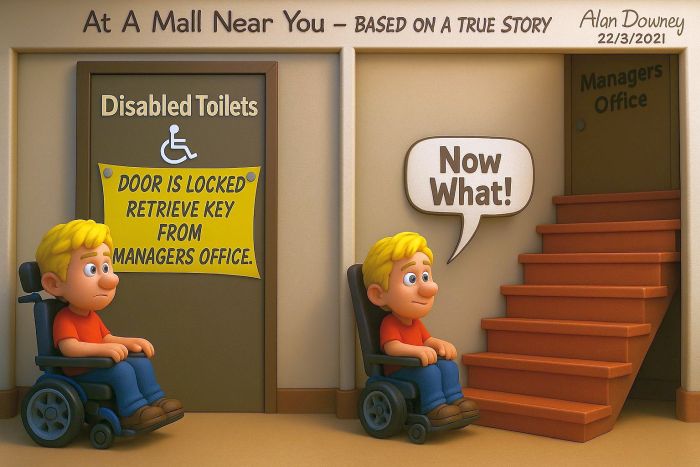
At a Mall Near You - Part 2

Why is it necessary to identify and report Disability Discrimination?

Cartoon image displaying a selection of persons with disabilities - everyone is entitled to equal rights

Across society, people’s lack of knowledge about and their attitudes and behaviour towards the rights and needs of persons with disabilities are the greatest barriers to access for equal participation and living a dignified, fulfilled and meaningful life…a life worth living for, plain and simple.

Equal, Dignified and Non-Discriminatory Access is a basic human need & civil right under the Constitution of South Africa (1996) and along with:

– The Employment Equity Act
The White Paper on the Rights of Persons with Disabilities (WPRPD)
– The Promotion of Equality and Prevention of Unfair Discrimination Act (PEPUDA)

forms the basis of the rights of people with disabilities and protects all its citizens from discrimination.

Yellow Arrow

The objective is to Educate and Advocate Inclusive Access by:

– inviting civil society and business owners alike, to join our campaign and
– participating voluntarily and pro-actively to help break down these barriers to
– create an all-inclusive and accessible living environment in South Africa.

With a willing, positive and caring attitude to enable change, We Are Stronger Together when we:


– Identify and report the injustice and continue to;
– Break down the physical, attitudinal and behavioural barriers to access to;
– Enable inclusive, equitable and dignified access for all.

Who can complain? When is the right time?

Anybody, at Any Time can report Any act or form of disability discrimination.

The unfair treatment of persons with disabilities may relate, but not limited to, people, buildings, outdoor spaces, facilities, products, services and or information. You are invited to lodge a Disability Discrimination Complaint (DDC) via our website by completing our online form here

How do I lodge a Disability Discrimination Complaint?

Yellow Arrow

Lodge a Complaint –
1. Complete the Complaint Form by clicking on the link or DDC button below and submit it.
OR
1. Select the relative button below to read the information provided and;
2. Return to this page to complete and submit the form.

Navy Arrow

What will happen next?
1. Once the complaint form is submitted you will receive an automated response and reference number to acknowledge your complaint.
2. The person or organisation being implicated will be contacted within 78 hours and invited to respond to the alleged complaint within 7 days.
3. DiSA will track and follow up on the complaint and report back on the progress.
4. All complaints will be received, logged and stored.for easy reference.

The sensitivity and confidentiality of all personal information will be respected and protected.
The following selection of incident buttons are available to identify and report a possible Disability Discrimination Complaint (DDC)

2. Know Your Rights! File a Complaint –

You have equal rights before the law as any person without disability. Below are categories of accessibility where you, as a person with disability have equal right of access. Know your rights. Click on your area of interest from the icons listed below to find out more:-

Despite these regulations listed above, many buildings and businesses in South Africa still do not have adequate Disabled Parking Bays to accommodate wheelchair users. The owners of these buildings and businesses may therefore be challenged by the need to find suitable equipment, specialists and renovators familiar with accessible design issues in order to advise them and make their Parking areas accessible to persons with disabilities, especially those in wheelchairs.

There are now various Organizations and Companies that specialize in Universal Design and Access and can advise you on how to adapt these Parking Bays to make sure that persons with disabilities have equal rights and access to businesses and shopping centres.

Click on the link below to find out more about these Organizations and Companies and how they can assist you.
Read More

3. Accessibility Category Guide

i. Parking and Accessible Parking Disks
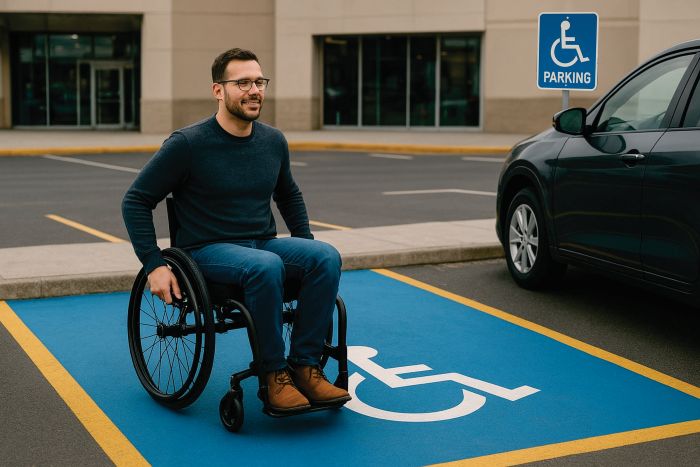
A man in a wheelchair waits to. be collected on a disabled parking bay

A Designated Accessible Parking Bay (DAPB), is required to provide access to either the driver or passenger to load and unload mobility aids from a wide range of vehicle sizes, without putting users at risk of being injured by passing traffic.

The following are only a few of the key areas which may present some access issues.
– Availability of a DAPB
– Visible and legible signage / displaying the Access Sign
– Marking / dimensions / layout / location
– Surface of DAPB / Accessible Path of Travel (CAPT)
– Abuse  / unauthorised parking without a permit
– Kerb-ramp / access to CAPT or entrance

There are a number of Organizations that you can apply to, to register and receive an Accessible Parking Disc, these include the National Council of and for Persons with Disabilities (NCPD), the QuadPara Association of South Africa (QASA) and an APD in your province.

Each province has different procedures with regards to the application for parking permits for persons with disabilities, but if you apply for your parking disk from Organizations such as QuadPara Association of South Africa (QASA), the disc can be used throughout South Click on the link below to see the procedures that you need to follow to register a Parking Disk with The National Council of and for Persons with Disabilities (NCPD) or QASA

If you wish to register your Disabled Parking Disc in your province and it is not listed, we recommend that you contact your local Association for Physically Disabled (APD) for the procedures in your area.

Read More

Despite these regulations listed above, many buildings and businesses in South Africa still do not have adequate Disabled Parking Bays to accommodate wheelchair users. The owners of these buildings and businesses may therefore be challenged by the need to find suitable equipment, specialists and renovators familiar with accessible design issues in order to advise them and make their Parking areas accessible to persons with disabilities, especially those in wheelchairs.

There are now various Organizations and Companies that specialize in Universal Design and Access and can advise you on how to adapt these Parking Bays to make sure that persons with disabilities have equal rights and access to businesses and shopping centres.

Click on the link below to find out more about these Organizations and Companies and how they can assist you.
Read More

If you believe that you have been discriminated against through Non Compliant Parking: –
Please complete and submit our Disability Discrimination Complaint (DDC) Form, which we will review, then take to the relevant authorities.

ii. Transport

Transport by road, rail, water or air should be available and accessible to everyone. 
The following are only a few of the key areas which may present some access issues.

– Online booking / trip planning
– Accessibility of bus stops / stations / airports
– Information / signage / communication
– Assistance with wayfinding / navigation  / Tactile Ground Surface Indicators ( TGSI’s)
– Assistive devices / mobility aids
– Sensitive and competent drivers / staff
– Access on / from / while using, the mode of transport
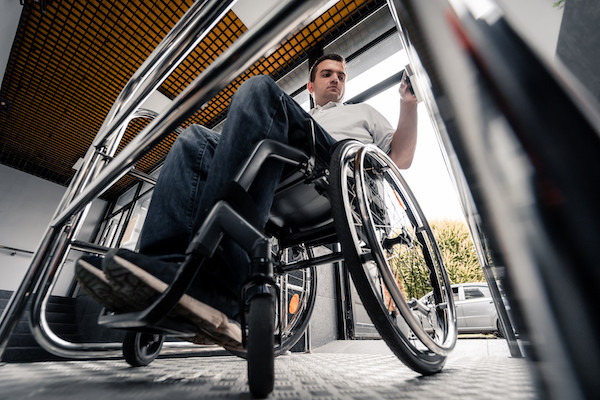
A young man in a wheelchair boards an accessible train

Some Government projects include introducing services to specific Cities or Provinces, these services cater and are accessible to some persons with disabilities.
There are also private companies who specialize in the transport of all persons with disabilities in South Africa. Some companies and organizations also rent out accessible or adapted vehicles suitable for persons who use Mobility Aids such as Wheelchairs, Scooters and Walkers.

South Africa is a very popular and relatively accessible tourist destination. They aim to ensure that all aspects of tourism are accessible to all people, regardless of their physical limitations, disabilities or age. Despite this, one of the biggest obstacles still faced by many travelers with Mobility Impairments, is finding suitable Accessible Travel and Transport which can cater for persons who use Mobility Aids such as Wheelchairs or Scooters. Persons who rely on this type of equipment traditionally face many obstacles when traveling, they not only require extra space to maneuver and store their Mobility Aids and other equipment, but many of these people also have difficulty transferring to and from their Mobility Aids into a seat or into a vehicle.

There are various options when traveling in South Africa or overseas, including traveling by Air, Sea, Rail or Road, which are all possible to some degree for persons with Mobility Impairments. Each person is different and each form of travel offer its own pro’s and cons. Your travel arrangements can be booked online via the company web site which may also specify more details on what disabilities they can cater for. When deciding to take a trip, whether it is for a holiday or for business, it is important to start organizing and planning your transportation and travel arrangements a couple of weeks or months before departure.

Click on the link below to find more information, links and tips about the different forms of travelling that is accessible to you, as well as some of the companies and web sites that can assist you in specific areas.
Read More XXXX

If you believe that you have been discriminated against through Non Compliant Transport and Travel: –
Please complete and submit our Disability Discrimination Complaint (DDC) Form, which we will review, then take to the relevant authorities.

iii. Buildings and Outdoors

Buildings and outdoor areas are of the most common barriers to access to people with disabilities, but also to the greater public.

The following are only a few of the key areas which may present some access issues.
– Accessible parking
– Walkways / ramps / steps / landings
– Kerb height / guardrails / handrails
– Information / signage / wayfinding / orientation/ Tactile Ground Surface Indicators (TGSI’s)
– Doorways / entrances
– Door opening pressure / handles
– Wheelchair circulation space inside / outside
– Stairways and lifts
– Auditory assistive devices in lifts
– Unisex Accessible Toilets (USAT)
– Emergency egress
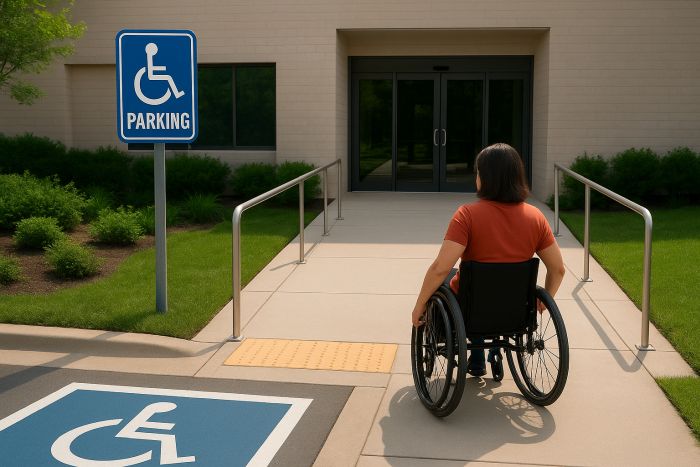
lady in wheelchair pushing past accessible signage

Persons with disabilities are often excluded from many events, services, information, communication, products and venues because during the planning phases all users were not considered. This can be prevented by applying Universal Design Principals during the design phase. Government Regulations have been put in place in South Africa and around the world to try to make public places more accessible to persons with disabilities, including persons with Mobility Impairments.

The Government often makes laws that insure that new buildings are designed & built with certain features to make them wheelchair friendly. These are known as The National Building Regulations and Building Standards Act, which was amended and published by the Department of Trade and Industry in May 2008. Some parts of the Act Part S deals with facilities for persons with disabilities and directly affected the building industry.

They include information about:
– Disabled Toilets
– Ramps
– Disabled Parking Bays
– Disabled Bays in Movie Theaters, Sports stadiums and Music Concerts

Read More

If you believe that you have been discriminated against through Non Compliant Built Environments: –
Please complete and submit our Disability Discrimination Complaint (DDC) Form, which we will review, then take to the relevant authorities.

iv. Accessible Education

Accessible Education – Section 12 of the South African Schools Act (Act 79 of 1996) through Section 5 makes provision for all schools to be full-service schools by stating that public schools must admit learners and serve their educational requirements without unfairly discriminating in any way.

Image of young kids running down the front steps of a school towards a young boy in a wheelchair at the bottom of the steps

The following are only a few of the key areas which may present some access issues.
– Denied access when eligible to learn
– Denied access for carer / personal assistant
– Personal abuse / discrimination
– Access to premises / buildings
– Designated accessible parking bay (DAPB)
– Accessible information / /wayfinding  / signage / communication / navigation
– Unisex Accessible Toilets (USAT)
– Transport or events / activities
– Assistive learning devices in classroom
– Training of teachers / lecturers to accommodate learners

If you believe that you have been discriminated against through Inaccessible Education: –
Please complete and submit our Disability Discrimination Complaint (DDC) Form, which we will review, then take to the relevant authorities.

v. Service Dogs

Access for Guide, Service, Support and Therapy Dogs. These are NOT pets or petting animals, BUT highly specialized and professionally trained assistance animals which provide assistance to persons with, but not limited to, vision and hearing and intellectual impairments. These registered and certified assistance animals are to be allowed access to all areas within the built-environment, outdoor and transport sectors when accompanied by their respective owners / handlers.

The following are only a few of the key areas which may present some access issues.
– Access to buildings / outdoor areas
– Animal refuge area / drinking bowl
– Signage or information to the refuge area
– Animal abuse / discrimination / lack of awareness

To find out more about these dogs please click on the relevant link below:-

Service Dogs for persons with Mobility Impairments: including Diabetics and persons in wheelchairs
Guide Dogs for persons with Visual Impairments: including persons who are blind.
Hearing Dogs for persons with Hearing Impairments: including persons who are Deaf
– Service Dogs, Therapy Dogs, Seizure Response Dogs, Autism Support Dogs for persons with Intellectual Impairments: including Autism, PTSD, Epilepsy, Mental Illnesses, etc

Image of a young man in a wheelchair, on a phone call. Seated neat to him is a mobility assistance dog.

If you believe that you have been discriminated against and your Guide/Assistance/Therapy Dog denied access: –
Please complete and submit our Disability Discrimination Complaint (DDC) Form, which we will review, then take to the relevant authorities.

vi. Travel / Tourism and Accommodation
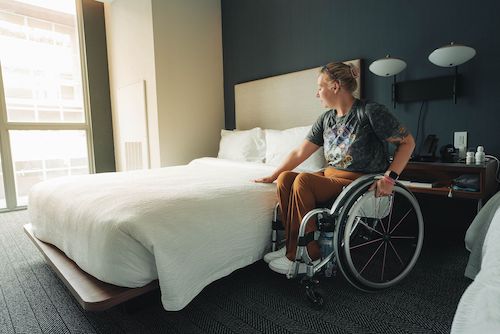
A young women in a wheelchair tests access to an hotel bed where she is staying

Tourism is described as an industry with 8 sectors which includes Accommodation, adventure tourism and recreation, attractions, events and conferences, food and beverage, tourism services, transportation and travel trade.

The Tourism Grading Council of South Africa determines the minimum compliance standard for Universal Accessibility in the industry to ensure equitable and dignified access to everyone visiting an establishment for accommodation, travel, products and services.

Tourism is one of South Africa’s most important windows to the world and by having groups of tourists, families or friends accompanied by people with for example ( but not limited to) physical disabilities (mobility aids, wheelchairs, etc), not being able to travel, stay, spend money and enjoy our beautiful country, its people, rich culture, what it offers and represents to its fullest potential, is an undignified tragedy.

The following are only a few of the key areas which may present some access issues.

No or inadequate accessible online booking
Misleading advertising of accessible tourism and accommodation
No or inadequate accessible modes of transport / transfers / outdoor events / sight-seeing / safari facilities
No or inadequate level, firm, even and slip resistant surfaces
No or inadequate Designated Accessible Parking Bays (DAPB)
No or inadequate accessible pathways / ramps / landing / steps and stairs
No or inadequate Continuous Accessible Paths of Travel (CAPT) – especially during emergencies
No or inadequate accessible information / signage / communication / navigation
No or inadequate Emergency Evacuation Plan
No or inadequate Evac chair (for stairs) and accessible assembly point
No or inadequate Handrails and grabrails
No or inadequate Height adjustable beds
No or inadequate Unisex accessible toilets (USAT)
No or inadequate Lowered counters (reception and self-service dining surface)
No or inadequate Wheelchair Circulation Space
No or inadequate accessible dining area
No or inadequate accessible spa’s  / bedrooms /  furniture / amenities
No or inadequate hearing / speech / vision assistive devices or technology
No or inadequate accessible lifts (e.g. audio prompted and tactile signage)
No or inadequate garden access
No or inadequate assistance animal accommodation / amenities
No or inadequate Swimming pool access via ramp/ steps / hoist (mobile or overhead)
No or inadequate Legible menus and information brochures
No or inadequate Staff and management training / understanding of the needs of people with disabilities.

South Africa is a popular tourist destination and tourism accounts for a substantial amount of the country’s revenue. South Africa offers both domestic and international tourists a wide variety of options, including Picturesque Natural Landscapes; Beautiful Beaches; Tours; Trails & Botanical Gardens; World Renowned Game Reserves; Highly Regarded Wines and Wine Farms and so much more.

Traveling and going to new places can however be daunting for persons with disabilities, especially those persons with Mobility Impairments who use wheelchairs or Scooters. In the past Transport Services, Restaurants, Hotels, Safaris, Beaches and other activities and forms of entertainment, were not always accessible for persons in wheelchairs, due to this inaccessibility and the fear of the unknown, some persons with disabilities were afraid to Travel on holiday or go to new places.

Modern society however is becoming increasingly aware of the concept of the integration of persons with disabilities and the National Department of Tourism (NDT) has been focusing on Accessible Tourism and making more South African attractions universally accessible to all travelers. They have recently engaged with various organisations that represent persons with disabilities, to explore how the tourism industry can serve them better and to ensure that tourist destinations, products and services are accessible to all people, regardless of their physical limitations, disabilities or age. Steps have been taken to promote guidelines, and major resources are now dedicated to Accessible Tourism which includes:

South Africa is a very popular and relatively accessible tourist destination. They aim to ensure that all aspects of tourism are accessible to all people, regardless of their physical limitations, disabilities or age. Despite this, one of the biggest obstacles still faced by many travelers with Mobility Impairments, is finding suitable Accessible Travel and Transport which can cater for persons who use Mobility Aids such as Wheelchairs or Scooters. Persons who rely on this type of equipment traditionally face many obstacles when traveling, they not only require extra space to maneuver and store their Mobility Aids and other equipment, but many of these people also have difficulty transferring to and from their Mobility Aids into a seat or into a vehicle.

There are various options when traveling in South Africa or overseas, including traveling by Air, Sea, Rail or Road, which are all possible to some degree for persons with Mobility Impairments. Each person is different and each form of travel offer its own pro’s and cons. Your travel arrangements can be booked online via the company web site which may also specify more details on what disabilities they can cater for. When deciding to take a trip, whether it is for a holiday or for business, it is important to start organizing & planning your transportation and travel arrangements a couple of weeks or months before departure.

Click on the link below to find more information, links and tips about the different forms of travelling that is accessible to you, as well as some of the companies and web sites that can assist you in specific areas.

Read More:

If you believe that you have been discriminated against through Non-Compliant Accessible Tourism & Accommodation: –
Please complete and submit our Disability Discrimination Complaint (DDC) Form, which we will review, then take to the relevant authorities.

vii. Disability Defamation

Disability Defamation, Discrimination and Harassment occurs anywhere and anytime, when a person with a disability is being treated unfairly, humiliated, insulted and intimidated or place at risk to injury.

The absence or denial of assistive devices in many public areas, e.g. education, employment and getting and using services, impacts on the ability of persons with physical, hearing, vision and intellectual impairments to be able to move, communicate and or participate in public life.
– Equitable and dignified Access
– Humiliating / discriminatory / undignified / offensive behavior
– Direct and Indirect discrimination (including carers, friends and relatives of people with disabilities)
– Assistive technology and devices
– Information, communication, navigation, way-finding and orientation
– Continuous loud noise / bright or continuous flickering light

Many public and private sector bodies have gradually realised that their work practices and policies fall far short of fulfilling the needs, rights and aspirations of persons with disabilities who are their clients, customers and co-workers and that, in order to change this situation, they need to turn to persons with disabilities for education and guidance. From this realisation has grown the demand for Disability Equality Training (DET) run by persons with disabilities, which aims to help people understand the meaning of disability, identify changes in work practice, and plan strategies to implement change.

Disability Equality Training courses have been organised and run by persons with disabilities and various organizations to address the need for information about reality of disability. A DET course will enable participants to identify and address discriminatory forms of practice towards disabled people. Through training they will find ways to challenge the organisational behaviour which reinforces negative myths and values and which prevents persons with disabilities from gaining equality and achieving full participation in society.

There are various Companies and Organizations who offer these Disability Equality Training courses and workshops, they include: Read More about Disability Equality Training courses:

If you believe that you have been discriminated against through Disability Defamation –
Please complete and submit our Disability Discrimination Complaint (DDC) Form, which we will review, then take to the relevant authorities.

viii. Accessible Bathrooms

A Unisex Accessible Toilet (USAT) is required so that a person who needs to use the toilet with a carer of the opposite gender, can both access the facility from a common area. Ambulant toilets are for people who can walk but with the assistance of a mobility aid.

The following are only a few of the key areas which may present some access issues.

– Signage of USAT
– Abuse / unauthorized use
– Problem opening / closing / locking the door
– Difficult to open the door (e.g. too heavy or wrong handle type)
– Handrails / Grab rails
– Wheelchair circulation space inside/ outside door
– Toilet amenities out of reach / not working
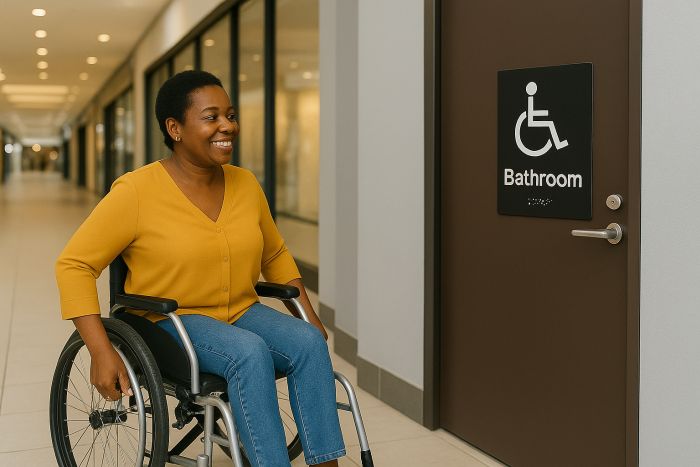
Accessible Bathroom

An accessible toilet is a special bathroom designed to accommodate people with physical disabilities, they are sometimes known as Disabled Toilets. Public Toilets can present accessibility challenges for people with disabilities, such as those people in wheelchairs. Stalls may not be able to fit a wheelchair in, and transferring between the wheelchair and the toilet seat may pose a challenge. Accessible Toilets are designed to address these issues by providing more space and Grab Bars/Rails for users to grab and hold onto during transfers.

XXX Read More: …..

The South African Government through The South African National Standard for Building Regulations makes laws that insure that new buildings are designed and build with a certain amount of Disabled Toilets.

In any building where facilities for persons with disabilities are required in terms of Regulation S1, there shall be one or more toilets or unisex toilet facilities suitable for use by wheelchair users. Persons with disabilities should be able to safely enter the building (Ramps) and be able to safely use all the facilities within it – specifically toilets.

Read More: ….. XXX

Unfortunately many buildings in South Africa have toilets and bathrooms that were not designed and built to accommodate wheelchair users or the elderly. The owners of these buildings may therefore be challenged by the need to find architects and renovators familiar with accessible design issues in order to make them accessible.There are now various Organizations and Companies that specialize in Universal Design and Access and can advise you on how to adapt these Bathrooms to make sure that persons with disabilities have equal rights and no loss of dignity.

These Organizations and Companies include: Read More: …..

If you believe that you have been discriminated against through inaccessible Bathrooms or Toilets –
Please complete and submit our Disability Discrimination Complaint (DDC) Form, which we will review, then take to the relevant authorities.

ix. Employment Equity

Man with Neurological Impairment applying for a job

In South Africa, people with disabilities have strong legal protections and rights in the workplace, supported by several laws and policy instruments that aim to ensure equal opportunity, non-discrimination, and inclusion.
The Employment Equity Act (No. 55 of 1998) prohibits unfair discrimination on the grounds of disability in all aspects of employment, including recruitment, hiring, promotion, and retention. It also mandates that designated employers take affirmative action to achieve equitable representation of disadvantaged groups, including persons with disabilities.
Visit the Accordion Menus listed below to find information or a policy that can assist you, or your company.

When employing people with disabilities, or providing educational services, it is essential for companies to foster an inclusive and supportive work environment through awareness and sensitization training for all staff and be aware of employment rights and legislation that exist, while also providing reasonable accommodation to ensure that people with disabilities are treated fairly and have equal access to opportunities. Together, these measures create a workplace that values diversity, inclusion, and equal participation for everyone.

Please read the information below to find out more about this and the companies and organisations that provide this training.

Disability Awareness Training

Reasonable accommodation involves making necessary and appropriate modifications to ensure that persons with disabilities can enjoy their rights on an equal basis with others. The National Strategic Framework on Reasonable Accommodation for Persons with Disabilities (2023) provides comprehensive guidelines to facilitate this process.

The Strategic Framework provides for:

Individualized Support: Recognizes that reasonable accommodation measures are often specific to the individual’s impairment and personal circumstances.
Comprehensive Measures: Includes assistive devices, technology, personal assistance, and environmental adaptations to promote independence and participation.
Standardized Procedures: Encourages the development of service charters and standards across all sectors to ensure consistent and equitable access to accommodations.

Examples of Reasonable Accommodation:

Adjusting Work Hours or Duties: Modifying schedules or job responsibilities to align with an individual’s needs.
Providing Assistive Technologies: Supplying tools such as screen readers, ergonomic chairs, or other devices to enhance accessibility.
Making Physical Spaces Accessible: Implementing changes like ramps, elevators, or modified workstations to ensure mobility and comfort.
Offering Live Assistance: Providing services such as personal aides, sign language interpreters, or guide dogs to support daily functions.

How to Request Reasonable Accommodation:

Disclosure: Communicate your specific needs to the relevant authority. While disclosure is voluntary, providing detailed information can facilitate appropriate accommodations.
Assessment Reports: Offer medical or professional documentation that outlines your disability and the recommended accommodations.
Confidentiality: Employers are obligated to handle all personal information with the utmost confidentiality.
Interactive Process: Engage in open dialogue to identify effective and reasonable accommodations.
Timely Implementation: The framework emphasizes prompt action to ensure that accommodations are provided without unnecessary delays.

These policies cover Human Rights, Equality and Protection against discrimination, they include:

1. The Constitution of the Republic of South Africa

The Constitution of the Republic of South Africa, 1996, was approved by the Constitutional Court (CC) on 4 December 1996 and took effect on 4 February 1997.
The Constitution is the supreme law of the land. No other law or government action can supersede the provisions of the Constitution. It states: –
“Everyone is equal before the law and has the right to equal protection and benefit of the law. Equality includes the full and equal enjoyment of all rights and freedoms.
To promote the achievement of equality, legislative and other measures designed to protect or advance persons or categories of persons, disadvantaged by unfair discrimination may be taken.”

Download the Constitution of the Republic of South Africa

2. Promotion of Equality and Prevention of Unfair Discrimination Act, 2000 (PEPUDA)
The Promotion of Equality and Prevention of Unfair Discrimination Act, 2000 (PEPUDA or the Equality Act, Act No. 4 of 2000) is a comprehensive South African anti-discrimination law. It prohibits unfair discrimination by the government and by private organisations and individuals and forbids hate speech and harassment.

The act specifically lists race, gender, sex, pregnancy, family responsibility or status, marital status, ethnic or social origin, HIV/AIDS status, colour,
sexual orientation, age, disability, religion, conscience, belief, culture, language and birth as “prohibited grounds” for discrimination.
It also contains criteria that courts may apply to determine which other characteristics are prohibited grounds.
Download The Promotion of Equality and Prevention of Unfair Discrimination Act (PEPUDA)

3. The White Paper on the Rights of Persons with Disabilities (2006)
The White Paper on the Rights of Persons with Disabilities (WPRPD) is a South African government policy document that outlines the rights of people with disabilities. The WPRPD was published by the Department of Social Development.

Purpose
– To create a just and free society that includes people with disabilities as equal citizens.
– To promote equality, integration, and full inclusion for people with disabilities.
– To improve the quality of life for people with disabilities and their families.

Download the White Paper on the Rights of Persons with Disabilities (WPRPD)

4. Broad-Based Black Economic Empowerment Act 53 of 2003
This Act deals with economic empowerment of black women and men and persons with disabilities. The Act gives priority to issues such as employment equity and equalising opportunities.
Download the Broad-Based Black Economic Empowerment Act here

These policies cover HumanThese Policies cover Labour, Employment and include Laws ensuring fair treatment in the workplace.

1. The Employment Equity Act, no 55 of 1988

The Employment Equity Act, no 55 of 1988 covers employees in both the public and private sectors as well as applicants for employment and training. The Acts outlaw discrimination in work-related areas such as pay, vocational training, access to employment, work experience and promotion.
Download the Employment Equity Act here

2. The Skills Development Act

The Skills Development Act of 1998 (Act 97 of 1998) in South Africa aims to improve the skills of the workforce. This is done by increasing investment in education and training, and by creating opportunities for people to learn new skills. The Act also aims to improve employment prospects for people who have been disadvantaged by unfair discrimination.
Download the Skills Development Act here

3. The “Technical Assistance Guidelines on the Employment of People with Disabilities” (TAG)

The “Technical Assistance Guidelines on the Employment of People with Disabilities” (TAG) is a document designed to help employers, employees, trade unions, and people with disabilities understand and implement the Employment Equity Act, specifically regarding non-discrimination and affirmative action measures for people with disabilities in the workplace;
It provides practical guidance on how to ensure fair employment practices for individuals with disabilities by outlining reasonable accommodation measures and other key considerations
Download the Technical Assistance Guidelines on the Employment of People with Disabilities (TAG) here

4. Code of Good Practice on the Prevention and Elimination of Harassment

The Code of Good Practice on the Prevention and Elimination of Harassment in the Workplace (Code) aims to eliminate all forms of harassment in the workplace by providing guidance on the policies and procedures to be implemented in the event that harassment occurs in the workplace.
Download the Code of Good Practice on the Prevention and Elimination of Harassment in the Workplace here

Rights, Equality and Protection against discrimination, they include:

1. The Constitution of the Republic of South Africa
The Constitution of the Republic of South Africa, 1996, was approved by the Constitutional Court (CC) on 4 December 1996 and took effect on 4 February 1997.
The Constitution is the supreme law of the land. No other law or government action can supersede the provisions of the Constitution. It states: –
“Everyone is equal before the law and has the right to equal protection and benefit of the law. Equality includes the full and equal enjoyment of all rights and freedoms.
To promote the achievement of equality, legislative and other measures designed to protect or advance persons or categories of persons, disadvantaged by unfair discrimination may be taken.”
Download the Constitution of the Republic of South Africa

2. Promotion of Equality and Prevention of Unfair Discrimination Act, 2000 (PEPUDA)
The Promotion of Equality and Prevention of Unfair Discrimination Act, 2000 (PEPUDA or the Equality Act, Act No. 4 of 2000) is a comprehensive South African anti-discrimination law. It prohibits unfair discrimination by the government and by private organisations and individuals and forbids hate speech and harassment.
The act specifically lists race, gender, sex, pregnancy, family responsibility or status, marital status, ethnic or social origin, HIV/AIDS status, colour,
sexual orientation, age, disability, religion, conscience, belief, culture, language and birth as “prohibited grounds” for discrimination.
It also contains criteria that courts may apply to determine which other characteristics are prohibited grounds.
Download The Promotion of Equality and Prevention of Unfair Discrimination Act (PEPUDA)

3. The White Paper on the Rights of Persons with Disabilities (2006)
The White Paper on the Rights of Persons with Disabilities (WPRPD) is a South African government policy document that outlines the rights of people with disabilities. The WPRPD was published by the Department of Social Development.

Purpose
– To create a just and free society that includes people with disabilities as equal citizens.
– To promote equality, integration, and full inclusion for people with disabilities.
– To improve the quality of life for people with disabilities and their families.

Download the White Paper on the Rights of Persons with Disabilities (WPRPD)

4. Broad-Based Black Economic Empowerment Act 53 of 2003
This Act deals with economic empowerment of black women and men and persons with disabilities. The Act gives priority to issues such as employment equity and equalising opportunities.
Download the Broad-Based Black Economic Empowerment Act here

The Employment Equity Act (EEA), 1998 (as amended in 2023) defines “people with disabilities” as those who have “a long-term or recurring physical, mental, intellectual, or sensory impairment which, in interaction with various barriers, may substantially limit their prospects of entry into, or advancement in, employment.” 

Under the Act, you have the right to:
Reasonable accommodation:
Your employer must make adjustments (e.g., modifying workspaces, providing assistive devices) to enable you to perform your job.
Protection from discrimination:
You cannot be unfairly treated because of your disability.
Equal opportunities:
Employers must implement affirmative action measures to promote the employment and advancement of persons with disabilities.

If your rights are violated, you can lodge a complaint with the Commission for Conciliation, Mediation, and Arbitration (CCMA).

Equally important policy instruments are two Codes of Good Practice.

Every employee has the right to a fair, respectful, and accessible workplace. The Code of Good Practice on the Employment of Persons with Disabilities (2015) and the Code of Good Practice on the Prevention and Elimination of Harassment in the Workplace (2023) set out guidelines to ensure that persons with disabilities are treated with dignity, provided equal opportunities and protected from discrimination and harassment.

Employment Rights of Persons with Disabilities:
Persons with disabilities have the right to equal treatmentin hiring, promotion, and workplace policies. Employers must:
– Ensure non-discrimination—hiring and workplace practices must be fair and inclusive.
– Provide reasonable accommodation—this may include assistive devices, flexible work arrangements, or workspace modifications.
– Respect confidentiality—employees are not required to disclose their disability, but if they do, employers must handle it with sensitivity.
– Develop inclusive policies—workplaces must actively support disability inclusion and consultation with disabled employees.

What is Workplace Harassment?
Harassment is any unwanted behavior that demeans, excludes, or intimidates someone. Persons with disabilities often face:
– Ableist harassment—mocking, questioning, or dismissing someone’s disability.
– Bullying—verbal abuse, exclusion, or setting unrealistic expectations.
– Denial of reasonable accommodations—refusing to adjust workspaces, schedules, or duties to accommodate disability-related needs.
– Online harassment—offensive messages, social exclusion, or inappropriate jokes.

Employer Responsibilities:
Employers must take proactive steps to create a harassment-free and disability-inclusive workplace by:
– Implementing clear anti-harassment and disability inclusion policies.
– Training staff on disability rights and appropriate workplace behaviour.
– Investigating and addressing harassment complaints immediately.
– Providing safe and accessible reporting systems for employees who experience or witness harassment.

What Can You Do?
– Know your rights—you deserve a workplace free from discrimination and harassment.
– Request accommodations—employers must make reasonable adjustments to support your work.
– Report harassment—if you experience or witness harassment, speak to HR, a manager, or a trusted workplace representative.
– Advocate for inclusion—raise awareness and support a culture of respect, accessibility, and equal opportunity.

If you believe that you have been discriminated against in the workplace –
Please complete and submit our Disability Discrimination Complaint (DDC) Form, which we will review, then take to the relevant authorities.

Disclaimers and References

DiSA is committed to promoting the rights, dignity, and inclusion of persons with disabilities as outlined in the White Paper on the Rights of Persons with Disabilities. We strive to ensure that all content on our website reflects appropriate, respectful, and inclusive language in alignment with these principles.

However, we also provide a platform for companies and organisations to advertise their services and products. While we encourage advertisers to adhere to correct terminology and inclusive practices, DiSA cannot guarantee the accuracy or appropriateness of the language used by external parties in their content.

Please note: Any views, language, or terminology used in advertisements, promotional material, or external links do not necessarily represent the views of DiSA.

DiSA disclaims any responsibility for inaccuracies or language that may not align with the White Paper or best practices for disability terminology.

Should you however encounter language or content that you believe is inappropriate or offensive, we encourage you to contact us at info@disa.org.za, so that we can address the issue.

DiSA remains dedicated to fostering a respectful and inclusive environment for all individuals. We appreciate your understanding and collaboration in supporting our mission.


While we strive for accuracy and clarity, AI-generated visuals may not always reflect real-life conditions or representations.
In addition, we feature authentic images and videos of actual instances, events, circumstances that have occurred, as well as products and services supplied by companies who advertise with us.

These authentic visuals are intended to accurately depict our content or the offerings of our advertising partners.
If you have any questions or concerns about the content displayed on this site, please feel free to contact us.

DiSA provides a platform for companies and organisations to advertise their products and services to assist persons with disabilities and their families. While we make every effort to list reputable and credible service providers, the inclusion of any company, organisation, product, or service on our website does not constitute an endorsement or guarantee by DiSA.

Please note the following: DiSA is not involved in the delivery, quality control, or customer service of any product or service offered by advertisers listed on our platform.

Any agreements, purchases, or arrangements made between users of this website and advertisers are solely between those parties. DiSA is not responsible for the outcome of such interactions.

DiSA disclaims any liability for dissatisfaction, damages, or disputes arising from products or services supplied by companies or organisations listed on our website.

We encourage users to thoroughly research and verify any service provider or product before engaging with them. If you have concerns or encounter issues with an advertiser listed on our platform, please let us know at: info@disa.org.za. We value your feedback to help maintain the integrity of our platform.


While we strive for accuracy and clarity, AI-generated visuals may not always reflect real-life conditions or representations.
In addition, we feature authentic images and videos of actual instances, events, circumstances that have occurred, as well as products and services supplied by companies who advertise with us.

These authentic visuals are intended to accurately depict our content or the offerings of our advertising partners.
If you have any questions or concerns about the content displayed on this site, please feel free to contact us.

DiSA is committed to providing accurate and up-to-date information to assist persons with disabilities and their families. However, the nature of online content and external resources means that information can change frequently.

Please note the following: DiSA cannot guarantee the accuracy, completeness, or reliability of all information on our website, particularly information obtained from external sources or links to third-party websites.
External websites may update or remove content without notice, which can result in broken links or outdated information. DiSA is not responsible for the content, accessibility, or functionality of external websites.

While we make every effort to keep our information current, some content may become outdated over time.
We encourage users to verify information directly with the relevant third parties or organisations before making any decisions based on the information found on our platform.

If you encounter a broken link or outdated content, please notify us at: info@disa.org.za and we will address it as soon as possible.
Thank you for understanding and helping us maintain a reliable and accessible platform.


While we strive for accuracy and clarity, AI-generated visuals may not always reflect real-life conditions or representations.
In addition, we feature authentic images and videos of actual instances, events, circumstances that have occurred, as well as products and services supplied by companies who advertise with us.

These authentic visuals are intended to accurately depict our content or the offerings of our advertising partners.
If you have any questions or concerns about the content displayed on this site, please feel free to contact us.

The Information services and website that we offer free of charge, is privately run and funded and is not run or funded by the government. We rely on advertising, paid services and donations to supply and improve this Free information service that we do provide.

The Companies, Clubs, Schools and Organisations that are listed on this site, have advertised or made donations to the Website and have therefore assisted us be able to provide this free Service.

Please support them as they have supported Us and please contact us via info@disa.org.za, if you can advertise with us or would like to make a donation. Alternatively, visit our “Support Us” page to find out how you can support us or acquire our services. – Thank You.

If you encounter a broken link or outdated content, please notify us at: info@disa.org.za and we will address it as soon as possible.
Thank you for understanding and helping us maintain a reliable and accessible platform.

Please Note: We do assist with inquiries via email but may need to send or copy your details and inquiry to various other organisations, companies or government departments, that we sometimes consult, so that we can help you in the best way possible.
If you have any objection to us sharing your query or contact details, please notify us in your email. We will only share your information to assist you and will never sell or use your personal information for any other purposes.

DiSA waivers any liability for what happens if information is shared or used for marketing or other purposes by other organisations who do have consent to view such information.


While we strive for accuracy and clarity, AI-generated visuals may not always reflect real-life conditions or representations.
In addition, we feature authentic images and videos of actual instances, events, circumstances that have occurred, as well as products and services supplied by companies who advertise with us.

These authentic visuals are intended to accurately depict our content or the offerings of our advertising partners.
If you have any questions or concerns about the content displayed on this site, please feel free to contact us.

Please note that this website uses images and videos that are AI-generated and created to visually represent certain information, concepts or scenarios for illustrative purposes.


While we strive for accuracy and clarity, AI-generated visuals may not always reflect real-life conditions or representations.
In addition, we feature authentic images and videos of actual instances, events, circumstances that have occurred, as well as products and services supplied by companies who advertise with us.

These authentic visuals are intended to accurately depict our content or the offerings of our advertising partners.
If you have any questions or concerns about the content displayed on this site, please feel free to contact us.

Disability Info South Africa (DiSA) is committed to protecting your personal information in compliance with the Protection of Personal Information Act (POPIA), Act No. 4 of 2013. By using our free information service, you acknowledge and agree to the following:

Collection of Personal Information:
DiSA may collect and process your personal information (such as name, contact details, and inquiries) solely for the purpose of assisting you with your requests and providing relevant information or support.

Use and Storage:
Your personal information will only be used for the purpose it was collected for, we may need to send or copy your details and inquiry to various organisations, companies or government departments, that we sometimes consult, so that we can assist you in the best way possible.
If you have any objection to us sharing your query or contact details, please notify us in your email. We will only share your information to assist you and will never sell or use your personal information for any other purposes.
DiSA implements appropriate measures to secure your personal information against unauthorized access or loss.

Consent:
By submitting your details through our Contact Form, or contacting us via our email address, you consent to allow DiSA to process your information as outlined in this disclaimer. If you are not comfortable with DiSA sharing your information for the above purposes, please contact us directly at info@disa.org.za.

Access and Updates:
You have the right to request the deletion of your personal information at any time.
To do so, please contact us at: info@disa.org.za.

Third-Party Websites:
DiSA is not responsible for the privacy practices of external websites linked on our platform. Users are encouraged to review the privacy policies of third-party sites before sharing personal information.
For any queries or concerns regarding the handling of your personal information, please contact us at: info@disa.org.za.
Thank you for trusting DiSA to support you with accessible, inclusive, and reliable information.

Simplified Summary

Our DiSA Yes to Access Discrimination Complaints Platform page informs people of their rights and helps people easily report accessibility barriers and discrimination so issues can be addressed and change can happen.