


Education For All
Persons with disabilities constitute approximately 15% of the world’s population. A significant proportion of these individuals live in low- and middle-income countries where unemployment rates for persons with disabilities can be as high as 80 to 90%.
Results of a 2013 study on the economic well-being of persons with disabilities, indicated that there was a clear link between disability and poverty, with persons with disabilities averaging a lower education, resulting in a lower participation in the workforce and a higher proportion living in poverty.
DiSA believes that it all starts with Education. We believe that it is essential that adults with disabilities are able to further their education and that all children should have access to a good quality education. That the school environment needs to be conducive to all children receiving the same standard of education.
Children and youth are the future of South Africa, but according to the South African Department of Basic Education, 489 036 children with disabilities (of a school going age) are not attending any school at all,
while other studies have suggested over 600 000 children are not in school. It is clear that there are discrepancies in the statistics that are available, but regardless, what is obvious, is that there is a serious problem!
What Are You Looking For?
1. Education Rights For Persons With Disabilities
2. Access Challenges facing children with Disabilities
3. Types of Schools and Schooling
– Inclusive Education
– Special Needs Schools
– Homeschooling
4. Protective Workshops
5. Learnerships For Persons With Disabilities
6. Companies and Organizations That Can Assist
– National Council of and for Persons With Disabilities (NCPD)
– Bradshaw LeRoux Consulting
– Disability Info South Africa (DiSA)
– QASA
– Higher and Further Education Disability Services
Association (HEDSA)
7. Products designed to aid in learning for persons with disabilities


1. Education Rights for Persons with Disabilities
According The Constitution of the Republic of South Africa, published in 1996. “Everyone is equal before the law and has the right to equal protection and benefit of the law.” Equality includes the full and equal enjoyment of all rights and freedoms, including the right to an education. Education rights are contained in Section 29 of the Constitution.
In terms of Section 29, everyone has the right to a basic education, including adult basic education; and to further education, which the state, through reasonable measures, must make progressively available and accessible. As can be seen from the statistics above, this unfortunately does not carry through in reality, as it is clear that many children with disabilities are still not attending school and many adults with disabilities are not able to get jobs due in part to their level of education.
Access Challenges facing Children with Disabilities

Parents of children with disabilities pay school fees and costs that parents of children without disability are not asked to pay. Mainstream schools are often not accessible for children with physical impairments, which forces many children to be enrolled in Special schools unnecessarily, which often have limited space, or have have expensive fees for families living on grants or earning a small income.
Public transport is generally not accessible for many persons with disabilities and is often not reliable, therefore forcing many parents to keep their children at home, as they cannot afford these extra costs of specialised transport. This makes it difficult for the parents to earn an income, as they need to stay at home and look after their children.
How can we help you?
At Disability Info South Africa (DiSA), we are committed to breaking down barriers and creating a more inclusive society.
One of the most life-changing forms of support for individuals with disabilities.
Guidance & Support
We provide information on eligibility, application processes, and legal rights regarding children and adults with disabilities.
Accessibility Audits
Ensuring businesses, educational facilities and other public spaces are compliant with accessibility standards.
Disability Awareness Training
Educating companies and individuals on the importance of equal rights and inclusivity.

Advocacy & Resources
Connecting individuals with the right support networks and legislation, to help them on their journey.
Let’s Make South Africa More Accessible – Together we can!
if you’re a business or business owner wanting to improve accessibility, or employ persons with disabilities get in touch with us today!
Together, we can create a world where independence has no limits!
3. Types of Schooling and Education
According to government data provided in 2015, nearly 121,500 learners with disabilities were in “ordinary” schools, over 119,500 learners were enrolled in special schools and, in 2017, close to 11,500 children with disabilities were on waiting lists to enrol in special schools. Some persons with disabilities are also home schooled and as mentioned above, approximately 600 000 learners are not in school.
The Department’s Inclusive Education Policy, set out in Education White Paper 6, states that the provision of schooling for children with disabilities may occur in mainstream schools for moderately disabled learners, full-service schools which are specially adapted mainstream schools and special schools which are exclusively for learners with severe disabilities.
This approach, that aims to build an Inclusive Education and Training System was launched on 26 July 2001 and gazetted as national policy on 27 July 2001. The implementation of Education White Paper 6 is a radical departure from the traditional model of special education provision. In order to implement the policy, the government has adopted an incrementalist approach in the provisioning for special needs schools.
1. Inclusive Education
Every child has a right to Inclusive Education, Inclusive Education means that all children should learn together in the same schools. Inclusive Education is an education system that includes all students, and welcomes and supports them to learn, whoever they are and whatever their abilities or requirements are.
This approach moves away from special schools and strives to integrate children with disabilities into mainstream education, recognising that every child deserves a supportive and inclusive learning environment

2. Special Needs Schools
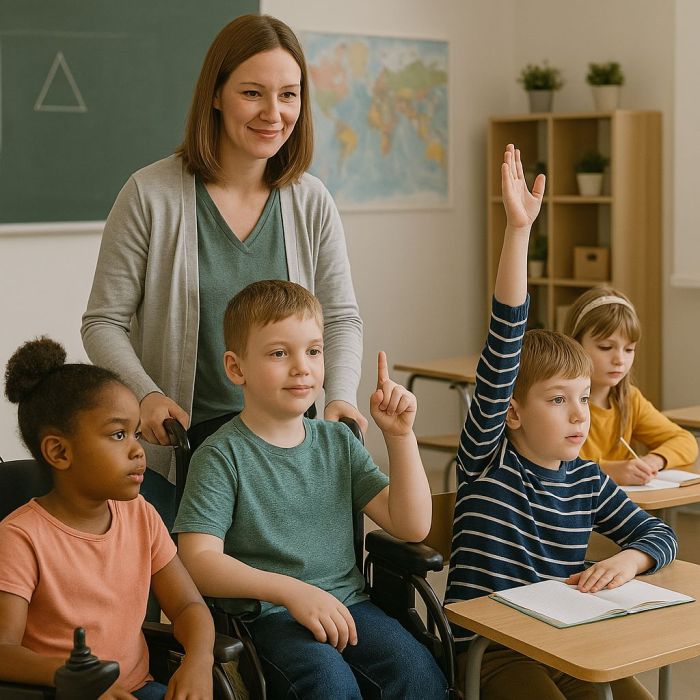
A Special Needs School is one that is segregated from a regular school. It can be non-public, meaning that it is privately run but publicly funded, or it can be a private school, either for profit or non-profit.
Special Needs Schools serve many students with different types and severities of learning disabilities, challenges or other disabilities that interfere with learning. They provide support that’s not normally provided in general education programs.
These schools and programs tailor learning to address each child’s unique combination of needs.
3. Homeschooling
Homeschooling is a legally recognised alternative to traditional schooling in South Africa. Parents can register their children for home education with the Provincial Education Department from Grade R (Reception) to Grade 12 (Matric).
Homeschooling in South Africa can offer several advantages for children with disabilities, including personalised learning, a safe and supportive environment, and flexible scheduling.
It allows for tailored curriculum and learning pace, enabling children to progress at their own speed and focus on their strengths.

4. Protective Workshops

Protective Workshops are safe, disability-friendly environments providing opportunities for persons with disabilities from the local community to develop and improve their skills and to earn an income through the products that they make to supplement their disability grants.
Services provided by Protective workshops include:
* Skills development such as life-skills, work-skills as well as entrepreneurial development.
* Psycho-social and other support services
* Empowerment and other capacity building programmes
* Contract work, which may be available at some protective workshops
There are a wide variety of Protective Workshops that are available throughout South Africa
5. Learnerships for Persons with Disabilities
Our schooling system in SA is largely not inclusive of learners with a disabilities. Many Special Needs Schools are under-resourced and not able to support learners until Matric. We need to challenge this. We need to promote Inclusive Education as much as possible.
Fortunately there are some bridging programs, or entry level NQF Learnerships available that offer a matric equivalent. An essential requirement considering many companies have a policy whereby all potential employees, no matter what the role, must have a minimum matric qualification.
This also applies to most learnership opportunities. Learnerships are work based learning programmes that leads to an NQF registered qualification. Learnerships are directly related to an occupation or field of work, such as, electrical engineering, hairdressing, project management, etc.
Companies and organisations in South Africa are encouraged to up-skill persons with disabilities by providing learnerships.
From time to time specific types of learnerships become available.
If your Company or Organisations are interested in advertising any llearnerships that are available, please Contact Us to find out more.

6. Companies and Organisations that can Assist
Historically, persons with disabilities have been prevented from gaining basic and further qualifications through physical and attitudinal barriers. There are however various companies and organisations who have initiatives in place to tackle and address these barriers and provide opportunities for persons with disabilities to gain skills and qualifications.
Some of these solutions include Education Bursaries and facilitating skills development through Internships; Employment Support through learnerships and promoting small businesses owned by persons with disabilities. They also fight for the rights for children with disabilities and promote and specialize in Education For All.
Companies and Organisations such as the National Council of and for Persons with Disabilities (NCPD), DiSA and Bradshaw LeRoux Consulting specialise in Disability Integration Training and Universal Design and Access and can advise your School or Educational Facility on how to adapt your policies, building and environment to make sure that persons with disabilities have equal rights and no loss of dignity.
National Council of and for Persons with Disabilities (NCPD)
The National Council of and for Persons with Disabilities (NCPD) is an NGO with a footprint throughout South Africa. It plays a lobbying and advocacy role when it comes to the rights of persons with disabilities. Delivering services targeted at the needs of Persons with Disabilities, and the creation of an equitable and inclusive society.
NCPD is “an umbrella body coordinating the advancement of the rights of persons with physical disabilities in accordance with the White Paper on the Rights of Persons with Disabilities, the UN Convention on the Rights of Persons with Disabilities and more.”
NCPD have nine provincial Associations for Persons with Disabilities with numerous projects and branches that focus on rural development, and social development.
NCPD offers a variety of services including:
Bradshaw LeRoux
Bradshaw LeRoux Consulting was established in 1998 and are recognised leaders in Disability Inclusion. We focus on sourcing, identifying, developing and retaining diverse talent within your organisation. Through our range of Disability Awareness Campaigns, Stereotype Busting Training, Strategic Consulting, and On the Ground support services, we leverage the benefit of their extensive network and experience in Disability Inclusivity to create enabling and flexible business environments
Our significant contribution to internationally recognised Best Practice principals of disability inclusion is making impact in South African organisations, with large focus being placed on Transformation and Scorecard objectives in the space of Disability Inclusion. In a nutshell, we represent both job seekers with a disability, and assist companies with including and developing people with a disability by creating a disability inclusive environment.
We also offer SETA Accredited Learnership Programmes and various other services including:
NCPD offers a variety of services including:
Contact: 031 765 2547 | Email: lesa@bradshawleroux.co.za | Website: www.bradshawleroux.co.za
Address: 4 Ironwood Way, Simbithi Eco Estate
Disability Info South Africa (DiSA)
We at DiSA believe that quality education for people with disabilities is essential to create an inclusive South Africa, but without access to the environment and awareness of disability rights, people with disabilities will be left behind. To this end DiSA provides a One-Stop Access Solution by working with various specialists in access, as well as providing various services listed below.
DiSA are able to provide these services through 30 years of lived experience of DiSA’s Executive Director, Alan Downey, ( a quadriplegic and disability advocate), as well as the extensive access consultancy expertise of co-founding director Igor Rix, a qualified access consultant. Additionally we leverage the vast resources of the DiSA website, a trusted platform for disability-related information in South Africa.
Thereby providing a unique combination of practical insights, expert guidance, and actionable strategies to help promote accessibility, inclusion, and disability rights within various sectors of society, including educational facilities.

Contact DiSA to find out more: Please feel free to contact Alan Downey on:
Email info@DiSA.org.za, or Contact Number: Office: 021 761 4831 or Mobile/WhatsApp: 084 504 9176,
to find out more, or Click Here to view the DiSA services that we provide.
QuadPara Association of South Africa (QASA)
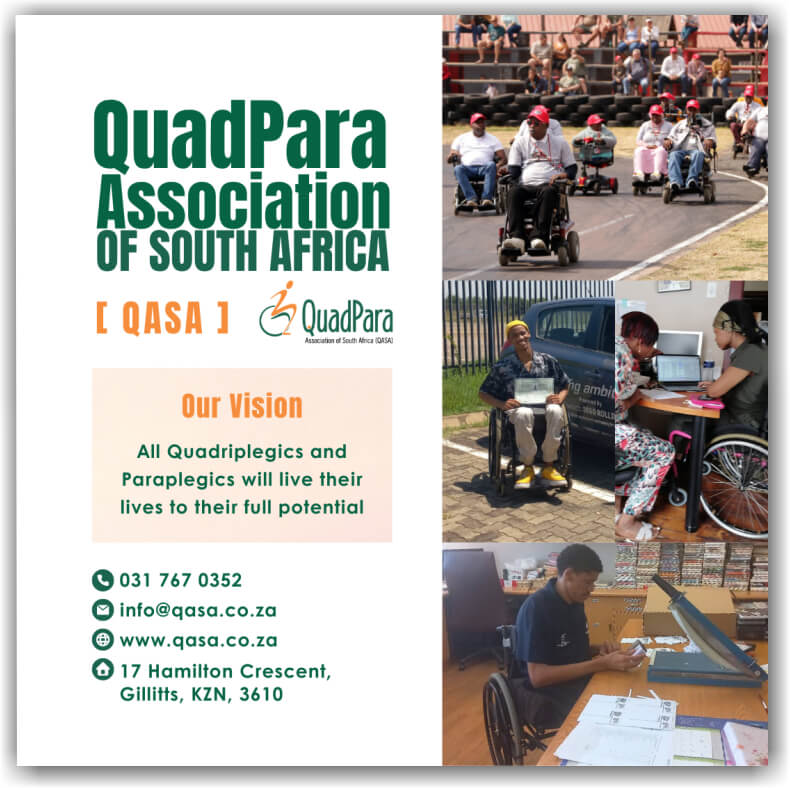
The QuadPara Association of South Africa (QASA) is a non-profit organisation (NPO 000-881) of Quadriplegics and Paraplegics in South Africa. QASA’s mission is “to improve lives by securing resources to advocate, educate, capacitate, support and mobilize”. QASA’s vision is that “all quadriplegics and paraplegics will live their lives to their full potential”. QASA develops products, programmes and services for quadriplegic and paraplegic members to build their capacity and ensure opportunities for societal integration and empowerment.
These projects include but are not limited to the Education Fund: QASA offers Further Learning opportunities to members, to access funding for education and / or skills training at recognised and Accredited Institutions in order to become employable or self-employed.
QASA offers Further Learning opportunities to members, to access funding for education and / or skills training at recognized and Accredited Institutions in order to become employable or self-employed.
Contact: 031 767 0352 / 0348 | Email: info@qasa.co.za | Website: www.qasa.co.za | Address: 17 Hamilton Cres, Gillitts, 3610
Higher and Further Education Disability Services Association (HEDSA)
Higher and Further Education Disability Services Association or HEDSA is an advocacy and rights-based non-profit in South Africa.
It is recognised and endorsed by the Department of Higher Education and Training, as well as being accepted as a community of practice by Universities South Africa. HEDSA comprises of institutions of Higher and Further Education and Training, striving to ensure equal opportunities for all students with disabilities.
Contact: Mr Sam Van Musschenbroek | Email: samvm@ufh.ac.za | Website: www.hedsa.org.za
7. Products designed to aid in learning for persons with disabilities
Assistive devices and technology for students with physical disabilities make education more accessible, independent, and engaging. Tools like adaptive keyboards, trackballs, touchscreens, and speech-to-text software enable easier communication and writing, while eye-gaze systems and head pointers allow those with limited mobility to control computers and interact with digital content.
Mobility aids such as powered wheelchairs with integrated tablet mounts, along with adjustable desks and ergonomic seating, improve comfort and classroom participation. Digital textbooks, e-readers, and screen-reading software help overcome barriers to accessing printed materials.
Together, these technologies support inclusive learning environments by reducing physical obstacles and empowering students to fully participate in lessons, collaborate with peers, and develop essential academic skills.
Visit our Computer and Adaptive Aids page to find out more about these products and the companies that sell them, Contact DiSA for more information.
Disclaimers and References
Simplified Summary
Education for All page: This page explains the rights of people with disabilities to accessible education, describing schooling options, common barriers, and support resources. It also provides links to organisations, learnerships, and assistive products that help make learning environments inclusive and accessible.