Organisations

This Physical Impairments Organisations page deals with organisations that assist persons with Physical Impairments and/or disabilities.

The page unpacks the services and/or products that these organisations provide, as well as the services they offer to companies seeking to accommodate persons with disabilities.

Please view the list (on the right of the page), to find out about some services and products that these organisations provide, or view the information below to find out more about these services, and the organisations that provide them.

Physical Impairments refer to injuries, conditions, or diseases that impair a person’s mobility or physical appearance, possibly affecting their ability to participate equally in society.

Impairments covered under this section include but are not limited to: Absent and Reduced Limbs (Amputees); Quadriplegics and Paraplegics (Spinal Cord Injuries); Stroke (Hemiplegia); Burn Victims; Arthritis; Short Stature (Dwarfism); Muscular Dystrophy*; Polio; Motor Neuron Disease*; Cerebral Palsy*, Multiple Sclerosis (MS)* and more.

Please Note: Some of these impairments, namely those with a “*” fall under more than one impairment category.

Since 1981, persons with disabilities have organised themselves into their own organisations all over the world, including in South Africa. These organisations not only provide various products and services to assist persons with disabilities, but also provide a voice of their own. Identifying needs, expressing views, evaluating services and advocating for change and public awareness, these organisations believe that persons with disabilities are their own best spokespersons.

Nothing About Us, Without Us!

“Nothing about us without us” – conveys the idea that people affected by a policy or law should be involved in its development and implementation. It’s a call to overcome oppression, empower people with disabilities, and demand equal inclusion.
Types of organisations in South Africa that cater for persons with physical impairments

1. Cross Disability Organisations

Double arrow indicating a click action is required should the reader wish to learn more about Cross Disability Organisations

2. Diagnostic-Focused Organisations

Represents persons in specific medical diagnostic groups in South Africa, such as the QuadPara Association of South Africa (QASA), which represents Quadriplegics and Paraplegics in South Africa. Learn More about QASA and the services that they can provide.

Double chevron arrow indicating a click action is required should the reader wish to learn more about Cross Disability Organisations

3. Population Specific Organisations

Represent a population group, such as Women or children with disabilities and include Disabled Women In Africa (DIWA). Learn More about DIWA and the services that they can provide.

Double chevron arrow indicating a click action is required should the reader wish to learn more about Cross Disability Organisations

4. Service Specific Organisations

Offers specific products or services suited for persons with disabilities, such as Cheshire Homes, which offers accommodation and homes in different provinces throughout South Africa, such as the Ann Harding Cheshire Homes, or Sports Organisations such as South African Sports Association for Physically Disabled (SASAPD), Learn More about the Ann Harding Cheshire Home and the services that they provide.

Double arrow indicating a click action is required should the reader wish to learn more about Cross Disability Organisations

1. Cross Disability Organisations

Cross Disability Organisations represents the interests of all persons with disabilities in South Africa.

1. The National Council of and for Persons With Disabilities (NCPD)

The National Council of and for Persons with Disabilities (NCPD) is an NGO with a footprint throughout South Africa. It plays a lobbying and advocacy role when it comes to the rights of persons with disabilities. Delivering services targeted at the needs of Persons with Disabilities, and the creation of an equitable and inclusive society.

NCPD is “an umbrella body coordinating the advancement of the rights of persons with physical disabilities in accordance with the White Paper on the Rights of Persons with Disabilities, the UN Convention on the Rights of Persons with Disabilities and more.”

NCPD have nine provincial Associations for Persons with Disabilities with numerous projects and branches that focus on rural development, and social development.

Logo for the National Council of Persons with Disabilities, an organisation which provides specialised services for persons with disabilities in South Africa

The National Council of and for Persons with Disabilities have programs in place that aid persons with disabilities, to find jobs & acquire skills that they may need in the workplace.

“We offer BBBEE advice and services related to persons with disabilities, including Job placement, Skills development, Preferential procurement, Ownership and supply chain development.”

Read More about the Job Placement and Skills Development that NCPD provide:

The National Council of and for Persons with Disabilities offers Disability Equality Training courses to address the need for information about the reality of disability. Training is tailor made for every sector, including Tourism, Tertiary Education, Banking, Mining and more.

Through training they will find ways to challenge the organisational behaviour which reinforces negative myths and values, and which prevents disabled people from gaining equality and achieving full participation in society.

Training is done by an expert well trained team of persons with disabilities.

Read More about the Disability Equity Training that NCPD provide:

The NCPD is proud to be in a position to offer various SETA accredited training courses ( short course, learnerships and internships) together with corporate partners whom then get their BBBEE POINTS for the DTI scorecard.

We also do short training of Professionals in the Services and Health profession, for which these professionals get CPD points.

The courses for architects, and other professionals is not accredited for CPD points. Other training includes Caregiver training for carers of children or adults; Governance training; Fundraising training; Disability Equity training; Reasonable accommodation; Inclusive design; Various impairments and the implications; Drivers of persons with disabilities; Human Rights and advocacy; Assistive device repairs & Transport and driving training.

The majority of training sessions can be tailor-made to suit your needs.

Read More about the Training that NCPD provides:

Many persons with disabilities require the use of an assistive device for independence, but these devices are usually extremely expensive and therefore unaffordable for the majority.

The public health system does what it can to provide devices, but the demand is huge and it cannot entirely fulfil the need.

NCPD is not in a position to fund assistive devices, but from time to time, we are approached by donors wishing to fund assistive devices, which we can then pass on to individuals requiring devices.

Read More about Funding of Assistive Devices:

Persons with disabilities are often excluded from many Events, Services, Information, Communication, Products and Venues, due to all users not considered during the planning phases.

The National Council of and for Persons with Disabilities can assist to prevent this from happening by applying Universal Design Principals during the design phase.

Read More about the Universal Design and Access Services that NCPD provide:

We go to certain areas to ascertain if the information we have on-hand is correct and/or to be up-to-date with the current situation in those areas.

The same goes for projects but with projects we also need to see how sustainable these projects are and if they need assistance to either stay the course or change the project toward better outcomes for the participants and beneficiaries of these projects.

Read More about the Economic Empowerment Services that NCPD provide:

Vava iYouth is a project of the National Council of and for Persons with Disabilities (NCPD).

As a youth wing of the NCPD, Vava iYouth is aimed at ensuring inclusion and equity for children and young persons with disabilities in South Africa in every facet of their lives and livelihoods.

We serve all youth with disabilities irrespective of impairment, race, language, ethnicity, sexual orientation, religion, or nationality.

Read More about the Va Va iYouth Project that NCPD provides:

One would think, that since we live in an age where access and information is for the most part a click, persons with disabilities would enjoy all the same benefits as their non-disabled counterparts.

Yet, despite all these advancements , persons with disabilities still find themselves on the side-line when it comes to securing employment or simple matters like access to enjoy a sports match or theatre production.

The need to raise awareness is beyond dispute. NCPD invests in a number of initiatives aimed at educating and raising awareness of the needs of persons with disabilities.

Read More about the Awareness Raising Initiatives that NCPD provide:

The National Council of and for Persons with Disabilities in partnership with the Department of Environmental Services, offers persons with severe physical Mobility Impairments the opportunity to gain access to certain beaches, by obtaining a permit from DEAT.

Read More about Obtaining a Beach Permit:

The National Council of and for Persons with Disabilities can assist you to apply for a Rebate on a new vehicle that has been imported and has been or will be adapted to suite you and your disability.

The SA government (through the International Trade Administration Commission (ITAC), the Department of Trade, Industry and Competitions (DTI) and the SA Revenue Services provides a rebate on the custom duties on the importation of adapted vehicles, either for use by persons with disabilities who drive themselves (self-drive), or by an organisation or individual that transports persons with disabilities (assisted transport).

The rebate is also available for imported second-hand vehicles that have already been adapted.

Read More about Obtaining a Motor Vehicle Importation Rebate:

The National Council of and for Persons with Disabilities can also supply information and assist with registering and applying for a Disabled Parking Disk, so that you will be able to park in a Disabled Parking space if you qualify.

Read More about Applying for an Accessible Parking Disk:

The National Council of and for Persons with Disabilities can also supply information and assist with a variety of other Services, including: Universal Design; Access Audits; and Disability Equity Training.

Workplace services such as Job Placement, reasonable accommodation and Policy Review, Internships and training.

As well as Entrepreneurs with disabilities; Disability information and children’s programmes; Fund Raising and Referrals of persons with disabilities needing our services.

Contact us for more information on:
Tel: +27 11 452 2774 or Email: therina@ncpd.org.za or read the article below about the Fund-Raising Partnerships that the National Council of and for Persons with Disabilities are involved in.

NCPD Fund Raising Partnerships

The National Council of and for Persons with Disabilities organise and run a number of fundraising projects to help raise funds including “Casual Day” and the “Nappy Run”

Casual Day: is South Africa’s leading fundraising and awareness campaign for persons with disabilities and is the flagship project of the National Council of and for Persons with Disabilities (NCPD).

Launched in 1994, Casual Day is an awareness and fundraising campaign benefiting persons with disabilities. Each year, South Africans are encouraged to wear the official Casual Day sticker and merchandise to show their support for persons with disabilities.

The campaign encourages the public to contribute financially through a small donation of R20 for a sticker, and at the same time lobbies for the full inclusion and equity of persons with disabilities. So, not only does Casual Day raise funds, but it also raises awareness in a fun way!

Read More about Casual Day:
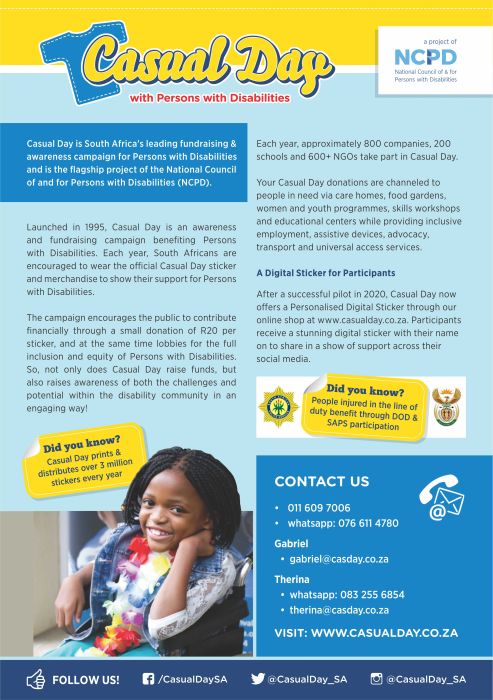
National Council of and for Persons With Disabilities Casual Day Fund Raising Initiative

Nappy Run: is a 5km Fun Run which takes place at the Joburg Zoo every year coinciding with National Children’s Day.
The purpose of the Nappy Run™ campaign is to educate the public on the violation of rights of our country’s most marginalized and vulnerable group of people – children with disabilities and to appeal to the public for online donations which go towards the purchase of nappies for children with disabilities.

The event is organised by the National Council of and for Persons with Disabilities (NCPD) and forms part of the NCPD’s observation of South Africa’s Disability Rights Awareness Month (DRAM) in November. The Nappy Run campaign runs until 3 December to coincide with the International Day of Persons with Disabilities (IDPD), while DRAM also culminates on that same day. For more information about the Nappy Run™ fun run, or to make a donation.

Read More about the Nappy Run on the NCPD Website:

Contact the National Council of and for Persons With Disabilities:
Email: therina@ncpd.org.za | Tel: +27 11 452 2774

2. Disability Info South Africa (DiSA)

DiSA is an NPC (NPO – 256-154) which provides a One-Stop Access Solution to assist persons with disabilities. This includes Easy Access to information and Access to the environment.

Through the services that DiSA provide, we strive to create equality for all persons with disabilities in Southern Africa.

DiSA was started in 2015 as a free information service but has since evolved to include 4 Pillar services including:
Logo of Disability Info South Africa, your one stop access solution

1. Information Desk: – Informs People of their rights and who or what is available to assist them through our Free Information Website and Contact Centre.

2. Yes To Access: – Identifies Discrimination, Barriers to Access and Inequalities through our Reporting and Complaints Platform.

3. Accessible Cities South Africa: – Addresses lack of equal rights for persons with disabilities by creating awareness and providing professional services through our Accessible Cities Project Management platform, which includes Universal Access Consulting, Auditing Services, Disability Consciousness Training and more. Thus, working together with society, industry and DiSA “Access Warriors” to help break down barriers to equality.

4. DNN Platform: – Empowers and Inspires persons with disabilities to live their lives to the fullest potential through Interviews, Cartoons and Educational and Awareness Videos.

Through these 4 Pillars DiSA provides the services listed below, to Inform people with disabilities on who or what is available to assist them, Identify and address barriers to access and Empower and Inspire persons with disabilities to be the best that they can be.

DiSA services include:

DiSA offers a dedicated information website that serves as a one-stop resource for disability-related support and solutions. The platform connects individuals with relevant services, products, and organisations across South Africa.

DiSA also facilitates Advertising and Product or Service Referrals, helping businesses and service providers reach their target audience while ensuring people with disabilities access high-quality, tailored solutions for their needs. This service promotes inclusion and accessibility while bridging gaps in information and resources.

Read More about the DiSA Information Desk and the Services that we supply

DiSA offers a “Yes to Access” Complaints and Reporting Platform to empower individuals with disabilities and their families by addressing accessibility issues, discrimination, or service gaps.

This platform allows users to report challenges they encounter in accessing public or private services, facilities, or products.

DiSA collaborates with relevant stakeholders to resolve these issues, advocating for greater inclusivity, compliance with disability rights, and improved accessibility standards across South Africa.

Read More about the DiSA Yes to Access Complaints and Reporting Platform

Alan Downey, co-founder of Disability Info South Africa (DiSA), delivers Motivational Speaking engagements that inspire and empower audiences.

Drawing from his personal journey as a quadriplegic of over 30 years and his work in disability advocacy, Alan shares insights on overcoming challenges, embracing resilience, and focusing on possibilities.

His talks aim to shift mindsets, foster inclusion, and motivate individuals, companies and organisations to break barriers and create positive change.

Read More about Alan Downey and the Motivational Speaking services that he provides

Alan Downey, Executive Director of DiSA provides a variety of services to share his knowledge and experience gained over 30 years in a wheelchair and 10 years running the top disability information service in Southern Africa.

This includes but is not limited to:
– Interviews around disability related issues.
– Consultations regarding living with a physical disability and adapting to your circumstances. 
– Peer Support to individuals, organisations, companies and communities that include or interact with persons with physical disabilities.

As a passionate disability advocate, with a wealth of knowledge gained from researching and running a disability information service,he continues to fight for disability rights.

As a member of the Global Peer Support Network and administrator of DiSA, he provides unique insights, practical guidance, and empathetic support to persons with disabilities, as well as companies wishing to accommodate them.

His services aim to empower people with disabilities, raise awareness, and foster inclusion by addressing challenges, sharing expertise, and encouraging positive change.

Visit our DiSA News Network to view our various Interviews that Alan Downey from DiSA have produced

Igor Rix, is a qualified access consultant and co-founder of Disability Info South Africa (DiSA). He specialises in conducting Accessibility Audits and providing detailed reports on barriers within physical spaces and services.

Igor develops practical Implementation Plans to address these challenges, ensuring compliance with both national accessibility standards and international best practices. While focusing on fostering inclusivity for all individuals.

Ensuring all people of diverse needs and preferences, can fully participate and contribute to society in a meaningful way.

Read More about Igor Rix and the Accessibility Audits, Reporting and Implementation plans that he can provide

The Disability Conscious Training also known as “Disability Awareness Training” or Disability Sensitisation Training” is offered by DiSA in a comprehensive program designed to raise awareness and foster understanding of disability-related issues.

Tailored to your company needs this training is delivered in collaboration with Access Warriors and disability specialists and equips organisations, businesses, and communities with the knowledge and tools to create inclusive environments.

The training draws on the 30 years of lived experience of DiSA’s Executive Director, Alan Downey, a quadriplegic and disability advocate, as well as the extensive access consultancy expertise of co-founding director Igor Rix, a qualified access consultant.

Additionally, it leverages the vast resources of the DiSA website, a trusted platform for disability-related information in South Africa.

This unique combination ensures practical insights, expert guidance, and actionable strategies to help participants promote accessibility, inclusion, and disability rights within their company.

Read More about the Disability Conscious Training (Awareness/Sensitisation Training) offered by the DiSA Team of experts

DiSA spearheads their Accessible Cities Project Management, working alongside Access Warriors and other specialists to transform organisations, companies, educational facilities, communities’ and urban environments into inclusive, accessible spaces.

This initiative focuses on changing attitudes, creating awareness, developing policies and identifying and addressing barriers in infrastructure, services, and public spaces, to ensure compliance with accessibility standards..

By leveraging expertise in access consultancy, disability advocacy and a variety of other specialists, DiSA facilitates sustainable, practical solutions to remove barriers and change cities one step at a time, to create environments where everyone, including people with disabilities, can thrive.

Read More about DiSA’s Accessible Cities Platform and Projects

Alan Downey, from DiSA, produces Educational and Awareness Videos, Interviews, and Awareness Cartoons to promote understanding and inclusivity.

These creative and engaging resources address key topics related to disability, such as accessibility, assistive devices, sport, advocacy and other important disability related topics.

Through these Videos, Interviews, and Awareness Cartoons, DiSA aims to foster awareness and empower individuals, companies and organisations to face barriers head on and act toward a more inclusive society.

To promote inclusivity Alan Downey also provides Closed Captioning services to videos already created, to ensure that they reach the widest possible audience and are accessible to persons who are Deaf or have hearing loss.

Visit our DiSA News Network (DNN) to find out more about the Closed Captioning services that we provide, or to view our various Educational and Awareness Videos, Interviews, and Cartoons that DiSA have produced.

Contact Us to find out more: Please feel free to contact Alan Downey on:
Email info@DiSA.org.za or info@disabilityinfosa.co.za, or
Contact Number: Office: 021 761 4831 or Mobile/WhatsApp: 084 504 9176,
to find out more about the services that DiSA provide, or to receive a quote.

2. Diagnostic Focused Organisations

Diagnostics Focused Organisations represents persons in specific medical diagnostic groups in South Africa

1. QuadPara Association of South Africa (QASA)

QASA is a non-profit organisation (NPO 000-881) of Quadriplegics and Paraplegics in South Africa.

Their vision is that “all quadriplegics and paraplegics will live their lives to their full potential”. Its mission is “to improve lives by securing resources to advocate, educate, capacitate, support and mobilise”. To this end, QASA develops products, programmes and services for quadriplegic and paraplegic members to build their capacity and ensure opportunities for societal integration and empowerment.
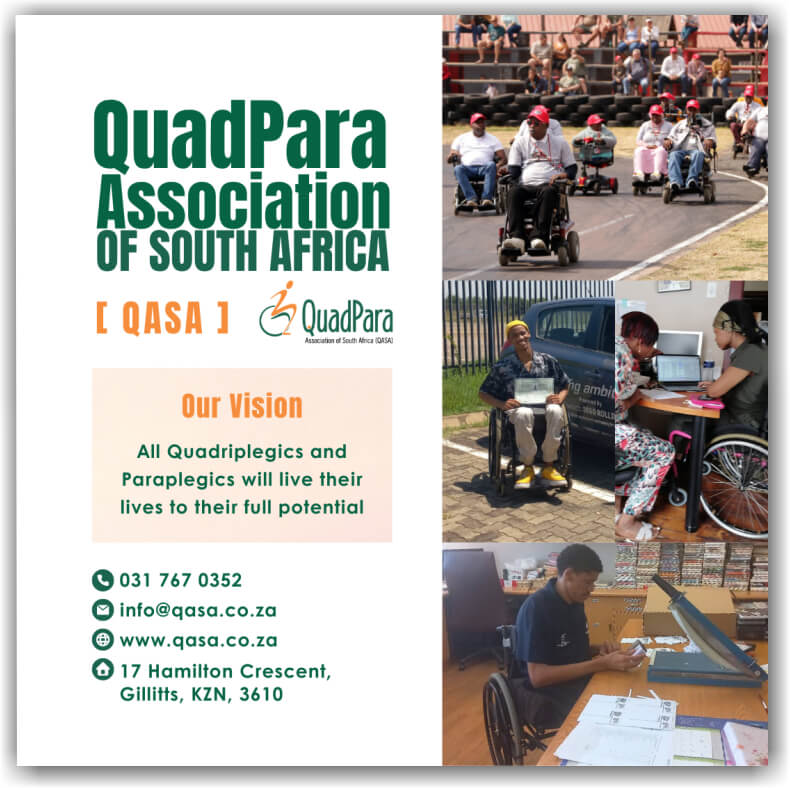
QASA’s mission is “to improve lives by securing resources to advocate, educate, capacitate, support and mobilize”. QASA develops products, programmes and services for quadriplegic and paraplegic members to build their capacity and ensure opportunities for societal integration and empowerment. QASA’s vision is that “all quadriplegics and paraplegics will live their lives to their full potential”.

QASA is a member of the South Africa Disability Alliance (SADA) and has significant relationships with other such organisations, such as the Department of Social Development, the Chris Burger Petro Jackson Players Fund and the National Council of and for Persons with Disabilities in South Africa (NCPD).

Four Regional Associations are affiliated to QASA: Gauteng South, Gauteng North, Western Cape and North West. The QASA Management Board is made up of representatives of each Regional Association.

QASA invests in programmes that up-skills and supports members who pursue employment opportunities, whether this is through skills development, employment programmes that educate employers on the value proposition of our skilled members, or bursaries for tertiary or continued education.

The organisation supports the health and wellness of its members through educational programmes for members, caregivers, and the healthcare sector. Well-researched information is shared with members and the public sector. QASA provides better mobility, assistive devices, and accessibility for its members to ensure a barrier-free environment. This includes assisting with accessible housing, independent living solutions and even driver training programmes.

QASA also advocates and lobbies on behalf of its members to ensure universal access and inclusion in the built environment and transport nodes. This includes disability awareness and sensitisation workshops, access audits, and the promotion of the White Paper on the Rights of Persons with Disabilities. Prevention of spinal cord injury forms part of our advocacy commitment.

QASA is sustained by strategic relationships with corporates, social enterprise, the National Lottery Commission and a number of campaigns and events. Some of QASA’s projects generate revenue which services the essential non-revenue generating projects.

Advertisement for QuadPara - Association of South Africa (QASA) Logo
QASA Additional Services

QASA invests in programmes that up skills and supports members who pursue employment opportunities, whether this is through skills development, employment programmes that educate employers on the value proposition of our skilled members, or bursaries for tertiary or continued education.

QASA provides Parking Disks to persons who use wheelchairs, so that they can easily transfer in and out of their vehicle at shopping centres etc.

Wheelchair Parking Bays and Discs are for persons who use wheelchairs and drive themselves or who are transported in a vehicle.

These Parking Bays are not only close to the entrance, but are also wider to cater for a wheelchair user who needs the extra space to enter or exit the vehicle.

Persons who use these parking bays need to apply for a Wheelchair Parking Permit, which is displayed on the vehicle upon parking in one of these bays. 

Read More about QASA’s Parking Permits that they provide

SABAT sponsors QASA members who own motorized wheelchairs, with one set of batteries each year. The battery project is a partnership between QASA and SABAT and ensures that thousands of quadriplegics and paraplegics remain mobile. 

Read More about applying for batteries for your Motorized Wheelchair

 QASA provides assistance for people leaving hospital after sustaining spinal cord injuries, by providing them with useful information and products. Once people leave a rehabilitation centre, they often have no further resources to assist them to cope with the changes in their lives.

QASA and Coloplast have launched a project called Bags of Hope, which provides a bag full of information to each person being discharged from a rehabilitation unit. 

Read More about QASA’s Bag of Hope

Motor vehicle crashes are the leading cause of spinal cord injury in South Africa. In 2003, QASA initiated its Road Safety Early Intervention & Prevention Campaign to promote responsible road-user behaviour. 

The campaign has two focuses: Distracted Driving- aimed at reducing motor vehicle accidents and Buckle Up – We Don’t Want New Members!’ – aimed at reducing injury

Read More about QASA’s Prevention Programme that they provide

Persons with mobility impairments can hire specially adapted self-drive vehicles. QASA has two such vehicles in Durban and Johannesburg. We offer accessible transport in the Gauteng and Kwazulu-Natal areas.

These three QASA Vehicles are equipped with wheelchair lifts and are available for rental with a driver or on a self-drive basis. 

Read More about QASA’s Adapted Vehicle Hire

Lack of accessible public transport is a huge obstacle for wheelchair users trying to lead an independent life. Recognising this, QASA rolled out a driver training project in KwaZulu-Natal, Gauteng and the Western Cape to teach persons with mobility impairments to drive a vehicle fitted with hand controls. 

Read More about QASA’s Driver Training Programme

QASA has an Education Fund for Further Learning to afford service users an opportunity to access funding for education and/or skills training at recognized and Accredited Institutions in order to become employable or self-employed. 

Read More about QASA’s Education Fund

QASA recognizes the value of sport and hobby and wants to encourage participation by Quadriplegics and Paraplegics. For this reason, QASA has a fund for wheelchair users to participate in sporting activities. 

Read More about QASA’s Sports Fund that they provide

The aim of the Work Readiness and Employment Programme is to equip trainees with the necessary skills and tools for gainful employment.

The programme facilitates an accredited 3-month online training programme (17 modules including MS Office) for over 150 unemployed youth with mobility impairments. 

Read More about QASA’s Work Readiness and Employment Programme

QASA can assist with access audits in the form of inspection which can be used to assess the ease of access to, and ease of use of an environment (such as a building or landscape), a service, or a facility, by people with a range of access impairments.

Everyone has the right to be able to fully participate within society, and the built environment and accessibility plays a vital role in achieving this goal.

Read More about QASA’s Access Audits

Quadriplegics may need 24-hour care by care attendants (either by family members or paid carers). QASA’s Care Attendant Training was initiated in response to the critical need for a comprehensive and holistic training programme for care attendants of Paraplegics and Quadriplegics. 

Read More about QASA Care Attendant Training

The focus of QASA’s Rural Development Project is to identify the accessibility needs of persons with mobility impairments and remove accessibility barriers.

Ramps and accessible bathrooms/toilets increase independence, uplifts morale and improves quality of life for persons with mobility impairments in peri-urban and rural communities. 

Read More about QASA’s Rural Development Project

One of QASA’s main focus areas is promoting independent living for quadriplegics and paraplegics.

QASA provides Self-help Centre’s which allow communities of wheelchair users to live independently of their families and provide accommodation, meals, care attendants and transport to the residents. 

Read More about QASA’s Self Help Centres

QASA provides Disability Awareness & Sensitization training to equip employers and employees with the skills and knowledge required to interact with persons with disabilities with confidence.

This half-day training workshop is tailor-made to suit the needs of your company or organisation.

Read More about QASA’s Disability Sensitizing and Workshops

The QuadPara Association of South Africa (QASA) have a Fund, whereby they provide Wheelchairs; Speech/Voice Recognition Software; Mouth and Typing Sticks, ensuring that members are as mobile and functional as possible. 

Read More about QASA’s equipment fund and how they can assist you

Contact: 031 767 0352 / 0348
via Email: info@qasa.co.za Website: www.qasa.co.za
Address: 17 Hamilton Cres, Gillitts, 3610

3. Population Specific Organisations

Population Specific Organisations represents the interests of all persons with disabilities in South Africa.

1. Disabled Women in Africa (DIWA)

Disabled Women in Africa (DIWA) empowers African women and girls with disabilities through research, information sharing and networking, partnership and capacity development for unity in diversity.

Click on the link below to learn more about the Disabled Women in Africa Organisation and how they assist women with disabilities in Africa.

4. Service Specific Organisations

Service Specific Organisations offers specific products or services suited for persons with disabilities.

1. Ann Harding Cheshire Homes

DiSA Ad for Leonard Cheshire Home of persons with physical disabilities

The Ann Harding Cheshire Home provides their Residents (all of whom live here permanently), with comfortable accommodation, 24-hour care, nutritious meals, laundry, access to therapists and social worker as well as physiotherapists, state clinics and hospitals and private practitioners using our own specially adapted vehicles. The majority of our 40 residents have taken up permanent residence and have permanent disabilities.

Various daily activities keep our Residents motivated and educated, including arts and crafts, painting, bingo, chess and card games. In 2014 we upgraded our swimming pool to a heated therapy pool. Residents enjoy spending time in the pool with our full-time Occupational Therapist, as well as private Physiotherapists.

Exterior image of the Leonard Cheshire Home care, education, training and development centre in Magaliesberg


The Ann Harding Cheshire Home has a committee of dedicated members who ensure exemplary ethics and code of conduct, and that any funds received are used for the intended purpose. Monthly reports detail the progress made in the utilisation of all donations, sponsorships and bequests made.

The Ann Harding Home is run like a business, with the care and advancement of our residents the priority. The residents themselves have a significant say in the running of the home, through the Residents’ Committee, which is fully represented on the Home Management Committee. The Home is registered as a PBO and can therefore offer Section 18a certificates for tax purposes.

For capital projects we offer naming rights, which bring the prestige of being associated with a long-standing NGO in the community. Our donors are proud to be associated with us, because of our good reputation and transparency. We are in good standing with the local media, schools and businesses in the community, and have the privilege of being supported by numerous volunteers from all walks of life. We prefer to build long-term, mutually beneficial partnerships that deliver significant benefits to disabled people and the stakeholders of a business alike.

Interior image of the Leonard Cheshire Home of persons with physical disabilitieS on the Magaliesberg mountains

In addition to applying for funding, Ann Harding also holds several fundraising events each year which are always very successful and assist enormously with costs. We also run a very successful Charity Shop, which is well supported by the local community.

Current projects include building self-living units, which are sold on a life-rights basis. The Home has a hall which is hired out to companies for meetings, training courses etc.

Plans include further development on Ann Harding Land, whereby the vision is to build:

1. A subacute step-down facility for adults with physical disabilities.
2. Twenty-two 2-bedroom, 2-bathroom, Independent Living Units for persons with physical disabilities, and a Caregiver or family member.
Download the PDF for more information: Independent Living for persons with mobility impairments.)
3. A Skills Development Centre to cater for all three homes in Johannesburg, as well as the surrounding community.

Advertisement for services rendered by the Leonard Cheshire Home of persons with physical disabilities

The best way to assess our services is to visit our Home, and we welcome such visits. The Home is a warm, homely place, with beautiful gardens and a swimming pool. Common areas include lounges, tea areas, a computer room, therapy room and dining area.  Above all, we are always cognisant of the fact that this is the residents’ home, and their comfort is foremost in our minds.

Should you have any queries, or require further information, please do not hesitate to contact us on the details below.

Contact: Jackie Kyle (Fundraising Manager) on:
011 792 3510 or 082 764 0973, or via
Email: Jackie@cheshirehomes.org.za
Website: www.annhardingcheshirehome.org.za. Physical Address: Plot 40, 4th Road, Northwold, 2155.
Registration No’s: 020-102-NPO; PBO 18/11/13/4017

Disability Sports Organisations

There are also a variety of Sports Organisations which assist and cater for persons with disabilities.

Sports organisations are organisations which govern and promote Disability Sports and promote opportunities for people with disabilities to participate in sports. They can include national governing bodies, international federations, professional leagues, amateur leagues, and grassroots organisations.
These Sports Organisations are categorised as per below.

Should you require more information about these organisations, and how they can assist you,
please visit our Physical Impairments Sports page or click here to search listed Sports Organisations [make link]

For example the International Paralympic Committee, which works to: Develop sports; Organize events; Promote rights; Support athletes; Exchange resources; Prepare standards, etc. Read More about the International Paralympic Committee the DiSA Sports Page

Double arrow indicating a click action is required should the reader wish to learn more about Cross Disability Organisations

Govern some disability sports. A good example of this. is: South African Sports Association for Physically Disabled (SASAPD). SASAPD is a federation that promotes and develops sports for athletes with physical disabilities and visual impairments, like boccia, goalball, para-athletics, para-cycling, para powerlifting, and para-swimming. Read More about SASAPD and the services that they provide

Double chevron arrow indicating a click action is required should the reader wish to learn more about Cross Disability Organisations

For example The Free State Sport Association for the Physically Disabled and Visually Impaired (FFSAPD), which promotes and develop sports in their specific province for people with disabilities. FFSAPD provides the following sports for persons with Physical and Visual Impairments: athletics, boccia, CP soccer, para cycling, goalball, and swimming. Read More about FFSAPD and the benefits of the services that they provide

Double chevron arrow indicating a click action is required should the reader wish to learn more about Cross Disability Organisations

Offers either a single or a variety of sports in a particular province or city in South Africa, this includes clubs such as the Differently Abled Cricket Club and “Handicapped Scuba Crew”. Read More about these sports on our Sports Page.

Double arrow indicating a click action is required should the reader wish to learn more about Cross Disability Organisations
Terminology: Why We Use The Words We Do

While the terms “Disability” and “Impairment” are often used interchangeably, they do in-fact have very different meanings.

An “Impairment” is something that has happened to the body which cannot be changed, such as a condition, disease or injury, while a “Disability” happens to the person with an impairment when society puts barriers in their way, fails to uphold their rights or does not provide reasonable accommodations.

Barriers that can create disability can be categorized into Environmental, Information, Communication and Attitudinal Barriers.

Visit our Information Desk to find out more about Disability and Impairment.

1. Disability-owned organisations (NPOs or NGO’s): are at least 50% owned by persons with disabilities and render disability services, including advocacy.

2. Representative organisations of persons with disabilities (OPDs): Constitute the collective voice of persons with disabilities, are at least 50% owned by persons with disabilities, have membership and primarily advocate for the rights of persons with disabilities and provide services to their members.

3. Disability Service Organisations (DSOs): Focus on service delivery (rehabilitation, habitation, counselling, training, employment support etc.) to persons with disabilities, and are not necessarily owned by persons with disabilities, or membership-based organisations.

Disclaimers and References

* Diabetes or Mobility Impairments
These are known as Diabetic Alert Dogs or Service Dogs respectively and can help persons with Diabetes, or those who use wheelchairs, or need assistance with balance.

* Visual Impairments
These are known as Guide Dogs and are used to guide people who are blind, or those who have Visual Impairments.

* Hearing Impairments
These are known as Hearing Dogs, or Alert Dogs, they can alert persons who are Deaf or those who have Hearing Impairments.

* Intellectual Impairments
There are a variety of different types of Assistance Dogs that can assist persons with Intellectual Impairments including, Autism Support Dogs; Psychiatric Service Dogs and Seizure Alert Dogs which alert and protect a person who is having a seizure, reminding a person with mental illness to take prescribed medications, etc.

* Therapy Pets/Dogs
A Therapy Dog or Therapy Pet is a dog that is trained so that they can provide affection, comfort and support to people in settings such as hospitals, retirement homes, nursing homes, schools, libraries, hospices, or disaster areas.

DiSA is committed to promoting the rights, dignity, and inclusion of persons with disabilities as outlined in the White Paper on the Rights of Persons with Disabilities. We strive to ensure that all content on our website reflects appropriate, respectful, and inclusive language in alignment with these principles.

However, we also provide a platform for companies and organisations to advertise their services and products. While we encourage advertisers to adhere to correct terminology and inclusive practices, DiSA cannot guarantee the accuracy or appropriateness of the language used by external parties in their content.

Please note: Any views, language, or terminology used in advertisements, promotional material, or external links do not necessarily represent the views of DiSA.

DiSA disclaims any responsibility for inaccuracies or language that may not align with the White Paper or best practices for disability terminology.

Should you however encounter language or content that you believe is inappropriate or offensive, we encourage you to contact us at info@disa.org.za, so that we can address the issue.

DiSA remains dedicated to fostering a respectful and inclusive environment for all individuals. We appreciate your understanding and collaboration in supporting our mission.

DiSA provides a platform for companies and organisations to advertise their products and services to assist persons with disabilities and their families. While we make every effort to list reputable and credible service providers, the inclusion of any company, organisation, product, or service on our website does not constitute an endorsement or guarantee by DiSA.

Please note the following: DiSA is not involved in the delivery, quality control, or customer service of any product or service offered by advertisers listed on our platform.

Any agreements, purchases, or arrangements made between users of this website and advertisers are solely between those parties. DiSA is not responsible for the outcome of such interactions.

DiSA disclaims any liability for dissatisfaction, damages, or disputes arising from products or services supplied by companies or organisations listed on our website.

We encourage users to thoroughly research and verify any service provider or product before engaging with them. If you have concerns or encounter issues with an advertiser listed on our platform, please let us know at: info@disa.org.za. We value your feedback to help maintain the integrity of our platform.

DiSA is committed to providing accurate and up-to-date information to assist persons with disabilities and their families. However, the nature of online content and external resources means that information can change frequently.

Please note the following: DiSA cannot guarantee the accuracy, completeness, or reliability of all information on our website, particularly information obtained from external sources or links to third-party websites.
External websites may update or remove content without notice, which can result in broken links or outdated information. DiSA is not responsible for the content, accessibility, or functionality of external websites.

While we make every effort to keep our information current, some content may become outdated over time.
We encourage users to verify information directly with the relevant third parties or organisations before making any decisions based on the information found on our platform.

If you encounter a broken link or outdated content, please notify us at: info@disa.org.za and we will address it as soon as possible.
Thank you for understanding and helping us maintain a reliable and accessible platform.

The Information services and website that we offer free of charge, is privately run and funded and is not run or funded by the government. We rely on advertising, paid services and donations to supply and improve this Free information service that we do provide.

The Companies, Clubs, Schools and Organisations that are listed on this site, have advertised or made donations to the Website and have therefore assisted us be able to provide this free Service.
Please support them as they have supported Us and please contact us via info@disa.org.za, if you can advertise with us or would like to make a donation. Alternatively, visit our “Support Us” page to find out how you can support us or acquire our services. – Thank You.

If you encounter a broken link or outdated content, please notify us at: info@disa.org.za and we will address it as soon as possible.
Thank you for understanding and helping us maintain a reliable and accessible platform.

Please Note: We do assist with inquiries via email but may need to send or copy your details and inquiry to various other organisations, companies or government departments, that we sometimes consult, so that we can help you in the best way possible.
If you have any objection to us sharing your query or contact details, please notify us in your email. We will only share your information to assist you and will never sell or use your personal information for any other purposes.

DiSA waivers any liability for what happens if information is shared or used for marketing or other purposes by other organisations who do have consent to view such information.

Disability Info South Africa (DiSA) is committed to protecting your personal information in compliance with the Protection of Personal Information Act (POPIA), Act No. 4 of 2013. By using our free information service, you acknowledge and agree to the following:

Collection of Personal Information:
DiSA may collect and process your personal information (such as name, contact details, and inquiries) solely for the purpose of assisting you with your requests and providing relevant information or support.

Use and Storage:
Your personal information will only be used for the purpose it was collected for, we may need to send or copy your details and inquiry to various organisations, companies or government departments, that we sometimes consult, so that we can assist you in the best way possible.
If you have any objection to us sharing your query or contact details, please notify us in your email. We will only share your information to assist you and will never sell or use your personal information for any other purposes.
DiSA implements appropriate measures to secure your personal information against unauthorized access or loss.

Consent:
By submitting your details through our Contact Form, or contacting us via our email address, you consent to allow DiSA to process your information as outlined in this disclaimer. If you are not comfortable with DiSA sharing your information for the above purposes, please contact us directly at info@disa.org.za.

Access and Updates:
You have the right to request the deletion of your personal information at any time.
To do so, please contact us at: info@disa.org.za.

Third-Party Websites:
DiSA is not responsible for the privacy practices of external websites linked on our platform. Users are encouraged to review the privacy policies of third-party sites before sharing personal information.
For any queries or concerns regarding the handling of your personal information, please contact us at: info@disa.org.za.
Thank you for trusting DiSA to support you with accessible, inclusive, and reliable information.