Parking Bays and Discs

Accessible Parking Bays and Discs play an important part to ensure access for people with disabilities. Accessible Parking Bays are specially designed and allocated for People with Disabilities who require the extra space and support to exit and enter their vehicle and have a registered Accessible Parking Disk.

These Accessible Parking Bays are not only close to the entrance, but are also 3500mm wide – wider than the average parking bay – to cater for users who needs the extra space to enter or exit the vehicle.

Whether you physically qualify for to use an Accessible Parking Bay, or not, you will only be able to use an accessible parking bay if you have a registered permit clearly displayed on your windscrean.

This page and the information below deals with all information pertaining to Accessible Parking Bays and Discs. From Regulations; Design; Application to the companies that can assist – We have you covered!

Design of Accessible Parking Bays: Who can Help?

Universal Access Consultants specialize in assessing, advising, and guiding the design of environments, services, and systems to ensure they are accessible and inclusive for everyone. Their role goes beyond minimum compliance — they promote universal design principles that make spaces safer, easier, and more convenient for all users, regardless of ability, age, or circumstance.

In South Africa, a Universal Access Consultant use accessibility standards such as the SANS 10400 Part S Building Regulations and align with human rights laws like the Promotion of Equality and Prevention of Unfair Discrimination Act (PEPUDA). Their work may include conducting access audits, developing accessibility implementation plans, and offering guidance on inclusive infrastructure, communication, and customer service practices.

There are various Organisations and Companies that specialize in Universal Design and Access and can advise you on how to adapt your building and environment to make sure that persons with disabilities have equal rights and no loss of dignity. This includes the design of Accessible Parking Bays.

They include: National Council of and for Persons with Disabilities (NCPD)Bradshaw LeRoux ConsultingUniversal Access Collective and DiSA.

Logo for the National Council of Persons with Disabilities, an organisation which provides specialised services for persons with disabilities in South Africa

The National Council of and for Persons with Disabilities (NCPD) believe that this can be prevented by applying Universal Design Principals during the design phase and they therefor offer the following services to assist:

– Workshops for architects, developers and other building professionals to develop an understanding of universal design and access.
– Facilitating access audits for new or existing buildings; echo e-access for the natural and communication environment. Audits are followed by a report indicating shortfalls and recommendations.
– Marketing of facilities that are accessible to persons with disabilities

Contact: Fanie Swanepoel or Danie Marais
Tel: +27 11 452 2774
Email: fanies@ncpd.org.za or danie@ncpd.org.za
BradshawLeRoux - Disability Inclusion Specialists

Bradshaw LeRoux Consulting conduct Environmental Accessibility Audits designed to identify environmental barriers that could hinder access for Persons with a Disability. Our consultants will review your site, note potential barriers from a functional and safety perspective, and propose cost-effective solutions which can be actioned within short-, medium- and longer-term time frames.

Our reports are practical in nature, specific in the solutions offered, and allow for ease of use by all. Relevant to all environments, from corporate offices, manufacturing or industry sites, education facilities or hospitality environments, we can assist.

For more information, please feel free to send any queries to 
Contact: 031 765 2547 via Email: lesa@bradshawleroux.co.za Website: www.bradshawleroux.co.za
The Universal Access Collective

Turn accessibility challenges into opportunities with inclusive design that actually works.

Whether you’re a business owner, facility manager, or someone navigating personal accessibility needs, most environments still create barriers instead of being accessible and welcoming.

Universal Access Collective (UAC) solves the accessibility puzzle for businesses and individuals across Africa, turning compliance requirements and personal challenges into practical solutions that work.

For Businesses:  We assist to create a Universal Access environment including National Building regulations as well as International Best practices spaces that welcome more customers. Our built environment audits, digital accessibility reviews, and staff training don’t just tick boxes—they unlock new revenue streams and reduce liability risks.

For Families, Individuals and the Elderly: Adapting your home or navigating new accessibility needs shouldn’t feel overwhelming. Our coaching and universal design advisory services provide practical guidance that transforms challenges into confidence.

What makes us different? We’re a women-led consultancy combining technical expertise with lived experience. Mandy Latimore (globally recognised universal design specialist) brings both compliance knowledge and real-world understanding to every project.

Our comprehensive services include:
– Built environment and digital access audits
– Universal design advisory for residential and commercial spaces
– Family coaching and caregiver support
– Staff disability confidence training
– Inclusive communication and content development
– Assistive technology recommendations

Beyond consulting, we’re building a supportive community where businesses, families, and professionals share knowledge and drive change together.

Ready to transform accessibility from obstacle to opportunity? Contact us to discover how inclusive design creates better outcomes for everyone—and better business results for you.

You can contact Universal Access Collective:
Cell: +27 83 283 3370,
E mail: info@ua-collective.com,
Website: www.universalaccesscollective.com, LinkedIn: https://www.linkedin.com/company/universal-access-collective.
DiSA - Your One-Stop Access Solution

DiSA provides a One-Stop Access Solution to improve inclusivity by removing barriers to access in the built environment by referring Companies and Educational Facilities to various qualified Universal Access Consultants around the country. This includes Igor Rix, a qualified access consultant and co-founder of Disability Info South Africa (DiSA), who specialises in conducting Accessibility Audits and providing detailed reports on barriers within physical spaces and services.

Igor develops practical Implementation Plans to address these challenges, ensuring compliance with both national accessibility standards and international best practices. While focusing on fostering inclusivity for all individuals.
Ensuring all people of diverse needs and preferences, can fully participate and contribute to society in a meaningful way.

Read More about Universal Access and the Accessibility Audits, Reporting and Implementation plans that we can provide.

Equality Starts With Access!


Universal Design and Access specialists follow standards set by The National Building Regulations and Building Standards Act to make sure that persons with disabilities are not excluded from any events, services, information, communication, products and venues.

What you need to know about Accessible Parking Bays and Disks?

Accessible parking bays are specially designed parking spaces for people with disabilities that provide extra space and safe access and can only be used by those with a valid registered Accessible Parking disk. To ensure that these Accessible Features are available and suitable for those that they were designed for, the proper design standards and official procedures should be followed. Please see the information below to find out more.
1. Who can use Accessible Parking Bays?

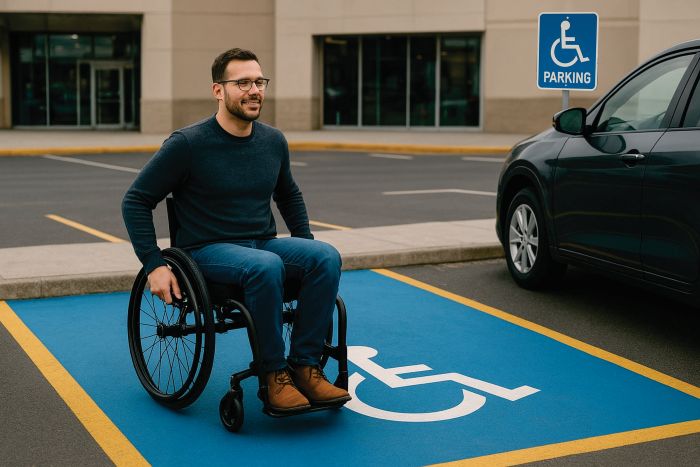
A man in a wheelchair waits to. be collected on a disabled parking bay

“Accessible Parking Bays are available to be used by those individuals or companies that are in possession of registered Accessible Parking Disks, sometimes referred to “Disabled Parking Disks”, or “Wheelchair Parking Bays”.

Temporary permits are valid for six months, and permanent permits are valid for two years. These parking discs can be linked to more than one vehicle. Anyone who qualifies can apply, but the form can only be completed by an occupational health practitioner.

The following people qualify to apply for Parking Disks:

– A person with a physical disability who uses a wheelchair or requires assistance to exit their vehicle. (Two years – permanent or Six months – temporary)
– Companies that transport people who use wheelchairs or require assistance to exit the vehicle.

Accessible Parking Bays can be easily identified, as they are not only close to the entrance, but are also wider than the average parking bay, (they are traditionally 3500mm wide). A vertical sign showing the international symbol for Accessibility, is also clearly painted on the road surface and visible on a sign post. (As per the Signage Regulations in the Sans 10400 Part S of the Building Regulations.)

The extra space helps:
– a wheelchair or Mobility Aid user transferring or being transferred into or out of their wheelchair/Mobility Aid into/out of their vehicle.
– The helper of a person with a physical impairment to get in and out of the vehicle.

Currently an Accessible Parking Disc is issued for up to two years, after which the applicant must re-apply. Since 2000, all general parking permits have a common style and blue colour, leading to the officially-used designation Blue Badge. Temporary discs are also issued for short-term disabilities (12 months), but the same process has to be followed.

If you are a visitor to South Africa and have a Blue Badge parking permit, this would be acceptable to use for a period up to a month, but if a visitor is staying for more than a month, they should apply for a temporary parking permit. Please contact NCPD via the following details.

2. How to apply for a Parking Bay Permit?

You can apply to register and receive an Accessible Parking Disc through most local municipalities and a number of Disability Support Organizations, including the National Council of and for Persons with Disabilities (NCPD).
Each province has different procedures with regards to the application for parking permits for persons with disabilities.

Below are listed the procedures that you need to follow to register an Accessible Parking Disk with The National Council of and for Persons with Disabilities (NCPD) or QASA. If you wish to register your Disabled Parking Disc in your province and it is not listed below, we recommend that you contact your local Association for Physically Disabled (APD) or your municipality for the procedures in your area.
If you have a disability, you can apply for a disabled parking disc from your local municipality. This disc allows you to park in disability parking bays and in certain circumstances, it exempts you from parking provisions.

To qualify for a disabled parking disc in this province, you need to have a letter from your doctor confirming that your mobility is severely impaired by an ongoing mental or physical condition, or that your mobility is temporarily but severely impaired.

Some municipalities require the doctor to complete a section of the form, so the form needs to be collected beforehand. The Western Cape Government’s suggests that you contact your local traffic department to confirm whether you require a doctor’s letter or a form.

Please Note: The disabled parking disc issued by any local authority may not automatically be recognised by any other local authority.

Click Here, to view steps to register as per City of Cape Town in the Western Cape or view Conditions Pertaining to The Issue Of Reserved Parking For Disabled Disc Holders

If you have a disability, you can apply for a disabled parking disc from your local municipality. This disc allows you to park in disability parking bays and in certain circumstances, it exempts you from parking provisions.

To qualify for a disabled parking disc in this province, you need to have a letter from your doctor confirming that your mobility is severely impaired by an ongoing mental or physical condition, or that your mobility is temporarily but severely impaired.

Some municipalities require the doctor to complete a section of the form, so the form needs to be collected beforehand. The Western Cape Government’s suggests that you contact your local traffic department to confirm whether you require a doctor’s letter or a form.

Please Note: The disabled parking disc issued by any local authority may not automatically be recognised by any other local authority.

Click Here, to view steps to register as per City of Cape Town in the Western Cape or view Conditions Pertaining to The Issue Of Reserved Parking For Disabled Disc Holders

In Kwazulu-Natal, the issuing of parking discs for persons with disabilities is regulated by the The Quadraplegic Association KZN.
Drivers need to apply for an official disabled parking disc. A detailed application process  has been developed by the Quadraplegic Association KZN.

The application procedure for an accessible parking disc is as follows:
– All the relevant documents must be completed in full by the applicant, as well as his or her medical practitioner.
– The application should be accompanied by a medical certificate from a registered health professional or an occupational therapist, or physio or medical doctor.
– The applicant must then send the completed documents back to the The Quadraplegic Association KZN, with a certified copy of the applicant’s ID document.
– The disc is registered in the applicant’s name and can be used with any vehicle.
– Once the form has been filled in you can email it to them at: qan@mweb.co.za you can also phone them on: 031 701 7444 or 082 875 2131.

In Gauteng, the issuing parking discs for persons with disabilities is regulated by the Gauteng Provincial Association for Persons with Disabilities (GPAPD).

Drivers need to apply for an official disabled parking disc. A detailed application process has been developed by the GPAPD.

The application procedure for an accessible parking disc is as follows:
– Download the application form here: GPAPD Application Form or contact your local to request the
-Or Click here to request the application form from Gauteng Provincial Association for Persons with Disabilities (GPAPD)
– All the relevant documents must be completed in full by the applicant, as well as his or her medical practitioner.
– The application should be accompanied by a medical certificate from a registered health professional or an occupational therapist, or physio or medical doctor.
– The applicant must then send the completed documents back to the GPAPD, with a certified copy of the applicant’s ID document.
– The disc is registered in the applicant’s name and can be used with any vehicle.

Once the above is completed an application is lodged with GPAPD, which requires the applicant to appear before a screening panel, who then pursue the final application on behalf of the applicant, with the relevant authorities.

Tel No: (011) 8383012 or 011 425 4025 or Leslie 0724 108 282
Fax No: 116465248
Address: Pallinghurst Road, Gauteng, Westcliff South Africa

Parking Disks GPAPD Website

If your province is not listed above, please contact your local Association for Physically Disabled (APD) for the procedures in your area.

If your province is not listed above, please contact your local Association for Physically Disabled (APD) for the procedures in your area.

3. Building Regulations & Who Can Help?

Wheelchair Parking is one of the many Accessible Features that the government has introduced along with certain regulations that state, how many of these Wheelchair Parking Bays must be available and the size of the Wheelchair Parking Bays.

The National Building Regulations state that where there is parking available for more than 50 motor vehicles, there must be parking facilities that accommodate disabled persons. There is also an obligation to ensure that persons with disabilities are provided with a suitable means of access from the parking area to the ground floor – or storey – of the building.

Unfortunately many buildings and businesses in South Africa still do not have adequate Disabled Parking Bays to accommodate wheelchair users. The owners of these buildings and businesses may therefore be challenged by the need to find suitable equipment, specialists and renovators familiar with accessible design issues in order to advise them and make there Parking areas accessible to persons with disabilities, especially those in wheelchairs. There are various Organizations and Companies that can assist with Universal Design and Access to make sure that persons with disabilities are not excluded from any events, services, information, communication, products and venues.

1. The South African National Standard for Building Regulations

Wheelchair Parking is one of the many Accessible Features that the government has introduced along with certain regulations that state, how many of these Wheelchair Parking Bays must be available and the size of the Wheelchair Parking Bays.

The National Building Regulations state that where there is parking available for more than 50 motor vehicles, there must be parking facilities that accommodate disabled persons. There is also an obligation to ensure that persons with disabilities are provided with a suitable means of access from the parking area to the ground floor – or storey – of the building.

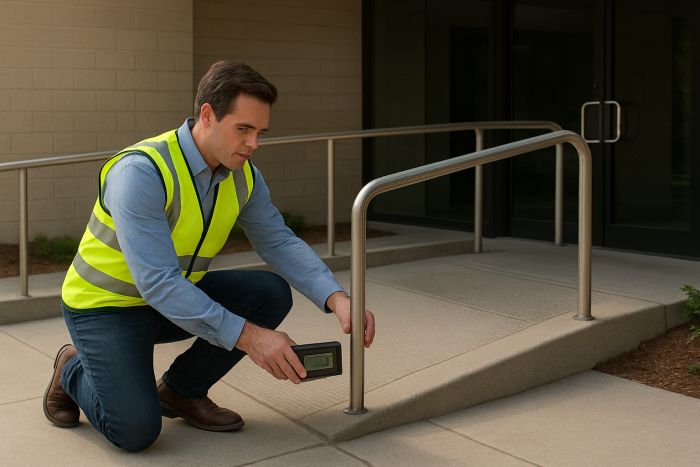
Universal Access Consultant doing an access audit

Unfortunately many buildings and businesses in South Africa still do not have adequate Disabled Parking Bays to accommodate wheelchair users. The owners of these buildings and businesses may therefore be challenged by the need to find suitable equipment, specialists and renovators familiar with accessible design issues in order to advise them and make there Parking areas accessible to persons with disabilities, especially those in wheelchairs.

There are various Organizations and Companies that can assist with Universal Design and Access to make sure that persons with disabilities are not excluded from any events and venues.

There are a number of other Accessible Parking Bay Regulations, to view all the Accessible Parking Bay Regulations, see below:

4.3.1 For employee parking, at least one parking space shall be accessible for persons with disabilities.
4.3.2 In addition to the above, where provision has been made within a building, or on the site on which such a building is erected, for the parking of more than 50 motor vehicles,
1. At least one parking space per 25 parking spaces (or part thereof) and at least 20 % of the parking spaces at rehabilitation and medical facilities shall be provided for parking of vehicles used by persons with disabilities.
2. The parking spaces provided for vehicles used by persons with disabilities shall be of a suitable length, shall be at least of the dimensions shown in figure 2, and shall be situated on and accessed from a surface that is not steeper than 1:50.
3. Any parking space provided for vehicles used by persons with disabilities shall be located within 50 m of an accessible entrance.
4. Any parking space provided for vehicles used by persons with disabilities shall be clearly demarcated as being intended for the use of persons with disabilities only;
5. Entry and routing to any parking space designated for persons with disabilities shall be provided with a clear height of at least 2,4 m and shall allow for the entry of vehicles suitable for use by wheelchair users, particularly those that have a hoist to carry the wheelchair on top of the car.
4.3.3 Parking spaces shall be identified by a vertical sign incorporating the international symbol for access by persons with disabilities, in accordance with 4.2. The international symbol shall also be clearly painted on the road surface and it shall be 1 000 mm × 1 000 mm.

NOTE: Road signs for persons with disabilities should be provided in accordance with the latest edition of The Southern African Development Community Road Traffic Signs Manual (SADC RTSM) published by the Department of Transport.

4. Abuse of Accessible Parking Bays

Abuse most often occurs with non-disabled drivers using the vehicle, plate or placard of another person who is disabled. This often occurs with family members of disabled people. The bays are 3500mm in width, which is designed to accommodate a wheelchair on either side of a vehicle for the purposes of exiting or entry. Bays are positioned in specific areas not only for location but to accommodate the specified width requirements.

A whistle blowing facility has been established by QASA to allow the general public to inform QASA when these facilities, which are so important to the rights and freedom of wheelchair users, are abused.
If you see someone misusing a wheelchair demarcated parking bay, please take a photo which shows the vehicle registration and wheelchair parking sign clearly.

WhattsApp it to 0738539675 including the location, date and time and QASA will kindly sensitize the offender.”
Click here to read more.
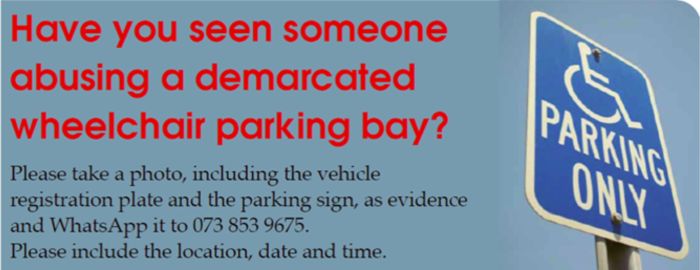
wheelchair parking signboard - are you abusing the system?

Please Note:


While DiSA is committed to use terminology and provide information as outlined in the White Paper on the Rights of Persons with Disabilities, language and opinions used by external parties in this content may differ to ours but we still see value in the services that the provide.

Disclaimers and References

DiSA is committed to promoting the rights, dignity, and inclusion of persons with disabilities as outlined in the White Paper on the Rights of Persons with Disabilities. We strive to ensure that all content on our website reflects appropriate, respectful, and inclusive language in alignment with these principles.

However, we also provide a platform for companies and organisations to advertise their services and products. While we encourage advertisers to adhere to correct terminology and inclusive practices, DiSA cannot guarantee the accuracy or appropriateness of the language used by external parties in their content.

Please note: Any views, language, or terminology used in advertisements, promotional material, or external links do not necessarily represent the views of DiSA.

DiSA disclaims any responsibility for inaccuracies or language that may not align with the White Paper or best practices for disability terminology.

Should you however encounter language or content that you believe is inappropriate or offensive, we encourage you to contact us at info@disa.org.za, so that we can address the issue.

DiSA remains dedicated to fostering a respectful and inclusive environment for all individuals. We appreciate your understanding and collaboration in supporting our mission.


While we strive for accuracy and clarity, AI-generated visuals may not always reflect real-life conditions or representations.
In addition, we feature authentic images and videos of actual instances, events, circumstances that have occurred, as well as products and services supplied by companies who advertise with us.

These authentic visuals are intended to accurately depict our content or the offerings of our advertising partners.
If you have any questions or concerns about the content displayed on this site, please feel free to contact us.

DiSA provides a platform for companies and organisations to advertise their products and services to assist persons with disabilities and their families. While we make every effort to list reputable and credible service providers, the inclusion of any company, organisation, product, or service on our website does not constitute an endorsement or guarantee by DiSA.

Please note the following: DiSA is not involved in the delivery, quality control, or customer service of any product or service offered by advertisers listed on our platform.

Any agreements, purchases, or arrangements made between users of this website and advertisers are solely between those parties. DiSA is not responsible for the outcome of such interactions.

DiSA disclaims any liability for dissatisfaction, damages, or disputes arising from products or services supplied by companies or organisations listed on our website.

We encourage users to thoroughly research and verify any service provider or product before engaging with them. If you have concerns or encounter issues with an advertiser listed on our platform, please let us know at: info@disa.org.za. We value your feedback to help maintain the integrity of our platform.


While we strive for accuracy and clarity, AI-generated visuals may not always reflect real-life conditions or representations.
In addition, we feature authentic images and videos of actual instances, events, circumstances that have occurred, as well as products and services supplied by companies who advertise with us.

These authentic visuals are intended to accurately depict our content or the offerings of our advertising partners.
If you have any questions or concerns about the content displayed on this site, please feel free to contact us.

DiSA is committed to providing accurate and up-to-date information to assist persons with disabilities and their families. However, the nature of online content and external resources means that information can change frequently.

Please note the following: DiSA cannot guarantee the accuracy, completeness, or reliability of all information on our website, particularly information obtained from external sources or links to third-party websites.
External websites may update or remove content without notice, which can result in broken links or outdated information. DiSA is not responsible for the content, accessibility, or functionality of external websites.

While we make every effort to keep our information current, some content may become outdated over time.
We encourage users to verify information directly with the relevant third parties or organisations before making any decisions based on the information found on our platform.

If you encounter a broken link or outdated content, please notify us at: info@disa.org.za and we will address it as soon as possible.
Thank you for understanding and helping us maintain a reliable and accessible platform.


While we strive for accuracy and clarity, AI-generated visuals may not always reflect real-life conditions or representations.
In addition, we feature authentic images and videos of actual instances, events, circumstances that have occurred, as well as products and services supplied by companies who advertise with us.

These authentic visuals are intended to accurately depict our content or the offerings of our advertising partners.
If you have any questions or concerns about the content displayed on this site, please feel free to contact us.

The Information services and website that we offer free of charge, is privately run and funded and is not run or funded by the government. We rely on advertising, paid services and donations to supply and improve this Free information service that we do provide.

The Companies, Clubs, Schools and Organisations that are listed on this site, have advertised or made donations to the Website and have therefore assisted us be able to provide this free Service.
Please support them as they have supported Us and please contact us via info@disa.org.za, if you can advertise with us or would like to make a donation. Alternatively, visit our “Support Us” page to find out how you can support us or acquire our services. – Thank You.

If you encounter a broken link or outdated content, please notify us at: info@disa.org.za and we will address it as soon as possible.
Thank you for understanding and helping us maintain a reliable and accessible platform.

Please Note: We do assist with inquiries via email but may need to send or copy your details and inquiry to various other organisations, companies or government departments, that we sometimes consult, so that we can help you in the best way possible.
If you have any objection to us sharing your query or contact details, please notify us in your email. We will only share your information to assist you and will never sell or use your personal information for any other purposes.

DiSA waivers any liability for what happens if information is shared or used for marketing or other purposes by other organisations who do have consent to view such information.


While we strive for accuracy and clarity, AI-generated visuals may not always reflect real-life conditions or representations.
In addition, we feature authentic images and videos of actual instances, events, circumstances that have occurred, as well as products and services supplied by companies who advertise with us.

These authentic visuals are intended to accurately depict our content or the offerings of our advertising partners.
If you have any questions or concerns about the content displayed on this site, please feel free to contact us.

Please note that this website uses images and videos that are AI-generated and created to visually represent certain information, concepts or scenarios for illustrative purposes.


While we strive for accuracy and clarity, AI-generated visuals may not always reflect real-life conditions or representations.
In addition, we feature authentic images and videos of actual instances, events, circumstances that have occurred, as well as products and services supplied by companies who advertise with us.

These authentic visuals are intended to accurately depict our content or the offerings of our advertising partners.
If you have any questions or concerns about the content displayed on this site, please feel free to contact us.

Disability Info South Africa (DiSA) is committed to protecting your personal information in compliance with the Protection of Personal Information Act (POPIA), Act No. 4 of 2013. By using our free information service, you acknowledge and agree to the following:

Collection of Personal Information:
DiSA may collect and process your personal information (such as name, contact details, and inquiries) solely for the purpose of assisting you with your requests and providing relevant information or support.

Use and Storage:
Your personal information will only be used for the purpose it was collected for, we may need to send or copy your details and inquiry to various organisations, companies or government departments, that we sometimes consult, so that we can assist you in the best way possible.
If you have any objection to us sharing your query or contact details, please notify us in your email. We will only share your information to assist you and will never sell or use your personal information for any other purposes.
DiSA implements appropriate measures to secure your personal information against unauthorized access or loss.

Consent:
By submitting your details through our Contact Form, or contacting us via our email address, you consent to allow DiSA to process your information as outlined in this disclaimer. If you are not comfortable with DiSA sharing your information for the above purposes, please contact us directly at info@disa.org.za.

Access and Updates:
You have the right to request the deletion of your personal information at any time.
To do so, please contact us at: info@disa.org.za.

Third-Party Websites:
DiSA is not responsible for the privacy practices of external websites linked on our platform. Users are encouraged to review the privacy policies of third-party sites before sharing personal information.
For any queries or concerns regarding the handling of your personal information, please contact us at: info@disa.org.za.
Thank you for trusting DiSA to support you with accessible, inclusive, and reliable information.

– www.bradshawleroux.co.za
– www.ncpd.org.za
– www.iol.co.za/motoring/industry-news/whatsapp-group-to-nab-disabled-parking-bay-invaders-12164571
– www.rolling-inspiration-archives.co.za/article/1101/Parking-for-the-disabled.php
– www.westerncape.gov.za/service/disabled-parking-discs
– www.universalaccesscollective.com

Simplified Summary

The Accessible Parking Bay page on the DiSA Information Desk explains what accessible parking bays are, who can use them, how they should be designed, and how to apply for an official parking disk.