Service and Therapy Dogs | Intellectual Impairments

1. Do you have an impairment or disability and require a dog to be trained to provide at least 3 services to assist you?
You may require a dog to be trained as an Assistance Dog.

2. Do you have a mental health condition or emotional disorder? Are you looking to have your Dog trained to provide emotional or therapeutic support to you within your home?
You may require a dog to be trained as an Emotional Support Dog.

3. Are you looking to train or acquire a Dog to provide Therapy for one or more people within your practice or in different settings such as hospitals and retirement Homes?
You may require a Therapy Dog

If you answer “Yes”, to any of these questions, please read the information below about the training required and the companies and organisations that may be able to assist you, as well as the rules and regulations regarding travelling with these dogs.

What kind of Dog do I Need?

Dog training that assists people with disabilities can be grouped into 3 primary categories: Assistance Dogs; Emotional Support Dogs and Therapy Dogs. Each category of training services a different need. With one exception, Assistance Dogs can be trained to fulfill specific tasks, whilst also functioning as emotional support dogs.
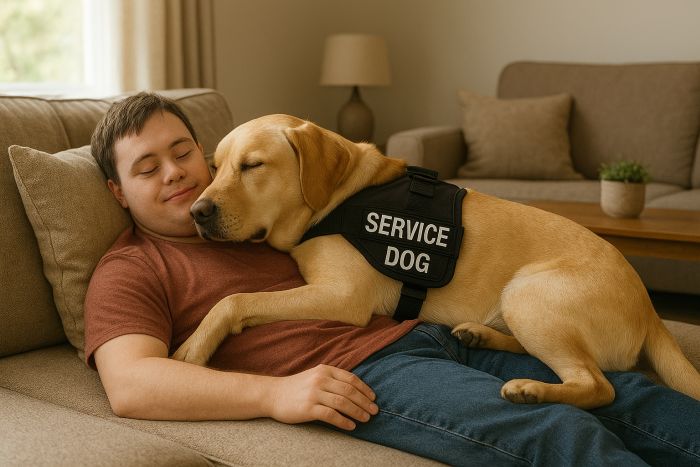
A Multipurpose Service Dog providing support to a man with Down Syndrome

1. Assistance Dogs

Assistance Dog is generic term for a Guide, Hearing, or Service Dog specifically trained to do three or more tasks to mitigate the effects of an individual’s disability.

Assistance Dogs are covered under legislative access laws for public access rights when working with their handler.

Click the following links to find out more about: Types of Assistance Dogs, Accredited Training Facilities, Laws and Regulations, Equipment Required

Image of a Golden Retriever, trained as an Emotional Support Dog, seated on the floor alongside, comforting a young women

2. Emotional Support Dogs

Emotional Support Dogs are companion animals that provide emotional or therapeutic support to an individual with a mental health condition or emotional disorder simply by being present.

Emotional Support Dogs do not have the same right to public access as an Assistance Dog.

Click the following links to find out more about:
Training of Emotional Support Dogs, and
Training Facilities are available to assist you.

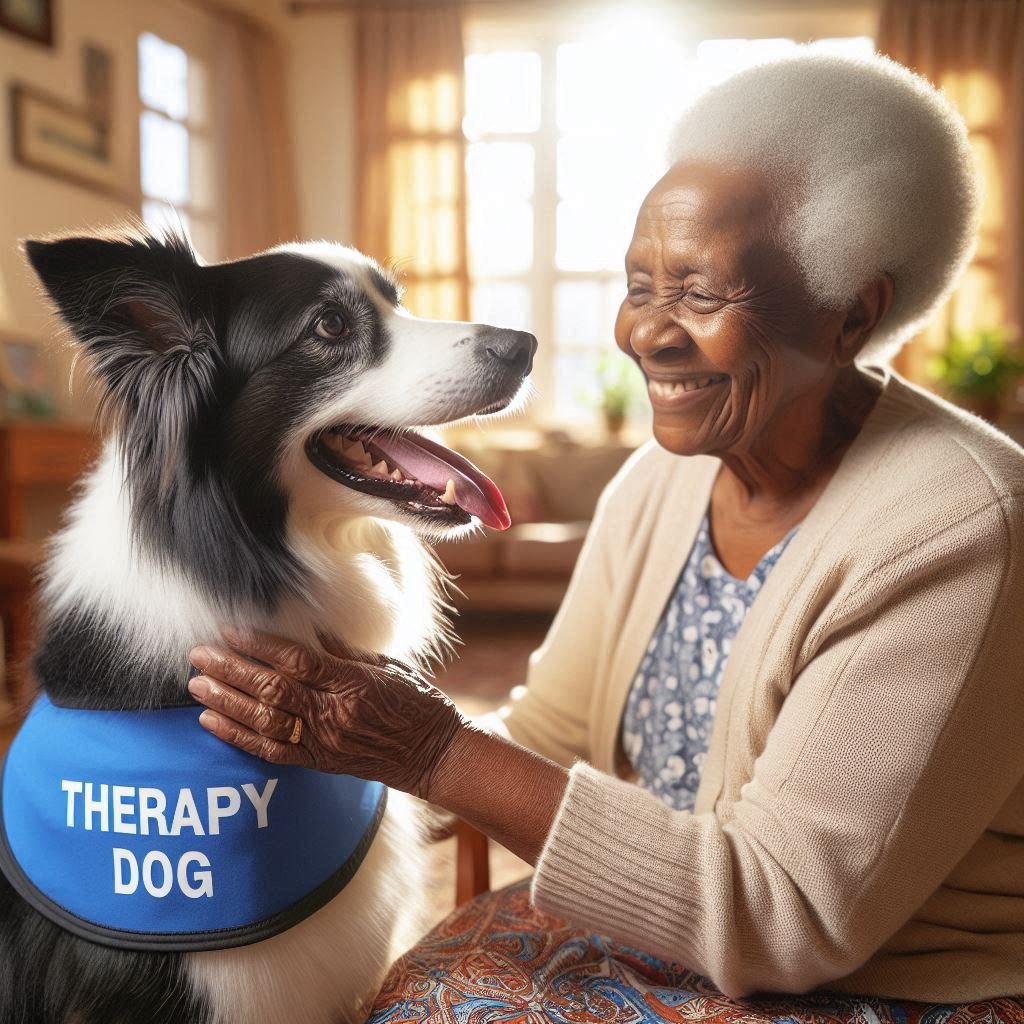
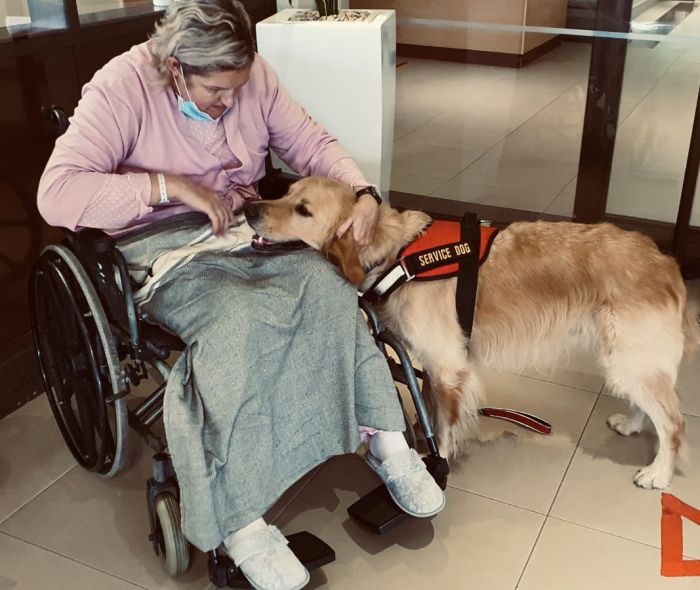
Image of an older african lady sitting with a Therapy Dog

3. Therapy Dogs

A Therapy Dog is a pet dog trained to provide affection, comfort, and love in both personal and/or professional settings.
Therapy dog owners visit facilities, with their dogs, by invitation only, either as guests or practitioners. Using the dog in a professional setting. They are not covered under the legislative public access laws, and do not have the same public access rights as an Assistance Dog.

Click the following links to find out more about:
Training of Therapy Dogs, and
Training Facilities are available to assist you.

2. Types of Assistance Dogs

Assistance Dogs are dogs specifically trained to do three or more tasks to mitigate the effects of an individual’s disability or impairment. There are currently 3 types of Assistance Dogs” that are trained in South Africa to assist persons with Physical Impairments or Diabetes:

3. Accredited Training Facilities

Dog training facilities may differ in the type of training they provide, in what provinces they provide the training and the cost.

Please read the information below to learn more about the Accredited Training Facilities available in South Africa and the specific services they offer to find a facility best suited to your specific requirements.

Theses include:
Smart Service Dog,
Paws4life Training Academy,
Honey’s Garden For Medical Alert Dogs SA or
The South African Dog Training College (SADTC)
1. Smart Service Dog
Smart Service Dog is a Dog training facility in Durban and Johannesburg that specialises in Puppy and Home Obedience Training. In 2016 Smart Service Dog became an independent training school and started focusing not only on Puppy and Home Obedience Training but, very importantly training The Handler, Owner and Dog Trainers as well.

Training offered by Smart Service Dog includes: Puppy School; Home Obedience; Fun Agility (Canine Hooper’s World Accredited); Scent Work (TDS accredited); Animal Behaviour Training; CD Companion Dog-Working Trials; Canine Good Citizen Testing; Protection work and Rally Obedience Classes.

Smart Service Dog offers training across five specialist fields including: Autism Assistance; Psychiatric Service Dogs; Seizure Alert Dogs; Hearing Assistance and Mobility Assistance.

Please read the information below to learn more about the training that Smart Service Dog provides.

A Mobility Assistance Dog enables their recipient to be more mobile whether they are in a wheelchair, or use a walker, cane, or crutches. These dogs allow their handler to be more independent in their day-to-day life. Smart Service Dog will not only train Mobility Assistance Dogs for adults, but also for children who demonstrate the ability to remain consistent with training exercises and are able to communicate clearly to the dog.

Animal-Assisted Therapy is a therapeutic intervention that incorporates animals, such as horses, dogs, cats, pigs, and birds, into a treatment plan used to enhance and complement the benefits of traditional therapy.

It can be a useful intervention for individuals or groups. Studies have reported positive outcomes and improved emotional well-being in those with autism, medical conditions, or behavioural issues, as well as those battling illnesses like depression, schizophrenia, or addiction.

Should you have any queries please feel free to contact Smart Service Dog via either the contact form on the website: www.smartservicedog.co.za, or contact Grant Smith on grant@smartservicedog.co.za | 081 270 4672.

2. Paws4life Training Academy
Advertisement for Paws for Life specialised K9 training facility based in Cape Town

The Paws4life Training Academy is a specialised K9 training facility based in Cape Town and started in 2015. They live by the motto: “Your dog is not just a dog”. They not only train puppies and dogs but aim to create an everlasting bond between human and dog.

Through education, Paws4Life strives to improve the lives of animals and in turn improve the lives of their people – cementing the bond between humans and canines. They aim to provide affordable dog training that provides for the needs of all dog owners.

Paws4life sees it as their social responsibility to ensure that the dogs they train are safe around children, not a danger or a nuisance to their owners or the public – and that the animals rights are upheld and considered at all times.

Paws4Life are committed to:
– Consistent, reliable and the optimal educational quality
– An atmosphere of understanding, learning and fun
– Friendly and caring staff and management
– Meeting the needs and exceeding the expectations of all our stakeholders, suppliers and clients
– Creating a better life for dogs and their people through usability of our training in the home environment
– That all training offered reflects our philosophies of trust, honesty, honour, virtue and integrity in all contacts with Paws4life.

What is our business philosophy?
– Delivery of quality in all encounters
– Trust through long-term relationship development
– Nurturing a learning environment
– Fun for person and pooch alike

– Puppy classes
– Adult dog classes
– One on one training
– Behaviour modification programs
– Therapy Dogs
– Service Dogs

i) Multipurpose Service Dogs
These dogs are trained to perform various tasks such as fetching a person’s shoes, picking something up that has fallen and so forth. These dogs can help individuals with: Adult Asperger, Down syndrome, Cerebral Palsy, Individuals who are medically frail.

ii) Mobility Assistance Service Dogs
These dogs are trained to help individuals who use wheelchairs, or those who struggle with balance. These dogs give the owner some stability to move around and regain some of their freedom.

iii) Diabetic Alert Dogs
These dogs are trained to alert an individual who has been diagnosed with diabetes, when their blood sugar levels drop and when the blood sugar levels are too high. They are also trained to get help, fetch a glucose meter, juice box or even the medication that is needed.

We also assist with the training of: Psychiatric Service Dogs; Seizure Alert Dogs; Hearing Assistance Service Dogs; Autism Assistance Dogs

All Service Dogs go through multiple levels of assessments. only proceeding after successfully completing all training requirements and levels. They are also required to complete the KUSA Good Citizen training, testing at bronze level. No dog will qualify unless they pass all the required tests and assessments.

If you require any more information or are interested in Service Dog Training, please contact Calika Morries from Paws4life Training Academy on:
Cell: +27 72 445 4310; Email: paws4lifetraining@gmail.com or visit our website at: www.paws4life.co.za

3. Honey’s Garden for Medical Alert Dogs SA

Honey's Garden For Medical Alert Dogs and task trained service dogs for persons with disabilities

Honeys Garden is a nonprofit organisation (2016/387235/08 ) whose mission is to place quality service dogs with people within South Africa who are under-privileged, fighting with disabilities or diseases, and veterans who have lost use of limbs or hearing.

Honeys Garden also assist with animal rescue and educate the public regarding the use of service dogs in public places. Enriching the lives of children and adults with medical disabilities and diseases by matching them with task trained service dogs.

Honeys Garden supplies and utilizes specifically trained TheraPets for working professionals and individuals.
They were the first company to train Medical Service Dogs in South Africa!
All their Service Dogs and Therapets undergo stringent testing, including the KUSA Canine Good Citizen Award.
Honey’s Garden for Medical Alert Dogs SA is run by Lucy Breytenbach (Director/Founder). Their purpose, to enrich the lives of families across the country by providing quality task trained service dogs.

‘We aim to increase the confidence and independence of those in need, and their families. We have successfully introduced medical service dogs, and Therapets for working facilities into South Africa. Our dogs save and change lives daily.’
The dogs that we are currently able to provide include but are in no way limited to:

Multipurpose Assistance Dogs
Every person and child is different and so are their needs. It is for this reason that we have developed “Multipurpose Service Dogs” who will generally assist in any way that is needed based on a detailed interview and home review (can be via video call).

Some examples of the types of people who may need a multipurpose service dog include but are certainly not limited to: Adult Asperger, Down syndrome, Cerebral Palsy, Individuals who are medically frail. (Includes but not limited to a variety of disabilities. E.g. Foetal Alcohol Syndrome / Aspergers / ADHD / Mobility impairments / Alzheimer’s / Cerebral Palsy).

Whatever your needs, we can tailor train a dog to match them. Although you can give us a shout if you are unsure of what you would need a dog to do, here are a few ideas: Retrieving dropped items or specific items (keys, phone, medication, etc); Opening, closing or holding open doors/fridge/cupboards; Tugging clothing to help remove; Turning lights on and off; Placing items in the bin trolley or onto a cashiers desk; Deep pressure therapy; Carrying shopping bags; Opening and closing curtains.

Diabetic Alert Dogs (DAD) are trained to alert diabetic handlers, in advance, of low or high blood sugar events, before a dangerous situation can occur. By using their incredible sense of smell, these dogs can sniff out any changes in their owner’s glucose level up to 30 minutes before a blood glucose monitor, giving the owner’s time to alter their artificial insulin level or sugar intake before symptoms occur. They are trained to get help, or to go and fetch a glucose meter, juice box or even the medication that is needed.

We also assist with the training of: Psychiatric Service Dogs; Seizure Response Dogs; Hearing Dogs for the Deaf; Autism Assistance Service Dogs; TheraPets (Facility Dogs) Our training takes place at our facility in Cape Town, as well as out and about in local public spaces. This is so that we build confident reliable dogs who can work in any environment that they are placed in.

We are able to place dogs across the country as long as families are able to attend an initial meeting or facilitate a video interview (to discuss needs and lifestyle so that we can match the perfect dog to their team) and spend 2 weeks at our facility upon completion of their service dog.

This 2-week full time workshop will enable applicants to learn what is expected of them, and how to handle their service dog when they get home.

We carry out a graduation ceremony for the dogs and new owners upon completion of their public access test (near end of workshop). All families will leave with their dog and a starter pack with notes, information and goodies to get them started at home.

We suggest that service dog teams join a weekly obedience school in their local area (we will gladly assist in sourcing a quality training school) in order to maintain confidence when working with their dog. We are also available to take questions and troubleshoot via video call should you require it, and you are always welcome to pay us a visit or join our local classes.

Please feel free to or contact Honey’s Garden via Lucy Breytenbach on Mobile: +27 72 250 0336,
via Email: honeysgardensa@gmail.com, or through their website at: www.medicalalert@shane.
Alternatively you can join our local classes in Leadville Dog Park, Leadville Way Sunningdale, Cape Town, 7441.

4. The South African Dog Training College (SADTC)

SA Dog Training Academy logo

The South African Dog Training College and Kennels (SADTC) is a dog training school which was established in 1984 by Chris and Christine van der Westhuizen. In 1984, puppy socializing, agility, consultations, etc. were hardly known to South Africans and SADTC brought these and many other courses to South Africa in a big way.

The SA Dog Training College offers a wide variety of Dog and Puppy Training including Therapy and Service Dog Training as well as various other services, including Dog Training Instructor Classes; Local and International Seminars; Sourcing Trained Dogs; Inboard (Kennel) Training; Home Dog Training; Social and Fun Events and Dog Physiotherapy.

The SA Dog Training College also supplies Dog Equipment and is now also offering Therapy and Service Dog Courses in South Africa, which fulfils a huge demand for this. The S.A. Dog Training College and Kennels offers training for a variety of Service Dog training including Autism Support Dogs, Alert Dogs, Service Dogs for persons with physical disabilities and Therapy Dogs. “Our prices are extremely reasonable.”

Therapy dogs and handlers play a vital role with regards to working with cases of trauma, head injuries, illnesses and in retirement villages or hospitals.

We have a therapy tester, and two therapy handlers, of which one is also a therapy instructor. They are qualified with DELTA, an international therapy organisation. We also offer training and testing right here in South Africa, as we are internationally endorsed with the Delta Society. Instructions and evaluations are now conducted locally by Christine van der Westhuizen who is an accredited alternate evaluator for Delta® and is conducting the local evaluations in the Gauteng Area.

Evaluations are also available on the South Coast from Heidi qualified as a Delta® evaluator who has also completed a number of Animal Behaviour Courses as well as Animal Assisted Activity Courses in South Africa and abroad and felt the need for trained handlers together with their pets to be qualified here in South Africa.

Please feel free to contact SADTC to find out more, email Christine on: info@sadtc.co.za or speak to her on:
Tel: 065 860 6784 if you require any information, or you can visit their website at: www.sadogtraining.co.za.

How can we help you?

At Disability Info South Africa (DiSA), we are committed to breaking down barriers and creating a more inclusive society.
One of the most life-changing forms of support for individuals with disabilities is an Assistance Dog —
a highly trained companion that provides mobility support, medical alerts, and emotional assistance. 

Guidance And Support

We provide information on eligibility, application processes, and legal rights regarding assistance dogs. 

Accessibility Audits

Ensuring businesses and public spaces are ‘assistance-dog friendly’ and compliant with accessibility standards. 
Educating organizations and individuals on the importance and rights of assistance dog users. 

Advocacy And Resources

Connecting individuals with the right support networks, including AADSA, to help them on their journey. 

Assistance Dogs Change Lives –
Let’s Make South Africa More Accessible

If you or someone you know could benefit from an assistance dog, or if you’re a business wanting to improve accessibility, get in touch with us today!  Together, we can create a world where independence has no limits!

Training Assistance Dogs: Frequently Asked Questions

Assistance Dogs need to be trained by an Accredited Training Facility.
Training facilities differ with some specialising in particular breeds or types of service, in location, and where they provide the training and the cost. Examples of Accredited Training Facilities include Smart Service Dog, Paws4life Training Academy, Honey’s Garden For Medical Alert Dogs SA and The South African Dog Training College (SADTC), you can learn more about them below.

These facilities will teach you how to train your Assistance Dog to assist you, and how to behave well while out in public.

South Africa does not currently have an official regulatory body overseeing Assistance Dog training. However, the Association of Assistance Dogs South Africa has recently been established to set and uphold industry standards for Assistance Dog training across various organisations.

The Association of Assistance Dogs South Africa is a key initiative under DiSA’s Accessible Cities platform. It was founded through a collaboration between DiSA and three leading Assistance Dog training organisations:
– Smart Service Dog
– Paws4Life Training Academy
– Honey’s Garden for Medical Alert Dogs SA

All Assistance Dogs trained by these accredited organizations are registered under the Association, ensuring they meet high ethical and professional training standards. The Association is dedicated to advancing the rights and recognition of Assistance Dogs in South Africa through the following key objectives:
1. Educating the public, businesses, and service providers about the rights and benefits of Assistance Dogs.
2. Advocating for equal access to public spaces, workplaces, and transportation for individuals with Assistance Dogs.
3. Addressing discrimination and misconceptions regarding Assistance Dogs and public accessibility.
4. Collaborating with airlines, travel operators, tourism agencies, government departments, and transport services to ensure Assistance Dog handlers receive equal treatment with dignity and respect.

For more information about the Association of Assistance Dogs South Africa, its member organizations, and how they can assist individuals in need of an Assistance Dog, please visit the link below:

Any breed or mix of breeds can become an Assistance Dog, if they have the necessary qualities and are properly trained. They would need to be able to provide the services that the owner requires, and the size of the dog can affect their ability to do this. For example, a Chihuahua would not be suitable as a Balance Dog while a Great Dane could be used as a Balance Dog but may provide a problem when flying.

While some Training Facilities focus on specific breeds known for their trainability and suitability for Assistance Dog work, such as Labradors and Golden Retrievers, most Training Facilities also train other breeds of dogs including crossbreeds and mixed breeds.

While some Training Facilities might prefer not to train “Power Breeds” like Boerboels, Pitbulls, and Rottweilers due to airline regulations, some Assistance Dog training facilities train them alongside breeds like Labradors and Golden Retrievers.

While some Assistance Dog Training Facilities have “Breeding Programs” and only train dogs that are provided by these programs, other Training Facilities will train dogs provided by their owners, which may include “Rescue dogs”.

Before purchasing a dog to be trained as an Assistant Dog, it is advisable to contact the training facility that you will be using, to find out If the breed and age of dog will be able to be trained by them.

Training of an Assistance Dog can take months or even years to complete. This can differ slightly, depending on the type of dog being trained – and the services the dog is going to need to render.

Dogs learn at different paces, with some breeds being more intelligent than others.

Some services that Assistance Dogs need to provide may take longer to learn than others, it depends on what the dog has to do to assist its handler and whether or not it will be required to accompany them on airplanes, buses, boats and into restaurants as well as other public places, without being distracted by strange noises, crowded areas, etc.

In general takes a minimum of 180 hours, about 6 months, before it would be tested to be qualified.

Once the Assistance Dog has qualified, it will be registered with that organisation or company on their data base and a letter or card, as well as a jacket or bib will be presented to the handler, stating that the Assistance Dog has been trained and qualified with them.

Please read the information below to find out more about these companies and organisations that provides this training and to find out more about the other services that they can provide.

Once the Assistance Dog has qualified, it will be registered with that organisation or company on their data base and a letter or card, as well as a jacket or bib will be presented to the handler, stating that the Assistance Dog has been trained and qualified with them.

Please read the information below to find out more about these companies and organisations that provides this training and to find out more about the other services that they can provide.

4. About Therapy Dogs

A Therapy Dog or Therapy Pet is a dog that is trained to provide affection, comfort and support to various people in settings such as hospitals, retirement homes, nursing homes, schools, libraries, hospices, or disaster areas.

In contrast to Assistance Dogs, which are trained to assist specific patients with their day-to-day physical needs. Therapy Dogs are required to be certified and are trained to interact with all kinds of people, not just their handlers.

While therapy pets and emotional support animals are not currently regulated in South African law, it’s generally accepted that for an animal to be considered a therapy pet or emotional support animal, it must be prescribed by a licensed mental health professional to a person with a mental health disability.
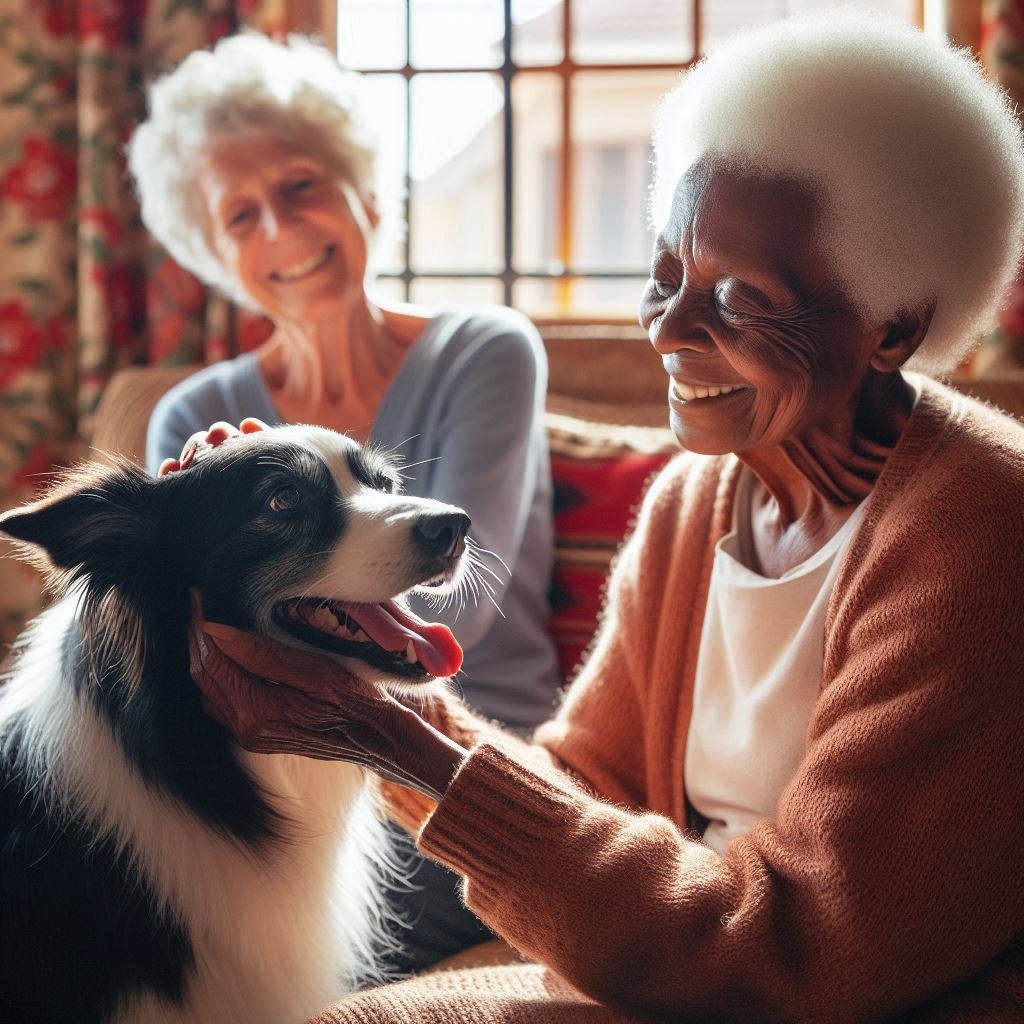
Image of an older lady sitting with a Therapy Dogs, while a therapist looks on.

When an ESD is needed in the workplace, the employer will need proper proof that this is necessary and that the person has a genuine disability, generally a letter from a registered mental health care provider. 

When traveling with an ESD, airlines may require a letter from a mental health professional stating the passenger has a condition that requires them to travel with their ESD, as well as an updated vaccination card and microchip number.

There are various organisations, companies and individuals in South Africa, who are qualified to train Therapy Dogs such as the The South African Dog Training College (SADTC), Smart Service Dog, Honey’s Garden For Medical Alert Dogs SA and Paws4life Training Academy.

These organisations and companies also offer programs, whereby they visit hospitals, retirement homes, nursing homes, schools, libraries, hospices, etc. to provide support.

We hope you find the information above useful. If however you have not found what you are looking for, or have additional questions pertaining to Therapy Dog Training please contact DiSA directly for further assistance.

5. About Emotional Support Dogs

Emotional Support dogs are companion animals that provides emotional or therapeutic support to an individual with a mental health condition or emotional disorder simply by being present. Emotional support animals do not generally receive the same training as assistance dogs and therefore, depending upon the country, may have different laws regarding their public access privileges.

In South Africa, Emotional Support Animals do not generally have the same rights to public access as an assistance dog and its handler and don’t generally undergo specific task training. However, thy are trained in basic obedience and good behaviour and may be allowed to fly on certain airlines but would need to be prescribed by a licensed mental health professional to a person with a mental health disability.

It is therefore recommended that you should contact the airline or public space to ensure that you have been granted access to any privately rented space, and other semi-private establishments by way of mutual agreement and understanding this includes a workplace. 

Emotionally upset women hugging a labrador trained as an emotional support dog

When an ESD is needed in the workplace, the employer will need proper proof that this is necessary and that the person has a genuine disability, generally a letter from a registered mental health care provider. 

When traveling with an ESD, airlines may require a letter from a mental health professional stating the passenger has a condition that requires them to travel with their ESD, as well as an updated vaccination card and microchip number.

Emotional Support Dog Training Facilities include Smart Service Dog, Paws4life Training Academy, Honey’s Garden For Medical Alert Dogs SA and The South African Dog Training College (SADTC). Please click on the links to find out more about these companies/organisations and the services that they provide.

6. Equipment Used by Assistance Dogs
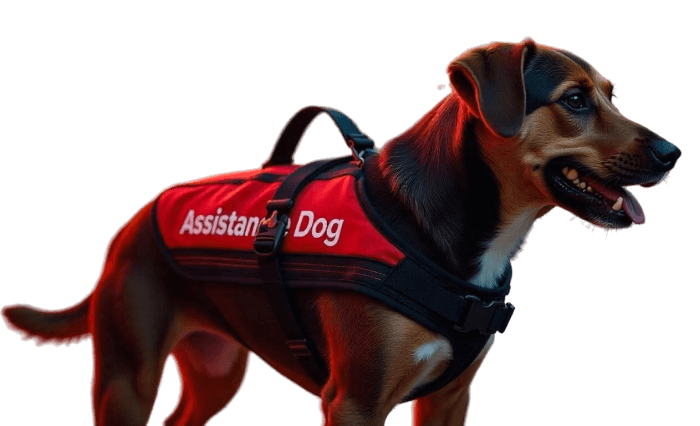
Image of an Assistance Dog, wearing a red Guide Dog bib

Assistance Dogs are allowed in public places such as buildings, restaurants on boats or airplanes, etc., where animals are normally not allowed. They are however required to wear certain equipment while out in public, which includes Assistance Dog Vests / Bibs and Harnesses.

This equipment may differ between companies and organisations and according to the type of Assistance Dog that they are qualified as. Assistance Dogs that are in training often wear different colour bibs according to their level of training.

These bibs and a variety of other equipment is available to purchase from the various organisations and companies that are accredited to train Assistance Dogs such as The South African Dog Training College (SADTC)Smart Service DogHoney’s Garden For Medical Alert Dogs SA and Paws4life Training Academy.

7. Legislation regarding Assistance Dogs

In South Africa, denying access to a person with a “Working Dog” is a form of discrimination, prohibited by the Constitution and the Equality Act. This means individuals with disabilities, including those with visual, physical, hearing or intellectual impairments, cannot be denied access to public places with their Assistance Dogs.

 The Constitution of South Africa and the Equality Act protect individuals with disabilities from discrimination, including the denial of access to public spaces with their working dogs.

These are specially trained animals that assist individuals with disabilities in their daily lives, such as guide dogs, hearing dogs, or assistance animals for people with mobility issues.

Service dogs are legally allowed in public spaces like restaurants, shopping centers, hospitals, schools, and on public transport.

Landlords and housing providers cannot enforce “no-pet” policies on individuals who depend on service dogs, as this constitutes discrimination under PEPUDA.

While landlords cannot inquire about the tenant’s specific disability, they can request verification that the animal is indeed a service animal, which may involve asking for a doctor’s note or other documentation.

In the Equality Court judgment of SA Guide-Dog Association for the Blind and Amanda Bester v The Department of Home Affairs and the Western Cape Department of Home Affairs, the court held that the denial of access to the applicant and her assistance animal was unfair discrimination

Landlords cannot enforce “no-pet” policies that discriminate against individuals with disabilities who rely on service dogs, and employers must make reasonable accommodations for employees with disabilities, including allowing service dogs.

There are various regulations in-place regarding Assistance Dogs in South Africa and the access of Assistance Dogs into public places and buildings, where animals are normally not allowed.

An Assistance Dog is a working dog not a pet, they are essential to assisting many people with disabilities. Denying access to a person with a working dog is a form of discrimination and is against the law in South Africa. It should be viewed as the same as disallowing entry to a person who uses a Wheelchair or White Cane.

Unfortunately, many South Africans are still unaware of what an Assistance Dog does and how much training they have gone through to ensure that they are well socialised and behaved in public places.

The Constitution of South Africa states that a person cannot be discriminated against due to their disability, which means that persons with visual, physical, hearing or intellectual impairments cannot be denied access to public places such as restaurants, retail environments, airports etc. due to the fact that they are accompanied by an Assistance Dog that has been trained by an accredited training facility.

Section 9 of the Equality Act in South Africa states that: No person may unfairly discriminate against any person on the ground of disability, including:
a) Denying or removing from any person who has a disability, any supporting or enabling facility necessary for their functioning in society;
b) Failing to eliminate obstacles that unfairly limit or restrict persons with disabilities from enjoying equal opportunities; or
c) Failing to take steps to reasonably accommodate the needs of such person.

This also applies to restaurants or shops that sell food: Establishments within the food industry are regulated by the Foodstuffs, Cosmetics and Disinfectants Act which states the following:
“In terms of the Foodstuffs, Cosmetics and Disinfectants Act, No. 54 of 1972 (“the Foodstuffs Act”) and regulation R962 (10)(i) governing general hygiene requirements for food premises and the transport of food, no animal, subject to the provisions of any law, is to be kept or permitted in any room or area where food is handled, except for guide dog accompanied by a blind person, who may be permitted in the sales of serving area of the food premises.”

It is submitted that the provision logically extends to working dogs who are Service Dogs in the areas of Autism or Service Dogs required for persons with disabilities (other than blind persons) on the basis of the principles discussed above in relation to the Equality Act and Constitution.

In terms of the above-mentioned legislation, should you refuse access and/or service to a person with a disability with their Guide Dog, Service Dog or Autism Support Dog, appropriate recourse in the Equality Court or other appreciate forum may be sought against you and your company. We are covered by the South African Constitution and the United Nations Convention on the Rights of Persons with Disabilities (UNCRPD). Earlier this year, Judge Saldanha handed down a landmark judgement, the first in South Africa with the denial of access of a working Guide Dog.

The S A Guide-Dogs Association for the Blind (GDA) will advocate for the access rights of persons with disabilities who use a working dog that has been professionally trained by the Association (or any working dog trained by a member organization of the International Guide Dog Federation or a member Organisation of Assistance Dogs International). GDA will assist people who use working dogs to take advantage of the legal rights that they are entitled to. Alternatively please feel free to contact us via Yes to Access or fill out our Complaints Form.

South African Guide-dogs Association for the Blind:
“Access Rights for Assistance Dog Owners” Provided by South African Guide-dogs Association for the Blind.
Is it Illegal to Deny Access to a Working Dog?www.Guidedog.org.za

Links to the legislation:
Regulations Governing General Hygiene Requirements for Food Premises and the Transport of Food

8. Assistance Dogs and Public Access Guidelines

Assistance Dogs are legally permitted to accompany their handlers in public spaces where pets are typically not allowed—such as buildings, restaurants, buses, boats, and airplanes. However, when in public, these dogs must wear specific equipment, including an Assistance Dog vest or harness, as well as a lead or bridging handle.

This is what you need to know:

By law, Assistance or Service Dogs must wear clearly identifiable gear—such as vests, harnesses, leads, or bridging handles—when in public. This equipment serves several purposes:

1. It signals to the public that the dog is working and should not be petted or distracted.

2. It helps prevent misunderstandings and supports the dog in staying focused on assisting its handler.

3. It helps the dog perform its tasks effectively and allows the handler to maintain better control.

Equipment requirements vary according to purpose – for example mobility support, wheelchair pulling, guiding the owner or bracing assistance, all require different equipment.

The aim is to ensure a secure and comfortable fit for dogs of various sizes and breeds.

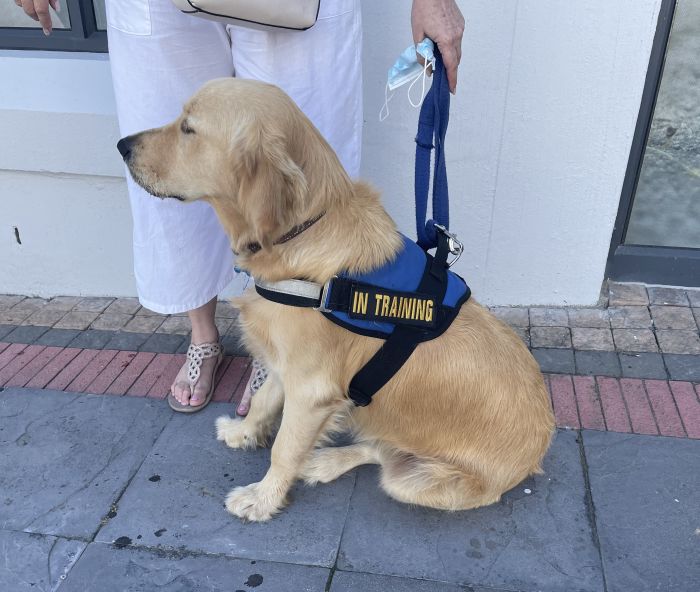
There is no official requirement regarding the colour of an Assistance Dog vest, and it does not need to indicate the specific disability the dog supports. However, vests should clearly state if the dog is “In Training,” when applicable.

It is illegal to ask a handler why they need a service dog or what assistance the dog provides.

These rights help protect the dignity and privacy of individuals using Assistance Dogs.

Harnesses and handles contribute to the overall safety of both dog and handler by providing guidance and control in public settings.

Handlers of certified Assistance Dogs are typically issued a letter, ID card and/or booklet from an Accredited Training Facility. This document can be useful when access is questioned, for instance by a business owner or staff member unfamiliar with the law.

The Assistant Dog Training Facilities who are registered under the Association of Assistance Dogs, would usually have the. Association logo included on the card, booklet and Harness.

Assistance Dog vests, bibs, and other gear can be purchased from a range of accredited training organisations, including:
The South African Dog Training College (SADTC)
Smart Service Dog
Honey’s Garden For Medical Alert Dogs SA and 
Paws4life Training Academy.

Equipment may vary depending on the organisation and the type of Assistance Dog trained, or if they are still in training.

While this equipment is available online to be purchased from other companies, it is illegal for a dog that was not trained as an Assistant Dog by a qualified company, to wear an Assistant or Service Dog vest.

Unfortunately, many members of the public, including restaurant and business owners, are still unfamiliar with the regulations around Assistance Dogs.

The Association of Assistance Dogs SA is dedicated to advancing the rights and recognition of Assistance Dogs in South Africa by:
1. Educating the public, businesses, and service providers about the rights of Assistance Dogs.
2. Advocating for equal access to public spaces for individuals with Assistance Dogs.
3. Addressing discrimination and misconceptions regarding Assistance Dogs and public accessibility.
4. Collaborating with airlines, travel operators, tourism agencies and transport services to ensure Assistance Dog handlers receive equal treatment with dignity and respect.

For more information about the Association of Assistance Dogs South Africa, please read the information directly below.

9. The Association of Assistance Dogs South Africa
Logo for the Association for Assistance Dogs

The Association of Assistance Dogs SA is a key initiative created under DiSA’s Accessible Cities platform.
It is dedicated to promoting the use of professionally trained Assistance Dogs to enhance the independence and quality of life of individuals with disabilities.

Assistance Dogs are life-changing partners that empower individuals with disabilities to navigate daily challenges with confidence. By setting training standards, registering Assistance Dogs, and collaborating with leading training organisations, the Association of Assistance Dogs seeks to ensure that these dogs are trained, respected, recognised, and able to perform their vital roles effectively

To this end, the “Association” works closely with various “Accredited Training Facilities” to set the standards for Assistance Dog Training and to ensure that all Assistance Dogs registered through the “Association meet strict ethical and professional guidelines.

Advocacy & Public Awareness

AADSA aims to advocate for the inclusion and accommodation of Assistance Dog teams in various aspects of society, by:
– Educating the public, businesses, and service providers on the rights and benefits of Assistance Dogs.
– Promoting equal access to public spaces, workplaces, and transportation for Assistance Dogs and their users.
– Addressing discrimination and misconceptions about Assistance Dogs.

* Assistance Dog Registration and Ethical Standardisation

To establish and uphold ethical standards for the training, handling, and care of Assistance Dogs, ensuring their well-being and the safety of individuals with disabilities. AADSA is committed to promoting best practices that prioritise the welfare of both dogs and handlers.
– The Association establishes and maintains standards for Assistance Dog training by the companies registered with the Association.
– All Assistance Dogs trained by associated organisations are registered under the association,
– All dogs trained by associated members are compliant with ethical and professional training guidelines.
– Registration provides official recognition by the Association, granting Assistance Dog users support by the Association.

* Collaboration and Networking: – Partnered Training Organisations


To facilitate collaboration and networking opportunities among Assistance Dog organisations, trainers, handlers, healthcare professionals, and other stakeholders. AADSA aims to create a supportive environment for sharing experiences, expertise, and innovative ideas.

The association works with leading Assistance Dog training facilities in South Africa to uphold these high standards, including:
– Smart Service Dog – Specializing in training Assistance Dogs for various disabilities.
– Paws4life Training Academy – Focused on obedience, therapy, and Assistance Dog training.
– Honey’s Garden for Medical Alert Dogs SA – Dedicated to training dogs for medical alert purposes, including seizure and diabetic alert dogs.

These organisations collaborate with DiSA as part of its Accessible Cities Initiative to ensure that:
– High training standards are maintained across all registered Assistance Dogs.
– Airlines, businesses, and public spaces recognize, and respect Assistance Dogs trained by companies within the association.
– Assistance Dog users experience greater accessibility and acceptance in society.

* Support & Resources for Individuals
– Providing guidance on acquiring and training an Assistance Dog through recognised training programs.
– Offering peer support to individuals integrating Assistance Dogs into their daily lives.
– Educating workplaces, businesses, and the public on how to accommodate Assistance Dogs.

* Education and Training
To provide educational resources, workshops, seminars, and training programs that empower Assistance Dog handlers, trainers, and the public. AADSA aims to foster a knowledgeable community that understands the roles and responsibilities of Assistance Dog teams.

* Legislation and Policy Advocacy
To advocate for the development and enforcement of laws and policies that recognise Assistance Dogs as valuable service animals and safeguard the rights of individuals with disabilities. AADSA is dedicated to promoting equal access and eliminating discrimination.

* Research and Innovation
To support research initiatives that contribute to the advancement of Assistance Dog training techniques, the understanding of the human-animal bond, and the overall impact of Assistance Dogs on the well-being of people with disabilities.

* Public Outreach and Partnerships
To engage with communities, schools, healthcare institutions, and other relevant organisations to promote the positive impact of Assistance Dogs. AADSA aims to build partnerships that foster inclusivity and enhance the lives of individuals with disabilities.

* Empowerment and Support
To empower individuals with disabilities and their families by providing resources, guidance, and emotional support throughout their journey with Assistance Dogs. AADSA is committed to working with the Training Facilities to help handlers realise their full potential and lead independent lives.

* Continuous Improvement
To continuously assess and improve the standards, practices, and effectiveness of Assistance Dog training, accreditation, and support services in South Africa. AADSA aims to adapt to evolving needs and advancements in the field.

* International Collaboration
To collaborate with international organisations and experts in the field of Assistance Dogs to exchange knowledge, share best practices, and stay informed about global developments. AADSA aims to contribute to the advancement of Assistance Dog programs worldwide.

By pursuing these aims, the Association of Assistance Dogs South Africa seeks to create a society where individuals with disabilities have equal opportunities, improved mobility, and enhanced well-being through the partnership with their trained Assistance Dogs.

The Association of Assistance Dogs SA

The Association of Assistance Dogs South Africa (AADSA) is joint initiative, facilitated by DiSA, aimed at standardising the Assistance Dog training programs in South Africa and Educating workplaces, businesses, and the public on how to accommodate Assistance Dogs.

For more information please contact Alan at Disability Info South Africa (DiSA) Email: info@disa.org.za | Whats app: 084 504 9176

Disclaimers and References

DiSA is committed to promoting the rights, dignity, and inclusion of persons with disabilities as outlined in the White Paper on the Rights of Persons with Disabilities. We strive to ensure that all content on our website reflects appropriate, respectful, and inclusive language in alignment with these principles.

However, we also provide a platform for companies and organisations to advertise their services and products. While we encourage advertisers to adhere to correct terminology and inclusive practices, DiSA cannot guarantee the accuracy or appropriateness of the language used by external parties in their content.

Please note: Any views, language, or terminology used in advertisements, promotional material, or external links do not necessarily represent the views of DiSA.

DiSA disclaims any responsibility for inaccuracies or language that may not align with the White Paper or best practices for disability terminology.

Should you however encounter language or content that you believe is inappropriate or offensive, we encourage you to contact us at info@disa.org.za, so that we can address the issue.

DiSA remains dedicated to fostering a respectful and inclusive environment for all individuals. We appreciate your understanding and collaboration in supporting our mission.


While we strive for accuracy and clarity, AI-generated visuals may not always reflect real-life conditions or representations.
In addition, we feature authentic images and videos of actual instances, events, circumstances that have occurred, as well as products and services supplied by companies who advertise with us.

These authentic visuals are intended to accurately depict our content or the offerings of our advertising partners.
If you have any questions or concerns about the content displayed on this site, please feel free to contact us.

DiSA provides a platform for companies and organisations to advertise their products and services to assist persons with disabilities and their families. While we make every effort to list reputable and credible service providers, the inclusion of any company, organisation, product, or service on our website does not constitute an endorsement or guarantee by DiSA.

Please note the following: DiSA is not involved in the delivery, quality control, or customer service of any product or service offered by advertisers listed on our platform.

Any agreements, purchases, or arrangements made between users of this website and advertisers are solely between those parties. DiSA is not responsible for the outcome of such interactions.

DiSA disclaims any liability for dissatisfaction, damages, or disputes arising from products or services supplied by companies or organisations listed on our website.

We encourage users to thoroughly research and verify any service provider or product before engaging with them. If you have concerns or encounter issues with an advertiser listed on our platform, please let us know at: info@disa.org.za. We value your feedback to help maintain the integrity of our platform.


While we strive for accuracy and clarity, AI-generated visuals may not always reflect real-life conditions or representations.
In addition, we feature authentic images and videos of actual instances, events, circumstances that have occurred, as well as products and services supplied by companies who advertise with us.

These authentic visuals are intended to accurately depict our content or the offerings of our advertising partners.
If you have any questions or concerns about the content displayed on this site, please feel free to contact us.

DiSA is committed to providing accurate and up-to-date information to assist persons with disabilities and their families. However, the nature of online content and external resources means that information can change frequently.

Please note the following: DiSA cannot guarantee the accuracy, completeness, or reliability of all information on our website, particularly information obtained from external sources or links to third-party websites.
External websites may update or remove content without notice, which can result in broken links or outdated information. DiSA is not responsible for the content, accessibility, or functionality of external websites.

While we make every effort to keep our information current, some content may become outdated over time.
We encourage users to verify information directly with the relevant third parties or organisations before making any decisions based on the information found on our platform.

If you encounter a broken link or outdated content, please notify us at: info@disa.org.za and we will address it as soon as possible.
Thank you for understanding and helping us maintain a reliable and accessible platform.


While we strive for accuracy and clarity, AI-generated visuals may not always reflect real-life conditions or representations.
In addition, we feature authentic images and videos of actual instances, events, circumstances that have occurred, as well as products and services supplied by companies who advertise with us.

These authentic visuals are intended to accurately depict our content or the offerings of our advertising partners.
If you have any questions or concerns about the content displayed on this site, please feel free to contact us.

The Information services and website that we offer free of charge, is privately run and funded and is not run or funded by the government. We rely on advertising, paid services and donations to supply and improve this Free information service that we do provide.

The Companies, Clubs, Schools and Organisations that are listed on this site, have advertised or made donations to the Website and have therefore assisted us be able to provide this free Service.
Please support them as they have supported Us and please contact us via info@disa.org.za, if you can advertise with us or would like to make a donation. Alternatively, visit our “Support Us” page to find out how you can support us or acquire our services. – Thank You.

If you encounter a broken link or outdated content, please notify us at: info@disa.org.za and we will address it as soon as possible.
Thank you for understanding and helping us maintain a reliable and accessible platform.

Please Note: We do assist with inquiries via email but may need to send or copy your details and inquiry to various other organisations, companies or government departments, that we sometimes consult, so that we can help you in the best way possible.
If you have any objection to us sharing your query or contact details, please notify us in your email. We will only share your information to assist you and will never sell or use your personal information for any other purposes.

DiSA waivers any liability for what happens if information is shared or used for marketing or other purposes by other organisations who do have consent to view such information.


While we strive for accuracy and clarity, AI-generated visuals may not always reflect real-life conditions or representations.
In addition, we feature authentic images and videos of actual instances, events, circumstances that have occurred, as well as products and services supplied by companies who advertise with us.

These authentic visuals are intended to accurately depict our content or the offerings of our advertising partners.
If you have any questions or concerns about the content displayed on this site, please feel free to contact us.

Please note that this website uses images and videos that are AI-generated and created to visually represent certain information, concepts or scenarios for illustrative purposes.


While we strive for accuracy and clarity, AI-generated visuals may not always reflect real-life conditions or representations.
In addition, we feature authentic images and videos of actual instances, events, circumstances that have occurred, as well as products and services supplied by companies who advertise with us.

These authentic visuals are intended to accurately depict our content or the offerings of our advertising partners.
If you have any questions or concerns about the content displayed on this site, please feel free to contact us.

Disability Info South Africa (DiSA) is committed to protecting your personal information in compliance with the Protection of Personal Information Act (POPIA), Act No. 4 of 2013. By using our free information service, you acknowledge and agree to the following:

Collection of Personal Information:
DiSA may collect and process your personal information (such as name, contact details, and inquiries) solely for the purpose of assisting you with your requests and providing relevant information or support.

Use and Storage:
Your personal information will only be used for the purpose it was collected for, we may need to send or copy your details and inquiry to various organisations, companies or government departments, that we sometimes consult, so that we can assist you in the best way possible.
If you have any objection to us sharing your query or contact details, please notify us in your email. We will only share your information to assist you and will never sell or use your personal information for any other purposes.
DiSA implements appropriate measures to secure your personal information against unauthorized access or loss.

Consent:
By submitting your details through our Contact Form, or contacting us via our email address, you consent to allow DiSA to process your information as outlined in this disclaimer. If you are not comfortable with DiSA sharing your information for the above purposes, please contact us directly at info@disa.org.za.

Access and Updates:
You have the right to request the deletion of your personal information at any time.
To do so, please contact us at: info@disa.org.za.

Third-Party Websites:
DiSA is not responsible for the privacy practices of external websites linked on our platform. Users are encouraged to review the privacy policies of third-party sites before sharing personal information.
For any queries or concerns regarding the handling of your personal information, please contact us at: info@disa.org.za.
Thank you for trusting DiSA to support you with accessible, inclusive, and reliable information.