


Welcome To The DiSA Information Desk
Unlocking The Shackles of Your Disability Using the Key of Knowledge
How Can We Help You?
The DiSA Information Desk can assist you through –
A Little About Our Information Desk
Welcome to the DiSA Information Desk, your one-stop gateway to reliable, practical disability-related support in South Africa — Whether you need guidance, services, or solutions, this hub connects you instantly to the right information to empower your independence and inclusion.
The DiSA Information Desk is a “Free Information Service for disability related issues in South Africa.
Started in 2015, DiSA has become the “Go-to-Information” portal for persons with disabilities, by:
– Providing reliable, up-to-date information and guidance on disability-related services, disability policies, disability rights, assistive devices, and support networks across South Africa.
– Creating a link between persons with disabilities and the companies, clubs and organisations that are available to assist them.
As per “The White paper on the rights of persons with disabilities”, the Information Desk is ‘categorised’ into five groups: Physical; Sensory; Intellectual; Psychosocial and Neurological impairments.
Key Objectives of the Information Desk include:
– Providing support and assistance to Persons with Disabilities and their families.
– Providing advertising opportunities to disability related Service and product suppliers.
– Aiding Companies employing or seeking to employ persons with disabilities.
“Unlocking The Shackles of Your Disability Using the Key of Knowledge” embodies our belief that knowledge is power, with the correct information at our fingertips, we can break free of our barriers to reach our goals and dreams.
What Are You Looking For?
1. What is a disability?
– What is an Impairment?
– Disability vs Impairment
2. Categories of Impairments
– Models of Disability
– Disability as Defined in South Africa
– What is considered a Disability in South Africa?
3. What Assistance Benefits do I qualify for?
4. Legislation, Policies and Disability Rights
– According to the Constitution
– According to the PEPUDA
– Looking for a policy that can assist me
5. Disability and Language
– People First Language
– Key Terms and Definitions
– Disability and Language According to PEPUDA
– Terminology and Definitions
6. Disability Statistics and Rates
7. Frequently Asked Questions












1. What is a Disability
What is An Impairment?
According to the White Paper on The Rights of Persons with Disabilities –
An Impairment is a perceived or actual feature in the person’s body or functioning that may result in limitation or loss of activity or restricted participation of the person in society with a consequential difference of physiological and/or psychological experience of life. For example, the International Classification of Disease (ICD) could be utilised for purposes of defining physical, sensory, intellectual, psychosocial and neurological impairments.
Disability vs an Impairment
While the terms disability and impairment are often used interchangeably, they do in fact have very different meanings.
An impairment is something that has happened to the body which cannot be changed, such as a condition, disease or injury.
A Disability happens to the person with an impairment when society puts barriers in their way, fails to uphold their rights or does not provide reasonable accommodations.
Still Confused? Let’s Unpack That a little more:
2. Categories of Impairments
As per “the white paper on the rights of persons with disabilities”, per the definition of disability, there are 5 types of impairments:
Injuries, conditions, or diseases that impair a person’s mobility, dexterity, or motor functions and/or physical appearance, affecting their ability to participate equally in society. Examples include Spinal Cord Injury (SCI), Cerebral Palsy, Amputation. Visit our Physical Impairments section to find out more >

Conditions that affect one or more of the senses, including sight, hearing, smell, touch, taste, and spatial awareness. Visit our Sensory Impairments section to find out more >
Developmental conditions that limit a person’s cognitive functioning and learning ability.
Example: Down Syndrome. Visit our Intellectual Impairments section to find out more >
Limitations or impairments to the nervous system and brain function that can affect a person’s ability to perform certain tasks. Example: Epilepsy, Multiple Sclerosis (MS). Visit our Neurological Impairments section to find out more >
A psychosocial impairment, also known as a mental disorder, is a clinically significant disturbance in a person’s cognition, emotional regulation, or behaviour. Example: Depression, Schizophrenia. Visit our Psychosocial Impairments section to find out more >
Please Note:
1. Some persons with impairments are affected by more than 1 type of impairment, whereby either one or both can be considered as disabling.
2. Conditions and diseases are NOT disabilities but can lead to an impairment.
3. Not all impairments may lead to disabilities.
How can we help you?
At Disability Info South Africa (DiSA), we are committed to provide a One-Stop Access Solution to create a more inclusive society.
Guidance & Support
We provide personalised guidance and practical support to help individuals with disabilities navigate accessibility challenges and available resources in South Africa.
Accessibility Audits
Be part of the solution not part of the problem. Get a professional Accessibility Audits to assess report, and recommend improvements for creating inclusive, barrier-free environments.
Disability Awareness Training
Do you employ persons with disabilities? DiSA provides Disability Awareness Training to educate and empower businesses, staff, management and communities to foster inclusive, respectful, and accessible working environments.
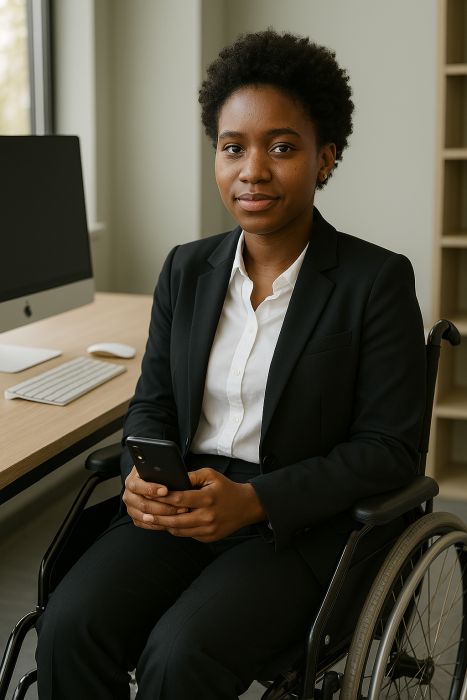
Advocacy & Resources
Do you have a problem? Contact DiSA, we connect individuals with the right legislation and support networks to help them on their journey.
Looking for talented staff?
Don’t overlook talented individuals with disabilities— ability comes in many forms. We have specialized recruitment companies that can assist. Get in touch with us today!
Access the Disability Market
Look no further! Advertise with us today and become part of our community!
Together, we can create a world where independence has no limits!
Models of Disability
There are different ways to understand and define disability:
1. Medical Model
Views disability as a problem to be “fixed” or cured.
2. Human Rights Model
Focuses on the dignity and rights of persons with disabilities to full participation in society.
3. Biopsychosocial Model
Combines biological, psychological, and social factors to understand disability holistically.
4. Social Model
Recognizes that disability arises from barriers in society rather than the individual.
South Africa has adopted the social Model of disability. The social model does not locate the “problem” within the person with impairment; rather it acknowledges and emphasizes barriers in the environment which disable the person with the impairment aimed at inclusion rather than exclusion of persons with disabilities from mainstream life.
The Social Model Explained:
Disability as Defined in South Africa
Disability is imposed by society when a person with a physical, psychosocial, intellectual, neurological and/or sensory impairment is denied access to full participation in all aspects of life, and when society fails to uphold the rights and specific needs of individuals with impairments. – White Paper on the Rights of Persons with Disabilities (WPRPD)
What is considered a Disability in South Africa?
Disability is a complex and evolving concept.
South African law and policy define disability using a social model, which focuses on the interaction between individuals with impairments and societal barriers. The White Paper on the Rights of Persons with Disabilities (WPRPD) defines disability as a barrier to participation in society that is imposed by society. This barrier occurs when people with impairments face discrimination and barriers in their environment.
3. What Assistance Benefits do I qualify for?
4. Legislation, Policies and Disability Rights
In South Africa, laws and policies are designed to uphold the Constitution, promote equality, and address social and economic challenges.
While legislation provides the legal foundation, policies serve as implementation tools. They guide government departments, businesses, and organisations in meeting legal requirements.
Policies help shape programs, allocate resources, and set priorities for national development.
Understanding legislation and policies is essential for individuals, businesses, and advocacy groups to ensure compliance, promote rights, and contribute to an inclusive and just society.

Looking for a Policy That Can Assist You?
Visit the categories listed below to find a policy that can assist you, or your company.
6. Disability and Language
“Words reflect as well as influence the way people think”
Language plays an important role in reinforcing values and attitudes that lead to discrimination and segregation of groups in society.
Language can therefore be used as a powerful tool to facilitate change and bring about new values, attitudes and social integration
Words have power. Be careful how you use them!

Terminology and Definitions
6. Disability Statistics and Rates
Stats SA, using the Washington Group Model, estimates an impairment prevalence of 7.5% derived from the 2011 National Census.
This however excludes, among others, children between 0-4 years, persons with disabilities in residential care and school boarding facilities and
persons with psychosocial, neurological and/or emotional disabilities.
We thought we would make your life just a little easier. And for your convenience have collated some of our most frequently asked questions here, in one place.
If you have a question, not addressed within the list below, please feel free to contact us directly at info@disa.org.za
Disclaimers and References
Simplified Summary
The DiSA Information Desk Page provides easy access to disability-related information, resources, services, and support to help people with disabilities and their families find what they need. From this page you are easily able to navigate to the various sections of the website to easily find what you are looking for.