Blind | Visual Impairments

Visual impairment refers to a reduced ability to see that cannot be fully corrected through conventional means such as glasses or contact lenses, and which significantly affects daily functioning.

People with visual impairments may experience challenges with everyday activities including reading, mobility, driving, recognising faces, and social interaction. The impact can range from low vision to complete blindness, depending on the nature and severity of the condition.

According to the World Health Organization, an estimated 285 million people worldwide were living with visual impairment as of 2012. Of these, approximately 246 million had low vision and 39 million were blind. Importantly, up to 80% of visual impairment is considered preventable or treatable through timely diagnosis and appropriate care.

Types of Visual Impairments

Visual impairment, also known as vision impairment or vision loss, is a decreased ability to see to a degree that causes problems not fixable by usual means, such as glasses. Some also include those who have a decreased ability to see because they do not have access to glasses or contact lenses. Visual Impairment can be divided into 3 categories: Blind, Visual Impairments and Colour Blind.

A. Blind and Partial Blindness

Visual impairment, also known as vision impairment or vision loss, is a decreased ability to see to a degree that causes problems not fixable by usual means, such as glasses. Some also include those who have a decreased ability to see because they do not have access to glasses or contact lenses. The term blindness is used for complete or nearly complete vision loss. Visual impairment may cause people difficulties with normal daily activities such as driving, reading, socializing, and walking.

The World Health Organization estimates that as of 2012 there were 285 million people who were visually impaired in the world, of which 246 million had low vision and 39 million were blind. The majority of people with poor vision are in the developing world and are over the age of 50 years. 80% of visual impairment is either preventable or curable with treatment.

Blind person walking with the aid of a walking cane


Visual impairments have considerable economic costs both directly due to the cost of treatment and indirectly due to decreased ability to work. In South Africa, the terms blindness and visual impairment are defined in line with the World Health Organization (WHO) standards and the Department of Health / Department of Social Development disability policies:

In terms of South Africa’s White Paper on the Rights of Persons with Disabilities (2016), blindness and visual impairment are defined within a rights-based and social model of disability—focusing not only on medical conditions, but on how societal barriers restrict participation.

The White Paper recognises that:
– Blindness and visual impairments refer to long-term or permanent loss of vision that, when combined with attitudinal, environmental, and institutional barriers, limits a person’s full and effective participation in society on an equal basis with others.

It shifts the focus from the individual’s impairment to the need for accessibility, reasonable accommodation, and inclusion in all areas of life—such as education, employment, transport, and information access.

The White Paper defines blindness and visual impairment not just by loss of sight, but by how environmental and social barriers prevent people from enjoying equal rights and opportunities.

1. Classification of Visual Impairments

The World Health Organization uses the following classifications of visual impairment.
When the vision in the better eye with best possible glasses correction is:

20/30 to 20/60
20/70 to 20/160
20/200 to 20/400
20/500 to 20/1,000
More than 20/1,000
No light perception

– is considered mild vision loss, or near-normal vision
– is considered moderate visual impairment, or moderate low vision
– is considered severe visual impairment, or severe low vision
– is considered profound visual impairment, or profound low vision
– is considered near-total visual impairment, or near total blindness
– is considered total visual impairment, or total blindness

2. Degrees of Visual Impairments

Visual impairments may take many forms and be of varying degrees. Some people who fall into this category can use their considerable residual vision (their remaining sight) to complete daily tasks without relying on alternative methods.

People with significantly reduced acuity may benefit from training conducted by individuals trained in the provision of technical aids. Low vision rehabilitation professionals, can provide advice on lighting and contrast to maximize remaining vision. These professionals also have access to non-visual aids, and can instruct patients in their uses.

The subjects making the most use of rehabilitation instruments, who lived alone, and preserved their own mobility and occupation were the least depressed, with the lowest risk of suicide and the highest level of social integration.

Those with worsening sight and the prognosis of eventual blindness are at comparatively high risk of suicide and thus may be in need of supportive services. These observations advocate the establishment and extension of therapeutic and preventative programs to include patients with impending and current severe visual impairment improving the quality of life of these patients. Such intervention should occur in the early stages of diagnosis.

Classification of Legal Blindness in South Africa

A person is considered blind if their best corrected visual acuity – with glasses or contact lenses – is 6/60 (20/200) or worse in the better eye, or If their visual field is 20 degrees or less, even if central vision is better. This means they can see at 6 metres what a normally sighted person can see at 60 metres, or they have tunnel vision.

3. Causes of Blindness and Partial Blindness
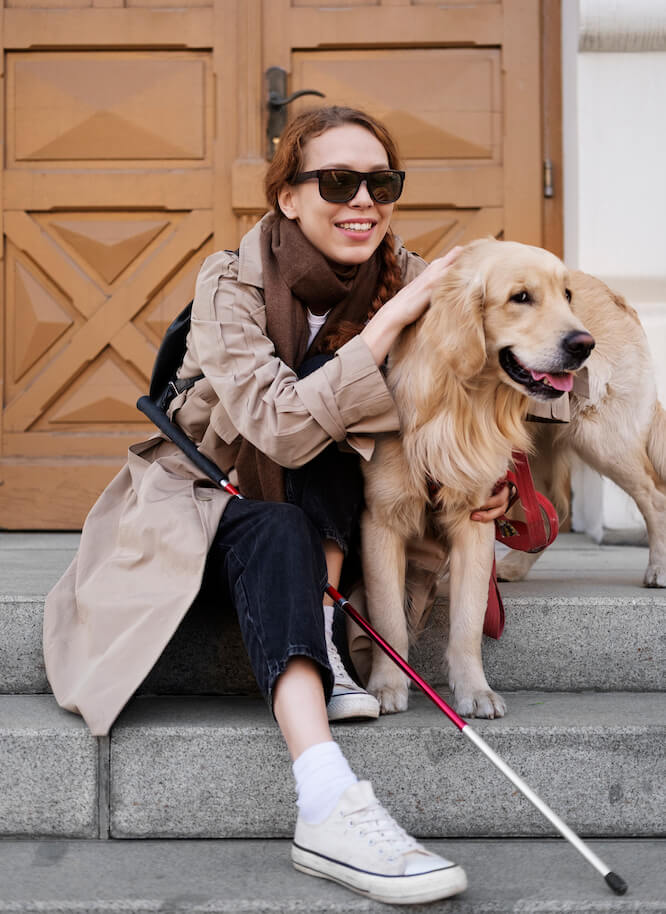
Women with visual impairments, seated on a step with her service dog.

The most common causes of visual impairment globally are:

– uncorrected refractive errors (43%)
– cataracts (33%)
– glaucoma (2%)
– age related macular degeneration
– diabetic retinopathy

– corneal clouding
– childhood blindness
– infections
– stroke
– prematurity
– trauma.

Blindness can also occur as a part of or in combination with the following :

– autism spectrum disorders
– cerebral palsy
– hearing impairments

– epilepsy
– intellectual disability

4. Diagnosis of Blindness

Scientists track eye movements in glaucoma patients to check vision impairment while driving

It is critical that all people be examined by someone specializing in low vision care prior to other rehabilitation training to rule out potential medical or surgical correction for the problem and to establish a careful baseline refraction and prescription of both normal and low vision glasses and optical aids. Only a doctor is qualified to evaluate visual functioning of a compromised visual system effectively.

The World Health Organization estimates that 80% of visual loss is either preventable or curable with treatment.

Poor Vision
vs
Visual Impairment

A person is considered to have a visual impairment if their vision, even after treatment and correction with lenses, is less than 6/18 but better than 6/60 in the better eye, or If they have significant restrictions in their visual field that affect daily functioning. This includes people who are not totally blind but struggle to read, move around safely, or perform tasks without assistive devices.

5. Communication

Communication with individuals who are blind or visually impaired can sometimes present unique challenges. Challenges aside however, it’s important to interact with visually impaired individuals just as you would with anyone else — with respect, naturalness, and equality — rather than focusing on their disability or offering unnecessary special treatment.
People with visual impairments develop effective ways to communicate not only with those around them, but also with their environment. Since vision is limited or absent, they rely heavily on their other senses — particularly hearing, touch, and smell — to gather information, navigate spaces, and interpret social cues.
Sound helps identify voices, movement, and environmental changes; touch provides information about objects, surfaces, and spatial orientation; and smell can help them recognize familiar places or people. Through these sensory channels, many visually impaired individuals form a rich understanding of the world and maintain meaningful, effective communication with others.

A young lady, sits at a table reading braille

Touch plays a vital role in how individuals who are blind or visually impaired perceive and interact with the world around them.
Through touch, a person can gather a wealth of information about an object’s shape, size, texture, temperature, and many other characteristics, allowing them to build a detailed mental picture of their surroundings.

Touch is also an essential means of communication — most notably through Braille, which uses raised dots that can be read by feeling them with the fingertips. However, touch does have its limitations.

Not all objects or environments are accessible to explore by hand, and the process of identifying objects through touch is often slower than through sight, as it requires careful and deliberate exploration before a complete understanding can be formed. Despite these challenges, touch remains an indispensable sense that supports independence, learning, and connection for people who are blind or visually impaired.

Sound
Sound is one of the most important senses that the blind or visually impaired use in order to locate objects in their surroundings.
A form of echolocation is used, similarly to that of a dolphin or bat. Echolocation from a person’s perspective is when the person uses sound waves generated from speech or other forms of noise such as cane tapping, which reflect off of objects and bounce back at the person giving them a rough idea of where the object is.
This does not mean they can depict details based on sound but rather where objects are in order to interact, or avoid them. Increases in atmospheric pressure and humidity increase a person’s ability to use sound to their advantage as wind or any form of background noise impairs it.

Smell
Certain smells can be associated with certain people and specific areas, this helps a person with vision problems to remember a familiar area or person. This way there is a better chance of recognizing an area layout in order to navigate themselves through that area and recognize people within their vicinity without that person saying a word.

6. Language Development

Visual impairment can have a profound impact on the communication development of infants and children. Because vision plays a crucial role in learning through observation and imitation, a child who is visually impaired may experience delays in both language and social development. Sighted children acquire much of their knowledge by watching and imitating others, whereas visually impaired children require deliberate and structured instruction to develop similar skills, such as postponed imitation.

A visually impaired infant may begin babbling or imitating words at a similar or even earlier stage than a sighted child, but may show delays in combining words or forming sentences independently. They may ask fewer questions and use descriptive language less frequently. Often, their sensory experiences are not easily translated into language, leading them to memorize and repeat phrases without fully understanding their context. As a result, the language of a blind child may reflect not their understanding of the world, but rather their exposure to the speech of others.

Additionally, visually impaired children may be hesitant to explore their surroundings due to fear of the unknown, or because overprotective caregivers limit their opportunities for independent exploration. Without direct, hands-on experiences, they may struggle to form meaningful concepts or acquire the language needed to describe and think about them.

Social development begins early in life through interactions between an infant and the people around them. For a sighted child, a parent’s smile is often the first recognizable sign of love, comfort, and connection — an immediate and powerful form of nonverbal communication. In contrast, for a visually impaired infant, recognition and bonding occur primarily through sound and touch. Around two months of age, a blind or visually impaired baby may begin to recognize a parent’s voice, while smiles or emotional responses are more likely to be triggered through physical contact, such as gentle touch or holding.

Because this initial form of visual communication is delayed or absent, the development of other social behaviors may also be slowed. Social interactions can become more complex, as subtle visual cues — such as facial expressions, gestures, and body language — are inaccessible. Without these cues, visually impaired children must rely heavily on tone of voice, touch, and direct verbal communication to interpret others’ emotions and intentions.

These communication delays may cause a child to appear withdrawn, uninterested, or unsure of how to engage with peers, even though the underlying cause is simply a lack of access to visual feedback. As a result, they may experience social isolation or be unintentionally avoided by other children who misinterpret their behavior. In turn, family members — motivated by love and concern — may become overprotective, further limiting opportunities for the child to explore, interact, and gain confidence in social situations. Encouraging consistent verbal interaction, physical affection, and inclusive play can greatly support the social and emotional growth of children who are blind or visually impaired.

Disclaimers and References

DiSA is committed to promoting the rights, dignity, and inclusion of persons with disabilities as outlined in the White Paper on the Rights of Persons with Disabilities. We strive to ensure that all content on our website reflects appropriate, respectful, and inclusive language in alignment with these principles.

However, we also provide a platform for companies and organisations to advertise their services and products. While we encourage advertisers to adhere to correct terminology and inclusive practices, DiSA cannot guarantee the accuracy or appropriateness of the language used by external parties in their content.

Please note: Any views, language, or terminology used in advertisements, promotional material, or external links do not necessarily represent the views of DiSA.

DiSA disclaims any responsibility for inaccuracies or language that may not align with the White Paper or best practices for disability terminology.

Should you however encounter language or content that you believe is inappropriate or offensive, we encourage you to contact us at info@disa.org.za, so that we can address the issue.

DiSA remains dedicated to fostering a respectful and inclusive environment for all individuals. We appreciate your understanding and collaboration in supporting our mission.


While we strive for accuracy and clarity, AI-generated visuals may not always reflect real-life conditions or representations.
In addition, we feature authentic images and videos of actual instances, events, circumstances that have occurred, as well as products and services supplied by companies who advertise with us.

These authentic visuals are intended to accurately depict our content or the offerings of our advertising partners.
If you have any questions or concerns about the content displayed on this site, please feel free to contact us.

DiSA provides a platform for companies and organisations to advertise their products and services to assist persons with disabilities and their families. While we make every effort to list reputable and credible service providers, the inclusion of any company, organisation, product, or service on our website does not constitute an endorsement or guarantee by DiSA.

Please note the following: DiSA is not involved in the delivery, quality control, or customer service of any product or service offered by advertisers listed on our platform.

Any agreements, purchases, or arrangements made between users of this website and advertisers are solely between those parties. DiSA is not responsible for the outcome of such interactions.

DiSA disclaims any liability for dissatisfaction, damages, or disputes arising from products or services supplied by companies or organisations listed on our website.

We encourage users to thoroughly research and verify any service provider or product before engaging with them. If you have concerns or encounter issues with an advertiser listed on our platform, please let us know at: info@disa.org.za. We value your feedback to help maintain the integrity of our platform.


While we strive for accuracy and clarity, AI-generated visuals may not always reflect real-life conditions or representations.
In addition, we feature authentic images and videos of actual instances, events, circumstances that have occurred, as well as products and services supplied by companies who advertise with us.

These authentic visuals are intended to accurately depict our content or the offerings of our advertising partners.
If you have any questions or concerns about the content displayed on this site, please feel free to contact us.

DiSA is committed to providing accurate and up-to-date information to assist persons with disabilities and their families. However, the nature of online content and external resources means that information can change frequently.

Please note the following: DiSA cannot guarantee the accuracy, completeness, or reliability of all information on our website, particularly information obtained from external sources or links to third-party websites.
External websites may update or remove content without notice, which can result in broken links or outdated information. DiSA is not responsible for the content, accessibility, or functionality of external websites.

While we make every effort to keep our information current, some content may become outdated over time.
We encourage users to verify information directly with the relevant third parties or organisations before making any decisions based on the information found on our platform.

If you encounter a broken link or outdated content, please notify us at: info@disa.org.za and we will address it as soon as possible.
Thank you for understanding and helping us maintain a reliable and accessible platform.


While we strive for accuracy and clarity, AI-generated visuals may not always reflect real-life conditions or representations.
In addition, we feature authentic images and videos of actual instances, events, circumstances that have occurred, as well as products and services supplied by companies who advertise with us.

These authentic visuals are intended to accurately depict our content or the offerings of our advertising partners.
If you have any questions or concerns about the content displayed on this site, please feel free to contact us.

The Information services and website that we offer free of charge, is privately run and funded and is not run or funded by the government. We rely on advertising, paid services and donations to supply and improve this Free information service that we do provide.

The Companies, Clubs, Schools and Organisations that are listed on this site, have advertised or made donations to the Website and have therefore assisted us be able to provide this free Service.
Please support them as they have supported Us and please contact us via info@disa.org.za, if you can advertise with us or would like to make a donation. Alternatively, visit our “Support Us” page to find out how you can support us or acquire our services. – Thank You.

If you encounter a broken link or outdated content, please notify us at: info@disa.org.za and we will address it as soon as possible.
Thank you for understanding and helping us maintain a reliable and accessible platform.

Please Note: We do assist with inquiries via email but may need to send or copy your details and inquiry to various other organisations, companies or government departments, that we sometimes consult, so that we can help you in the best way possible.
If you have any objection to us sharing your query or contact details, please notify us in your email. We will only share your information to assist you and will never sell or use your personal information for any other purposes.

DiSA waivers any liability for what happens if information is shared or used for marketing or other purposes by other organisations who do have consent to view such information.


While we strive for accuracy and clarity, AI-generated visuals may not always reflect real-life conditions or representations.
In addition, we feature authentic images and videos of actual instances, events, circumstances that have occurred, as well as products and services supplied by companies who advertise with us.

These authentic visuals are intended to accurately depict our content or the offerings of our advertising partners.
If you have any questions or concerns about the content displayed on this site, please feel free to contact us.

Please note that this website uses images and videos that are AI-generated and created to visually represent certain information, concepts or scenarios for illustrative purposes.


While we strive for accuracy and clarity, AI-generated visuals may not always reflect real-life conditions or representations.
In addition, we feature authentic images and videos of actual instances, events, circumstances that have occurred, as well as products and services supplied by companies who advertise with us.

These authentic visuals are intended to accurately depict our content or the offerings of our advertising partners.
If you have any questions or concerns about the content displayed on this site, please feel free to contact us.

Disability Info South Africa (DiSA) is committed to protecting your personal information in compliance with the Protection of Personal Information Act (POPIA), Act No. 4 of 2013. By using our free information service, you acknowledge and agree to the following:

Collection of Personal Information:
DiSA may collect and process your personal information (such as name, contact details, and inquiries) solely for the purpose of assisting you with your requests and providing relevant information or support.

Use and Storage:
Your personal information will only be used for the purpose it was collected for, we may need to send or copy your details and inquiry to various organisations, companies or government departments, that we sometimes consult, so that we can assist you in the best way possible.
If you have any objection to us sharing your query or contact details, please notify us in your email. We will only share your information to assist you and will never sell or use your personal information for any other purposes.
DiSA implements appropriate measures to secure your personal information against unauthorized access or loss.

Consent:
By submitting your details through our Contact Form, or contacting us via our email address, you consent to allow DiSA to process your information as outlined in this disclaimer. If you are not comfortable with DiSA sharing your information for the above purposes, please contact us directly at info@disa.org.za.

Access and Updates:
You have the right to request the deletion of your personal information at any time.
To do so, please contact us at: info@disa.org.za.

Third-Party Websites:
DiSA is not responsible for the privacy practices of external websites linked on our platform. Users are encouraged to review the privacy policies of third-party sites before sharing personal information.
For any queries or concerns regarding the handling of your personal information, please contact us at: info@disa.org.za.
Thank you for trusting DiSA to support you with accessible, inclusive, and reliable information.