


Accessible Features and Parking Discs


Making Your Home/Office/Building Accessible: Who can Help?
Universal Access Consultants specialize in assessing, advising, and guiding the design of environments, services, and systems to ensure they are accessible and inclusive for everyone. Their role goes beyond minimum compliance — they promote universal design principles that make spaces safer, easier, and more convenient for all users, regardless of ability, age, or circumstance.
In South Africa, a Universal Access Consultant use accessibility standards such as the SANS 10400 Part S Building Regulations and align with human rights laws like the Promotion of Equality and Prevention of Unfair Discrimination Act (PEPUDA). Their work may include conducting access audits, developing accessibility implementation plans, and offering guidance on inclusive infrastructure, communication, and customer service practices.
There are various Organisations and Companies that specialize in Universal Design and Access and can advise you on how to adapt your building and environment to make sure that persons with disabilities have equal rights and no loss of dignity.
They include: National Council of and for Persons with Disabilities (NCPD), Bradshaw LeRoux Consulting, Universal Access Collective and DiSA.
The National Council of and for Persons with Disabilities (NCPD) believe that this can be prevented by applying Universal Design Principals during the design phase and they therefor offer the following services to assist:
– Workshops for architects, developers and other building professionals to develop an understanding of universal design and access.
– Facilitating access audits for new or existing buildings; echo e-access for the natural and communication environment. Audits are followed by a report indicating shortfalls and recommendations.
– Marketing of facilities that are accessible to persons with disabilities
Contact: Fanie Swanepoel or Danie Marais
Tel: +27 11 452 2774
Email: fanies@ncpd.org.za or danie@ncpd.org.za
Bradshaw LeRoux Consulting conduct Environmental Accessibility Audits designed to identify environmental barriers that could hinder access for Persons with a Disability. Our consultants will review your site, note potential barriers from a functional and safety perspective, and propose cost-effective solutions which can be actioned within short-, medium- and longer-term time frames.
Our reports are practical in nature, specific in the solutions offered, and allow for ease of use by all. Relevant to all environments, from corporate offices, manufacturing or industry sites, education facilities or hospitality environments, we can assist.
For more information, please feel free to send any queries to
Contact: 031 765 2547 via Email: lesa@bradshawleroux.co.za Website: www.bradshawleroux.co.za
Turn accessibility challenges into opportunities with inclusive design that actually works.
Whether you’re a business owner, facility manager, or someone navigating personal accessibility needs, most environments still create barriers instead of being accessible and welcoming.
Universal Access Collective (UAC) solves the accessibility puzzle for businesses and individuals across Africa, turning compliance requirements and personal challenges into practical solutions that work.
For Businesses: We assist to create a Universal Access environment including National Building regulations as well as International Best practices spaces that welcome more customers. Our built environment audits, digital accessibility reviews, and staff training don’t just tick boxes—they unlock new revenue streams and reduce liability risks.
For Families, Individuals and the Elderly: Adapting your home or navigating new accessibility needs shouldn’t feel overwhelming. Our coaching and universal design advisory services provide practical guidance that transforms challenges into confidence.
What makes us different? We’re a women-led consultancy combining technical expertise with lived experience. Mandy Latimore (globally recognised universal design specialist) brings both compliance knowledge and real-world understanding to every project.
Our comprehensive services include:
– Built environment and digital access audits
– Universal design advisory for residential and commercial spaces
– Family coaching and caregiver support
– Staff disability confidence training
– Inclusive communication and content development
– Assistive technology recommendations
Beyond consulting, we’re building a supportive community where businesses, families, and professionals share knowledge and drive change together.
Ready to transform accessibility from obstacle to opportunity? Contact us to discover how inclusive design creates better outcomes for everyone—and better business results for you.
You can contact Universal Access Collective:
Cell: +27 83 283 3370,
E mail: info@ua-collective.com,
Website: www.universalaccesscollective.com, LinkedIn: https://www.linkedin.com/company/universal-access-collective.
DiSA provides a One-Stop Access Solution to improve inclusivity by removing barriers to access in the built environment by referring Companies and Educational Facilities to various qualified Universal Access Consultants around the country. This includes Igor Rix, a qualified access consultant and co-founder of Disability Info South Africa (DiSA), who specialises in conducting Accessibility Audits and providing detailed reports on barriers within physical spaces and services.
Igor develops practical Implementation Plans to address these challenges, ensuring compliance with both national accessibility standards and international best practices. While focusing on fostering inclusivity for all individuals.
Ensuring all people of diverse needs and preferences, can fully participate and contribute to society in a meaningful way.
Read More about Universal Access and the Accessibility Audits, Reporting and Implementation plans that we can provide.
Building Facilities That Accommodate Everyone

The Government often makes laws that insure that new buildings are designed and built with certain features to make them wheelchair friendly. These are known as The National Building Regulations and Building Standards Act, which was amended and published by the Department of Trade and Industry in May 2008. Some parts of the Act deals with facilities for persons with disabilities and directly affected the building industry.
They include information about: Accessible Toilets; Ramps; Accessible Parking Bays; Proof of residence. and Wheelchair Bays in Movie Theaters, Sports stadiums & Music Concerts
A noticeable change recently in some parts of the world is the installation of elevators, automatic doors, wide doors and corridors, transit lifts, wheelchair ramps, curb cuts, and the elimination of unnecessary steps where ramps and elevators are not available, allowing persons who use wheelchairs and other Mobility Aids to use public sidewalks and public transit easier and safely.
There are however still unfortunately many buildings and most houses in South Africa which are not designed and built to accommodate wheelchair users or the elderly. The owners of these buildings and houses may therefore be challenged by the need to find architects and renovators familiar with accessible design issues in order to make them accessible.
All is not lost, there are various Organizations and Companies that can assist with Universal Design and Access to make sure that persons with disabilities are not excluded from any events, services, information, communication, products and venues. In this article we will introduce you to the companies and organizations that can assist you ensure that your business is accessible and safe, giving equal opportunities and equal rights for persons with disabilities.
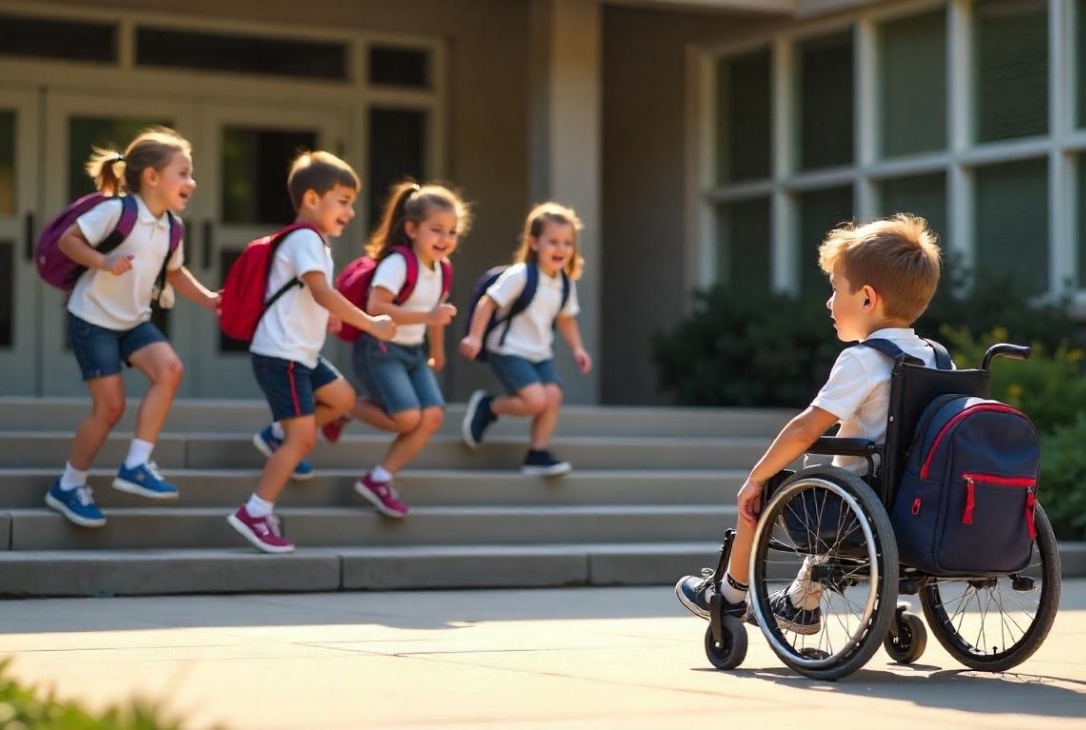
The National Building Regulations and Building Standards Act
Accessible Features Unpacked
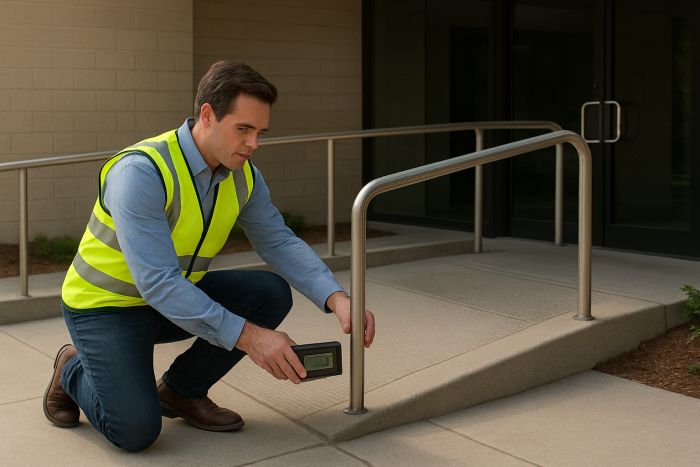
Let’s unpack these Accessible Features listed in the 10400 Part S of the Building Regulations, developed to improve the usability of environments.
By unpacking these features in a simple, user-friendly way, the page aims to empower individuals to identify what accessibility should look like, advocate for access, and make informed choices when adapting buildings, public spaces, or services.
While our goal is to provide the information support to improve functionality for all users, this is just a guideline and it is of utmost importance to consult the Universal Access Consultants listed above to ensure accessibility.
i. Signage
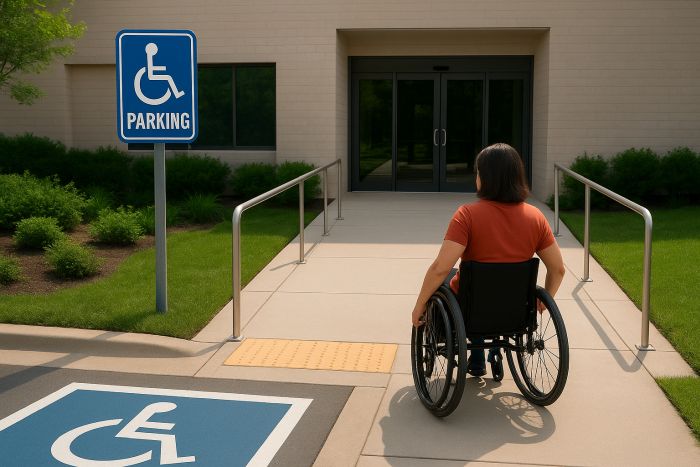
The International Symbol of Access (ISA), also known as the (International) Wheelchair Symbol, consists of a blue square overlaid in white with a stylized image of a wheelchair. It is maintained as an international standard, ISO 7001 image of the International Commission on Technology and Accessibility (ICTA)
The symbol is often seen where access has been improved, particularly for wheelchair users, but also for other disability issues. Frequently, the symbol shows the removal of environmental barriers, such as steps, to help the disabled, elderly, parents with baby carriages, and travellers. Universal design aims to obviate such symbols by creating products and facilities that are accessible to nearly all users from the start. The wheelchair symbol is “International” and therefore not accompanied by Braille in any particular language.
Providing clear and visible marking by using this accessible disabled sign is essential in making facilities visible for those who need them. The South African Government through The South African National Standard for Building Regulations therefore makes laws that insure that new buildings are designed and build with a certain regulations, which includes regulations on Signage.
Read More about Signage Regulations in the Accordion Menus below
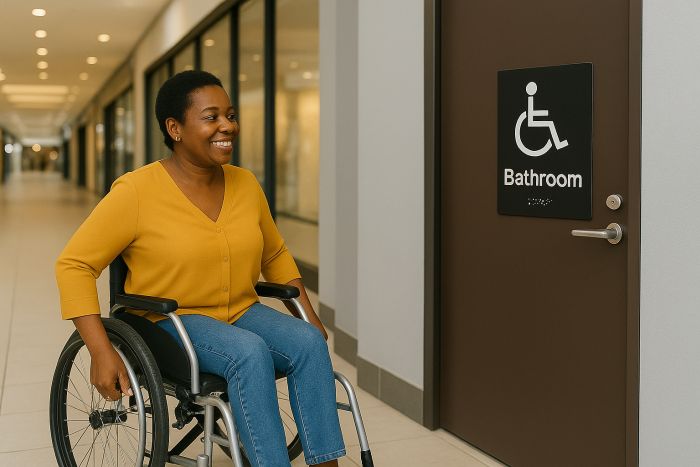
ii. Accessible Bathrooms
An Accessible Bathroom/Toilet is a special bathroom/toilet designed to accommodate people with disabilities. They are sometimes incorrectly referred to as “Disabled Toilets.”
Public toilets can present accessibility challenges for people with disabilities, such as those people in wheelchairs. Stalls may not be able to fit a wheelchair, and transferring between the wheelchair and the toilet seat may pose a challenge. Accessible toilets are designed to address these issues by providing more space and bars for users to grab and hold during transfers.
The South African Government through The South African National Standard for Building Regulations makes laws that insure that new buildings are designed & build with a certain amount of Disabled Toilets.
In any building where facilities for persons with disabilities are required in terms of Regulation S1, there shall be one or more toilets or unisex toilet facilities suitable for use by wheelchair users. People with disabilities should be able to safely enter the building (Ramps) and be able to safely use all the facilities within it – specifically toilets. These Accessible Toilets:
iii. Ramps
A wheelchair ramp is an inclined plane installed in addition to or instead of stairs. Ramps permit wheelchair users, as well as people pushing strollers, carts, or other wheeled objects, to more easily access a building.
A wheelchair ramp can be permanent, semi-permanent or portable. Permanent ramps are designed to be bolted or otherwise attached in place. Semi-permanent ramps rest on top of the ground or concrete pad and are commonly used for the short term. Permanent and semi-permanent ramps are usually of aluminum, concrete or wood.
Ramps must be carefully designed in order to be useful. Many jurisdictions have established minimum widths and maximum slopes. A less steep rise can be easier for a wheelchair user to navigate, as well as safer in wet or icy conditions.

The South African National Standard for Building Regulations state that Wheelchair ramps are required in new construction for public accommodations in South Africa. They also state that these wheelchair Lifts and Ramps must meet certain regulations & requirements.
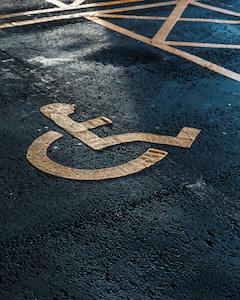
iv. Accessible Parking Bays and Accessible Parking Discs
The Government has introduced certain regulation that state, how many of these “Accessible Parking Bays” must be available & the size of the “Parking Bays”
The National Building Regulations state that where there is parking available for more than 50 motor vehicles, there must be parking facilities that accommodate disabled persons. There is also an obligation to ensure that persons with disabilities are provided with a suitable means of access from the parking area to the ground floor – or storey – of the building.
These parking bays are not only close to the entrance, but are also wider than the average parking bay. Wheelchair parking bays are traditionally 3500mm wide to cater for a wheelchair user who needs the extra space to enter or exit the vehicle, thus enabling:
By having this extra space helps these transfers to be done safely for the wheelchair user & helps prevent the vehicle in the parking space next door from getting damaged.
Read More about Accessible Parking Disks
Vi. Accessible Routes and Doorways
An important part of accessibility is not only accessible parking spaces, passenger loading zones, ramps, Accessible Toilets and Lifts, etc but also insuring that there are various accessible routes from the public streets onto the pavements and to the accessible building entrance and to the facilities inside the building and visa versa. Appropriate accessible routes should also be made available for emergency exits. Accessible Routes include:
The South African Government through The South African National Standard for Building Regulations passes laws that insure that new buildings and structures are designed and build with a certain regulations, which includes regulations on Accessible Routes.
There must be a means of access that is suitable for people with disabilities to use. In addition, access must be available from various approaches of the building via the main entrance and any secondary entrances, and should lead to the ground floor.
There must be a means of egress (a point of departure) that is suitable for people with disabilities to use in the event of any sort of emergency. This relates to any sort of emergency, but in addition, a further clause states that departure routes (or egress) must also be designed in accordance with Part T of the regulations, namely the section that relates to Fire Protection.
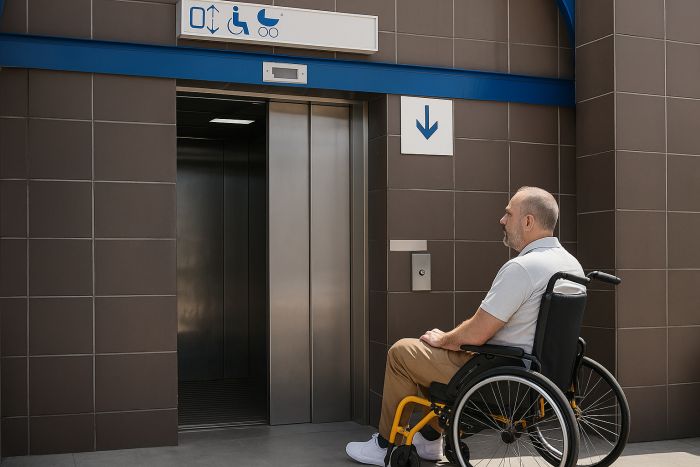
Vi. Lifts / Elevators
Thanks partly to the disability rights movement we have seen an improvement in building accessibility. With the installation of elevators or lifts buildings are now accessible even for those in a wheelchairs.
A lift (or elevator) is a form of vertical transportation between building floors, levels or decks, commonly used in offices, public buildings and other types of multi-storey accommodation. Lifts can be essential for providing vertical circulation, particularly in tall buildings, for wheelchair and other non-ambulant building users and for the vertical transportation of goods. Some lifts may also be used for firefighting and evacuation purposes.
The South African Government through The South African National Standard for Building Regulations therefore makes laws that insure that new buildings are designed & build with a certain regulations, which includes Lifts & the regulations set aside for these Lifts.
There must be a means of egress (a point of departure) that is suitable for people with disabilities to use in the event of any sort of emergency. This relates to any sort of emergency, but in addition, a further clause states that departure routes (or egress) must also be designed in accordance with Part T of the regulations, namely the section that relates to Fire Protection.
Lifts in buildings must be able to serve the needs of disabled people. This includes ensuring that any commonly used “path of travel” MUST be free of any sort of obstacles that would limit, restrict or endanger people with disabilities who use that route.
There must also be absolutely no obstacles that will prevent people with disabilities from accessing facilities within the building. The regulations refer specifically to people with impaired vision, but clearly they also relate to people in wheelchairs, or people who have trouble walking freely.
Vii. Regulations for Auditoriums, Grandstands and Halls
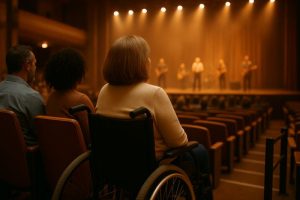
In South Africa & around the world buildings such as Auditoriums, grandstands, halls & sports stadiums are made wheelchair friendly by adding among other things, wheelchair platforms, so that wheelchair users can enjoy the event from their wheelchairs & also have a clear view of the stage, field, screen, etc.
Buildings where these “platforms” are built include: Movie Theaters; Sports Stadiums, Music Concert etc. The South African Government through The South African National Standard for Building Regulations makes laws that insure that these type of buildings are designed & build with these wheelchair bays/platforms & that they meet certain regulations.
How can we help you?
At Disability Info South Africa (DiSA), we are committed to breaking down barriers and creating a more inclusive society.
One of the most life-changing forms of support for individuals with disabilities is an Assistance Dog —a highly trained companion that provides mobility support, medical alerts, and emotional assistance.
Guidance & Support
We provide information on eligibility, application processes, and legal rights regarding assistance dogs.
Accessibility Audits
Ensuring businesses and public spaces are ‘assistance-dog friendly’ and compliant with accessibility standards.
Disability Awareness Training
Educating organizations and individuals on the importance and rights of assistance dog users.

Advocacy & Resources
Connecting individuals with the right support networks, including AADSA, to help them on their journey.
Assistance Dogs Change Lives –
Let’s Make South Africa More Accessible
If you or someone you know could benefit from an assistance dog, or if you’re a business wanting to improve accessibility, get in touch with us today!
Together, we can create a world where independence has no limits!
Disclaimers and References
Simplified Summary
The Accessible Features page on the DiSA Information Desk explains different accessibility features that the government has introduced through the Building Regulations and how they help people with disabilities access spaces, services, and daily activities more easily when environments are designed accordingly.