


Wheelchair Racing | ParaTriathlons
Welcome to a DiSA Page on Wheelchair Racing.
Wheelchair Racing is more than just a sport — its a powerful way to push personal boundaries, build strength, and connect with a community that moves with purpose. No matter your goal, fitness, friendship, or flying down the track at top speed, wheelchair racing offers a clear and exciting path forward. Challenging your limits, and pushing your boundaries. Its fun fitness with purpose.
And, its a game-changer in rehabilitation—improving cardiovascular health, muscle tone, and mental well-being.
Better still, its accessible and available to enthusiasts at every level, from beginners just starting out to elite athletes chasing gold.
If you’re looking for personal growth. You found it. Let’s roll!
What Assistance are you Looking for?
1. About Wheelchair Racing
2. Races and Events
3. Classifications in Wheelchair Racing
4. Rules and Regulations for Wheelchairs Racing
5. Para-Triathlon
Useful Links:
6. Adaptive cycling for beginners. Joining a Club.

About Wheelchair Racing
Wheelchair Racing in South Africa is an exciting and fast-growing sport that welcomes athletes of all ages and skill levels, including amputees, persons with spinal cord injuries, cerebral palsy and persons who are partially sighted (when combined with another disability.)
Whether you’re just starting out for fun, joining a local club to train and compete, or dreaming of representing your country on the world stage, there’s a place for you in this dynamic sport.
– Wheelchair racing is the racing of wheelchairs on a track or road
– Wheelchair racing is open to athletes with any qualifying type of disability
– Athletes are classified in accordance with the nature and severity of their disability or combinations of disabilities.
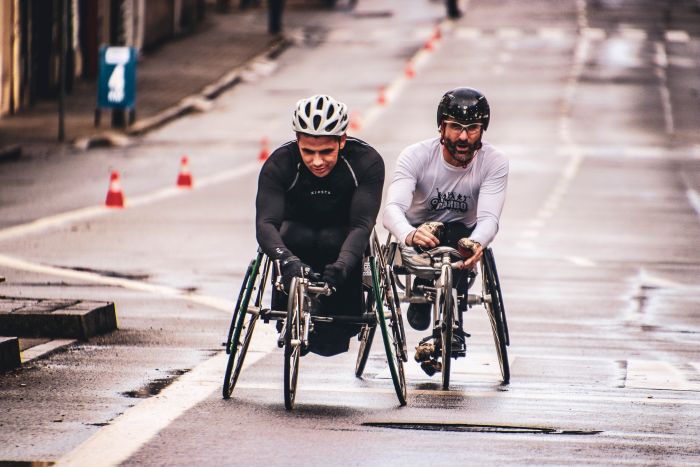
At the amateur and club level: Wheelchair racing provides a great way to stay fit, build confidence, and meet others who share your passion for speed and sport.
Many local clubs across South Africa offer coaching, training sessions, and entry into community and provincial races.
For those looking to take it further: The South African Sports Association for Physically Disabled (SASAPD) plays a key role in developing athletes and organizing national championships. These events serve as stepping stones to international competition, including the IWAS World Games, World Para Athletics Championships, and ultimately, the Paralympic Games.
Competitors compete in specialized wheelchairs. This which allow the athletes to reach speeds of 30 km/h or more. The main competitions take place at the Summer Paralympics which wheelchair racing and athletics has been a part of since 1960. It is one of the most prominent forms of Paralympics athletics.
2. Races and Events
The distances involved in wheelchair racing include sprint distances of 100 m, 200 m and 400 m, middle distances of 800 m and 1500 m, long distances of 5000 m and 10,000 m and relay races of 4 x 100 m and 4 x 400 m. There is also a road event like 108 km, 21 km, 25 km and 42.2 km.
One of South Africa’s best known Disabled Athletes is Ernst van Dyk. He is best-known for his achievements as a top track and road wheelchair racer. He competes in between three and six high-profile marathons per year, the majority of which are international.
He has won the Boston Marathon which is the most prestigious wheelchair event 9 consecutive times from 2001 to 2006 and 2008 to 2010.
He was the first wheelchair racer in this particular event to break the 1h 20min barrier.
Other open races include the London Marathon, the Seoul International Wheelchair Marathon, the ASA Marathon, the OCC Marathon, the New York Marathon, the Oita Marathon and the LA Marathon. To view upcoming events, visit: www.marathons.ahotu.com/calendar/south-africa/wheelchair
3. Classifications in Wheelchair Racing
Classification systems have been put into place to ensure that all competitors have an equal opportunity to compete & win. Athletes are divided into categories depending on their disability, these are spinal cord injury, amputee, or cerebral palsy. The classification guidelines are continually being changed to include more athletes.
Athletes who are in a wheelchair due to spinal cord injury or are an amputee are in classes T51 – T58.
– T51 – T54 are for athletes in a wheelchair who are competing in track events.
– T55 – T58 are for athletes who are competing in field events.
– T54 are for athletes who are completely functional from the waist up.
– T53 has restricted movement in their abdominals.
– T52 or T51 has restricted movement in their upper limbs.
Athletes who are in a wheelchair due to cerebral palsy are in classes T32 – T38.
They different guidelines compared to an athlete with a spinal cord injury or an amputee
– T32 –T34 are for athletes in wheelchairs.
– T35 – T38 are for athletes who can stand.
4. Rules and Regulations for Wheelchair Racing
Wheelchairs are a necessary piece of equipment for athletes competing in wheelchair racing and track and field events. These are normally very lightweight and have pneumatic tires. The dimensions and features on the wheelchairs are clearly specified in the IPC Athletics rules.
The rules for each event regarding the athletes’ equipment varey a little, but the foundational rules remain the same:
5. Para-Triathlon
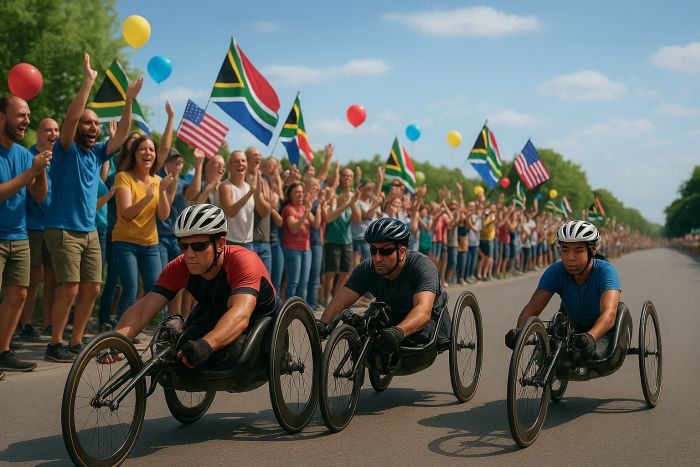
Handcycle (HC) is a competitive division open to athletes who are paraplegic, quadriplegic or double above-the-knee amputees.
Para-Triathletes race using a hand cranked cycle on the bike section, and a racing chair for the run.
Handcycle athletes must use a recumbent handcycle on the bike course, and a racing wheelchair on the run course.
Conduct and standards for handlers of HC athletes is governed by the International Triathlon Union
Click here to download the Rules of competitive Para-Triathlon
6. Club Level Cycling and Adaptive Cycling
If you are interested in adaptive cycling, on an introductory and club level, please click on the below link.
Cycling and Adaptive Cycling in South Africa is an inclusive and empowering sport for individuals with physical impairments – and its growing rapidly.
With increasing access to clubs, events, schools, and national organisations like SASAPD (South African Sports Association for Physically Disabled), as well as organisations such as Bidii Yetu, there has never been a better time to get involved.
Whether you are Cycling with your arms or legs, for fun, fitness, rehabilitation, or professional competition, adaptive cycling overs something for everyone.
If you are looking for a sport with huge personal growth potential – this is it.
To learn more about Adaptive Cycling, on an introductory and club level, please Click Here.
Lets get started!