Cycling and Adaptive Cycling

Cycling and Adaptive Cycling in South Africa is an inclusive and empowering sport for individuals with physical impairments – and its growing rapidly.

With increasing access to clubs, events, schools, and national organisations like SASAPD (South African Sports Association for Physically Disabled), as well as organisations such as Bidii Yetu, there has never been a better time to get involved.
Whether you are Cycling with your arms or legs, for fun, fitness, rehabilitation, or professional competition, adaptive cycling overs something for everyone.

If you are looking for a sport with huge personal growth potential – this is it.

To learn more about adaptive cycling, on an introductory and club level, please keep reading. For competitive level Wheelchair Racing, please click here.
Lets get started!

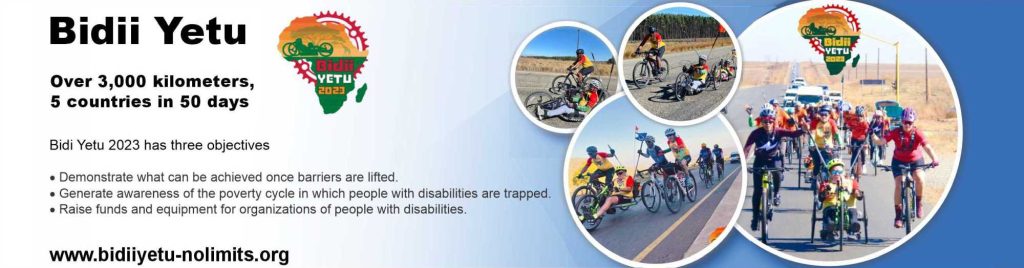
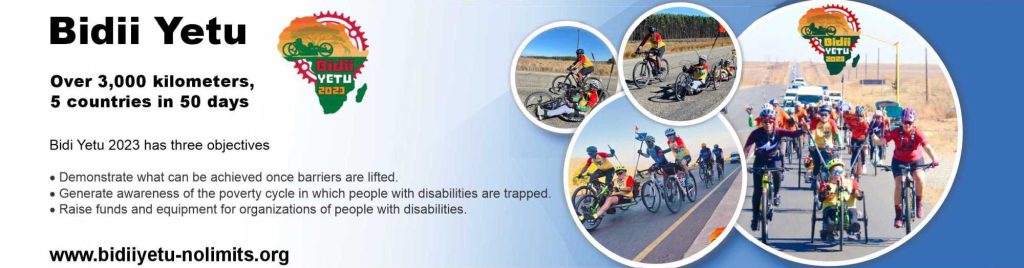
Bidii Yetu - No Limits

What is Adaptive Cycling?

Adaptive cycling refers to modified bicycles or tricycles designed to support individuals with physical disabilities, including spinal cord injuries, limb loss, cerebral palsy, and more. It allows people of all abilities to experience the joy and independence of cycling, using equipment tailored to their specific needs.

Cycling was introduced as a Paralympic Sport in Seoul in 1988.
The competition includes Track and Road events for individuals and teams, with the following events included: Sprints; Individual Pursuits; 1,000m Time Trial; Road Races and Road Time Trials
These events are for both men and women, with the cyclists grouped together according to their functional ability. Persons with cerebral palsy, amputations or other physical impairments can participate in classes depending on their degree of function and skills required for Cycling.
Depending on their classification, athletes use a bicycle, tricycle, tandem or hand cycle.
The convenor for cycling South Africa is Rudi Kuhn. The sport is active in all provinces of South Africa.
Types of Adaptive Bicycles

There are various types of adaptive bicycles suited to different impairments:
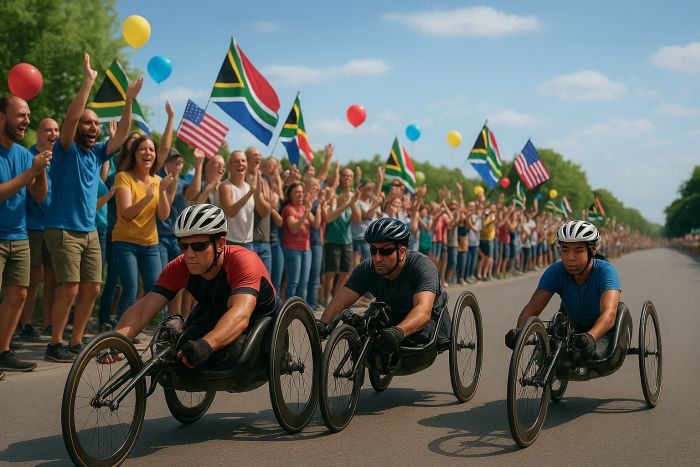
Hand Cyclists taking part in a road race
  • Handcycles
    Operated with hand cranks; ideal for wheelchair users or those with limited leg function.
  • Recumbent Bikes
    Provide trunk support and comfort for those with back or core instability.
  • Tandem Bikes
    Used by riders with visual impairments, paired with a sighted pilot in front.
  • Tricycles (Trikes)
    Three-wheeled cycles that provide extra balance and are great for those with coordination or balance challenges.
  • Upright Modified Bikes
    Traditional bicycles adapted for riders with prosthetics or partial mobility.

3. How to Get Started in Adaptive Cycling

Thinking of getting started in Adaptive Cycling, but not sure where to start?

These are the steps to follow:
1. Find a local club or contact SASAPD to connect with para-cycling programs.
2. Schedule an assessment for equipment needs and classification.
3. Start with a fun ride or community race to build confidence.
4. Apply for funding or sponsorships through NGOs like Bidi Yeti or local disability sport associations
5. Train regularly
6. Start competing
7. Join your provincial team for more structured support.
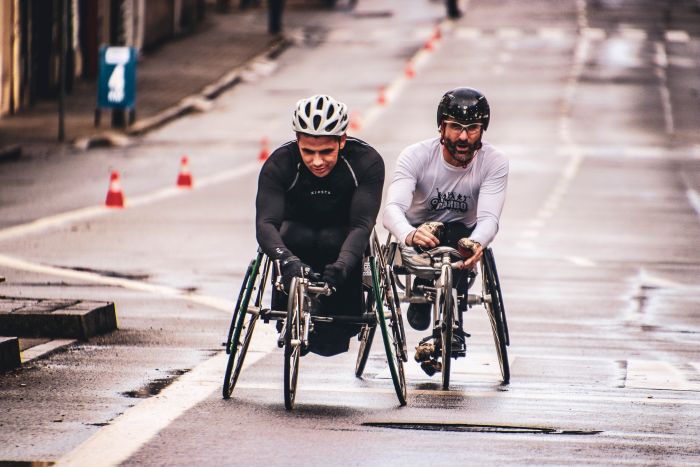
Two Wheelchair Racers competing in a wheelchair race

4. Classifications in Para-Cycling

Para-cycling classification is the process of classifying participants in para-cycling covering four functional disability types.
Classification is handled by the Union Cycliste Internationale (UCI).
While the CP-ISRA has an interest in the sport because it is open to people with cerebral palsy – it is not governed by them.
In 1983, the rules for this sport and approval for classification was taken over by the UCI coordinated Federation Internationale de Amateur de Cyclisme.
The classification system includes classes for handcycles for people who have lower limb mobility issues.

There are fourteen classifications based on functional disability type, research done at the Central Institute on Employment Abilities of the Handicapped in Moscow has found differences in functional capabilities based on differences in visual acuity.
This does not play a significant role in tandem cycling.
To ensure fair competition, para-cycling uses a classification system defined by the UCI (Union Cycliste Internationale) and endorsed by SASAPD in South Africa:

– H1–H5: Handcyclists based on mobility level and trunk function
– T1–T2: Tricyclists, generally for those with neurological or balance challenges
– C1–C5: Cyclists using standard or modified bicycles based on impairment severity
– B: Blind or visually impaired riders using tandem cycles with a sighted pilot
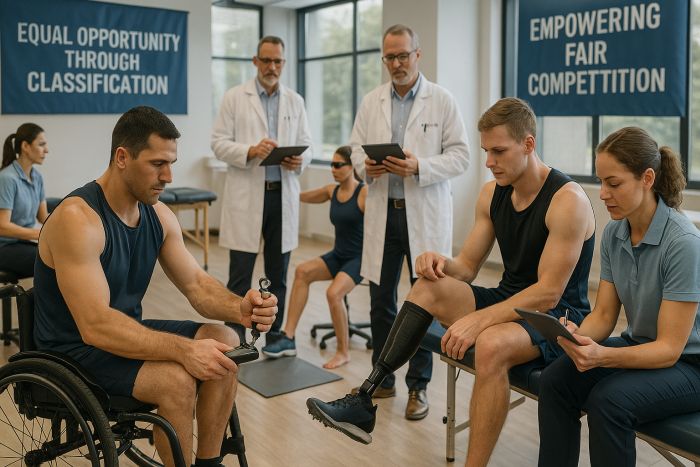
Athletes undergoing evaluation - Classification Process
Classification Application: Classes

GENDER

CYCLING

HAND CYCLE

TRICYCLE

BLIND/V1

TANDEM

MEN

MC1-MC5

MH1-MH5

MT1-M12

MB

TCB

WOMEN

WC1 – WC5

WH1-WH5

WT1-WT2

WB

TCB

The sport is governed by the Union Cycliste Internationale (UCI). Para-cycling classes, as defined by the UCI, can be decoded easily.

The first letter stands for the gender (M for men, W for women). Subsequent letters stand for the sport division:
– C for Cycling
– H for Handbike/handcycle
– T for Tricycle
– B for blind or visually impaired – also known as TCB for Tandem Class Blind).

The sport is governed by the Union Cycliste Internationale (UCI). Para-cycling classes, as defined by the UCI, can be decoded easily.

The first letter stands for the gender (M for men, W for women). Subsequent letters stand for the sport division:
– C for Cycling
– H for Handbike/handcycle
– T for Tricycle
– B for blind or visually impaired – also known as TCB for Tandem Class Blind).

The final number is the class in that division – with the lower the number, the greater the degree of impairment.
Therefore WH3 stands for the class Women’s Handbike 3.

International classification is undertaken by a UCI panel which consists of “a medical doctor, a physiotherapist and a sports technician” who will assess the athlete and assign them a class. The evaluation is done in English, and athletes are allowed to be accompanied by an interpreter and/or a representative of their country’s National Federation in the sport. Classified athletes will be issued a para-cycling classification card.

5. Eligibility

In 1983, classification for cerebral palsy competitors in this sport was done by the Cerebral Palsy-International Sports and Recreation Association. The classification used the classification system designed for track events. In 1983, there were five cerebral palsy classifications.

In 1983, Cerebral Palsy-International Sports and Recreation Association (CP-ISRA) set the eligibility rules for classification for this sport. They defined cerebral palsy as a non-progressive brain lesion that results in impairment. People with cerebral palsy or non-progressive brain damage were eligible for classification by them.
The organisation also dealt with classification for people with similar impairments.
For their classification system, people with spina bifida were not eligible unless they had medical evidence of loco-motor dysfunction.
People with cerebral palsy and epilepsy were eligible provided the condition did not interfere with their ability to compete.
People who had strokes were eligible for classification following medical clearance.
Competitors with multiple sclerosis, muscular dystrophy and arthrogryposis were not eligible for classification by CP-ISRA, but were eligible for classification by International Sports Organisation for the Disabled for the Games of Les Autres.

The debate about inclusion of competitors into able-bodied competitions was seen by some disability sport advocates like Horst Strokhkendl as a hindrance to the development of an independent classification system not based on the rules for able-bodied sport. These efforts ended by 1993 as the International Paralympic Committee tried to carve out its own identity and largely ceased efforts for inclusion of disability sport on the Olympic programme.

As of 2012, people with physical and visual disabilities are eligible to compete in this sport.

6. Types of Handcycles

Handcycles are not wheelchairs, they have cranks and gears, while a wheelchair has push-rims directly on the main wheels. A handcycle is a type of tricycle powered by the arms rather than the legs, as on a bicycle. These handcycles are steered and powered by the front wheels, with two coasting rear wheels. Despite usually having three wheels, they are also known as handbikes.

The cyclists use their torso to help propel & steer the cycle simultaneously. Some designs use two front wheels and a single rear wheel, while others use lean-steer designs. , they have cranks and gears, while a wheelchair has push-rims directly on the main wheels. Handcycles come in a variety of styles, making them accessible to people with a wide variety of disabilities. There are also hybrids between a handcycle, a recumbent bike and a tricycle.

7. Get Involved: Who To Contact

Want to get involved?
Not sure who to call?
Where to go?
This will help:- South Africa boasts several inclusive cycling clubs and disability sport organisations: with a number of accessible cycling events suitable for both beginners and elite para-cyclists – to learn more, please click on the links below to learn more.
Adaptive cycling in South Africa is more than a sport—it’s a lifestyle that promotes freedom, health, and inclusion for persons with physical impairments. Whether you’re just getting started or aspiring to represent the country at the Paralympics, there’s a place for everyone in this vibrant, supportive community.

For guidance, referrals, or help finding a local adaptive cycling club, reach out to Disability Info South Africa (DiSA) – your one-stop information hub for inclusive living.

South Africa boasts several accessible cycling events for both beginners and elite para-cyclists:

– National Para-Cycling Championships (under SASAPD)
– Cape Town Cycle Tour – Offers handcycle and para divisions
– 947 Ride Joburg – Inclusive of adaptive cycling categories
– Provincial Para-Cycling Leagues
– Community Disability Rides and Fun Days – Hosted in major cities and rural areas

South Africa is home to several inclusive cycling clubs and disability sport organisations:

South African Sports Association for Physically Disabled (SASAPD)
Cycling South Africa (CSA) – Para-Cycling
– Jumping Kids Foundation
– Chaeli Sports and Recreation Club
– Blits Para-Cycling Club
– Cape Town Para-Cycling Team

– Western Cape Sport School and other regional schools are integrating para-sport programs.
Universities like Stellenbosch and Pretoria support adaptive sport development and have Paralympic alumni.
– Disability Sport South Africa (DISSA) and SASAPD work with schools to provide early exposure to para-sports.
– Several adaptive cycling projects are being piloted in special needs schools and inclusive PE programs.

South African para-cyclists have made an impact internationally, representing the country at:
– Paralympic Games – e.g., Justine Asher and Ernst van Dyk
– UCI Para-Cycling World Cup and Championships
– African Para Games and Commonwealth Games

1. QuadPara Association of South Africa (QASA)

QASA is a non-profit organisation (NPO 000-881) of Quadriplegics and Paraplegics in South Africa.

Their vision is that “all quadriplegics and paraplegics will live their lives to their full potential”.
Its mission is “to improve lives by securing resources to advocate, educate, capacitate, support and mobilise”.
To this end, QASA develops products, programmes and services for quadriplegic and paraplegic members to build their capacity and ensure opportunities for societal integration and empowerment.

QASA invests in programmes that up skills and supports members who pursue employment opportunities, whether this is through skills development, employment programmes that educate employers on the value proposition of our skilled members, or bursaries for tertiary or continued education.
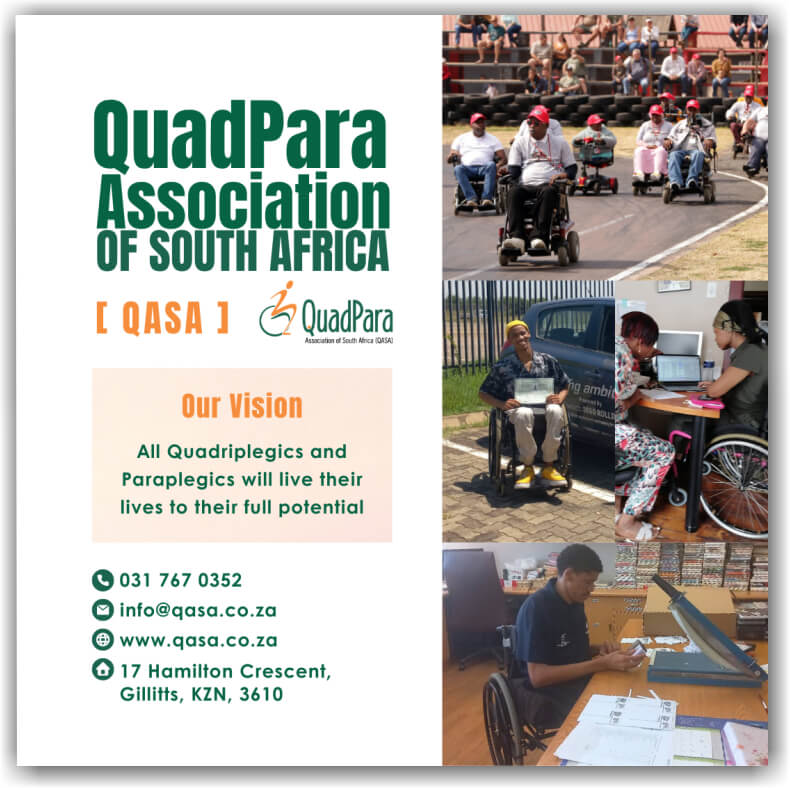
Advertisement for QuadPara - Association of South Africa (QASA) Logo

QASA’s mission is “to improve lives by securing resources to advocate, educate, capacitate, support and mobilize”. QASA develops products, programmes and services for quadriplegic and paraplegic members to build their capacity and ensure opportunities for societal integration and empowerment. QASA’s vision is that “all quadriplegics and paraplegics will live their lives to their full potential”.

QASA is a member of the South Africa Disability Alliance (SADA) and has significant relationships with other such organisations, such as the Department of Social Development, the Chris Burger Petro Jackson Players Fund and the National Council of and for Persons with Disabilities in South Africa (NCPD).

Four Regional Associations are affiliated to QASA: Gauteng South, Gauteng North, Western Cape and North West. The QASA Management Board is made up of representatives of each Regional Association.

QASA invests in programmes that up-skills and supports members who pursue employment opportunities, whether this is through skills development, employment programmes that educate employers on the value proposition of our skilled members, or bursaries for tertiary or continued education.

The organisation supports the health and wellness of its members through educational programmes for members, caregivers, and the healthcare sector. Well-researched information is shared with members and the public sector. QASA provides better mobility, assistive devices, and accessibility for its members to ensure a barrier-free environment. This includes assisting with accessible housing, independent living solutions and even driver training programmes.

QASA also advocates and lobbies on behalf of its members to ensure universal access and inclusion in the built environment and transport nodes. This includes disability awareness and sensitisation workshops, access audits, and the promotion of the White Paper on the Rights of Persons with Disabilities. Prevention of spinal cord injury forms part of our advocacy commitment.

QASA is sustained by strategic relationships with corporates, social enterprise, the National Lottery Commission and a number of campaigns and events. Some of QASA’s projects generate revenue which services the essential non-revenue generating projects.

Education Fund
QASA has an Education Fund for Further Learning to afford service users an opportunity to access funding for education and/or skills training at recognized and Accredited Institutions in order to become employable or self-employed. 
Read More about QASA’s Education Fund here

Sports Fund
QASA recognizes the value of sport and hobby and wants to encourage participation by Quadriplegics and Paraplegics. For this reason, QASA has a fund for wheelchair users to participate in sporting activities. 
Read More about QASA’s Sports Fund that they provide

Contact: 031 767 0352 / 0348 via Email: info@qasa.co.za Website: www.qasa.co.za
Address: 17 Hamilton Cres, Gillitts, 3610

Disclaimers and References

DiSA is committed to promoting the rights, dignity, and inclusion of persons with disabilities as outlined in the White Paper on the Rights of Persons with Disabilities. We strive to ensure that all content on our website reflects appropriate, respectful, and inclusive language in alignment with these principles.

However, we also provide a platform for companies and organisations to advertise their services and products. While we encourage advertisers to adhere to correct terminology and inclusive practices, DiSA cannot guarantee the accuracy or appropriateness of the language used by external parties in their content.

Please note: Any views, language, or terminology used in advertisements, promotional material, or external links do not necessarily represent the views of DiSA.

DiSA disclaims any responsibility for inaccuracies or language that may not align with the White Paper or best practices for disability terminology.

Should you however encounter language or content that you believe is inappropriate or offensive, we encourage you to contact us at info@disa.org.za, so that we can address the issue.

DiSA remains dedicated to fostering a respectful and inclusive environment for all individuals. We appreciate your understanding and collaboration in supporting our mission.


While we strive for accuracy and clarity, AI-generated visuals may not always reflect real-life conditions or representations.
In addition, we feature authentic images and videos of actual instances, events, circumstances that have occurred, as well as products and services supplied by companies who advertise with us.

These authentic visuals are intended to accurately depict our content or the offerings of our advertising partners.
If you have any questions or concerns about the content displayed on this site, please feel free to contact us.

DiSA provides a platform for companies and organisations to advertise their products and services to assist persons with disabilities and their families. While we make every effort to list reputable and credible service providers, the inclusion of any company, organisation, product, or service on our website does not constitute an endorsement or guarantee by DiSA.

Please note the following: DiSA is not involved in the delivery, quality control, or customer service of any product or service offered by advertisers listed on our platform.

Any agreements, purchases, or arrangements made between users of this website and advertisers are solely between those parties. DiSA is not responsible for the outcome of such interactions.

DiSA disclaims any liability for dissatisfaction, damages, or disputes arising from products or services supplied by companies or organisations listed on our website.

We encourage users to thoroughly research and verify any service provider or product before engaging with them. If you have concerns or encounter issues with an advertiser listed on our platform, please let us know at: info@disa.org.za. We value your feedback to help maintain the integrity of our platform.


While we strive for accuracy and clarity, AI-generated visuals may not always reflect real-life conditions or representations.
In addition, we feature authentic images and videos of actual instances, events, circumstances that have occurred, as well as products and services supplied by companies who advertise with us.

These authentic visuals are intended to accurately depict our content or the offerings of our advertising partners.
If you have any questions or concerns about the content displayed on this site, please feel free to contact us.

DiSA is committed to providing accurate and up-to-date information to assist persons with disabilities and their families. However, the nature of online content and external resources means that information can change frequently.

Please note the following: DiSA cannot guarantee the accuracy, completeness, or reliability of all information on our website, particularly information obtained from external sources or links to third-party websites.
External websites may update or remove content without notice, which can result in broken links or outdated information. DiSA is not responsible for the content, accessibility, or functionality of external websites.

While we make every effort to keep our information current, some content may become outdated over time.
We encourage users to verify information directly with the relevant third parties or organisations before making any decisions based on the information found on our platform.

If you encounter a broken link or outdated content, please notify us at: info@disa.org.za and we will address it as soon as possible.
Thank you for understanding and helping us maintain a reliable and accessible platform.


While we strive for accuracy and clarity, AI-generated visuals may not always reflect real-life conditions or representations.
In addition, we feature authentic images and videos of actual instances, events, circumstances that have occurred, as well as products and services supplied by companies who advertise with us.

These authentic visuals are intended to accurately depict our content or the offerings of our advertising partners.
If you have any questions or concerns about the content displayed on this site, please feel free to contact us.

The Information services and website that we offer free of charge, is privately run and funded and is not run or funded by the government. We rely on advertising, paid services and donations to supply and improve this Free information service that we do provide.

The Companies, Clubs, Schools and Organisations that are listed on this site, have advertised or made donations to the Website and have therefore assisted us be able to provide this free Service.
Please support them as they have supported Us and please contact us via info@disa.org.za, if you can advertise with us or would like to make a donation. Alternatively, visit our “Support Us” page to find out how you can support us or acquire our services. – Thank You.

If you encounter a broken link or outdated content, please notify us at: info@disa.org.za and we will address it as soon as possible.
Thank you for understanding and helping us maintain a reliable and accessible platform.

Please Note: We do assist with inquiries via email but may need to send or copy your details and inquiry to various other organisations, companies or government departments, that we sometimes consult, so that we can help you in the best way possible.
If you have any objection to us sharing your query or contact details, please notify us in your email. We will only share your information to assist you and will never sell or use your personal information for any other purposes.

DiSA waivers any liability for what happens if information is shared or used for marketing or other purposes by other organisations who do have consent to view such information.


While we strive for accuracy and clarity, AI-generated visuals may not always reflect real-life conditions or representations.
In addition, we feature authentic images and videos of actual instances, events, circumstances that have occurred, as well as products and services supplied by companies who advertise with us.

These authentic visuals are intended to accurately depict our content or the offerings of our advertising partners.
If you have any questions or concerns about the content displayed on this site, please feel free to contact us.

Please note that this website uses images and videos that are AI-generated and created to visually represent certain information, concepts or scenarios for illustrative purposes.


While we strive for accuracy and clarity, AI-generated visuals may not always reflect real-life conditions or representations.
In addition, we feature authentic images and videos of actual instances, events, circumstances that have occurred, as well as products and services supplied by companies who advertise with us.

These authentic visuals are intended to accurately depict our content or the offerings of our advertising partners.
If you have any questions or concerns about the content displayed on this site, please feel free to contact us.

Disability Info South Africa (DiSA) is committed to protecting your personal information in compliance with the Protection of Personal Information Act (POPIA), Act No. 4 of 2013. By using our free information service, you acknowledge and agree to the following:

Collection of Personal Information:
DiSA may collect and process your personal information (such as name, contact details, and inquiries) solely for the purpose of assisting you with your requests and providing relevant information or support.

Use and Storage:
Your personal information will only be used for the purpose it was collected for, we may need to send or copy your details and inquiry to various organisations, companies or government departments, that we sometimes consult, so that we can assist you in the best way possible.
If you have any objection to us sharing your query or contact details, please notify us in your email. We will only share your information to assist you and will never sell or use your personal information for any other purposes.
DiSA implements appropriate measures to secure your personal information against unauthorized access or loss.

Consent:
By submitting your details through our Contact Form, or contacting us via our email address, you consent to allow DiSA to process your information as outlined in this disclaimer. If you are not comfortable with DiSA sharing your information for the above purposes, please contact us directly at info@disa.org.za.

Access and Updates:
You have the right to request the deletion of your personal information at any time.
To do so, please contact us at: info@disa.org.za.

Third-Party Websites:
DiSA is not responsible for the privacy practices of external websites linked on our platform. Users are encouraged to review the privacy policies of third-party sites before sharing personal information.
For any queries or concerns regarding the handling of your personal information, please contact us at: info@disa.org.za.
Thank you for trusting DiSA to support you with accessible, inclusive, and reliable information.