Horse Riding | Equestrian Sports

Para-equestrian sport and adaptive horse riding open the world of equestrianism to riders with a wide range of physical and sensory disabilities.
Offering freedom, connection, and movement in a uniquely powerful way.
Whether enjoyed recreationally or pursued competitively — these programmes provide a safe, supportive environment where riders develop balance, coordination, confidence, and deep partnership with their horses. With tailored instruction, adaptive equipment, and graded classification systems, para-equestrian sport ensures that every rider can participate meaningfully, progress at their own pace, and experience the joy and independence that come from working with horses.

About Horse Riding

Equestrian sport includes a wide range of horseback activities such as riding, driving, steeplechasing, and vaulting. For athletes with disabilities, the recognised competitive discipline is Para Dressage—the only equestrian sport featured in the Paralympic Games.
Equestrian events have been part of the Olympics for many years and were formally introduced into the Paralympic programme in Atlanta 1996.

The sport is open to riders with physical or visual impairments, and athletes compete in mixed events grouped according to functional ability.

Para Dressage includes a set championship test, a freestyle test performed to music, and a team test with three to four riders. Competitors are assessed on precision, control, and harmony with the horse, and may use approved adaptive equipment such as dressage crops, connecting rein bars, rubber bands, and other aids to support safe and effective riding.
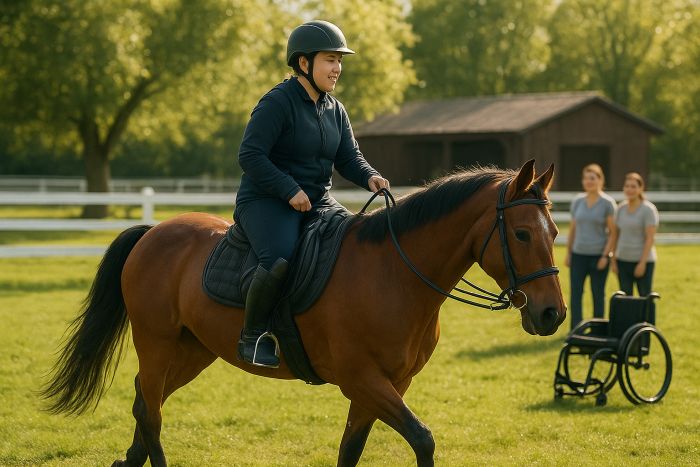
Wheelchair user taking part in horse riding /Equestrian

 2. The Classification System

Riders are assigned to five different sport classes. Para-equestrian dressage riding consists of five sport classes called ‘grades’ for athletes with Physical and Visual impairments. Lower grades indicate more severe activity limitations and higher grades include athletes with less severe activity limitations.

CLASS

CONDITIONS

GRADE 1A

Athletes who have severe impairments affecting all limbs and the trunk, these athletes usually require the use of a wheelchair in daily life.

GRADE 1B

These Athletes here have either a severe impairment of the trunk and minimal impairment of the upper limbs or moderate impairment of the trunk, upper and lower limbs. Most athletes in this class use a wheelchair in daily life.

GRADE 2

Athletes in this class have severe impairments in both lower limbs with minimal or no impairment of the trunk or moderate impairment of the upper and lower limbs and trunk. Some athletes in this class may use a wheelchair in daily life.

GRADE 3

Athletes in grade III have a severe impairment or deficiency of both upper limbs or a moderate impairment of all four limbs or short stature. Athletes in grade III are able to walk and generally do not require a wheelchair in daily life. Grade III also includes athletes having a visual impairment equivalent to B1 (very low visual acuity and/ or no light perception).

GRADE 4

Athletes here have a mild impairment of range of movement or muscle strength or a deficiency of one limb or mild deficiency of two limbs. Grade IV also includes athletes with visual impairment equivalent to B2 (higher visual acuity than visually impaired athletes) competing in the grade III sport class and/ or a visual field of less than five degrees radius.

Athletes with the following impairments are eligible to compete in para-equestrian:

– Impaired muscle power
– Athetosis
– Impaired passive range of movement

– Hypertonia
– Limb deficiency
– Ataxia

– Leg length difference
– Short stature
– Visual impairment

3. Benefits of Horse-Riding

Horse Riding provides many benefits and is available in South Africa, as a Sport in Equestrian events, a form of Therapy or just for fun as a Hobby. Horse Riding Therapy and Hippotherapy is available in most Provinces in South Africa and is supplied by companies and organizations such as Tumanako Equine Therapy.
Equestrian is also one of the sports that are available for persons with Mobility Impairments at the Paralympics.
Persons with varying forms of Mobility Impairments can benefit from Horse Riding, including persons with:

– Amputations
– Brain Injuries
– Cerebral Palsy

– Cerebrovascular Accident (CVA) / Stroke
– Multiple Sclerosis
– Muscular Dystrophy

– Spina Bifida
– Spinal Cord Injury (SCI)
Read More: …..

4. Equestrian In South Africa

There are a number of Horse riding or Equestrian organizations or clubs available for persons with disabilities in South Africa, including SASCOC, The South African Equestrian Association-SAEA, South African Equestrian Federation and the South African Riding for the Disabled Association (S.A.R.D.A.)

South African Equestrian Federation: The SAEF are the representative body for Equestrian Sport in South Africa registered with SASCOC and the representative for South Africa at the FEI. As the officially registered federation under SASCOC, it is governed by the rules and regulations of the Sports Act as well as the rules and regulations of the FEI.

As the representative for equestrian sport with the regulatory bodies, the SAEF are responsible for:
– Adherence of the Sports Act, rules and regulations of SASCOC and Discipline Constitutions in the Republic of South Africa by its members.
– The SAEF are also responsible for supporting members in obtaining Protea Colours. The biggest task currently faced is the support towards Disciplines with funding to enable development of the sport.

5. South African Riding for the Disabled Association S.A.R.D.A.

South African Riding for the Disabled Association S.A.R.D.A. was established in Cape Town in 1973 by Belinda Sampson and Joy Finlay. At first they started with one horse and a monetary donation, but because the results were so successful, the method of therapeutic riding became popular, with more and more people wanting to try to improve different abilities. Today, there are two centres in Cape Town (in Constantia and Noordhoek) and even branches in Durban, Gauteng, Pietermaritzburg and Port Elizabeth.

SARDA’s aim is to provide the opportunity of therapeutic and recreational horse riding for disabled people so that they might benefit in all aspects of their mental, physical and social lives. teach horse riding to people living with disabilities. Special needs schools from all over Cape Town bring learners on a weekly basis. We also hold classes for children and adults who don’t attend these schools.

SARDA is affiliated to the RDA in the United Kingdom and the Federation for Disabled Riding International.
SARDA Cape Town practises its work according to the RDA principles which means teaching people living with disabilities to ride, done by qualified Riding for the Disabled instructors, who may or may not be therapists. Ultimate goal is that the RIDERS are taught to ride independently as possible. The riders benefit physically from the movement of the horse and from many other aspects of riding including psycho-social, self-esteem and competing with peers on equal footing.

SARDA encourages equestrians and therapists to learn about the RDA and Hippotherapy practices. Equine Assisted Therapy (ETASA) offer training in Hippotherapy, while SARDA offers training in the practice of RDA. If you are interested in becoming a teacher in either area of expertise, please see our SARDA Volunteers Page for more information. Alternatively, click on link provided to view the website of ETASA.

SARDA at Sleepy Hollow practises Hippotherapy using Physio, Occupational or Speech Therapists in treating children and adults living with disabilities, using the horse as a treatment modality. The ultimate goal is to achieve therapeutic goals and aims. Hippotherapy literally means “treatment with the help of the horse” from the Greek word, “hippos” meaning horse

Special needs schools from all over Cape Town bring learners on a weekly basis. We also hold classes for children and adults who don’t attend these schools.

The minimum age for our riding lessons is 6 years.

6. How to join

Anyone can apply to be put onto our waiting list. Once you have downloaded the application form please take your time to fill it in.
Then return it to us, our Senior Instructor will assess the form and will inform you if your application was successful.

Once your name has been added to the waiting list you are eligible to be considered for any spot that might become available.
Our senior instructor matches the applications to the opening according to age and disability/ability.

For Schools to become part of SARDA’s Riding Program please download the School Form once you filled it in please and send it to capetown@sarda.co.za or fax it to 0866953409. Application form for: South African Riding for the Disabled Cape Town Branch.

Disclaimers and References

DiSA is committed to promoting the rights, dignity, and inclusion of persons with disabilities as outlined in the White Paper on the Rights of Persons with Disabilities. We strive to ensure that all content on our website reflects appropriate, respectful, and inclusive language in alignment with these principles.

However, we also provide a platform for companies and organisations to advertise their services and products. While we encourage advertisers to adhere to correct terminology and inclusive practices, DiSA cannot guarantee the accuracy or appropriateness of the language used by external parties in their content.

Please note: Any views, language, or terminology used in advertisements, promotional material, or external links do not necessarily represent the views of DiSA.

DiSA disclaims any responsibility for inaccuracies or language that may not align with the White Paper or best practices for disability terminology.

Should you however encounter language or content that you believe is inappropriate or offensive, we encourage you to contact us at info@disa.org.za, so that we can address the issue.

DiSA remains dedicated to fostering a respectful and inclusive environment for all individuals. We appreciate your understanding and collaboration in supporting our mission.


While we strive for accuracy and clarity, AI-generated visuals may not always reflect real-life conditions or representations.
In addition, we feature authentic images and videos of actual instances, events, circumstances that have occurred, as well as products and services supplied by companies who advertise with us.

These authentic visuals are intended to accurately depict our content or the offerings of our advertising partners.
If you have any questions or concerns about the content displayed on this site, please feel free to contact us.

DiSA provides a platform for companies and organisations to advertise their products and services to assist persons with disabilities and their families. While we make every effort to list reputable and credible service providers, the inclusion of any company, organisation, product, or service on our website does not constitute an endorsement or guarantee by DiSA.

Please note the following: DiSA is not involved in the delivery, quality control, or customer service of any product or service offered by advertisers listed on our platform.

Any agreements, purchases, or arrangements made between users of this website and advertisers are solely between those parties. DiSA is not responsible for the outcome of such interactions.

DiSA disclaims any liability for dissatisfaction, damages, or disputes arising from products or services supplied by companies or organisations listed on our website.

We encourage users to thoroughly research and verify any service provider or product before engaging with them. If you have concerns or encounter issues with an advertiser listed on our platform, please let us know at: info@disa.org.za. We value your feedback to help maintain the integrity of our platform.


While we strive for accuracy and clarity, AI-generated visuals may not always reflect real-life conditions or representations.
In addition, we feature authentic images and videos of actual instances, events, circumstances that have occurred, as well as products and services supplied by companies who advertise with us.

These authentic visuals are intended to accurately depict our content or the offerings of our advertising partners.
If you have any questions or concerns about the content displayed on this site, please feel free to contact us.

DiSA is committed to providing accurate and up-to-date information to assist persons with disabilities and their families. However, the nature of online content and external resources means that information can change frequently.

Please note the following: DiSA cannot guarantee the accuracy, completeness, or reliability of all information on our website, particularly information obtained from external sources or links to third-party websites.
External websites may update or remove content without notice, which can result in broken links or outdated information. DiSA is not responsible for the content, accessibility, or functionality of external websites.

While we make every effort to keep our information current, some content may become outdated over time.
We encourage users to verify information directly with the relevant third parties or organisations before making any decisions based on the information found on our platform.

If you encounter a broken link or outdated content, please notify us at: info@disa.org.za and we will address it as soon as possible.
Thank you for understanding and helping us maintain a reliable and accessible platform.


While we strive for accuracy and clarity, AI-generated visuals may not always reflect real-life conditions or representations.
In addition, we feature authentic images and videos of actual instances, events, circumstances that have occurred, as well as products and services supplied by companies who advertise with us.

These authentic visuals are intended to accurately depict our content or the offerings of our advertising partners.
If you have any questions or concerns about the content displayed on this site, please feel free to contact us.

The Information services and website that we offer free of charge, is privately run and funded and is not run or funded by the government. We rely on advertising, paid services and donations to supply and improve this Free information service that we do provide.

The Companies, Clubs, Schools and Organisations that are listed on this site, have advertised or made donations to the Website and have therefore assisted us be able to provide this free Service.
Please support them as they have supported Us and please contact us via info@disa.org.za, if you can advertise with us or would like to make a donation. Alternatively, visit our “Support Us” page to find out how you can support us or acquire our services. – Thank You.

If you encounter a broken link or outdated content, please notify us at: info@disa.org.za and we will address it as soon as possible.
Thank you for understanding and helping us maintain a reliable and accessible platform.

Please Note: We do assist with inquiries via email but may need to send or copy your details and inquiry to various other organisations, companies or government departments, that we sometimes consult, so that we can help you in the best way possible.
If you have any objection to us sharing your query or contact details, please notify us in your email. We will only share your information to assist you and will never sell or use your personal information for any other purposes.

DiSA waivers any liability for what happens if information is shared or used for marketing or other purposes by other organisations who do have consent to view such information.


While we strive for accuracy and clarity, AI-generated visuals may not always reflect real-life conditions or representations.
In addition, we feature authentic images and videos of actual instances, events, circumstances that have occurred, as well as products and services supplied by companies who advertise with us.

These authentic visuals are intended to accurately depict our content or the offerings of our advertising partners.
If you have any questions or concerns about the content displayed on this site, please feel free to contact us.

Please note that this website uses images and videos that are AI-generated and created to visually represent certain information, concepts or scenarios for illustrative purposes.


While we strive for accuracy and clarity, AI-generated visuals may not always reflect real-life conditions or representations.
In addition, we feature authentic images and videos of actual instances, events, circumstances that have occurred, as well as products and services supplied by companies who advertise with us.

These authentic visuals are intended to accurately depict our content or the offerings of our advertising partners.
If you have any questions or concerns about the content displayed on this site, please feel free to contact us.

Disability Info South Africa (DiSA) is committed to protecting your personal information in compliance with the Protection of Personal Information Act (POPIA), Act No. 4 of 2013. By using our free information service, you acknowledge and agree to the following:

Collection of Personal Information:
DiSA may collect and process your personal information (such as name, contact details, and inquiries) solely for the purpose of assisting you with your requests and providing relevant information or support.

Use and Storage:
Your personal information will only be used for the purpose it was collected for, we may need to send or copy your details and inquiry to various organisations, companies or government departments, that we sometimes consult, so that we can assist you in the best way possible.
If you have any objection to us sharing your query or contact details, please notify us in your email. We will only share your information to assist you and will never sell or use your personal information for any other purposes.
DiSA implements appropriate measures to secure your personal information against unauthorized access or loss.

Consent:
By submitting your details through our Contact Form, or contacting us via our email address, you consent to allow DiSA to process your information as outlined in this disclaimer. If you are not comfortable with DiSA sharing your information for the above purposes, please contact us directly at info@disa.org.za.

Access and Updates:
You have the right to request the deletion of your personal information at any time.
To do so, please contact us at: info@disa.org.za.

Third-Party Websites:
DiSA is not responsible for the privacy practices of external websites linked on our platform. Users are encouraged to review the privacy policies of third-party sites before sharing personal information.
For any queries or concerns regarding the handling of your personal information, please contact us at: info@disa.org.za.
Thank you for trusting DiSA to support you with accessible, inclusive, and reliable information.