Wheelchair Fencing

Adaptive fencing is an exciting and highly inclusive sport that offers persons with disabilities in South Africa the opportunity to compete in a fast-paced, strategic, and elegant discipline.
Using specialised equipment and anchored wheelchairs, athletes participate on a level playing field where skill, timing, precision, and tactical thinking take centre stage. Adaptive fencing is open to individuals with a wide range of mobility impairments, allowing them to train and compete at social, club, provincial, and international levels.
More than just a sport, it builds confidence, discipline, upper-body strength, and mental agility — while offering a vibrant community where athletes can grow, challenge themselves, and experience the thrill of competition.

1. About Wheelchair Fencing

Wheelchair fencing has been a part of every Summer Paralympic Games since they were first held in Rome 1960. Introduced to the Stoke Mandeville International Games by Dr Ludwig Guttmann in 1953.

It is governed by the International Wheelchair and Amputee Sports Federation (IWAS), who strive to develop wheelchair fencing across South Africa and Africa. Until recently Libya was the only African country with active wheelchair fencers.

2. Wheelchair Fencing South Africa
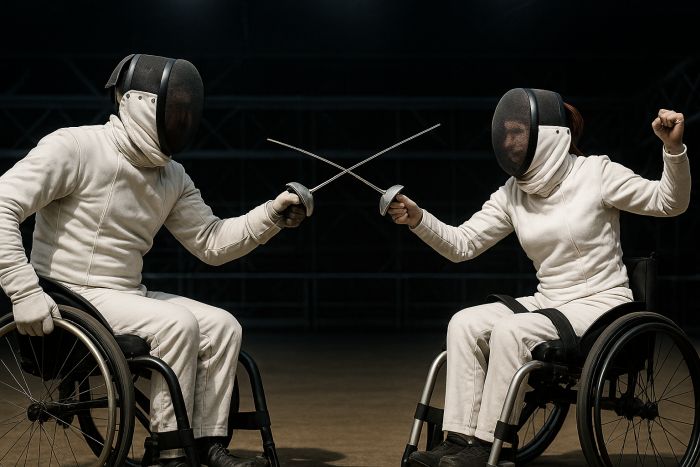
Man and woman competing in Wheelchair Fencing

In October 2015 Wheelchair Fencing was introduced by the Klein Karoo Sports Club for the Disabled to 40 athletes in Oudtshoorn, South Africa.

Klein Karoo were keen to develop an inclusive sport suitable for people with a variety of impairments and found wheelchair fencing could open up those opportunities. Following a demonstration from Susan Agrella of a local able-bodied fencing club in early October, athletes tried the sport out.

In a short time following the official introduction, the club produced eight wheelchair fencing athletes aspiring for fencing success. The first competition for the fencers was in February 2016 in Cape Town, South Africa, with the eventual aim to represent their country on an international level at International Wheelchair and Amputee Sports Federation (IWAS) World Championships and the Paralympic Games.

This makes the development of the Klein Karoo sports club the first of its kind in Southern Africa.
The club is also looking for opportunities to train coaches and officials to strengthen the infrastructure of the sport within South Africa & IWAS looks forward to the promising potential of wheelchair fencers from Africa as development and promotion continues across the continent.

For more information: Contact Le-Ana Olivier on 044-2720683 or 0825791254 | Address: Klein Karoo Sport Club for the Disabled at P. O. Box 86, Oudtshoorn, 6620.

3. Wheelchair Fencing Rules and Regulations

The competition takes place in the form of pool stages followed by direct elimination rounds.
During a contest the fencers’ wheelchairs are fastened into medal frames on the floor, allowing freedom of the upper body only.

Although fencers cannot move back and forth, the fact that there are no restrictions to upper body movement means duals are as exciting and fast as in non-disabled Fencing events.

Fencers record hits by striking their opponent cleanly in the valid area, with successful hits recorded by the electronic equipment.
There are three disciplines in Wheelchair Fencing, and they are based on the type of sword used, which include The Foil, The Epee and the Sabre.

In the Foil event, fencers are only permitted to strike the trunk area of the opponent, whereas in the Sabre and Epee, anywhere above the waist is a valid target area.

Bouts last a maximum of four minutes in the preliminary stages, with victory going to the first fencer to score five valid hits or the one with the most hits at the end of the four minutes. Bouts in the first round of competition are the best of nine hits. The top competitors are promoted to a direct elimination, where bouts are awarded to the first get to 15 hits.

In the knockout stages, bouts consist of three rounds of three minutes. The winner is the first to score 15 hits, or the highest scorer at the completion of the contest. In the event of a tie, an extra one-minute sudden death bout is held, with the first person to score a valid hit taking the contest.

4. Classification

Classification divisions are based on impairment conditions:

CLASS

CONDITIONS

CLASS A

Athletes with full trunk movement and good balance.
Classified as either Class 3 or Class 4 fencer.
These athletes have a good sitting balance, either with or without the support of their lower limbs.
Suitable for: Athletes with a low level spinal lesion, athletes with double above the knee amputation and comparable impairments

CLASS B

Athletes with no leg movement and impaired trunk and balance functions
Classified as a Class 2 fencer.
These athletes have a fair sitting balance and an unaffected fencing arm.
They most often have paraplegia or incomplete tetraplegia with fencing arms that are minimally affected.

CLASS C

Athletes with a disability in all four limbs
Classified as either Class 1A or 1B fencer.
This classification features at international competition but is not included at the Paralympic Games.

5. Wheelchair Fencing Equipment

Adaptive fencing uses specialised equipment designed to ensure fairness, safety, and full participation for athletes with disabilities. The core equipment is similar to that used in able-bodied fencing, with a few key adaptations

1. Wheelchair and Frame System
Athletes compete from specially designed wheelchairs that are securely fastened to a metal frame.
– The frame keeps both wheelchairs fixed in place.
– Distance and alignment are adjustable to match each athlete’s reach and classification.
– This setup ensures that competition focuses on skill, speed, and technique rather than mobility.

2. Weapons
Adaptive fencing uses the same three weapon types found in conventional fencing:
Foil – targets the torso.
Épée – targets the entire body.
Sabre – targets the upper body above the waist.
Each weapon has an electrical connection that registers valid touches.

3. Protective Gear
To ensure safety, athletes wear:
– A fencing mask
– A glove
– A padded jacket (lamé for foil and sabre)
– Underarm protector (plastron)
– Chest protector (required for some athletes)

Additional Adaptations: Depending on the athlete’s specific mobility needs, equipment such as straps, cushions, or support brackets may be used to ensure stability, comfort, and proper positioning.

Disclaimers and References

DiSA is committed to promoting the rights, dignity, and inclusion of persons with disabilities as outlined in the White Paper on the Rights of Persons with Disabilities. We strive to ensure that all content on our website reflects appropriate, respectful, and inclusive language in alignment with these principles.

However, we also provide a platform for companies and organisations to advertise their services and products. While we encourage advertisers to adhere to correct terminology and inclusive practices, DiSA cannot guarantee the accuracy or appropriateness of the language used by external parties in their content.

Please note: Any views, language, or terminology used in advertisements, promotional material, or external links do not necessarily represent the views of DiSA.

DiSA disclaims any responsibility for inaccuracies or language that may not align with the White Paper or best practices for disability terminology.

Should you however encounter language or content that you believe is inappropriate or offensive, we encourage you to contact us at info@disa.org.za, so that we can address the issue.

DiSA remains dedicated to fostering a respectful and inclusive environment for all individuals. We appreciate your understanding and collaboration in supporting our mission.


While we strive for accuracy and clarity, AI-generated visuals may not always reflect real-life conditions or representations.
In addition, we feature authentic images and videos of actual instances, events, circumstances that have occurred, as well as products and services supplied by companies who advertise with us.

These authentic visuals are intended to accurately depict our content or the offerings of our advertising partners.
If you have any questions or concerns about the content displayed on this site, please feel free to contact us.

DiSA provides a platform for companies and organisations to advertise their products and services to assist persons with disabilities and their families. While we make every effort to list reputable and credible service providers, the inclusion of any company, organisation, product, or service on our website does not constitute an endorsement or guarantee by DiSA.

Please note the following: DiSA is not involved in the delivery, quality control, or customer service of any product or service offered by advertisers listed on our platform.

Any agreements, purchases, or arrangements made between users of this website and advertisers are solely between those parties. DiSA is not responsible for the outcome of such interactions.

DiSA disclaims any liability for dissatisfaction, damages, or disputes arising from products or services supplied by companies or organisations listed on our website.

We encourage users to thoroughly research and verify any service provider or product before engaging with them. If you have concerns or encounter issues with an advertiser listed on our platform, please let us know at: info@disa.org.za. We value your feedback to help maintain the integrity of our platform.


While we strive for accuracy and clarity, AI-generated visuals may not always reflect real-life conditions or representations.
In addition, we feature authentic images and videos of actual instances, events, circumstances that have occurred, as well as products and services supplied by companies who advertise with us.

These authentic visuals are intended to accurately depict our content or the offerings of our advertising partners.
If you have any questions or concerns about the content displayed on this site, please feel free to contact us.

DiSA is committed to providing accurate and up-to-date information to assist persons with disabilities and their families. However, the nature of online content and external resources means that information can change frequently.

Please note the following: DiSA cannot guarantee the accuracy, completeness, or reliability of all information on our website, particularly information obtained from external sources or links to third-party websites.
External websites may update or remove content without notice, which can result in broken links or outdated information. DiSA is not responsible for the content, accessibility, or functionality of external websites.

While we make every effort to keep our information current, some content may become outdated over time.
We encourage users to verify information directly with the relevant third parties or organisations before making any decisions based on the information found on our platform.

If you encounter a broken link or outdated content, please notify us at: info@disa.org.za and we will address it as soon as possible.
Thank you for understanding and helping us maintain a reliable and accessible platform.


While we strive for accuracy and clarity, AI-generated visuals may not always reflect real-life conditions or representations.
In addition, we feature authentic images and videos of actual instances, events, circumstances that have occurred, as well as products and services supplied by companies who advertise with us.

These authentic visuals are intended to accurately depict our content or the offerings of our advertising partners.
If you have any questions or concerns about the content displayed on this site, please feel free to contact us.

The Information services and website that we offer free of charge, is privately run and funded and is not run or funded by the government. We rely on advertising, paid services and donations to supply and improve this Free information service that we do provide.

The Companies, Clubs, Schools and Organisations that are listed on this site, have advertised or made donations to the Website and have therefore assisted us be able to provide this free Service.
Please support them as they have supported Us and please contact us via info@disa.org.za, if you can advertise with us or would like to make a donation. Alternatively, visit our “Support Us” page to find out how you can support us or acquire our services. – Thank You.

If you encounter a broken link or outdated content, please notify us at: info@disa.org.za and we will address it as soon as possible.
Thank you for understanding and helping us maintain a reliable and accessible platform.

Please Note: We do assist with inquiries via email but may need to send or copy your details and inquiry to various other organisations, companies or government departments, that we sometimes consult, so that we can help you in the best way possible.
If you have any objection to us sharing your query or contact details, please notify us in your email. We will only share your information to assist you and will never sell or use your personal information for any other purposes.

DiSA waivers any liability for what happens if information is shared or used for marketing or other purposes by other organisations who do have consent to view such information.


While we strive for accuracy and clarity, AI-generated visuals may not always reflect real-life conditions or representations.
In addition, we feature authentic images and videos of actual instances, events, circumstances that have occurred, as well as products and services supplied by companies who advertise with us.

These authentic visuals are intended to accurately depict our content or the offerings of our advertising partners.
If you have any questions or concerns about the content displayed on this site, please feel free to contact us.

Please note that this website uses images and videos that are AI-generated and created to visually represent certain information, concepts or scenarios for illustrative purposes.


While we strive for accuracy and clarity, AI-generated visuals may not always reflect real-life conditions or representations.
In addition, we feature authentic images and videos of actual instances, events, circumstances that have occurred, as well as products and services supplied by companies who advertise with us.

These authentic visuals are intended to accurately depict our content or the offerings of our advertising partners.
If you have any questions or concerns about the content displayed on this site, please feel free to contact us.

Disability Info South Africa (DiSA) is committed to protecting your personal information in compliance with the Protection of Personal Information Act (POPIA), Act No. 4 of 2013. By using our free information service, you acknowledge and agree to the following:

Collection of Personal Information:
DiSA may collect and process your personal information (such as name, contact details, and inquiries) solely for the purpose of assisting you with your requests and providing relevant information or support.

Use and Storage:
Your personal information will only be used for the purpose it was collected for, we may need to send or copy your details and inquiry to various organisations, companies or government departments, that we sometimes consult, so that we can assist you in the best way possible.
If you have any objection to us sharing your query or contact details, please notify us in your email. We will only share your information to assist you and will never sell or use your personal information for any other purposes.
DiSA implements appropriate measures to secure your personal information against unauthorized access or loss.

Consent:
By submitting your details through our Contact Form, or contacting us via our email address, you consent to allow DiSA to process your information as outlined in this disclaimer. If you are not comfortable with DiSA sharing your information for the above purposes, please contact us directly at info@disa.org.za.

Access and Updates:
You have the right to request the deletion of your personal information at any time.
To do so, please contact us at: info@disa.org.za.

Third-Party Websites:
DiSA is not responsible for the privacy practices of external websites linked on our platform. Users are encouraged to review the privacy policies of third-party sites before sharing personal information.
For any queries or concerns regarding the handling of your personal information, please contact us at: info@disa.org.za.
Thank you for trusting DiSA to support you with accessible, inclusive, and reliable information.