


Quad Rugby
Quad rugby, also known as wheelchair rugby, is a fast-paced, full-contact sport designed for athletes with impairments in 3 or 4 limbs.
Born from a blend of rugby, basketball, and ice hockey, the game is played on an indoor court using specially reinforced wheelchairs built for speed, agility, and impact.
Quad rugby is far more than an adaptive sport — it’s a showcase of strategy, precision, strength, and teamwork. Today, quad rugby stands as one of the most dynamic Paralympic sports, empowering athletes with independence, confidence, and an intense competitive spirit.
What Assistance are you Looking for?
1. About Quad Rugby
2. Quad Rugby Rules
3. Equipment
4. Classification
– The Classification Process
5. History of Quad Rugby
6. Benefits to Players
About Quad Rugby
Quad Rugby or Wheelchair rugby previously called Murderball is a team sport for people with mobility impairments in three limbs ie. spinal cord injuries, or four limbs ie. amputees and people with neurological disabilities like cerebral palsy. People with impairments in only one or two limbs i.e. paraplegics are not permitted to play the sport.
It is practised in over twenty-eight countries around the world and is a summer Paralympic sport. Played indoors on a hardwood court – physical contact between wheelchairs is an integral part of the game. The rules include elements from wheelchair basketball, ice hockey, handball and rugby union. Players are assigned a functional level in points, and each team is limited to fielding a team with a total of eight points.
The sport is governed by the International Wheelchair Rugby Federation (IWRF) which was established in 1993.

2. Quad Rugby Rules
Quad Rugby is mostly played by two teams of up to twelve players. Only four players from each team may be on the court at any time. It is a mixed gender sport, and both male and female athletes play on the same teams.
Quad Rugby is played indoors on a hardwood court of the same measurements as a regulation basketball court -28 metres long by 15 metres wide. The required court markings are a centre line and circle, and a key area measuring 8 metres wide by 1.75 metres deep at each end of the court.
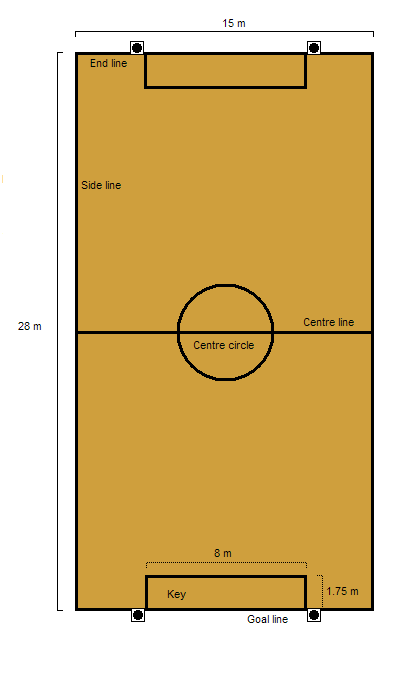
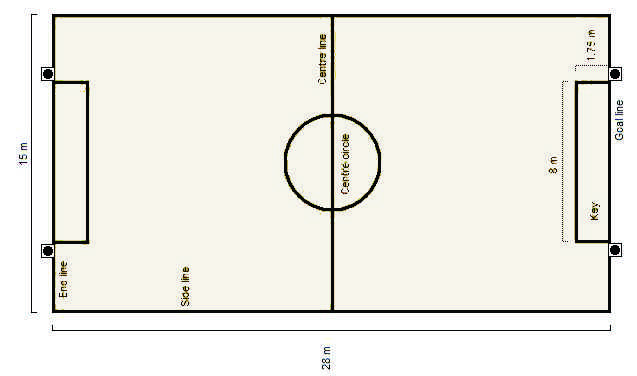
The goal line is the section of the end line within the key. Each end of the goal line is marked with a cone-shaped pylon. Players score by carrying the ball across the goal line. For a goal to count, two wheels of the player’s wheelchair must cross the line while the player has possession of the ball.
A team is not allowed to have more than three players in their own key while they are defending their goal line. Offensive players are not permitted to remain in the opposing team’s key for more than ten seconds & a player with possession of the ball must bounce or pass the ball within ten seconds.
A team’s back court is the half of the court containing the goal they are defending & their front court is the half containing the goal they are attacking. Teams have twelve seconds to advance the ball from their back court into the front court and a total of forty seconds to score a point or concede possession.
Physical contact between wheelchairs is permitted, and forms a major part of the game. However, physical contact between wheelchairs that is deemed dangerous, such as striking another player from behind, is not allowed. Direct physical contact between players is not permitted. Fouls are penalized by either a one-minute penalty, for defensive fouls and technical fouls, or a loss of possession, for offensive fouls. In some cases, a penalty goal may be awarded in lieu of a penalty.
Common fouls include spinning (striking an opponent’s wheelchair behind the main axle, causing it to spin horizontally or vertically), illegal use of hands or reaching in (striking an opponent with the arms or hands), and holding (holding or obstructing an opponent by grasping with the hands or arms, or falling onto them).
Wheelchair rugby games consist of four eight-minute quarters.
If the game is tied at the end of regulation play, three-minute overtime periods are played.
Much like able-bodied rugby matches, highly competitive wheelchair rugby games are fluid and fast-moving, with possession switching back and forth between the teams while play continues. The game clock is stopped when a goal is scored, or in the event of a violation, such as the ball being played out of bounds, or a foul. Players may only be substituted during a stoppage in play.
3. Equipment
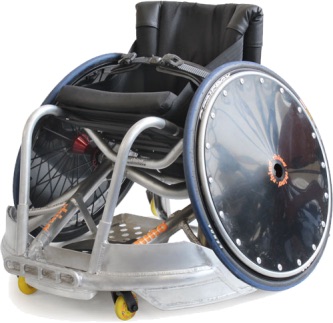
Quad Rugby is played in a manual wheelchair. The rules include detailed specifications for the wheelchair. Players use custom-made sports wheelchairs that are specifically designed for Quad Rugby.
Key design features include a front bumper, designed to help strike and hold opposing wheelchairs, and wings, which are positioned in front of the main wheels to make the wheelchair more difficult to stop and hold. All wheelchairs must be equipped with spoke protectors, to prevent damage to the wheels, and an anti-tip device at the back.
New players and players in developing countries sometimes play in wheelchairs that have been adapted for wheelchair rugby by the addition of temporary bumpers and wings.
Quad Rugby uses a regulation volleyball typically of a ‘soft-touch’ design, with a slightly textured surface to provide a better grip. The balls are normally over-inflated compared to volleyball, to provide a better bounce.
Players use a variety of other personal equipment, such as gloves and applied adhesives to assist with ball handling due to their usually impaired gripping ability, and various forms of strapping to maintain a good seating position.
4. Classification
To be eligible to play Quad Rugby, athletes must have some form of disability with a loss of function in both the upper and lower limbs. The majority of wheelchair rugby athletes have spinal cord injuries at the level of their cervical vertebrae. Other eligible players have multiple amputations, polio, or neurological disorders such as cerebral palsy, some forms of muscular dystrophy, or Guillain-Barré syndrome, among other medical conditions.
Players are classified according to their functional level and assigned a point value ranging from 0.5 (the lowest functional level) to 3.5 (the highest). The total classification value of all players on the court for a team at one time cannot exceed eight points.
The Classification Process
The classification process begins with an assessment of the athlete’s level of disability to determine if the minimum eligibility requirements for wheelchair rugby are met. These require that an athlete have a neurological disability that involves at least three limbs, or a non-neurological disability that involves all four limbs. The athlete then completes a series of muscle tests designed to evaluate the strength and range of motion of the upper limbs and trunks.
A classification can then be assigned to the athlete.
Classification frequently includes subsequent observation of the athlete in competition to confirm that physical function in game situations reflects what was observed during muscle testing.
Athletes are permitted to appeal their classification if they feel they have not been properly evaluated.
Athletes can be granted a permanent classification if they demonstrate a stable level of function over a series of classification tests.
Wheelchair rugby classification is conducted by personnel with medical training, usually physicians, physiotherapists, or occupational therapists.
Classifiers must also be trained in muscle testing and in the details of wheelchair rugby classification.
5. History of Quad Rugby
Quad Rugby was created to be a sport for persons with quadriplegia in 1976 by five Canadian wheelchair athletes, Jerry Terwin, Duncan Campbell, Randy Dueck, Paul LeJeune and Chris Sargent.
At that time, wheelchair basketball was the most common team sport for wheelchair users. The new sport, originally called murderball due to its aggressive, full-contact nature, was designed to allow quadriplegic athletes with a wide range of functional ability levels to play integral offensive and defensive roles.
Murderball was first introduced into Australia in 1981 and brought back to Australia where it has flourished.
Murderball was introduced to the United States in 1981 by Brad Mikkelsen.
The first North American competition was held in 1982.
In the late 1980s, the name of the sport outside the United States was officially changed from Murderball to Wheelchair Rugby.
In the United States, the sport’s name was changed to Quad Rugby
The first international tournament was held in 1989 in Toronto, Canada, with teams from Canada, the United States and Great Britain.
The sport has had full medal status since the 2000 Summer Paralympics in Sydney, Australia and there are now twenty-eight active countries in international competition, with several others developing the sport.
6. Benefits to Players
Quad rugby offers far more than athletic competition — it provides a powerful platform for physical, social, and emotional growth. Physically, the sport helps players build strength, endurance, coordination, and improved wheelchair handling skills, all of which translate into greater independence in daily life. The fast-paced nature of the game also boosts cardiovascular fitness and overall mobility.
Socially, quad rugby creates a sense of belonging and camaraderie. Players become part of a supportive community that understands their challenges and celebrates their achievements. Teamwork, communication, and shared goals help build lasting friendships and a strong support network.
Emotionally, the sport fosters confidence, resilience, and a renewed sense of purpose. Competing, improving, and achieving personal milestones can be deeply empowering, helping players redefine what is possible. For many, quad rugby is not just a sport — it’s a pathway to greater self-esteem, motivation, and quality of life.