Adaptive Tennis

Adaptive tennis, including wheelchair tennis, provides people with disabilities in South Africa the opportunity to enjoy one of the world’s most dynamic and inclusive sports. Played on a standard tennis court with only minor rule adjustments — such as allowing the ball to bounce twice — adaptive tennis emphasises skill, strategy, and athleticism rather than mobility.
Athletes use specialised sports wheelchairs that allow quick turns, speed, and stability, making the game fast, competitive, and highly engaging.
Whether played socially or at elite international levels, adaptive tennis offers physical fitness, confidence, independence, and a welcoming community where players can challenge themselves and thrive.

1. About Adaptive Tennis

Wheelchair tennis is one of the forms of tennis adapted for those who have disabilities, it welcomes people with nearly every disability. It is even suitable for people in electric wheelchairs. As an integrated sport, able-bodied people are welcome to play. Disabilities include spinal cord injuries, amputation, cerebral palsy, spina bifida, muscular dystrophy, multiple sclerosis, arthritis, and many more.

The size of courts, balls, and rackets are the same, but there are two major differences from pedestrian tennis, the athletes use specially designed wheelchairs and the ball may bounce up to two times. The second bounce may also occur outside the court.

2. Who Can Play?

Anyone can play tennis!
However, in order to be eligible to compete in ITF sanctioned wheelchair tennis tournaments and the Paralympic Games, a player must have a medically diagnosed permanent mobility related physical disability.

This permanent physical disability must result in a substantial loss of function in one or both lower extremities.
A quad player must meet the criteria for permanent physical disability as defined above.

In addition, the player must have a permanent physical disability that results in a substantial loss of function in one or both upper extremities.
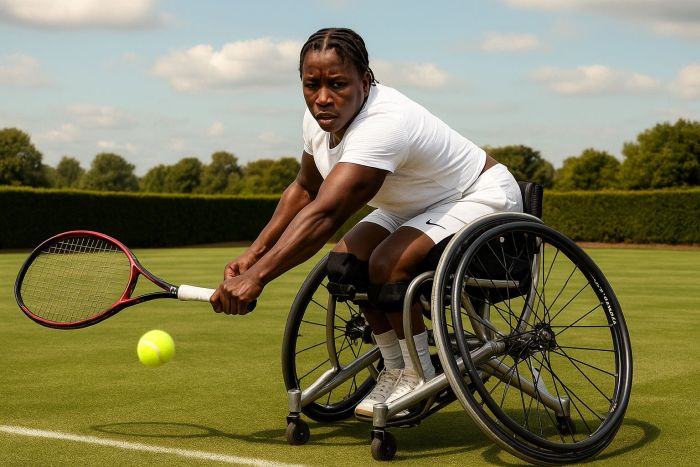
Man in a wheelchair playing Wheelchair Tennis

3. Rules of the Game

The game of wheelchair tennis follows the ITF Rules of Tennis with a few exceptions. Here are some of the significant exceptions:

1. The Two-Bounce Rule
The wheelchair tennis player is allowed two bounces of the ball. The player must return the ball before it hits the ground a third time. The second bounce can be either in or out of the court boundaries.

2. The Wheelchair
The wheelchair is considered part of the body and all applicable Rules which apply to a player’s body shall apply to the wheelchair. One buttock must remain in contact with the wheelchair seat when contacting the ball.

3. Propelling the Chair with the Foot
If due to lack of capacity a player is unable to propel the wheelchair via the wheel then he may propel the wheelchair using one foot.
For a complete list of rules, click here.

4. Equipment

All you need is a racquet and some tennis balls!
Beginners can play in their everyday chairs, including power chairs, but the more serious player can use a sports chair specifically made for tennis. You may wish to strap yourself into the chair to improve your stability. Straps can be used around the waist, knees and ankles, depending on the racquet to one’s hand if there is a lack of grip strength.

Adaptive equipment, including special socket devices with rings that attach to prostheses and which enable players to hold, toss, and serve balls, has also made tennis a popular sport among amputees.
Wheelchair tennis is one of the official Paralympic sports and also played at Grand Slams.
There are three categories; Men, Ladies, and Quads.

Each category has singles and doubles tournaments.
Quads is the category for those with quadriplegia and it is sometimes called Mixed especially at Paralympic Games. Quads players can hold rackets taped to the hand and use electric-powered wheelchairs.

The Invacare Top End Pro Tennis Wheelchair

5. South African Wheelchair Tennis

Wheelchair Tennis is one of the fastest growing wheelchair sports in the world. The ITF considers South Africa one of the global success stories in introducing the sport, making Wheelchair Tennis South Africa (WTSA) one of the top wheelchair tennis structures and nations in the world.

Wheelchair Tennis South Africa (WTSA) was established as a non-profit company in 2005 when a handful of players, including Craig Fairall and Kevin Smith, came together with a collective vision of formalising and developing wheelchair tennis into a mainstream sport.

WTSA was initially aligned with SASAPD (South African Sports Association for the Physically Disabled), but has recently closely re-aligned the organisation with TSA (Tennis South Africa) as its mother body. WTSA is also affiliated to the ITF (International Tennis Federation).

The ITF has sighted South Africa as a global success story for the introduction and growth of the sport. As a result of this recognition, South Africa now hosts six tournaments on the NEC World Wheelchair Tennis Tour including one of only 6 Super Series (Premier events) offered each year.  WTSA also hosted the Wheelchair Tennis World Team Cup in 2011.

WTSA now has sustainable sports programs running in each of South Africa’s 9 provinces to introduce and offer wheelchair tennis to as many physically disabled individuals & communities as possible. Through these programs people with disabilities are given the opportunity to learn a new skill and excel at a sport. Players are continuously developed and discovered through these programs from introduction to the game, to ultimately, representing South Africa internationally. To find out more, you can visit their website at: www.tennis.co.za

6. History

Wheelchair tennis increased in popularity in 1976 due to the efforts of Brad Parks, who is seen as the creator of competitive wheelchair tennis. In 1982, France became the first country in Europe to put a wheelchair tennis program in place. Since then, much effort has made to promote the sport to rid it of its ‘therapy’ image that still affects many sports for people with disabilities.

The sport quickly became popular worldwide and was introduced to the Paralympic Games as a demonstration event at the Seoul 1988 Summer Paralympics. It was at the 1992 Summer Paralympics in Barcelona that wheelchair tennis acquired the status of a full-fledged competition.
The 2000 Summer Paralympics in Sydney boosted public awareness immensely & led to the introduction of the sport to Grand Slams of pedestrian tennis.

For the 2013 season the ITF decided to adopt match tiebreakers in place of a third and deciding set in doubles matches. However the tiebreaker would only be used at events which were rated as ITF1 or lower and at the World Team Cup. The grand slams however were free to decide on the format of their tournaments.

7. Major Tournaments

International tournaments are organized by International Tennis Federation as a Uniqlo Wheelchair Tennis Tour.
In wheelchair tennis there are five top-ranked major tournaments called Super Series (SS); Australian Open (Melbourne), British Open (Nottingham), Japan Open (Iizuka), US Open (St. Louis) and French Open (Paris, BNP Paribas Open de France).

The World Team Cup is an international team event held annually. To wrap up the season, they have NEC Wheelchair Tennis Masters (singles event) and Uniqlo Wheelchair Doubles Masters tournaments which only world top-ranked players can compete. The top eight men and women based on the ranking after the US Open at the end of the year compete to be the champion of the year. In addition, Grand Slams, Australian Open, Wimbledon, Roland Garros, and US Open have each created wheelchair tennis category.

Yellow Arrow

It is also played at Paralympic Games and FESPIC games as well.
In 1990 wheelchair tennis was played at the abled bodied event in Miami, this lasted for more than 15 years.
In 2002 at the Australian Open, competitive wheelchair tennis took place at the same time and the same venue at a Grand Slam.
In 2005 the Masters series was created, comprising all the events at the Grand Slams and the end of year championships, as Wimbledon and the US Open joined Melbourne.
In 2007 Roland Garros joined and the Classic 8s were replaced by the Australian Open which had been held at the same venue two weeks later.
In 2009 all events played at the abled bodied Grand Slams were renamed Grand Slams.

The Netherlands has dominated numerous victories at major tournaments including Paralympic Games and Grand Slams.

Disclaimers and References

DiSA is committed to promoting the rights, dignity, and inclusion of persons with disabilities as outlined in the White Paper on the Rights of Persons with Disabilities. We strive to ensure that all content on our website reflects appropriate, respectful, and inclusive language in alignment with these principles.

However, we also provide a platform for companies and organisations to advertise their services and products. While we encourage advertisers to adhere to correct terminology and inclusive practices, DiSA cannot guarantee the accuracy or appropriateness of the language used by external parties in their content.

Please note: Any views, language, or terminology used in advertisements, promotional material, or external links do not necessarily represent the views of DiSA.

DiSA disclaims any responsibility for inaccuracies or language that may not align with the White Paper or best practices for disability terminology.

Should you however encounter language or content that you believe is inappropriate or offensive, we encourage you to contact us at info@disa.org.za, so that we can address the issue.

DiSA remains dedicated to fostering a respectful and inclusive environment for all individuals. We appreciate your understanding and collaboration in supporting our mission.


While we strive for accuracy and clarity, AI-generated visuals may not always reflect real-life conditions or representations.
In addition, we feature authentic images and videos of actual instances, events, circumstances that have occurred, as well as products and services supplied by companies who advertise with us.

These authentic visuals are intended to accurately depict our content or the offerings of our advertising partners.
If you have any questions or concerns about the content displayed on this site, please feel free to contact us.

DiSA provides a platform for companies and organisations to advertise their products and services to assist persons with disabilities and their families. While we make every effort to list reputable and credible service providers, the inclusion of any company, organisation, product, or service on our website does not constitute an endorsement or guarantee by DiSA.

Please note the following: DiSA is not involved in the delivery, quality control, or customer service of any product or service offered by advertisers listed on our platform.

Any agreements, purchases, or arrangements made between users of this website and advertisers are solely between those parties. DiSA is not responsible for the outcome of such interactions.

DiSA disclaims any liability for dissatisfaction, damages, or disputes arising from products or services supplied by companies or organisations listed on our website.

We encourage users to thoroughly research and verify any service provider or product before engaging with them. If you have concerns or encounter issues with an advertiser listed on our platform, please let us know at: info@disa.org.za. We value your feedback to help maintain the integrity of our platform.

While we strive for accuracy and clarity, AI-generated visuals may not always reflect real-life conditions or representations.
In addition, we feature authentic images and videos of actual instances, events, circumstances that have occurred, as well as products and services supplied by companies who advertise with us.

These authentic visuals are intended to accurately depict our content or the offerings of our advertising partners.
If you have any questions or concerns about the content displayed on this site, please feel free to contact us.

DiSA is committed to providing accurate and up-to-date information to assist persons with disabilities and their families. However, the nature of online content and external resources means that information can change frequently.

Please note the following: DiSA cannot guarantee the accuracy, completeness, or reliability of all information on our website, particularly information obtained from external sources or links to third-party websites.
External websites may update or remove content without notice, which can result in broken links or outdated information. DiSA is not responsible for the content, accessibility, or functionality of external websites.

While we make every effort to keep our information current, some content may become outdated over time.
We encourage users to verify information directly with the relevant third parties or organisations before making any decisions based on the information found on our platform.

If you encounter a broken link or outdated content, please notify us at: info@disa.org.za and we will address it as soon as possible.
Thank you for understanding and helping us maintain a reliable and accessible platform.


While we strive for accuracy and clarity, AI-generated visuals may not always reflect real-life conditions or representations.
In addition, we feature authentic images and videos of actual instances, events, circumstances that have occurred, as well as products and services supplied by companies who advertise with us.

These authentic visuals are intended to accurately depict our content or the offerings of our advertising partners.
If you have any questions or concerns about the content displayed on this site, please feel free to contact us.

The Information services and website that we offer free of charge, is privately run and funded and is not run or funded by the government. We rely on advertising, paid services and donations to supply and improve this Free information service that we do provide.

The Companies, Clubs, Schools and Organisations that are listed on this site, have advertised or made donations to the Website and have therefore assisted us be able to provide this free Service.
Please support them as they have supported Us and please contact us via info@disa.org.za, if you can advertise with us or would like to make a donation. Alternatively, visit our “Support Us” page to find out how you can support us or acquire our services. – Thank You.

If you encounter a broken link or outdated content, please notify us at: info@disa.org.za and we will address it as soon as possible.
Thank you for understanding and helping us maintain a reliable and accessible platform.

Please Note: We do assist with inquiries via email but may need to send or copy your details and inquiry to various other organisations, companies or government departments, that we sometimes consult, so that we can help you in the best way possible.
If you have any objection to us sharing your query or contact details, please notify us in your email. We will only share your information to assist you and will never sell or use your personal information for any other purposes.

DiSA waivers any liability for what happens if information is shared or used for marketing or other purposes by other organisations who do have consent to view such information.


While we strive for accuracy and clarity, AI-generated visuals may not always reflect real-life conditions or representations.
In addition, we feature authentic images and videos of actual instances, events, circumstances that have occurred, as well as products and services supplied by companies who advertise with us.

These authentic visuals are intended to accurately depict our content or the offerings of our advertising partners.
If you have any questions or concerns about the content displayed on this site, please feel free to contact us.

Please note that this website uses images and videos that are AI-generated and created to visually represent certain information, concepts or scenarios for illustrative purposes.


While we strive for accuracy and clarity, AI-generated visuals may not always reflect real-life conditions or representations.
In addition, we feature authentic images and videos of actual instances, events, circumstances that have occurred, as well as products and services supplied by companies who advertise with us.

These authentic visuals are intended to accurately depict our content or the offerings of our advertising partners.
If you have any questions or concerns about the content displayed on this site, please feel free to contact us.

Disability Info South Africa (DiSA) is committed to protecting your personal information in compliance with the Protection of Personal Information Act (POPIA), Act No. 4 of 2013. By using our free information service, you acknowledge and agree to the following:

Collection of Personal Information:
DiSA may collect and process your personal information (such as name, contact details, and inquiries) solely for the purpose of assisting you with your requests and providing relevant information or support.

Use and Storage:
Your personal information will only be used for the purpose it was collected for, we may need to send or copy your details and inquiry to various organisations, companies or government departments, that we sometimes consult, so that we can assist you in the best way possible.
If you have any objection to us sharing your query or contact details, please notify us in your email. We will only share your information to assist you and will never sell or use your personal information for any other purposes.
DiSA implements appropriate measures to secure your personal information against unauthorized access or loss.

Consent:
By submitting your details through our Contact Form, or contacting us via our email address, you consent to allow DiSA to process your information as outlined in this disclaimer. If you are not comfortable with DiSA sharing your information for the above purposes, please contact us directly at info@disa.org.za.

Access and Updates:
You have the right to request the deletion of your personal information at any time.
To do so, please contact us at: info@disa.org.za.

Third-Party Websites:
DiSA is not responsible for the privacy practices of external websites linked on our platform. Users are encouraged to review the privacy policies of third-party sites before sharing personal information.
For any queries or concerns regarding the handling of your personal information, please contact us at: info@disa.org.za.
Thank you for trusting DiSA to support you with accessible, inclusive, and reliable information.