


Boccia
Boccia is a precision ball sport designed specifically for athletes with severe physical disabilities, offering a highly strategic and inclusive competitive experience.
Played indoors on a smooth court, the game requires players to use skill, accuracy, and tactical planning to place their coloured balls as close as possible to a white target ball, known as the “jack.”
Boccia can be played individually, in pairs, or in teams, with specialised equipment and assistive devices available for athletes who need support with throwing or releasing the ball. Boccia provides a meaningful opportunity for athletes to compete at all levels — while building confidence, concentration, and a strong sense of achievement.
What Assistance are you Looking for?
1. About Boccia
2. How to Play Boccia
3. Equipment
4. Classification
5. Making Boccia Accessible
6. Boccia International
About Boccia
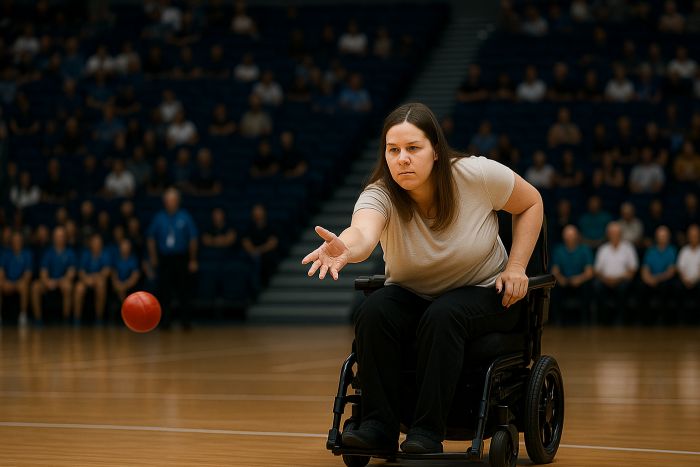
Boccia is a precision ball sport, similar to bocce, and related to bowls and pétanque. The sport is traditionally a recreational sport but can be contested at local, national and international levels, by athletes with severe physical disabilities.
It is a game of strategy and accuracy that was originally designed to be played by people with cerebral palsy, but now includes athletes with other severe disabilities affecting motor skills.
Boccia can be played on a recreational and/or competitive basis.
Competitions are organized locally, regionally, nationally, and internationally.
The international competition calendar is based on the Summer Paralympic Games quadrennial, with international regional championships in the first year, world championships in the second year, world cup in the third year, and the Paralympic games in the fourth year.
2. How do you Play Boccia?
Boccia can be played by individuals, pairs, or teams of three. All events are mixed gender. The aim of the game is to throw leather balls — coloured red or blue (which side uses which is determined by a coin toss) as close as they can to a white target ball, or jack. The sport is played on a flat, smooth surface, where players must throw or roll coloured balls as close as possible to a white target ball, known as the “jack.” The player, pair or team with the most balls near the jack is the winner.
The individual and pair matches consist of four ends, while team matches have six ends. After each end, the athlete, pair or team with the ball closest to the jack receive one point, and an additional point for every ball that is closer to the jack than the opponent’s. Each athlete, pair or team “throws” six balls per end.
The jack is thrown first, then the first two regular balls are played (first, the player who threw the jack then the opposing side), after which the side furthest away from the jack goes next in an attempt to either get closer to the jack or knock the opposition’s ball out of the way. In this fashion, each end will continue until one side has played all their balls, at which point, the opposing side will play their remaining balls.
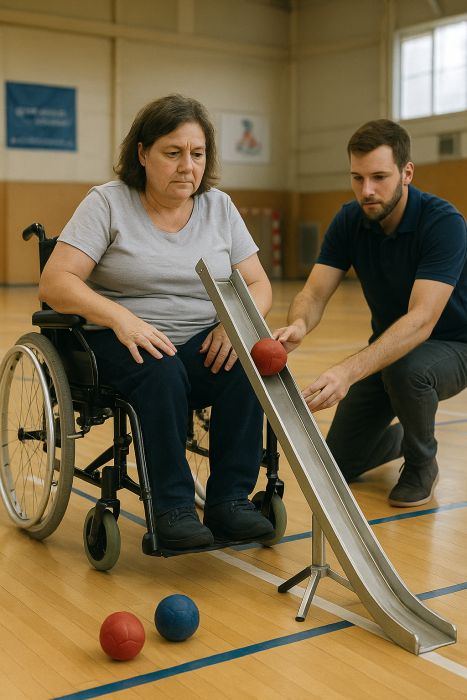
The balls can be moved with hands, feet, or, if the competitor’s disability is severe, with an assistive device such as a ramp. At the end of each round, or end, the referee measures the distance of the balls closest to the jack, and awards points accordingly — one point for each ball that is closer to the jack than the opponent’s closest ball. The team/player with the highest number of points at the end of play is the winner.
If both teams have the same number of points after all ends have been played, one additional end is played to determine a winner.
The number of ends and balls in each end depends on the side makeup.
Individual competition consists of four ends and six balls per player per end, whilst paired competition is four ends and six balls per pair per end (three per player). Team competition is six ends, and six balls per team per end (two per player).
In pair and team events, a reserve player is allowed.
Between ends a reserve can be substituted for a player during a game, but only one substitution per game is permitted.
3. Equipment
Boccia is played on a court measuring 12.5 × 6 m with 2 m of empty space around it. The surface of the court is flat and smooth. The throwing area is divided into six rectangular throwing boxes in which the athletes must stay completely within during play. On the court is a V-shaped line over which the jack must cross for the throw to be valid. At the end of the court is the ‘dead ball container’ in which balls are put if they are thrown outside of the time limit, out of the area of play or if the athlete violates a rule during his or her throw. A cross marks the position where the jack must be placed if it touches or crosses the boundary line or in the case of a tie-break.
The balls themselves are made of leather and are slightly larger than a tennis ball, weighing approximately 275 grams and measuring 270 mm in circumference. They are available in different grades of softness and hardness
4. Classification
To be eligible to compete in boccia at national or international level, athletes must have a disability and be in a wheelchair, as a result of cerebral palsy, or another neurological condition that has similar effects, such as muscular dystrophy or traumatic brain injury. Players are examined to determine the extent of their9disability and then assigned to a sport class, designed to allow them to compete against other athletes with a similar level of physical function.
Boccia players are assigned to one of four sport classes, depending on their functional ability:
CLASS
CONDITIONS
BC1
Players in this class throw the ball with the hand or foot.
They may compete with an assistant who stays outside of the competitor’s playing box, to stabilize or adjust their playing chair and give the ball to the player when requested.
BC2
Players in this class throw the ball with the hand.
They are not eligible for assistance.
BC3
Players in this class have very severe locomotor dysfunction in all four extremities.
Players in this class have no sustained grasp or release action and although they may have arm movement, they have insufficient range of movement to propel a boccia ball onto the court. They may use an assistive device such as a ramp to deliver the ball.
They may compete with an assistant; assistants must keep their back to the court and their eyes averted from play.
BC4
Players in this class have severe locomotor dysfunction of all four extremities as well as poor trunk control.
They can demonstrate sufficient dexterity to throw the ball onto the court. Players are not eligible for assistance.
5. Making Boccia Accessible
There are over 350 internationally ranked boccia players. 88 Athletes from 19 countries competed at the 2008 Summer Paralympics in Beijing.
Athletes from 36 countries attended the 2010 Boccia World Championships. 28 Countries participated in the team competition.
Boccia is active in all the provinces of South Africa. The convenor for Boccia at SASAPD is: Ruon van Zyl.
The Making Boccia Accessible project was first conceived in 2013.
The first step was to identify a manufacturer for the equipment, as they wanted to provide the essentials, at no charge, to children in disadvantaged countries around the world. All manufacturers of boccia balls were given the opportunity to tender for the project. A shortlist was created, and samples requested to ensure that the highest quality balls were purchased.
Handilife were selected as the successful bidder based on price, quality and company values.
You can visit their web site to find out more: Making Boccia Accessible
Officially rolling out in 2014, the Project made its way to South Africa in 2015. and has since spread to more developing countries.
To encourage more people to get involved, participants were taught the basics and sent away with equipment.
The project is continuing to grow, with courses now being held across other countries Africa and America.
The next step is to introduce the game to countries within Asia that don’t currently participate.
6. Boccia International
The Boccia International Sports Federation (BISFed) is the international governing body for the sport of boccia.
Their aims and objectives include:
– To promote, enhance and support Boccia as a sport for all people and to help promote its activities
– To govern the sport of Boccia internationally through a set of rules, a classification system and an international competition structure.
– To promote Boccia amongst those who make decisions that directly impact upon the sport.
– To promote and represent the interests of the members of the Company, and on their behalf to undertake lobbying and similar activities.
– To create a network of members and individuals which encourages contact and exchange of ideas and experience regarding the sport of Boccia.
Boccia was practiced for many years as a leisure activity until it was introduced at the New York 1984 Paralympic Games as a competitive sport.
In 1984, it became a Paralympic sport, and by 2008 was played in over fifty countries worldwide.
Boccia is governed by the Boccia International Sports Federation (BISFed).
It is one of only two Paralympic sports that do not have an Olympic counterpart (goalball being the other).