


Sailing and Surfing
Para sailing and para surfing open the ocean to athletes of all abilities, proving that adventure has no physical limits. Both sports use adaptive equipment and tailored coaching to create safe, empowering ways for persons with disabilities to experience the freedom of the sea.
Para sailing offers stability, teamwork, and the thrill of harnessing the wind, while para surfing provides direct contact with the movement of the waves, balance, and pure ocean energy. Together, these parasports build confidence, strength, and independence — showing that the ocean truly belongs to everyone.
What Assistance are you Looking for?
1.1. About Adaptive Sailing
1.2. Classification System
1.3. History
1.4. Get Involved
2.0. Surfing
About Adaptive Sailing
Disabled Sailing takes many forms, if you want to race, cruise or simply potter around in all kinds of boats, on the sea or inland water. It is one of the few sports in which able-bodied sailors and disabled sailors with degrees of disabilities can participate on equal terms.
The Para World Sailing Committee is responsible for sailing for people with disabilities worldwide.
The committee are responsible for the Paralympics Sailing Program including Events and Equipment selection. They promote, assess and support program’s for disabled sailing run by their Member National Authorities (MNAs).
The committee promotes all types of sailing for people with all types and degrees of disability. It is practiced by athletes in more than 70 countries worldwide and is open to athletes with any type of physical impairment. The values of the committee are equity, opportunity to excel and empowerment for sailors with disabilities.

2. The Classification System
Unlike many other Paralympic sports, Para Sailing uses a functional classification system that evaluates an athlete’s physical abilities rather than a medical diagnosis. The goal is to ensure fair competition by grouping sailors with similar functional abilities.
Athletes are assessed across several areas of physical function, including:
– Mobility
– Strength
– Coordination
– Trunk stability
– Hand and arm function
– Balance
Each athlete is given a numerical classification score, typically ranging from 1 to 7, where:
1 = highest level of impairment
7 = minimal impairment
Athletes compete in three events, which are non-gender specified:-
– single-person keelboats
– two-person keelboats.
– three-person keelboats
The values of the committee are equity, opportunity to excel and empowerment for sailors with disabilities.
Those interested in taking part in the disabled sailing programme can contact Gray on: iuan@pixu.co.za
3. History
Sailing was introduced at the Atlanta 1996 Paralympic Games as a demonstrative sport.
It became a medal sport at the Sydney 2000 Paralympic Games. At the London 2012 Games, 80 athletes competed in three medal events.
SA Sailing and the international sailing federation, have one simple philosophy regarding disability and the sport – inclusion.
We are merely working towards including disabled sailors in something that any person could choose to do.
Sailing is an activity that we can all take part in and really enjoy.
4. How to Get Involved
Key Organisations and Initiatives:
South African Sailing (SAS): The national authority promoting accessible sailing, with resources like manuals and news on adaptive programs in Pretoria and elsewhere.
The Little Optimist Trust: Focuses on mental health and child development through sailing, organizing events like the Great Optimist Race that feature adaptive teams.
Milnerton Aquatic Club: An accredited club aiming to provide all-inclusive sailing access.
Adaptive Sports Fund: A group involved in promoting adaptive sports, including sailing and canoeing.
How to Get Involved:
Contact SAS: Visit the South African Sailing website for training materials and to find affiliated clubs.
Look for Local Clubs: Check with clubs like Milnerton Aquatic Club for adaptive programs.
Support Charities: Engage with organizations like The Little Optimist Trust for events and opportunities.
Surfing
About Adaptive Surfing
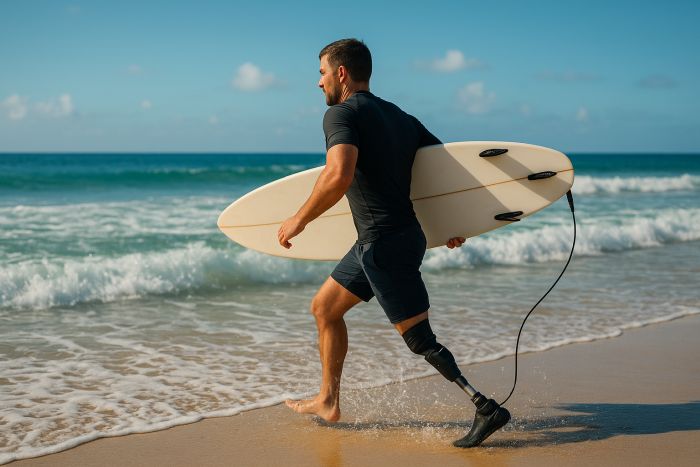
Having a disability doesn’t mean that surfing is out of reach. Surfing for the disabled, known as Adapted surfing was introduced in December 2011.
Adapted surfing was introduced to the disabled community of the Western Cape when the first ever Adapted Surfing event, hosted by Extreme Abilities and Surfing South Africa at Big Bay, was held at Big Bay Bloubergstrand in December 2011.
The first event hosted 15 disabled individuals and every year the event grew in size to a point where more than 70 disabled individuals are hosted at each event.
A number of these events have taken place since then, where participants with different disabilities, ranging from high spinal cord injuries and amputees to intellectual disabilities and blindness are able to participate in these events.
Surfers with different disabilities, ranging from high spinal cord injuries and amputations – to intellectual disabilities and blindness, can participate.
At the moment Adaptive Surfing is in a fast paced developing stage on an international scale with the first ever World Adaptive Surfing Championships hosted in 2015 with 17 countries represented.
The aim is to give opportunities to individuals who live with disabilities to explore their own capabilities and experience the freedom of riding a wave.
This would not be possible without the many volunteers who assist the participants get down to the water’s edge and onto the waves.
Visit Extreme Abilities to view the events they they have hosted since the inception of Adaptive Surfing in South Africa as well as other adaptive surf events organised by other like minded groups.
If you are a South African resident with a disability and you surf or have surfed before your disability,
please contact Extreme Abilities for more information on adaptive surf clubs in South Africa. They will put you in contact with an adaptive surf club near you. If there is no club near you and you are as passionate about surfing, they will help you start your own club.
Contact www.extremeabilities.co.za