


Golf and Bowls
Para-Golf and Para-Bowls are highly accessible, inclusive sports that offer people with physical, sensory, or neurological impairments the opportunity to compete, socialise, and stay active.
Both sports emphasise precision, strategy, and control rather than speed or strength, making them adaptable for athletes with a wide range of abilities.
With modified equipment, supportive rules, and structured classification systems,
Para-Golf and Para-Bowls provide meaningful pathways for participation—from recreational play to high-level competition—while fostering confidence, independence, and a strong sense of community.
What Assistance are you Looking for?
Para-Golf
1. About Para-Golf
2. South African Disabled Golf Association (SADGA)
Para-Bowls
1. About Para-Bowls
2. Paralympic Games
3. Disability Classification
4. Disability Bowls in South Africa
About Para-Golf
Golf, as you know, is a precision club and ball sport, in which competing players (or golfers) use many types of clubs to hit balls into a series of holes on a golf course using the fewest number of strokes.
The game is played on golf courses, each of which features a unique design, although courses typically consist of either nine or 18 holes.
Disability golf classification is used to guarantee that no matter your disability, you can compete on an even footing. It is used for deaf golf, blind golf, amputee golf, golf for the mentally challenged, paraplegic golf and other forms of golf involving the disabled.
Disabled golf in South Africa is run by the South African Disabled Golf Association (SADGA)
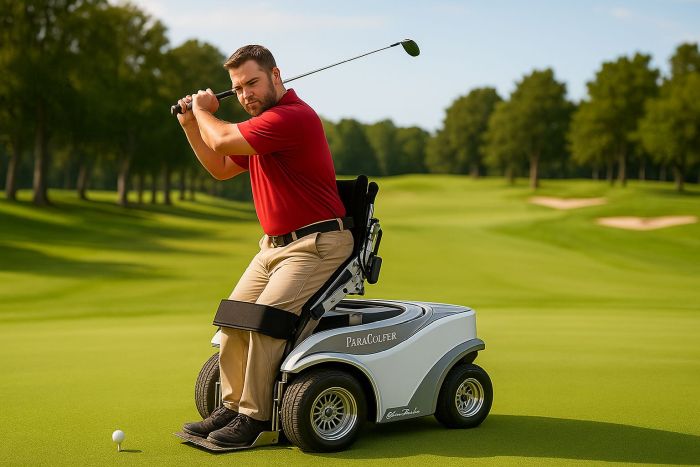
2. South African Disabled Golf Association (SADGA)
This includes those with Intellectual Disabilities. South African Disabled Golf Association (SADGA) helps people regardless of your physical or sensory disability, to take part in golf, in doing so it also builds your character. Disability golf classification is used to guarantee that no matter your disability, you can compete on an even footing
SADGA was incorporated as a Section 21 Company in July 2004.Through golf they pride themselves on being a unique community that produce strong & courageous persons that can effectively handle adversity and face any challenge that comes before them.
Their aims include:
– Encourage every South African with a permanent disability to play golf.
– Promote golf as a viable form of rehabilitation and recreation for the disabled.
– Bring together able and disabled golfers to share their love for the game, in the spirit of friendship and competition.
– Create public awareness of challenges facing disabled golfers, and to highlight their achievements.
Para-Bowls
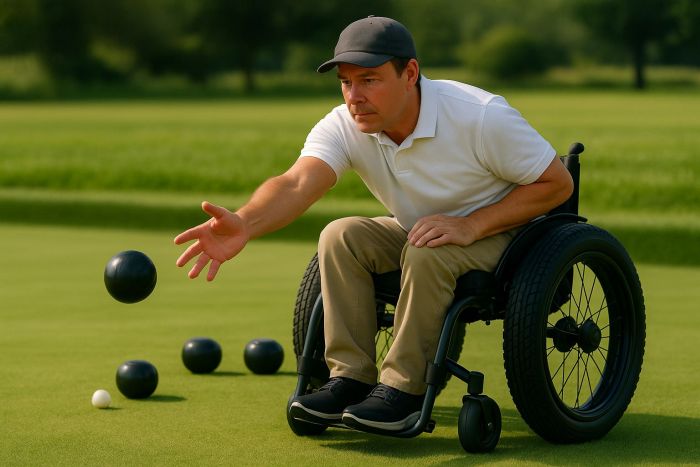
Lawn bowls is a precision sport where disabled individuals can equally compete with their able-bodied rivals. The game calls for rolling round balls, which are referred to as lawn bowls, toward small white-colored ball target, which is referred to as Jack.
The sport is usually played on a surface called “Bowling Green” which is divided into parallel playing strips dubbed as rinks. The objective of the game is to enable one or more bowls of the team get nearer to the Jack than that of the opposing team’s.
Lawn bowls made its debut in the 1984 Paralympic Games, where competitors with vision and impairment and cerebral palsy participated. The sport was later scrapped in the 2000 edition of the Games.
All of the lawn bowls players are categorized based on their disability. The lawn bowls classification system has eight sections and there are certain requirements that should be satisfied to determine what type of wheelchair an athlete can use during competition.
International Bowls for the Disabled has its origins in the family of the International Paralympic Committee (IPC), one of the largest sporting organisations in the world and the peak international body governing sport for athletes with a disability.
Formerly a sport on the program of the Paralympic Games, bowls was excluded from this high profile world event in 1996.
2. Paralympic Games
Competitors with cerebral palsy classifications were allowed to compete at the Paralympics for the first time at the 1984 Summer Paralympics.
Bowls was dropped at the 1992 Summer Paralympics, returning again in the 1996 Summer Paralympics – and dropped again in 2000 Summer Paralympics.
Blind, wheelchair and amputee disability types were eligible to participate, with classification being run through the International Paralympic Committee, with classification being done based on wheelchair and blindness.
The sport was not on the Paralympic program as of 1999.
3. Disability Classification
Bowls classification is the classification system for lawn bowls where players with a disability are classified into different categories based on their disability type. Classifications exist for blind bowlers. Bowls was played at the Paralympics.
Bowls has rules that were designed specifically with people with disabilities in mind.
Classifications for this sport is based on functional mobility.
The visual impairment classification was part of the 1994 Commonwealth Games. Several classes in this sport were included in the 2002 Commonwealth Games.
4. Bowls for the Disabled South Africa (BDSA)
BDSA is the body that represents bowlers with disabilities — including physically disabled and visually impaired bowlers — at national and provincial levels across South Africa.
It operates under Bowls South Africa (BSA), which governs bowls generally. The BSA’s “Disability” Standing Committee oversees the needs and representation of disabled bowlers through BDSA.
BDSA organizes a national championship for disabled bowlers each year. This brings together participants from across the country — including people using wheelchairs, people with visual impairment, amputees, and those with mobility impairments.
Through the committee system, BDSA helps manage classification, tournament organization, and integration of disabled bowls within broader bowls club networks across South Africa. They also support inclusion efforts: many regular bowls clubs and districts in South Africa welcome disabled players, offering coaching, adapted facilities, and social/competitive opportunities.
For more information, about Bowls for the Disabled in South Africa visit their website: https://www.dbza.co.za/