


Adaptive Cricket
Adaptive cricket offers people with disabilities in South Africa the chance to participate in one of the nation’s most loved sports through inclusive formats tailored to different abilities.
With adaptations for players who are visually impaired, Deaf or hard of hearing, or who have physical or mobility impairments, the game maintains the spirit, strategy, and excitement of traditional cricket. Modified rules, specialised equipment, and flexible team structures ensure fair play while highlighting each player’s strengths. Whether played socially, competitively, or at international level, adaptive cricket promotes fitness, confidence, teamwork, and equal opportunity — proving that cricket truly is a game for everyone.
What assistance are you looking for?
1. About Wheelchair Cricket
2. International Cricket Governance
– International Wheelchair Cricket
3. Rules and Regulations
4. Wheelchair Cricket in South Africa
– Differently Abled Cricket Club


1. About Wheelchair Cricket
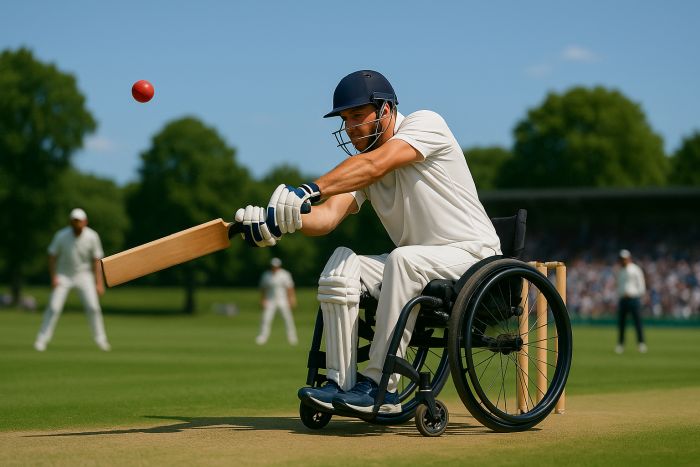
Wheelchair cricket is an exciting adaptive format that enables players with mobility impairments to enjoy the strategy, skill, and competitive spirit of traditional cricket from a wheelchair.
Played on a hard, smooth surface with modified rules and lightweight equipment, the sport allows athletes to bat, bowl, and field with speed and precision using sports wheelchairs designed for agility and stability.
Wheelchair cricket is growing rapidly in South Africa, offering opportunities at social, club, and competitive levels.
Beyond the game itself, it promotes fitness, coordination, teamwork, and confidence, while building an inclusive community where players can challenge themselves and experience the thrill of cricket in a fully accessible format.
2. International Cricket Governance
The International Cricket Council (ICC) is the global governing body of cricket. It was founded as the Imperial Cricket Conference in 1909 by representatives from Australia, England and South Africa. It was renamed as the International Cricket Conference in 1965, and took up its current name in 1989.
The ICC has 104 members: 12 Full Members that play Test matches and 92 Associate Members. The ICC is responsible for the organisation and governance of cricket’s major international tournaments, most notably the Cricket World Cup. It also appoints the umpires and referees that officiate at all sanctioned Test matches, One Day International and Twenty20 Internationals. It promulgates the ICC Code of Conduct, which sets professional standards of discipline for international cricket, and also co-ordinates action against corruption and match-fixing through its Anti-Corruption and Security Unit (ACSU).
The ICC does not control bilateral fixtures between member countries (which include all Test matches), it does not govern domestic cricket in member countries, and it does not make the laws of the game, which remain under the control of the Marylebone Cricket Club. [ Read More: …. ]
i. International Wheelchair Cricket
At this moment in time there is no recognised international cricket for persons with Mobility Impairments. One of the barriers that needs to be overcome is the standardising of a classification system that will be accepted globally. This is to ensure that someone who uses a wheelchair isn’t competing against someone who is missing half a finger.
There are however some countries around the world that are beginning to compete against each other in cricket for physical disabilities, such as the first wheelchair cricket tournament which got underway in Nepal in 2016. The inaugural International Wheelchair Cricket Tournament started off in Nepal’s Kathmandu. Teams from different nations are involved in a T20 series. The tournament has participation of teams from Nepal, India and Bangladesh” which is supported by the Sushil Koirala Memorial Foundation and technical assistance from the Kathmandu Cricket Training Center. [ Read More: …. ]
3. Rules and Regulations
In disability cricket, there are a few rules and regulations that are specific to the different impairment groups. Where possible the game is played in accordance with the MCC Laws of Cricket but there are some differences. In the domestic structure in England, the players in the domestic structure have adopted the DSE profiling system for athletes with physical impairments otherwise known as the Coaches Guide to Functional Ability. [ Read More: … ]
In some countries such as India and Australia, they play Para Sitting Cricket. The Para Sitting Cricket Association of India was formed and they created their own set of Rules and Regulations. [ Read More: … ]
4. Wheelchair Cricket in South Africa
Cricket for persons with Mobility Impairments, is available in certain clubs and schools in South Africa, but is not currently part of Cricket South Africa. Cricket South Africa (CSA) has three Disability entities affiliated to the organisation: Blind Cricket South Africa (BCSA); South African Deaf Cricket Association (SADCA) and South African Sports Association for the Intellectually Impaired (SASA-II). [ Read More: …. ]
Contact Johan Weyers for more information: Tel: 012 484 1835 | Email: johanw@cricket.co.za
The Differently Abled Cricket Club
The Differently Abled Cricket Club from South Africa are on a mission to uplift the Physically Disabled side of Cricket in South Africa.
“We have to start from the bottom and work our way up. We are in the process of establishing a league within the schools for this, then once that is done we are looking at the Northerns side”.
In 2017 the Differently Abled Cricket Club (DACC) adopted the principle of not being ashamed of who we are and hence the name Differently Abled Cricket Club, the club felt it’s time we have our own identity and independence and focus on the awareness of LSEN (Learners with Special Educational Needs) which includes the Blind, Deaf, Intellectually Impaired and Physically Disabled.”
The home of Differently Abled Cricket Club is located at FH Odendaal High School, we have embarked on a new journey and with the relationship we have built with the school they have given us permission to make the school our new home. We are in the process of building a clubhouse at the school and we also want to build a cricket academy specifically for differently abled players. Currently we are in the process of getting junior teams going as this is the feeding system for the club going forward.
With our new constitution we not only want to develop the cricket skills of players but also want to create a skills development program for our cricketers in order to attain the required skills for the workplace.
For more information: Contact Christo Pelzer – Cell: +27 82 998 4568 or Email: admin@dacc.co.za
Address: 200 Baviaanspoort Road, Derdepoort, Pretoria, 0186 | Website: www.dacc.co.za