


Wheelchair Basketball
Wheelchair basketball is one of the most popular and widely recognised adaptive sports in the world — and for good reason. Dynamic, fast, and highly strategic, it offers all the intensity and excitement of traditional basketball while ensuring full inclusivity for athletes with physical impairments.
Played on a standard court with a regulation-height hoop, the sport uses specially designed wheelchairs that allow players to manoeuvre, pivot, and compete at remarkable speed and precision.
Wheelchair basketball brings together skill, teamwork, athleticism, and community, empowering players of all abilities to push their limits, build confidence, and experience the thrill of high-level competition.
What Assistance are you Looking for?
1. About Wheelchair Basketball
2. Wheelchair Basketball in SA
3. Rules and Regulations
4. Wheelchair Basketball Classifications
5. Equipment
6. History of Wheelchair Basketball
About Wheelchair Basketball
Wheelchair Basketball is an integrated sport, meaning that able-bodied people can compete up to the national level. It’s a great sport for paraplegics, amputees, people with spina bifida, people with arthritis, people with cerebral palsy and people with a wide range of orthopaedic injuries. Though quadriplegics do play wheelchair basketball, many find that the sport requires too much upper-body strength and so prefer sports like wheelchair rugby.
Wheelchair basketball is played by people in wheelchairs and is considered one of the major disabled sports practiced. The International Wheelchair Basketball Federation (IWBF) is the governing body for this sport. It is recognized by the International Paralympics Committee (IPC) as the sole competent authority in wheelchair basketball world wide.
It is estimated that more than 100,000 people play wheelchair basketball for recreation, or in clubs, provincial or national teams.

Wheelchair basketball is included in the Paralympics Games. The Wheelchair Basketball World Championship is organized two years after every Paralympics Games. It is played mainly by Paraplegics or people with disabilities below the waist. Quadriplegics do sometimes play, but often battle to compete.
At international level players are given classifications according to their disabilities.
2. Wheelchair Basketball South Africa (WBSA)
Wheelchair Basketball SA (WBSA) was Established in 1970 under the SA Sports for the Physically Disabled, it’s focus was to create an organisation with a corporate identity that would enhance investors & in so doing, secure funding for its participants.
The establishment of commissions were established with the emphasis to develop & promote basketball, create awareness of basketball, improve the standard of local and national competition, assist all clubs and members to participate in National, District and Regional Competitions & to organize league competitions, tours and exhibitions in all areas within its jurisdiction.
In doing this they have gained financial support by investment and sponsorship & thus provided return of investment by achieving set company goals following the ethics of honesty and integrity. If you would like to visit their site, you can go to: www.basketball.co.za
3. Rules and Regulations
Wheelchair basketball retains most major rules and scoring of basketball, and maintains a 10-foot basketball hoop and standard basketball court.
The exceptions are rules which have been modified with consideration for the wheelchair.
For example, “travelling” in wheelchair basketball occurs when the athlete touches their wheels more than twice after receiving or dribbling the ball. The individual must pass, bounce or shoot the ball before touching the wheels again.
In some countries such as Canada, Australia and England, non-disabled athletes using wheelchairs are allowed to compete alongside other athletes on mixed teams.
4. Wheelchair Basketball Classifications
Classification is an international regulation for playing wheelchair basketball to harmonize the different levels of disabilities players have.
All teams which compete above a recreational level use the classification system to evaluate the functional abilities of players on a point scale of 1 to 4.5.
Minimally disabled athletes are classified as a 4.5, and an individual with the highest degree of disability (such as a paraplegic with a complete injury below the chest) would have the classification of 1.0. Competitions restrict the number of points allowable on the court at one time.
The five players from each team on the court during play may not exceed a total of 14 points.
In places where teams are integrated, non disabled athletes compete as either a 4.5 in Canada or a 5.0 in Europe, however non-disabled athletes are not allowed to compete internationally.
5. Equipment
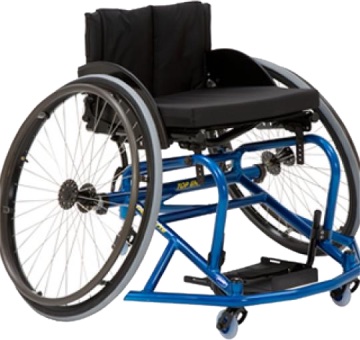
Basketball wheelchairs are designed for enhanced stability. The centre of gravity is where the chair and the athlete’s mass are equally distributed in all directions. A wheelchair with a higher seat is easier to tip.
Basketball chairs have lower seats and wheels that are angled outward so that the centre of gravity is lower to help prevent the chair from tipping.
The wheelchairs are classified in two groups based on position.
There are chairs for forwards and centres and there are chairs for guards.
Forwards and centres are typically under the net, their chairs have higher seats and therefore less mobility, but the height increases the player’s reach for shots at the hoop and for rebounds.
Guards have lower seats and therefore greater stability for ball handling and getting down the court as quickly as possible.
6. History of Wheelchair Basketball
In 1944, Ludwig Guttmann, through the rehabilitation program at the Stoke Mandeville Hospital, in Aylesbury, Buckinghamshire, England, adapted existing sports to use wheelchairs. It was known as wheelchair netball. Around the same time, around 1946, wheelchair basketball games were played primarily between American World War II disabled veterans. Since then, the sport has spread throughout the world.
In 1947, the Stoke Mandeville Wheelchair Games were held. These were the first games to be held and included only 26 participants, a few other events like shot put, javelin, club throw, and archery were also played.
Growth in both the number of wheelchair events and participants came quickly.
Wheelchair netball was introduced in the 1948 Games.
In 1952, a team from the Netherlands was invited to compete with the British team. This became the first International Stoke-Mandeville Games (ISMG), an event that has been held annually ever since.
Wheelchair basketball, as we know it now, was first played at the 1956.
In 1973, the International Stoke Mandeville Games Federation (ISMGF) established the first sub-section for wheelchair basketball. At that time ISMGF was the world governing body for all wheelchair sports.
In 1989 ISMGF was named International Wheelchair Basketball Federation (IWBF).
Full independence came in 1993 with the IWBF becoming the world body for wheelchair basketball with full responsibility for development of the sport. Over the following years IWBF membership grew in size & configured itself into four geographical zones: Africa, Americas, Asia/Oceania and Europe.