Sports and Hobbies for the Hearing Impaired

Welcome to the Deaf and Hearing Impairment – Sports and Hobbies section of the DiSA website. This space is dedicated to informing, supporting, and inspiring people who are deaf or hard of hearing by showcasing the sports, and recreational activities that are available, accessible, and enjoyable.

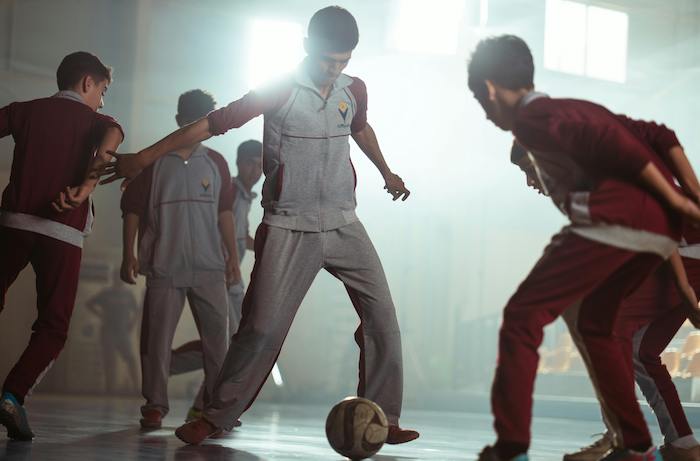
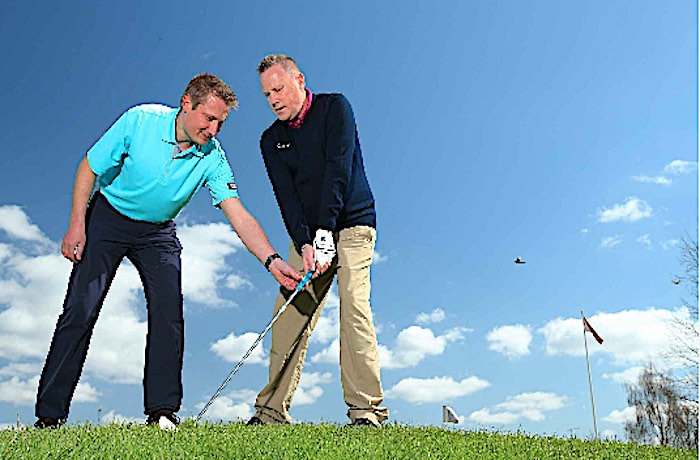
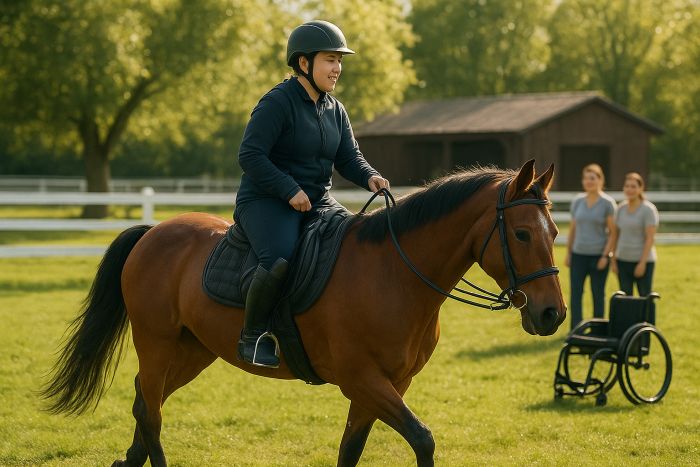
A Hearing impairment does not limit participation in an active lifestyle. With appropriate communication methods, visual adaptations, and supportive environments, deaf and hard-of-hearing individuals can take part in a diverse range of activities, from team and individual sports to fitness and leisure pursuits.

Whether your interest lies in social engagement, physical fitness, skill development, or high-level competition, there are opportunities featured here to suit different interests, abilities, and lifestyles.

The Benefits of Sport and Recreational Activities

Sports, hobbies, and recreational activities are not only enjoyable, but also play an important role in overall health and wellbeing. They offer powerful opportunities to stay active, build confidence, manage stress, and connect meaningfully with others.

Participation in sport and recreation provides significant physical, psychological, and social benefits for people with physical challenges. These include improved fitness, mood, and self-esteem, as well as a stronger sense of community, inclusion, and personal growth. Over time, this participation can support greater independence in daily life and contribute to an improved sense of wellbeing and belonging.

Whether participating on the field or supporting from the sidelines, sport brings people together, inspires communities, and helps challenge misconceptions and stigma around disability.
Choosing a Sport or Hobby best suited for you

Hearing impairment is not a barrier to participation. Regardless of your age, level of hearing, experience, or gender, there are sports and hobbies that can be adapted to suit your needs and goals — whether you are looking for recreation, fitness, social connection, or competitive sport.

The first step is choosing a sport or hobby that matches your interests, abilities, lifestyle, and budget. Take time to think about what you would enjoy most. Whether you prefer high-energy or more relaxed activities, team or individual sports, considerations such as communication methods, accessibility, available adaptations, and support structures should form part of your decision-making process. From there, you can explore the wide range of opportunities available and find an activity that fits your needs and aspirations.

3. Sports and Hobbies for persons with Deaf|Hearing Impairments

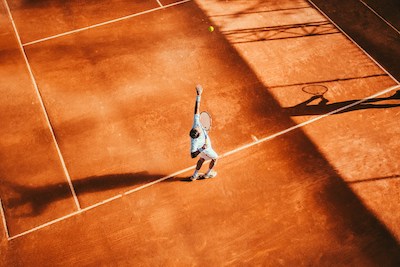
Take your Pick: Choose a Sport That Suits Your Interests

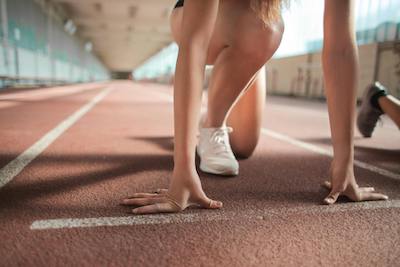
Below are a list of a few sports that are available to the Blind and persons with Visual Impairments in South Africa. These sports are available at social, club and Provincial level, while some are available at the Paralympics and The IBSA World Championships, where the classification process is used.
To view more information about these Sports please click on your preferred link below:
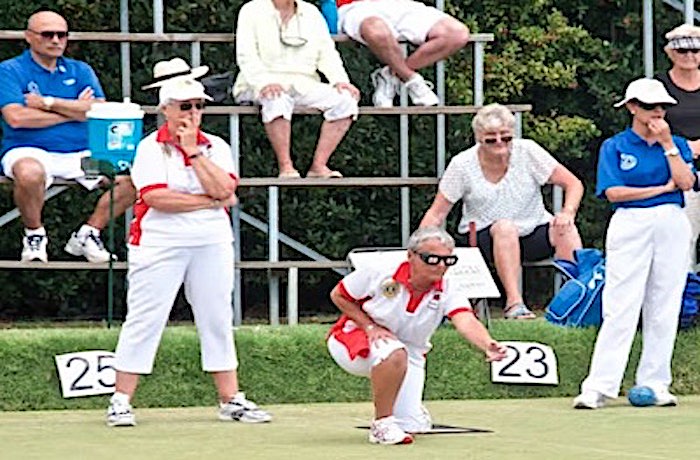
Choose a Hobby that suits your interests:

Not every form of activity has to be competitive — meaningful, adaptive hobbies can be just as empowering.
Depending on your interests, abilities, resources, and location, explore the hobby ideas below and discover new ways to stay engaged, creative, and fulfilled. Let’s find the pastime that brings you joy.
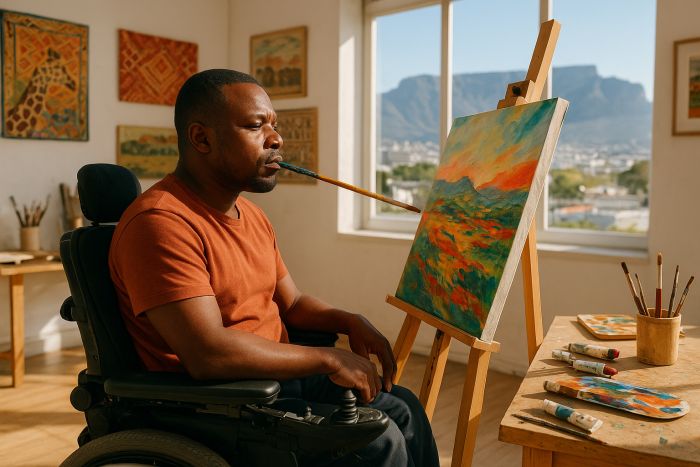
Art - Mouth Painter painting a landscape in his studio
Art and Creative Writing

Being deaf doesn’t limit your creativity. You can write poems, stories, or essays – or express yourself through drawing, painting, or other forms of art.
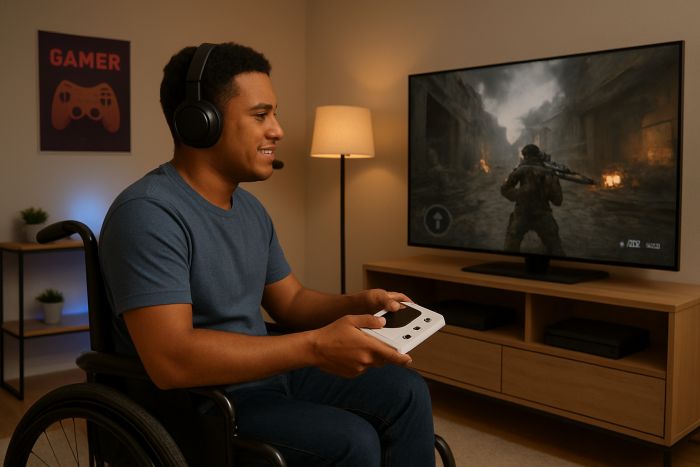
Young man in a wheelchair playing a video game
Card, Video and Board Games

Games are for everyone! Whether it’s card games, board games, or video games, you can enjoy social interaction, strategy, and fun, with visual cues and adapted communication making play fully accessible.

Books & Reading - Man in a motorized wheelchair reading a book on a lap tray.
Books and Reading

Books and reading open up worlds of imagination and knowledge. enjoy printed books, e-books, or graphic novels, as well as audiobooks with captions or sign language adaptations.

Organisations that can assist with support and expenses
If you are not in a position to afford the equipment you require, consider looking for Organisations that can sponsor equipment and other expenses, such as the QASA Education and Sports Fund and Bidii Yetu – No Limits.

Bidii Yetu - No Limits

Bidii Yetu No Limits is a U.S.-based 501(c)(3) non-profit organization registered in New Mexico and dedicated to promoting the inclusion of persons with disabilities through sports.
 
In 2023 Bidii Yetu No Limits had a Vision to create a world in which people with impairments discover the strength to overcome the barriers that hold them back, regardless of their disability.Bidi-Yetu-No-Limits
 
Their mission was exemplified by organizing adaptive and able-bodied cycling events, such as a notable journey that the organised covering over 3,000 kilometres across five countries in Southern Africa. Furthermore, Bidii Yetu showed their commitment to creating awareness and growing the sport of Adaptive Cycling by donating money raised during the cycling event, to various organisations involved in Adaptive Cycling, including DiSA.
 
In 2024, after completing this amazing event, Bidii Yetu No Limits joined our “Accessible Cities South Africa (AC – SA)” platform by providing funding to DiSA to help promote adaptive cycling and create awareness for the benefits of sport for persons with disabilities.
 
Through the funding provided by Bidii Yetu, DiSA have been able to:
 
    Create various videos to create awareness for the benefits of sports, including Adaptive Cycling for persons with disabilities.
    Provide free advertising on the DiSA website to promote various selected Sports Clubs that provide Adaptive Cycling for persons with disabilities.
 
Thereby assisting DiSA to promote the sport of Adaptive Cycling to persons with disabilities and making the information about these clubs easily accessible through our information service. Through this partnership between DiSA and Bidii Yetu, we look forward to growing the sport of Adaptive Cycling to make it truly accessible to all persons with disabilities.
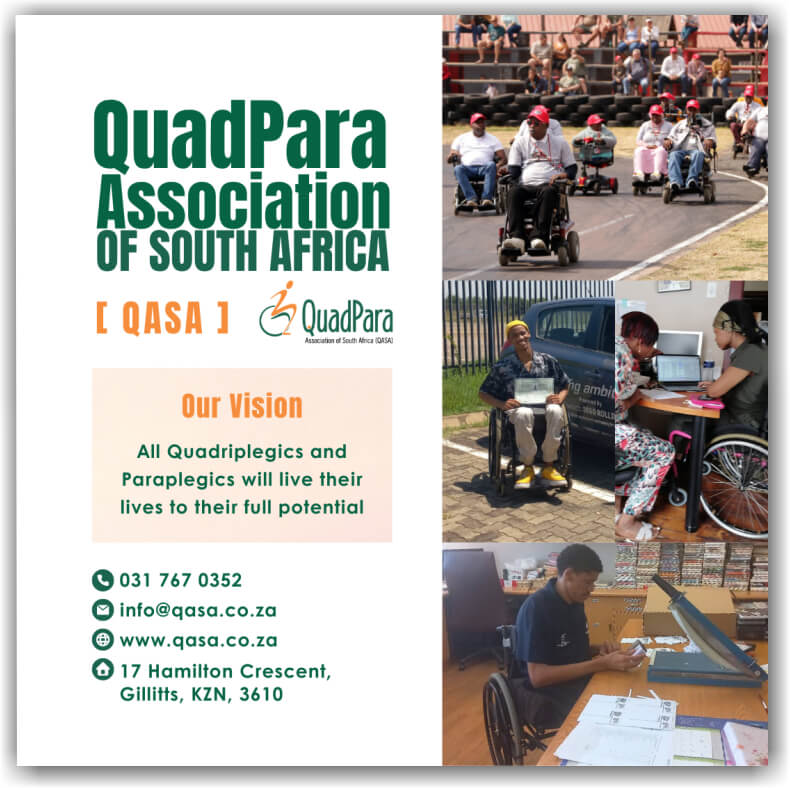
Advertisement for QuadPara - Association of South Africa (QASA) Logo


QASA Education and Sports Fund – The QuadPara Association of South Africa (QASA) is a non-profit organisation (NPO 000-881) of Quadriplegics and Paraplegics in South Africa. QASA’s mission is “to improve lives by securing resources to advocate, educate, capacitate, support and mobilize”.QuadPara Association of South Africa QASA’s vision is that “all quadriplegics and paraplegics will live their lives to their full potential”

QASA develops products, programmes and services for quadriplegic and paraplegic members to build their capacity and ensure opportunities for societal integration and empowerment.

These projects and services include but are not limited to the Education and Sports Fund:

Wheelchair sports are sporting activities where participants use wheelchairs – either manual or power. There are several sports that have been adapted to be played by wheelchair users in South Africa. QASA wants to give their membership a holistic development and feels that sports are a vital way of keeping fit and healthy for wheelchair users. QASA recognizes the value of sport and hobby and wants to encourage participation by Quadriplegics and Paraplegics. For this reason, QASA has a fund for wheelchair users to participate in sporting activities.

Read More about the QASA Education and Sports Fund on the QASA Website


iii. Eligibility Criteria

To compete formally in deaf sport, athletes must meet recognised deaf eligibility criteria, which are used to ensure fair and equal competition. Eligibility is typically based on a confirmed level of permanent hearing loss, verified through an official audiogram.

Eligibility determines who may compete in deaf sport and ensures that all athletes participate under the same conditions, minimising any advantage related to hearing ability. For this reason, hearing aids, cochlear implants, and assistive listening devices are not permitted during competition.

Eligibility requirements are consistent across deaf sports, as hearing impairment affects participation differently from physical or visual impairments. An athlete may therefore be eligible for deaf sport competition while competing under standard rules in mainstream sport in other contexts.
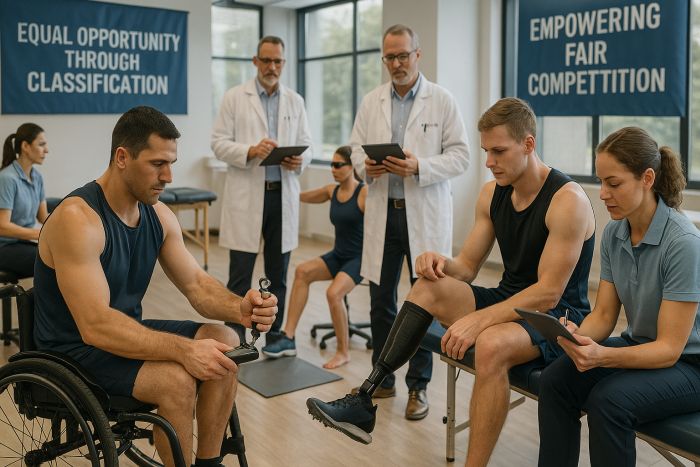
Athletes undergoing evaluation - Classification Process
vi. Join a Local Club or Provincial Body

There are a variety of sports clubs within South Africa, that cater for people with Hearing impairments, depending on your province.
These clubs and organisations offer either a single or a variety of sports in a particular province or city in South Africa.
Please click on these clubs or organisations listed below to find out more about the sports they provide and which cities they are located in.

5. Sports Organisations that govern and promote Disability Sports

the Deaf do not compete in the Olympics and Paralympics, there is no category for deaf athletes. The Deaf have their own Olympics called Deaflympics – an International Olympic Committee (IOC)-sanctioned event at which deaf athletes compete at an elite level.
There are also a variety of Sports Organisations which govern and promote Deaf Sports and promote opportunities for people with hearing disabilities to participate in sports. They can include national governing bodies, international federations, professional leagues, amateur leagues, and grassroots organisations.
These Sports Organisations are categorised as per below.
Should you require more information about these organisations, and how they can assist you, please visit the appropriate links to their websites below.

There are various provincial Deaf cricket teams such as:
The Gauteng Deaf Cricket: which was founded in 1975 with the aim of becoming the flagship provincial Deaf Team of South Africa They also one of the oldest Provincial teams in Deaf Cricket in South Africa and is actively involved in grass roots development and is currently working on setting up a Deaf KFC Mini Cricket Contest in conjunction with various stakeholders and Deaf Schools around Gauteng.
Read More: ….

1. The South African Sports Confederation and Olympic Commitee (SASCOC)

The South African Sports Confederation and Olympic Committee (SASCOC) is the National Olympic Committee (NOC) and National Paralympic Committee (NPC) for South Africa, and are the responsible body for South Africa at the CommonwealthGames.
SASCOC is also responsible for high-performance sport in the country and coordinates the relationship with various international sports federations. They not only help look after all our various National Federations who are affiliated to them, but are responsible for awarding National Protea Colours to athletes who have met the criteria to represent South Africa in different sporting codes, including: Athletics, Swimming /Aquatics, Waterpolo, Archery, Badminton, Baseball, Basketball, Boxing, Canoeing, Cycling, Equestrian, Fencing,  Football, Gymnastics,  Handball, Hockey, Judo, Karate, Modern Pentathlon, Netball, Rowing, Rugby 7s, Sailing, Shooting, Table Tennis, Taekwondo, Tennis, Triathlon, Volleyball, Weightlifting and Wrestling.
Not all of these sports are however available for The Deaf or persons with Hearing Impairments. Read More: …..

2. South African Deaf Sports Federation | SADSF

SADSF has participated in all the Deaflympic Games since 1993 and these games have become very popular amongst athletes in South Africa, with each and every athlete aspiring to be part Team South Africa. These aspirations alone are enough to push athletes to work hard at school, local, provincial and national competitions so as to be considered for selection.
The Deaflympics are held every four years, and are the longest running multi-sport event excluding the Olympics themselves. The first games, held in Paris in 1924, were also the first ever international sporting event for athletes with a disability. The SADSF currently promotes 10 sport codes, namely: Athletics; Cricket; Soccer; Netball; Volleyball; Golf; Table Tennis; Swimming; Squash; Cycling.
Most of these codes have their own structures and constitutions and are, as provided for in the SADSF Constitution.

SADSF is affiliated to International Committee of Sports for the Deaf (ICSD) or CISS as it is widely known around the world. SADSF was also affiliated to National Paralympics Committee of South Africa (NAPCOSA) which has now disbanded to pave the way for Disability Sport South Africa (DISSA) which has also been dissolved.

As a result of the resolution of Sport and Recreation South Africa (SRSA) Ministerial Task Team, the new body, namely; South African Sports Confederation and Olympic Committee (SASCOC) was established and SADSF became an affiliated member of this body in 2005.
To contribute to the pride of Deaf athletes and to unite Deaf people from diverse cultures in South Africa, the medium of sport and sport participation remain one of the major tools and challenges of SADSF.
Read More: …..

3. Deaf School Sport Commission, hereinafter referred to as the Commission, is a permanent Standing Committee of SADSF and its responsibility is to administer and coordinate sport for the Deaf at school level. It directly maintains working relationship with SASCOC School Sport Commission, National Coordinating Council (NACOC) – a Sub Directorate of Sport and Recreation South Africa (SRSA) and Department of Education (DoE) in terms of implementation of school sport projects and policies. The Commission advices SADSF on matters affecting Deaf school sport and oversee the organizing of National Deaf School Games and Championships for Deaf athletes up to 19 years of age.
SADSF Constitution includes some basic objectives such as the provision of training, campaigning for better facilities and the organizing of sporting events. In the years that SADSF have existed, it has won respect and acclaim for the dedicated role it has played in the field of Deaf sport development in the country.

4. South African Deaf Games
South African Deaf Games take place biannually, depending on the availability of funds. Participation is open to all age groupings. The proviso is, however, that to qualify for participation, individuals or teams first need to have proven their qualifying status by prior achievements at formal provincial championships. Likewise, South African School Games for the Deaf also takes place biannually depending on availability of funds.

The International Committee of Sports for the Deaf (ICSD) & Deaflympics

The International Committee of Sports for the Deaf (ICSD) is the main governing body responsible for the organization of Deaflympics and other World Deaf Championships. It was founded in 1924 and is now approaching the century mark of being the organization behind the building, evolving and fortifying the tradition of inviting deaf/hard of hearing elite athletes from all of the world to come together not only to compete in their respective sports, but to also develop comradeships between their countries.

The Deaflympics (previously called World Games for the Deaf, and International Games for the Deaf) are an International Olympic Committee (IOC)-sanctioned event at which deaf athletes compete at an elite level. The games have been organized by the Comité International des Sports des Sourds (CISS, “The International Committee of Sports for the Deaf”) since the first event.

To qualify for the games, athletes must have a hearing loss of at least 55 db in their “better ear”. Hearing aids, cochlear implants and the like are not allowed to be used in competition, to place all athletes on the same level. Other examples of ways the games vary from hearing competitions are the manner in which they are officiated. To address the issue of Deaflympians not being able to be guided by sounds, certain sports use alternative methods of commencing the game. For example, the football referees wave a flag instead of blowing a whistle; on the track, races are started by using a light, instead of a starter pistol. It is also customary for spectators not to cheer or clap, but rather to wave – usually with both hands. Read More: …..

Sports Clubs

Sports Clubs are also available, which offer either a single or a variety of sports in a particular province or city in South Africa, these clubs may include “Disabled” and Abled Body athletes or just “Disabled” athletes. There are a variety of these clubs in South Africa, including:

The Differently Abled Cricket Club

The Differently Abled Cricket Club is an open cricket club for the differently abled cricket players, which includes the Blind, Deaf, Intellectually Impaired (SID and MID) and Physically Disabled.
They are the only club of this kind in South Africa and need your support

To find out more …..
Differently Abled Cricket Club logo - everyone welcome
The Differently Abled Cricket Club

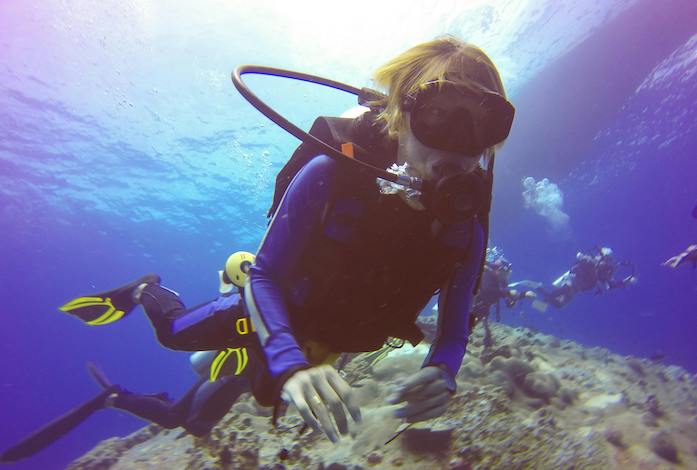
Handicapped Scuba Crew is a Nonprofit Organization (Registration No: NPO 240/281) which is based in Pretoria and has a mission to break down barriers with “Scubility” –
“We Use SCUBA as a tool for rehabilitation back into normal society and to make sure that persons with disabilities are given the same opportunities to receive excellent quality training, certification and dive adventures, as able-bodied divers do. We enhance the lives of all persons with disabilities and their families through the sport of SCUBA Diving.
– We raise funds for all of these activities.”

Adaptive techniques enable our organization to live our ethos of everyone is equal, giving people as above an equal opportunity to experience all parts of the dives, including sitting on the pontoon if viable! The benefits of Scuba Diving are vast and include both mental and physical benefits. New medical studies confirm the therapeutic benefits of Scuba Diving and the Handicapped Scuba Crew have been recognised for the work that they are doing and the benefits of Scuba Diving for persons with disabilities.

To learn more contact: Dean on: 083 6789 849 or via email: dean@scubacrew.co.za
Richard on: 082 579 3732 or via email: info@scubacrew.co.za or 
Sue on: 064 545 1671 or via email: sue@scubacrew.co.za.
The Handicapped Scuba Crew Company Ad

How can we help you?

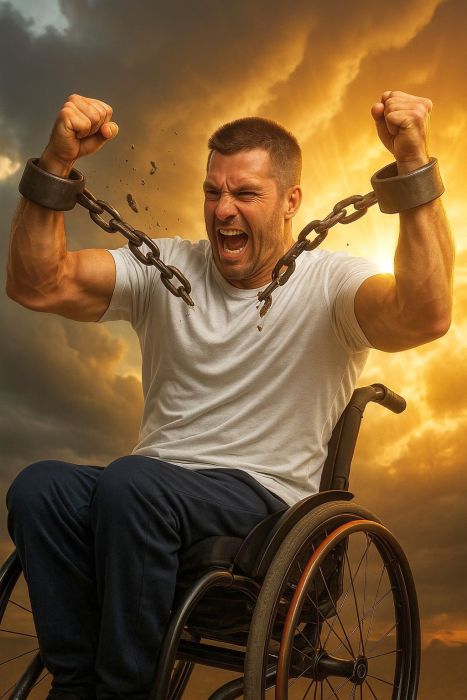
At Disability Info South Africa (DiSA), we are committed to help you break free of the shackles of your disability by providing you with the right tools to improve your daily life. Below is a brief introduction of the services we offer. Browse now and take the next step toward accessible living!

Key Objectives of the Information Desk include:

– Providing support and assistance to Persons with Disabilities and their families through our free Contact Centre.
– Linking People with the products and services they need.
– Providing a free information service showing the various products and services that are available to suit your needs.
– Providing advertising opportunities to disability related Service and product suppliers.

Unlocking The Shackles of Your Disability Using the Key of Knowledge embodies our belief that knowledge is power. With the correct information at your fingertips, you can break free of the barriers to reach your goals and dreams.
Explore Assistive Devices That Support Your Independence

Whether you’re looking for the right wheelchair, a pressure care cushion, or a product to rent—DiSA connects you to the right assistive devices and companies that sell or rent them, making everyday living more accessible, safe, and comfortable.
Find the tools that fit your lifestyle –
Browse DiSA’s Assistive Devices now!

Access the Disability Market

Do you provide Products and services to assist people with disabilities?
Look no further! Advertise with DiSA today and become part of our community!
Together, we can create a world where independence has no limits!

Disclaimers and References

DiSA is committed to promoting the rights, dignity, and inclusion of persons with disabilities as outlined in the White Paper on the Rights of Persons with Disabilities. We strive to ensure that all content on our website reflects appropriate, respectful, and inclusive language in alignment with these principles.

However, we also provide a platform for companies and organisations to advertise their services and products. While we encourage advertisers to adhere to correct terminology and inclusive practices, DiSA cannot guarantee the accuracy or appropriateness of the language used by external parties in their content.

Please note: Any views, language, or terminology used in advertisements, promotional material, or external links do not necessarily represent the views of DiSA.

DiSA disclaims any responsibility for inaccuracies or language that may not align with the White Paper or best practices for disability terminology.

Should you however encounter language or content that you believe is inappropriate or offensive, we encourage you to contact us at info@disa.org.za, so that we can address the issue.

DiSA remains dedicated to fostering a respectful and inclusive environment for all individuals. We appreciate your understanding and collaboration in supporting our mission.


While we strive for accuracy and clarity, AI-generated visuals may not always reflect real-life conditions or representations.
In addition, we feature authentic images and videos of actual instances, events, circumstances that have occurred, as well as products and services supplied by companies who advertise with us.

These authentic visuals are intended to accurately depict our content or the offerings of our advertising partners.
If you have any questions or concerns about the content displayed on this site, please feel free to contact us.

DiSA provides a platform for companies and organisations to advertise their products and services to assist persons with disabilities and their families. While we make every effort to list reputable and credible service providers, the inclusion of any company, organisation, product, or service on our website does not constitute an endorsement or guarantee by DiSA.

Please note the following: DiSA is not involved in the delivery, quality control, or customer service of any product or service offered by advertisers listed on our platform.

Any agreements, purchases, or arrangements made between users of this website and advertisers are solely between those parties. DiSA is not responsible for the outcome of such interactions.

DiSA disclaims any liability for dissatisfaction, damages, or disputes arising from products or services supplied by companies or organisations listed on our website.

We encourage users to thoroughly research and verify any service provider or product before engaging with them. If you have concerns or encounter issues with an advertiser listed on our platform, please let us know at: info@disa.org.za. We value your feedback to help maintain the integrity of our platform.


While we strive for accuracy and clarity, AI-generated visuals may not always reflect real-life conditions or representations.
In addition, we feature authentic images and videos of actual instances, events, circumstances that have occurred, as well as products and services supplied by companies who advertise with us.

These authentic visuals are intended to accurately depict our content or the offerings of our advertising partners.
If you have any questions or concerns about the content displayed on this site, please feel free to contact us.

DiSA is committed to providing accurate and up-to-date information to assist persons with disabilities and their families. However, the nature of online content and external resources means that information can change frequently.

Please note the following: DiSA cannot guarantee the accuracy, completeness, or reliability of all information on our website, particularly information obtained from external sources or links to third-party websites.
External websites may update or remove content without notice, which can result in broken links or outdated information. DiSA is not responsible for the content, accessibility, or functionality of external websites.

While we make every effort to keep our information current, some content may become outdated over time.
We encourage users to verify information directly with the relevant third parties or organisations before making any decisions based on the information found on our platform.

If you encounter a broken link or outdated content, please notify us at: info@disa.org.za and we will address it as soon as possible.
Thank you for understanding and helping us maintain a reliable and accessible platform.


While we strive for accuracy and clarity, AI-generated visuals may not always reflect real-life conditions or representations.
In addition, we feature authentic images and videos of actual instances, events, circumstances that have occurred, as well as products and services supplied by companies who advertise with us.

These authentic visuals are intended to accurately depict our content or the offerings of our advertising partners.
If you have any questions or concerns about the content displayed on this site, please feel free to contact us.

The Information services and website that we offer free of charge, is privately run and funded and is not run or funded by the government. We rely on advertising, paid services and donations to supply and improve this Free information service that we do provide.

The Companies, Clubs, Schools and Organisations that are listed on this site, have advertised or made donations to the Website and have therefore assisted us be able to provide this free Service.
Please support them as they have supported Us and please contact us via info@disa.org.za, if you can advertise with us or would like to make a donation. Alternatively, visit our “Support Us” page to find out how you can support us or acquire our services. – Thank You.

If you encounter a broken link or outdated content, please notify us at: info@disa.org.za and we will address it as soon as possible.
Thank you for understanding and helping us maintain a reliable and accessible platform.

Please Note: We do assist with inquiries via email but may need to send or copy your details and inquiry to various other organisations, companies or government departments, that we sometimes consult, so that we can help you in the best way possible.
If you have any objection to us sharing your query or contact details, please notify us in your email. We will only share your information to assist you and will never sell or use your personal information for any other purposes.

DiSA waivers any liability for what happens if information is shared or used for marketing or other purposes by other organisations who do have consent to view such information.


While we strive for accuracy and clarity, AI-generated visuals may not always reflect real-life conditions or representations.
In addition, we feature authentic images and videos of actual instances, events, circumstances that have occurred, as well as products and services supplied by companies who advertise with us.

These authentic visuals are intended to accurately depict our content or the offerings of our advertising partners.
If you have any questions or concerns about the content displayed on this site, please feel free to contact us.

Please note that this website uses images and videos that are AI-generated and created to visually represent certain information, concepts or scenarios for illustrative purposes.


While we strive for accuracy and clarity, AI-generated visuals may not always reflect real-life conditions or representations.
In addition, we feature authentic images and videos of actual instances, events, circumstances that have occurred, as well as products and services supplied by companies who advertise with us.

These authentic visuals are intended to accurately depict our content or the offerings of our advertising partners.
If you have any questions or concerns about the content displayed on this site, please feel free to contact us.

Disability Info South Africa (DiSA) is committed to protecting your personal information in compliance with the Protection of Personal Information Act (POPIA), Act No. 4 of 2013. By using our free information service, you acknowledge and agree to the following:

Collection of Personal Information:
DiSA may collect and process your personal information (such as name, contact details, and inquiries) solely for the purpose of assisting you with your requests and providing relevant information or support.

Use and Storage:
Your personal information will only be used for the purpose it was collected for, we may need to send or copy your details and inquiry to various organisations, companies or government departments, that we sometimes consult, so that we can assist you in the best way possible.
If you have any objection to us sharing your query or contact details, please notify us in your email. We will only share your information to assist you and will never sell or use your personal information for any other purposes.
DiSA implements appropriate measures to secure your personal information against unauthorized access or loss.

Consent:
By submitting your details through our Contact Form, or contacting us via our email address, you consent to allow DiSA to process your information as outlined in this disclaimer. If you are not comfortable with DiSA sharing your information for the above purposes, please contact us directly at info@disa.org.za.

Access and Updates:
You have the right to request the deletion of your personal information at any time.
To do so, please contact us at: info@disa.org.za.

Third-Party Websites:
DiSA is not responsible for the privacy practices of external websites linked on our platform. Users are encouraged to review the privacy policies of third-party sites before sharing personal information.
For any queries or concerns regarding the handling of your personal information, please contact us at: info@disa.org.za.
Thank you for trusting DiSA to support you with accessible, inclusive, and reliable information.