Cricket and Soccer

Deaf soccer and cricket are well-established, inclusive sports in South Africa, offering athletes the opportunity to participate, compete, and excel at every level.
Both sports follow the same core rules as their mainstream counterparts, with adaptations focused mainly on communication and officiating.

Together, deaf soccer and deaf cricket provide clear development pathways, from community and club participation through provincial structures to national team representation and international competition.

Eligibility is based on recognised deaf sport criteria, typically requiring a permanent hearing loss of 55 decibels or greater.

Beyond competition, both sports play an important role in promoting fitness, teamwork, confidence, and social connection, while strengthening representation and pride within South Africa’s deaf sporting community.

About Deaf Cricket

Hearing disabilities are no obstacle to playing cricket. In disability cricket, there are a few rules and regulations that are specific to the different impairment groups.
Where possible the game is played in accordance with the MCC Laws of Cricket.
The South African Deaf Cricket’s team manager, Michael Lombard, with the help of Linley Verster, an interpreter and physiotherapist, explains. “The only difference is that we are deaf … but we play by the same rules.
A deaf player must have a 55 decibels or under to play in the first team. To play the international game, all cricketers with a hearing impairment must have a hearing loss of 55 decibels or less in their better ear. To put that in context it means they would be unable to hear an everyday conversation.” 
A lot of the players will use digital hearing aids to help them in their everyday lives, however these must be removed when they take the field.

Cricket for the blind

2. International Cricket Governance

The International Cricket Council (ICC) is the global governing body of cricket. It was founded as the Imperial Cricket Conference in 1909 by representatives from Australia, England and South Africa. It was renamed as the International Cricket Conference in 1965, and took up its current name in 1989.

The ICC has 104 members: 12 Full Members that play Test matches and 92 Associate Members. The ICC is responsible for the organisation and governance of cricket’s major international tournaments, most notably the Cricket World Cup. It also appoints the umpires and referees that officiate at all sanctioned Test matches, One Day International and Twenty20 Internationals. It promulgates the ICC Code of Conduct, which sets professional standards of discipline for international cricket, and also co-ordinates action against corruption and match-fixing through its Anti-Corruption and Security Unit (ACSU).

The ICC does not control bilateral fixtures between member countries (which include all Test matches), it does not govern domestic cricket in member countries, and it does not make the laws of the game, which remain under the control of the Marylebone Cricket Club. [ Read More: …. ]

3. South Africa – Disability Cricket

Cricket South Africa (CSA) has three Disability entities affiliated to the organisation, namely South African Deaf Cricket Association (SADCA); Blind Cricket South Africa (BCSA) and South African Sports Association for the Intellectually Impaired (SASA-II).”

“Cricket really is the everybody-est sport! Find out how you can get involved today and become part of the team.
Contact Johan Weyers by Email: johanw@cricket.co.za or on Tel: 012 484 1835

Cricket South Africa’s vision is to make cricket a truly national sport of winners.

This has two elements to it:
– To ensure that cricket is supported by the majority of South Africans, and available to all who want to play it.
– To pursue excellence at all levels of the game.

As the governing body of cricket in South Africa, Cricket South Africa will be led by:

– Promoting and protecting the game and its unique spirit in the context of a democratic South Africa.
– Basing our activities on fairness, which includes inclusivity and non-discrimination.
– Accepting South Africa’s diversity as a strength.
– Delivering outstanding, memorable events.
– Providing excellent service to Affiliates, Associates and Stakeholders.
– Optimising commercials rights and properties on behalf of its Affiliates and Associates.
– Implementing good governance based on King 2, and matching diligence, honesty and transparency to all our activities. Read More

4. Provincial Deaf Cricket

There are various provincial Deaf cricket teams such as:

The Gauteng Deaf Cricket: which was founded in 1975 with the aim of becoming the flagship provincial Deaf Team of South Africa; it is also one of the oldest Provincial teams in Deaf Cricket in South Africa and is actively involved in grass roots development and is currently working on setting up a Deaf KFC Mini Cricket Contest in conjunction with various stakeholders and Deaf Schools around Gauteng.
Cricket for persons with Hearing Impairments is also available at club level in South Africa. One of these clubs that offers this sport, is the Differently Abled Cricket Club. The Differently Abled Cricket Club are on a mission to uplift persons with disabilities or differences in South Africa.

i. The Differently Abled Cricket Club
Differently Abled Cricket Club logo - everyone welcome

The Differently Abled Cricket Club from South Africa are on a mission to uplift the Physically Disabled side of Cricket in South Africa.
“We have to start from the bottom and work our way up. We are in the process of establishing a league within the schools for this, then once that is done we are looking at the Northerns side”.

In 2017 the Differently Abled Cricket Club (DACC) adopted the principle of not being ashamed of who we are and hence the name Differently Abled Cricket Club, the club felt it’s time we have our own identity and independence and focus on the awareness of LSEN (Learners with Special Educational Needs) which includes the Blind, Deaf, Intellectually Impaired and Physically Disabled.”

The home of Differently Abled Cricket Club is located at FH Odendaal High School, we have embarked on a new journey and with the relationship we have built with the school they have given us permission to make the school our new home. We are in the process of building a clubhouse at the school and we also want to build a cricket academy specifically for differently abled players. Currently we are in the process of getting junior teams going as this is the feeding system for the club going forward.

With our new constitution we not only want to develop the cricket skills of players but also want to create a skills development program for our cricketers in order to attain the required skills for the workplace.

For more information: Contact Christo Pelzer – Cell: +27 82 998 4568 or Email: admin@dacc.co.za
Address: 200 Baviaanspoort Road, Derdepoort, Pretoria, 0186 | Website: www.dacc.co.za

Football / Soccer

soccer

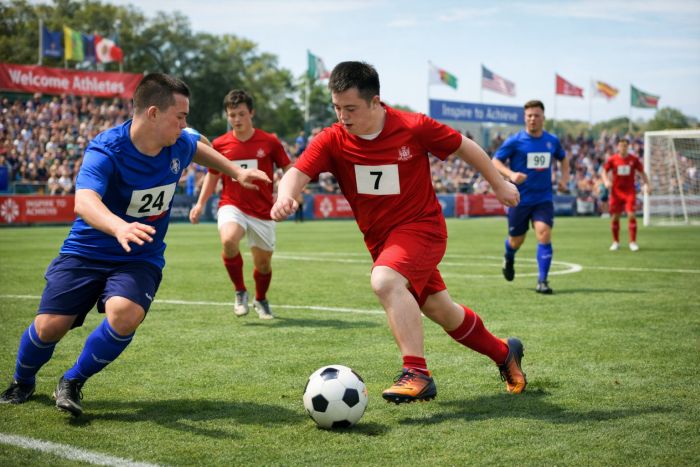
Deaf soccer in South Africa follows the same laws of the game as mainstream football and is played under FIFA rules, with adaptations to ensure full accessibility for deaf and hard-of-hearing players.

The sport is fast, competitive, and team-based, relying heavily on visual awareness, positioning, and non-verbal communication rather than sound.

Players use visual signals, hand gestures, and eye contact to communicate, while referees replace whistle-based control with flags, hand signals, and visual cues.

Participation pathways are well established, starting at community and club level, progressing through provincial structures, and leading to national team selection.

South Africa’s deaf national teams compete in regional and international competitions, including events sanctioned by the International Committee of Sports for the Deaf (ICSD), such as the Deaflympics and continental championships. These pathways allow talented players to progress from grassroots participation to elite international competition.

Eligibility for deaf soccer is based on recognised deaf sport criteria. Players must have a permanent hearing loss of at least 55 decibels in the better ear, confirmed by an audiogram. In line with international regulations, hearing aids and cochlear implants are not permitted during match play, ensuring an equal playing environment. Beyond competition, deaf soccer plays a vital role in physical fitness, teamwork, confidence, and social inclusion, while providing a powerful platform for representation and pride within South Africa’s deaf community.

2. South African Deaf Sport Federation (SADSF)

There are a number of organizations that oversee soccer for the Deaf in South Africa, this includes the South African Deaf Sport Federation which currently promotes 10 sport codes, namely Athletics; Cricket; Soccer; Netball; Volleyball; Golf; Table Tennis; Swimming; Squash; Cycling. SADSF further has 9 constituted Provincial structures that are responsible for the identification and development of sporting talent for Deaf at grassroots level and also for the administering and coordination of sport for the Deaf at a Provincial level. Read More: ….

3. South African Deaf Football Association
South African Deaf Football Association (SADFA) is the national association responsible for the Deaf football clubs and provincial associations in South Africa. The South African Deaf Football Association is located in Gauteng, and also oversee and promote the development of soccer for the Deaf in South Africa along with Deaf Football Associations and Clubs in different Provinces. Read More: …
Disclaimers and References

DiSA is committed to promoting the rights, dignity, and inclusion of persons with disabilities as outlined in the White Paper on the Rights of Persons with Disabilities. We strive to ensure that all content on our website reflects appropriate, respectful, and inclusive language in alignment with these principles.

However, we also provide a platform for companies and organisations to advertise their services and products. While we encourage advertisers to adhere to correct terminology and inclusive practices, DiSA cannot guarantee the accuracy or appropriateness of the language used by external parties in their content.

Please note: Any views, language, or terminology used in advertisements, promotional material, or external links do not necessarily represent the views of DiSA.

DiSA disclaims any responsibility for inaccuracies or language that may not align with the White Paper or best practices for disability terminology.

Should you however encounter language or content that you believe is inappropriate or offensive, we encourage you to contact us at info@disa.org.za, so that we can address the issue.

DiSA remains dedicated to fostering a respectful and inclusive environment for all individuals. We appreciate your understanding and collaboration in supporting our mission.


While we strive for accuracy and clarity, AI-generated visuals may not always reflect real-life conditions or representations.
In addition, we feature authentic images and videos of actual instances, events, circumstances that have occurred, as well as products and services supplied by companies who advertise with us.

These authentic visuals are intended to accurately depict our content or the offerings of our advertising partners.
If you have any questions or concerns about the content displayed on this site, please feel free to contact us.

DiSA provides a platform for companies and organisations to advertise their products and services to assist persons with disabilities and their families. While we make every effort to list reputable and credible service providers, the inclusion of any company, organisation, product, or service on our website does not constitute an endorsement or guarantee by DiSA.

Please note the following: DiSA is not involved in the delivery, quality control, or customer service of any product or service offered by advertisers listed on our platform.

Any agreements, purchases, or arrangements made between users of this website and advertisers are solely between those parties. DiSA is not responsible for the outcome of such interactions.

DiSA disclaims any liability for dissatisfaction, damages, or disputes arising from products or services supplied by companies or organisations listed on our website.

We encourage users to thoroughly research and verify any service provider or product before engaging with them. If you have concerns or encounter issues with an advertiser listed on our platform, please let us know at: info@disa.org.za. We value your feedback to help maintain the integrity of our platform.


While we strive for accuracy and clarity, AI-generated visuals may not always reflect real-life conditions or representations.
In addition, we feature authentic images and videos of actual instances, events, circumstances that have occurred, as well as products and services supplied by companies who advertise with us.

These authentic visuals are intended to accurately depict our content or the offerings of our advertising partners.
If you have any questions or concerns about the content displayed on this site, please feel free to contact us.

DiSA is committed to providing accurate and up-to-date information to assist persons with disabilities and their families. However, the nature of online content and external resources means that information can change frequently.

Please note the following: DiSA cannot guarantee the accuracy, completeness, or reliability of all information on our website, particularly information obtained from external sources or links to third-party websites.
External websites may update or remove content without notice, which can result in broken links or outdated information. DiSA is not responsible for the content, accessibility, or functionality of external websites.

While we make every effort to keep our information current, some content may become outdated over time.
We encourage users to verify information directly with the relevant third parties or organisations before making any decisions based on the information found on our platform.

If you encounter a broken link or outdated content, please notify us at: info@disa.org.za and we will address it as soon as possible.
Thank you for understanding and helping us maintain a reliable and accessible platform.


While we strive for accuracy and clarity, AI-generated visuals may not always reflect real-life conditions or representations.
In addition, we feature authentic images and videos of actual instances, events, circumstances that have occurred, as well as products and services supplied by companies who advertise with us.

These authentic visuals are intended to accurately depict our content or the offerings of our advertising partners.
If you have any questions or concerns about the content displayed on this site, please feel free to contact us.

The Information services and website that we offer free of charge, is privately run and funded and is not run or funded by the government. We rely on advertising, paid services and donations to supply and improve this Free information service that we do provide.

The Companies, Clubs, Schools and Organisations that are listed on this site, have advertised or made donations to the Website and have therefore assisted us be able to provide this free Service.
Please support them as they have supported Us and please contact us via info@disa.org.za, if you can advertise with us or would like to make a donation. Alternatively, visit our “Support Us” page to find out how you can support us or acquire our services. – Thank You.

If you encounter a broken link or outdated content, please notify us at: info@disa.org.za and we will address it as soon as possible.
Thank you for understanding and helping us maintain a reliable and accessible platform.

Please Note: We do assist with inquiries via email but may need to send or copy your details and inquiry to various other organisations, companies or government departments, that we sometimes consult, so that we can help you in the best way possible.
If you have any objection to us sharing your query or contact details, please notify us in your email. We will only share your information to assist you and will never sell or use your personal information for any other purposes.

DiSA waivers any liability for what happens if information is shared or used for marketing or other purposes by other organisations who do have consent to view such information.


While we strive for accuracy and clarity, AI-generated visuals may not always reflect real-life conditions or representations.
In addition, we feature authentic images and videos of actual instances, events, circumstances that have occurred, as well as products and services supplied by companies who advertise with us.

These authentic visuals are intended to accurately depict our content or the offerings of our advertising partners.
If you have any questions or concerns about the content displayed on this site, please feel free to contact us.

Please note that this website uses images and videos that are AI-generated and created to visually represent certain information, concepts or scenarios for illustrative purposes.


While we strive for accuracy and clarity, AI-generated visuals may not always reflect real-life conditions or representations.
In addition, we feature authentic images and videos of actual instances, events, circumstances that have occurred, as well as products and services supplied by companies who advertise with us.

These authentic visuals are intended to accurately depict our content or the offerings of our advertising partners.
If you have any questions or concerns about the content displayed on this site, please feel free to contact us.

Disability Info South Africa (DiSA) is committed to protecting your personal information in compliance with the Protection of Personal Information Act (POPIA), Act No. 4 of 2013. By using our free information service, you acknowledge and agree to the following:

Collection of Personal Information:
DiSA may collect and process your personal information (such as name, contact details, and inquiries) solely for the purpose of assisting you with your requests and providing relevant information or support.

Use and Storage:
Your personal information will only be used for the purpose it was collected for, we may need to send or copy your details and inquiry to various organisations, companies or government departments, that we sometimes consult, so that we can assist you in the best way possible.
If you have any objection to us sharing your query or contact details, please notify us in your email. We will only share your information to assist you and will never sell or use your personal information for any other purposes.
DiSA implements appropriate measures to secure your personal information against unauthorized access or loss.

Consent:
By submitting your details through our Contact Form, or contacting us via our email address, you consent to allow DiSA to process your information as outlined in this disclaimer. If you are not comfortable with DiSA sharing your information for the above purposes, please contact us directly at info@disa.org.za.

Access and Updates:
You have the right to request the deletion of your personal information at any time.
To do so, please contact us at: info@disa.org.za.

Third-Party Websites:
DiSA is not responsible for the privacy practices of external websites linked on our platform. Users are encouraged to review the privacy policies of third-party sites before sharing personal information.
For any queries or concerns regarding the handling of your personal information, please contact us at: info@disa.org.za.
Thank you for trusting DiSA to support you with accessible, inclusive, and reliable information.