Sports and Hobbies for the Visually Impaired

Welcome to the Blind and Visual Impairment – Sports, Hobbies, and Activities section of the DiSA website. This section is designed to empower and inspire persons who are blind or partially sighted by unpacking the sports, hobbies, and recreational activities that are available, accessible, achievable, and enjoyable in SA.

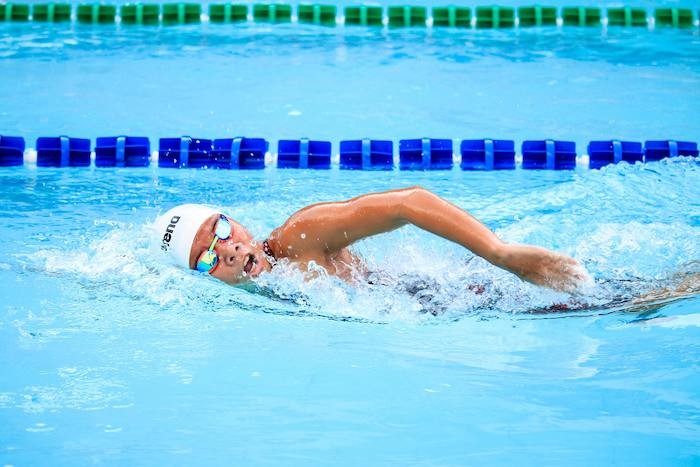
People who are blind or visually impaired can participate in a broad spectrum of sports, including swimming, cycling, cricket, judo, athletics, and many others. Some sports have been specifically developed for visual impairments, while others have been adapted to ensure safe and fair participation. With several disciplines represented at national and international level.

Whether your goal is social participation, fitness, skill development, or competitive sport, there is an option to suit your interests, abilities, and lifestyle.

The Benefits of Sport and Recreational Activities

Being active can make a real difference if you are blind or visually impaired. Sports, hobbies, and recreational activities help improve fitness, mobility, confidence, and independence, while also creating opportunities to meet people and feel more connected. Whether through sport, music, clubs, or creative activities, staying involved supports mental wellbeing, reduces isolation, and helps build everyday life skills — contributing to a stronger sense of confidence and belonging.

Disability sport in South Africa is both highly popular and internationally successful. Athletes with visual impairments compete at the Paralympic Games, where the South African Paralympic team has consistently finished near the top of the medal table. In fact, South African athletes with disabilities have often outperformed their able-bodied counterparts at the Paralympics when compared to Olympic results. Since the 1970s, disability sport has grown significantly, with improved structures, increased recognition, and opportunities for some athletes to earn a living through sport.

Whether you’re joining in or cheering from the sidelines, sport brings people together, inspires communities, and helps challenge the stigma around disability.
Choose a Sport or Hobby best suited for you

Visual impairment is not a barrier to participation. Regardless of your age, level of vision, experience, or gender, there is an activity for you — whether for recreation, fitness, social connection, or competitive sport.

Let’s get started: First things first, you need to choose a sport or hobby that suits your abilities, interests, lifestyle, and budget.
So take time to consider what you would enjoy. Whether you prefer high-energy or more relaxed activities, team or individual sports, accessibility to the club or venue, adaptations required, and available support should also form part of your decision-making process.
Then follow the steps below to explore the full range of options available to you.

3. Sports and Hobbies for persons with Blind/Visual Impairments

Take your Pick: Choose a Sport That Suits Your Interests

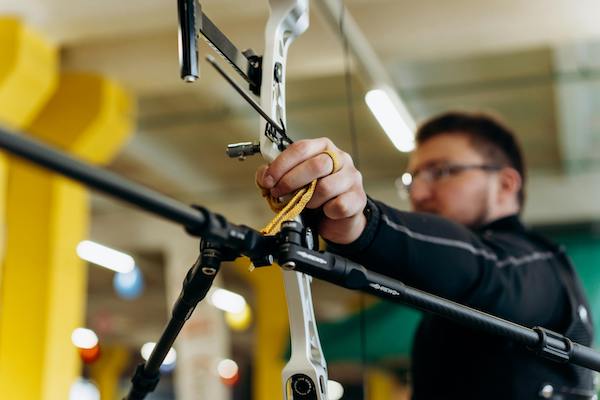
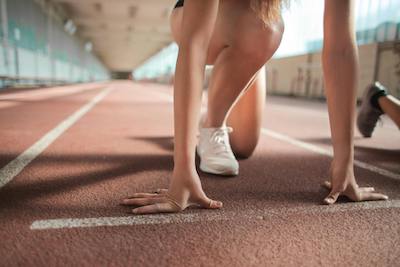
Below are a list of a few sports that are available to the Blind and persons with Visual Impairments in South Africa. These sports are available at social, club and Provincial level, while some are available at the Paralympics and The IBSA World Championships, where the classification process is used.
To view more information about these Sports please click on your preferred link below:
Choose a Hobby that suits your interests:

Not every form of activity has to be competitive — meaningful, adaptive hobbies can be just as empowering.
Depending on your interests, abilities, resources, and location, explore the hobby ideas below and discover new ways to stay engaged, creative, and fulfilled. Let’s find the pastime that brings you joy.
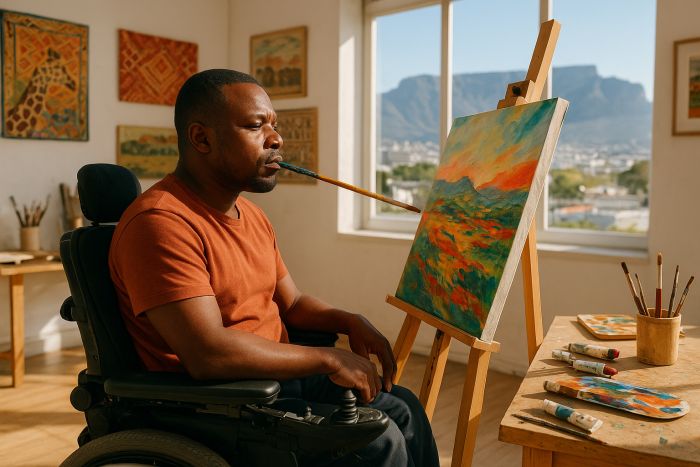
Art - Mouth Painter painting a landscape in his studio
Art and Creative Writing

You don’t need sight to write, paint or express yourself. Poems, fictional stories, etc. can be written on a Perkins Brailler, a Braille and speak, or even on a computer that has adaptive software.
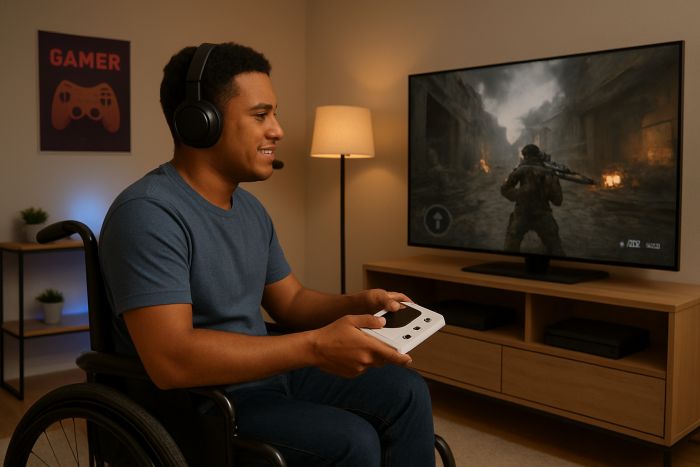
Young man in a wheelchair playing a video game
Card, Video and Board Games

If you enjoy playing cards, video or board games, you can still play.
You might need a little help or the assistance of assistive devices, but most of these games are still possible 

Books & Reading - Man in a motorized wheelchair reading a book on a lap tray.
Books and Reading

Reading provides so many benefits and is a hobby that can still be enjoyed. With the help of the many assistive devices available, books and reading can still be enjoyed, even with a severe disability.

4. Steps to Getting Active and Involved

i. Consider costs of Equipment and Adaptions you will require

When planning to participate in any sport, it is important to consider the full range of costs involved. Within the visual impairment spectrum, some sports require little or no adapted equipment, while others rely on specialised aids to ensure safe and fair participation.

Equipment needs vary depending on the sport and classification. For example, athletes in the B3 class may require different forms of support depending on the activity, including sighted guides, guide rails, beeping or audible balls, and slapsticks. Some sports allow or require the use of a guide, while others do not permit guides at all. In certain cases, modified or specially designed equipment is essential. As participation in disability sport continues to grow, assistive technology is constantly evolving to better support athletes’ needs. Both equipment requirements and the possible need for a guide should form part of your decision-making process.

Beyond equipment, there are additional costs to consider, such as transport to training sessions and competitions, accommodation for out-of-town events, entry fees, and ongoing equipment maintenance. Understanding these costs upfront can help you choose a sport that suits your budget and plan realistically for participation. For more information on assistive devices, audible equipment, and suppliers, visit our Assistive Devices

The use of a sighted guide by people in this class is dependent on the specific requirements of the sport. In athletics, where the parallel classification is T13, runners do not use guides in competition and generally do not use them in training. In cycling, this classification uses a guide, while utilizing a tandem bicycle with the guide sitting at the front. When a cyclist is looking for a guide, they are encouraged to find one with a pace similar to their own.

The sighted guides for athletes with a visual impairment are such a close and essential part of the competition that the athlete with visual impairment and the guide are considered a team. Beginning in 2012, these guides (along with sighted goalkeepers in 5-a-side football became eligible to receive medals of their own.

ii. Organisations that can assist with support and expenses
If you are not in a position to afford the equipment you require, consider looking for Organisations that can sponsor equipment and other expenses, such as the QASA Education and Sports Fund and Bidii Yetu – No Limits.

Bidii Yetu - No Limits

Bidii Yetu No Limits is a U.S.-based 501(c)(3) non-profit organization registered in New Mexico and dedicated to promoting the inclusion of persons with disabilities through sports.
 
In 2023 Bidii Yetu No Limits had a Vision to create a world in which people with impairments discover the strength to overcome the barriers that hold them back, regardless of their disability.Bidi-Yetu-No-Limits
 
Their mission was exemplified by organizing adaptive and able-bodied cycling events, such as a notable journey that the organised covering over 3,000 kilometres across five countries in Southern Africa. Furthermore, Bidii Yetu showed their commitment to creating awareness and growing the sport of Adaptive Cycling by donating money raised during the cycling event, to various organisations involved in Adaptive Cycling, including DiSA.
 
In 2024, after completing this amazing event, Bidii Yetu No Limits joined our “Accessible Cities South Africa (AC – SA)” platform by providing funding to DiSA to help promote adaptive cycling and create awareness for the benefits of sport for persons with disabilities.
 
Through the funding provided by Bidii Yetu, DiSA have been able to:
 
    Create various videos to create awareness for the benefits of sports, including Adaptive Cycling for persons with disabilities.
    Provide free advertising on the DiSA website to promote various selected Sports Clubs that provide Adaptive Cycling for persons with disabilities.
 
Thereby assisting DiSA to promote the sport of Adaptive Cycling to persons with disabilities and making the information about these clubs easily accessible through our information service. Through this partnership between DiSA and Bidii Yetu, we look forward to growing the sport of Adaptive Cycling to make it truly accessible to all persons with disabilities.
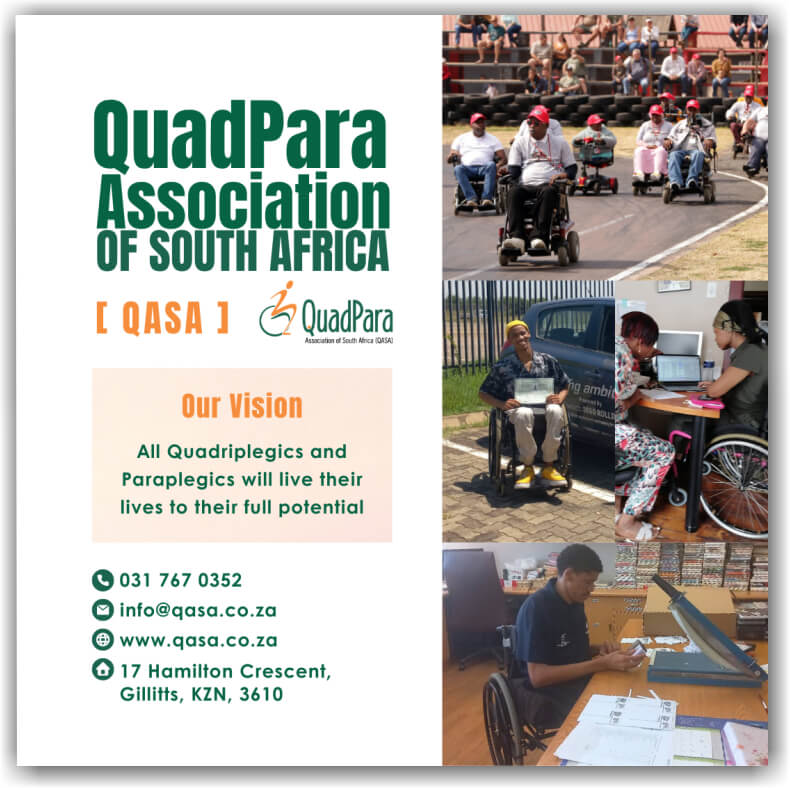
Advertisement for QuadPara - Association of South Africa (QASA) Logo


QASA Education and Sports Fund – The QuadPara Association of South Africa (QASA) is a non-profit organisation (NPO 000-881) of Quadriplegics and Paraplegics in South Africa. QASA’s mission is “to improve lives by securing resources to advocate, educate, capacitate, support and mobilize”.QuadPara Association of South Africa QASA’s vision is that “all quadriplegics and paraplegics will live their lives to their full potential”

QASA develops products, programmes and services for quadriplegic and paraplegic members to build their capacity and ensure opportunities for societal integration and empowerment.

These projects and services include but are not limited to the Education and Sports Fund:

Wheelchair sports are sporting activities where participants use wheelchairs – either manual or power. There are several sports that have been adapted to be played by wheelchair users in South Africa. QASA wants to give their membership a holistic development and feels that sports are a vital way of keeping fit and healthy for wheelchair users. QASA recognizes the value of sport and hobby and wants to encourage participation by Quadriplegics and Paraplegics. For this reason, QASA has a fund for wheelchair users to participate in sporting activities.

Read More about the QASA Education and Sports Fund on the QASA Website


Once you have considered the full range of costs involved, including the specialized equipment you will require, lets have have a look at the next 3 Steps.

iv. Get a Classification

To compete formally, especially at Paralympic, or Special Olympic level, you must undergo functional classification based on your physical, visual, or intellectual impairment. This helps ensure fair competition.

Classification determines which athletes are eligible to compete in a sport and how those athletes are then grouped together for competition in order to minimise the impact of the athletes’ impairments on sport performance. This is done to safeguard the integrity of fair competition.

Classification is sport-specific because an impairment affects the ability to perform in different sports to a different extent.
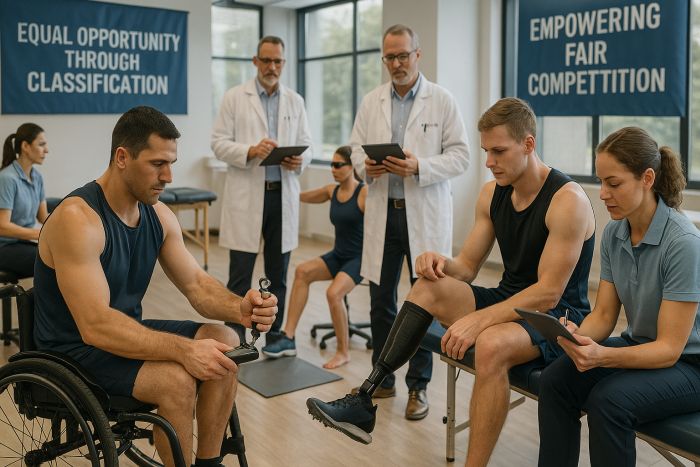
Athletes undergoing evaluation - Classification Process

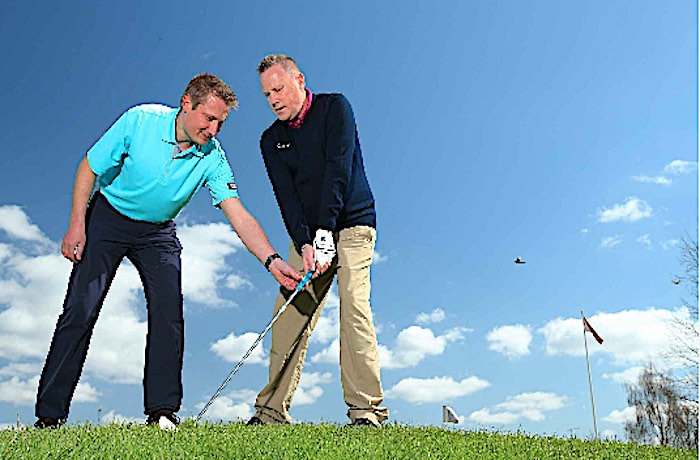
The B3 classification is used, in order for athletes of varying degrees of visual impairment to be able to compete. The classification process is a medical based Paralympics classification for blind sport. Competitors in this classification have partial sight, with visual acuity from 2/60 to 6/60. It is used by a number of blind sports including Para-alpine skiing, Para-Nordic skiing, blind cricket, blind golf, five-a-side football, goal ball and judo. Some other sports, including adaptive rowing, athletics and swimming, have equivalents to this class

Athletes with visual impairments ranging from partial vision, sufficient to be judged legally blind, to total blindness. This includes impairment of one or more component of the visual system (eye structure, receptors, optic nerve pathway, and visual cortex).

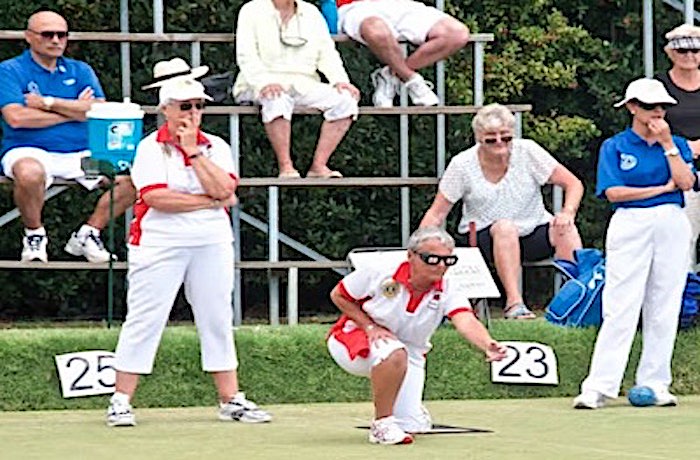
Eligible Paralympics sports for the B3 classification include adaptive rowing, athletics, cycling five-a-side football, goal ball, judo, Para-alpine skiing, Para-Nordic skiing, and swimming. On the Paralympics level, a number of disability sports are not open to this classification or other visually impaired competitors including archery, basketball, boccia, curling, fencing, ice sledge hockey, power lifting, rugby, shooting, table tennis, tennis, volleyball. Equestrian sport is not open to Paralympics sport in this classification, and the FEI classification system has no parallel classification available for other levels of national and international competition. For non-Paralympics sports or sports removed from the Paralympics programme, the classification is used in blind golf and lawn bowls.

Performance can differ for this class compared to other blind classes. In swimming, the B1 class is significantly slower than B2 and B3 classes in 100 meter freestyle. The B3 class is significantly faster than B1 and B2 in the 100 meter backstroke.

The B3 classification was first created by the IBSA in the 1970s, and has largely remained unchanged since despite an effort by the International Paralympics Committee (IPC) to move towards a more functional and evidence-based classification system. Classification is often handled on the international level by the International Blind Sports Association (IBSA) although it is also handled by national sport federations. There are exceptions for sports like athletics and cycling.

v. Join a Local Club or Provincial Body

There are a variety of sports clubs within South Africa, that cater for people with Neurological impairments, depending on your province.
These clubs and organisations offer either a single or a variety of sports in a particular province or city in South Africa.

Please click on these clubs or organisations listed below to find out more about the sports they provide and which cities they are located in..

Sports Clubs

Sports Clubs are also available, which offer either a single or a variety of sports in a particular province or city in South Africa, these clubs may include “Disabled” and Abled Body athletes or just “Disabled” athletes. There are a variety of these clubs in South Africa, including:

The Differently Abled Cricket Club

The Differently Abled Cricket Club is an open cricket club for the differently abled cricket players, which includes the Blind, Deaf, Intellectually Impaired (SID and MID) and Physically Disabled.
They are the only club of this kind in South Africa and need your support

To find out more …..
Differently Abled Cricket Club logo - everyone welcome
Handicapped Scuba Crew

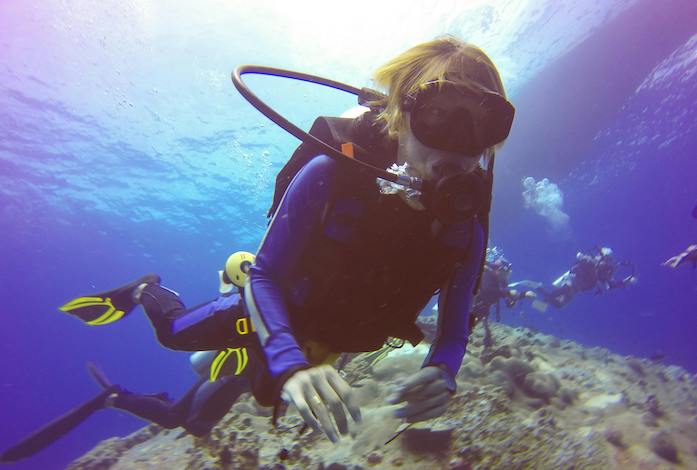
Handicapped Scuba Crew is a Nonprofit Organization (Registration No: NPO 240/281) which is based in Pretoria and has a mission to break down barriers with “Scubility” –
“We Use SCUBA as a tool for rehabilitation back into normal society and to make sure that persons with disabilities are given the same opportunities to receive excellent quality training, certification and dive adventures, as able-bodied divers do. We enhance the lives of all persons with disabilities and their families through the sport of SCUBA Diving.
– We raise funds for all of these activities.”

Adaptive techniques enable our organization to live our ethos of everyone is equal, giving people as above an equal opportunity to experience all parts of the dives, including sitting on the pontoon if viable! The benefits of Scuba Diving are vast and include both mental and physical benefits. New medical studies confirm the therapeutic benefits of Scuba Diving and the Handicapped Scuba Crew have been recognised for the work that they are doing and the benefits of Scuba Diving for persons with disabilities.

To learn more contact: Dean on: 083 6789 849 or via email: dean@scubacrew.co.za
Richard on: 082 579 3732 or via email: info@scubacrew.co.za or 
Sue on: 064 545 1671 or via email: sue@scubacrew.co.za.
The Handicapped Scuba Crew Company Ad

5. Organisations and Tournaments

There are also a variety of Sports Organisations which govern and promote Disability Sports and promote opportunities for people with disabilities to participate in sports. They can include national governing bodies, international federations, professional leagues, amateur leagues, and grassroots organisations.
These Sports Organisations are categorised as per below.
Should you require more information about these organisations, and how they can assist you, please visit the appropriate links to their websites below.

There are also many Provincial Sports Associations that govern a variety sports in a particular province in South Africa, such as:

The Free State Sport Association for the Physically Disabled and Visually Impaired: have a sound understanding and passion to build character through sport. “Our executive has years of experience working with the disabled in sport and other social environments. We have an in-depth understanding of our sport codes and the special classification criteria that is associated with each code.

At the FSSAPD we are all volunteers. We serve the association with dedication and commitment to honor our most valued assets, our Athletes. We cater for the following sporting codes: Athletics – Track and Field, Boccia, CP Soccer, Para Cycling, Goal Ball, Swimming. Each of these codes is equally important to us but as with everything in life we are also limited with resources. With funding we will be able to support and grow all our sporting codes to the best in the country.” Read More: …..

1. The South African Sports Confederation and Olympic Committee (SASCOC)
The South African Sports Confederation and Olympic Committee (SASCOC) is the National Olympic Committee (NOC) and National Paralympic Committee (NPC) for South Africa, and are the responsible body for South Africa at the Commonwealth Games.

SASCOC is also responsible for high-performance sport in the country and coordinates the relationship with various international sports federations. They not only help look after all our various National Federations who are affiliated to them, but are also responsible for awarding National Protea Colours to athletes who have met the criteria to represent South Africa in different sporting codes. Read More: …..

2. South African Sports Association for Physically Disabled (SASAPD)

The South African Sports Association for Physically Disabled ( SASAPD) was established in 1962 and focuses on the development and promotion of the sporting codes offered at Paralympic level for athletes with Physical Disabilities, Visual Impairments and blindness.

They offer pathways for qualification towards Paralympic Games across a variety of sports, through their affiliations with international bodies such as: IBSA, IWAS, CPISRA and The Nedbank National Championships for Physically Disabled. They also work and are an affiliate member of SASCOC as well as being associated members of a number of other national sporting federations. SASAPD promote and a number of sports including: Para Athletics, Boccia, CP Football, Para Cycling, Goalball, Judo for the blind, Para Powerlifting and Para Swimming.

In order to ensure that competition in sport is fair and equal, a classification process is put in place which provides a structure for fair competition. It is important to note that the competitive structure provided by Classification systems is not only important for elite sport but also is essential for promoting grassroots participation in Para-sports by people with an impairment. Read More:

There are a variety of sports tournaments that a person who is Blind or Visually Impaired can compete in. They include:
– The Paralympic Games
– IBSA World Championships and Games

1. Paralympic Games and IPC

The International Paralympic Committee (IPC) were founded on the 22nd of September 1989 as a non-profit organisation and are based in Bonn, Germany with aims to develop sports opportunities for all people with an impairments from the beginner to elite level.

The Paralympic Games comprise all the sports contested in the Summer and Winter Paralympic Games. As of 2016, the Summer Paralympics will include 22 sports and 526 medal events, and the Winter Paralympics include 5 sports and disciplines and about 72 events. The Paralympic Games are a major international multi-sport event for athletes with disabilities which includes blindness.

Paralympic sports refers to organized competitive sporting activities as part of the global Paralympic movement. These sports are organized and run under the supervision of the International Paralympic Committee and other international sports federations.There were nine sports which were included at the last Paralympic Games for the Blind and persons with Visual Impairments which the International Paralympic Committee has direct governance over, they include: Athletics, Cycling, Equestrian, Football 5 a side, Goalball, Judo, Rowing, Sailing and Swimming.
The number and kinds of events may change from one Paralympic Games to another.

Athletes with visual impairments range from partial vision, sufficient to be judged legally blind, to total blindness. This includes impairment of one or more component of the visual system (eye structure, receptors, optic nerve pathway, and visual cortex). The sighted guides for athletes with a visual impairment are such a close and essential part of the competition that the athlete with visual impairment and the guide are considered a team. Beginning in 2012, these guides (along with sighted goalkeepers in 5-a-side football became eligible to receive medals of their own. People with vision impairments have participated in the Paralympic Games since the 1976 Toronto summer Paralympics.

The vision of the IPC, run by 200 members, is ‘To enable Para athletes to achieve sporting excellence and inspire and excite the world.’
– Enable: Creating conditions for athlete empowerment
– Para athletes: The primary focus, from initiation to elite level
– Achieve: Sporting excellence is the goal of a sport centred organisation
– Inspire and excite: Touch the heart of all people for a more equitable society. Read More: ….

2. The IBSA World Championships

The IBSA World Championships and Games is held every four years. The first games took place in 1998 in Madrid, Spain. This Tournament is organized & run by The International Blind Sports Federation (IBSA), which is a nonprofit organization founded 1981 in Paris, France.

IBSA’s mission is to promote the full integration of blind and partially sighted people in society through sport and to encourage people with a visual impairment to take up and practice sports. IBSA is a full and founding member of the International Paralympic Committee (IPC).

IBSA is the international federation for several sports for people with a visual impairment, including three Paralympic sports (Five-a-side football, Goalball and Judo), Powerlifting, Ten-pin bowling, Nine-pin bowling, Torball, Athletics, Alpine skiing, Biathlon, Swimming, Shooting, Archery, Showdown, Nordic skiing, and Cycling.

IBSA also organizes world and regional championships in many of its sports. Regional or continental championships are generally held in odd years, while world championships take place every four years in even years when there are no Paralympic Games. Read More: ….

How can we help you?

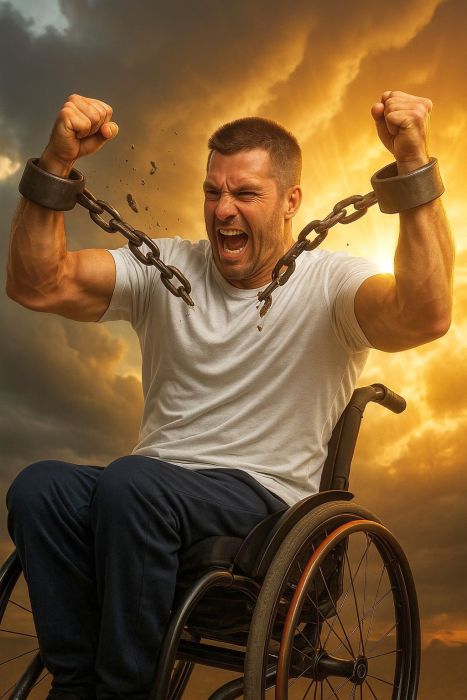
At Disability Info South Africa (DiSA), we are committed to help you break free of the shackles of your disability by providing you with the right tools to improve your daily life. Below is a brief introduction of the services we offer. Browse now and take the next step toward accessible living!

Key Objectives of the Information Desk include:

– Providing support and assistance to Persons with Disabilities and their families through our free Contact Centre.
– Linking People with the products and services they need.
– Providing a free information service showing the various products and services that are available to suit your needs.
– Providing advertising opportunities to disability related Service and product suppliers.

Unlocking The Shackles of Your Disability Using the Key of Knowledge embodies our belief that knowledge is power. With the correct information at your fingertips, you can break free of the barriers to reach your goals and dreams.
Explore Assistive Devices That
Support Your Independence

Whether you’re looking for the right wheelchair, a pressure care cushion, or a product to rent—DiSA connects you to the right assistive devices and companies that sell or rent them, making everyday living more accessible, safe, and comfortable.
Find the tools that fit your lifestyle –
Browse DiSA’s Assistive Devices now!

Access the Disability Market

Do you provide Products and services to assist people with disabilities?
Look no further! Advertise with DiSA today and become part of our community!
Together, we can create a world where independence has no limits!

Disclaimers and References

DiSA is committed to promoting the rights, dignity, and inclusion of persons with disabilities as outlined in the White Paper on the Rights of Persons with Disabilities. We strive to ensure that all content on our website reflects appropriate, respectful, and inclusive language in alignment with these principles.

However, we also provide a platform for companies and organisations to advertise their services and products. While we encourage advertisers to adhere to correct terminology and inclusive practices, DiSA cannot guarantee the accuracy or appropriateness of the language used by external parties in their content.

Please note: Any views, language, or terminology used in advertisements, promotional material, or external links do not necessarily represent the views of DiSA.

DiSA disclaims any responsibility for inaccuracies or language that may not align with the White Paper or best practices for disability terminology.

Should you however encounter language or content that you believe is inappropriate or offensive, we encourage you to contact us at info@disa.org.za, so that we can address the issue.

DiSA remains dedicated to fostering a respectful and inclusive environment for all individuals. We appreciate your understanding and collaboration in supporting our mission.


While we strive for accuracy and clarity, AI-generated visuals may not always reflect real-life conditions or representations.
In addition, we feature authentic images and videos of actual instances, events, circumstances that have occurred, as well as products and services supplied by companies who advertise with us.

These authentic visuals are intended to accurately depict our content or the offerings of our advertising partners.
If you have any questions or concerns about the content displayed on this site, please feel free to contact us.

DiSA provides a platform for companies and organisations to advertise their products and services to assist persons with disabilities and their families. While we make every effort to list reputable and credible service providers, the inclusion of any company, organisation, product, or service on our website does not constitute an endorsement or guarantee by DiSA.

Please note the following: DiSA is not involved in the delivery, quality control, or customer service of any product or service offered by advertisers listed on our platform.

Any agreements, purchases, or arrangements made between users of this website and advertisers are solely between those parties. DiSA is not responsible for the outcome of such interactions.

DiSA disclaims any liability for dissatisfaction, damages, or disputes arising from products or services supplied by companies or organisations listed on our website.

We encourage users to thoroughly research and verify any service provider or product before engaging with them. If you have concerns or encounter issues with an advertiser listed on our platform, please let us know at: info@disa.org.za. We value your feedback to help maintain the integrity of our platform.


While we strive for accuracy and clarity, AI-generated visuals may not always reflect real-life conditions or representations.
In addition, we feature authentic images and videos of actual instances, events, circumstances that have occurred, as well as products and services supplied by companies who advertise with us.

These authentic visuals are intended to accurately depict our content or the offerings of our advertising partners.
If you have any questions or concerns about the content displayed on this site, please feel free to contact us.

DiSA is committed to providing accurate and up-to-date information to assist persons with disabilities and their families. However, the nature of online content and external resources means that information can change frequently.

Please note the following: DiSA cannot guarantee the accuracy, completeness, or reliability of all information on our website, particularly information obtained from external sources or links to third-party websites.
External websites may update or remove content without notice, which can result in broken links or outdated information. DiSA is not responsible for the content, accessibility, or functionality of external websites.

While we make every effort to keep our information current, some content may become outdated over time.
We encourage users to verify information directly with the relevant third parties or organisations before making any decisions based on the information found on our platform.

If you encounter a broken link or outdated content, please notify us at: info@disa.org.za and we will address it as soon as possible.
Thank you for understanding and helping us maintain a reliable and accessible platform.


While we strive for accuracy and clarity, AI-generated visuals may not always reflect real-life conditions or representations.
In addition, we feature authentic images and videos of actual instances, events, circumstances that have occurred, as well as products and services supplied by companies who advertise with us.

These authentic visuals are intended to accurately depict our content or the offerings of our advertising partners.
If you have any questions or concerns about the content displayed on this site, please feel free to contact us.

The Information services and website that we offer free of charge, is privately run and funded and is not run or funded by the government. We rely on advertising, paid services and donations to supply and improve this Free information service that we do provide.

The Companies, Clubs, Schools and Organisations that are listed on this site, have advertised or made donations to the Website and have therefore assisted us be able to provide this free Service.
Please support them as they have supported Us and please contact us via info@disa.org.za, if you can advertise with us or would like to make a donation. Alternatively, visit our “Support Us” page to find out how you can support us or acquire our services. – Thank You.

If you encounter a broken link or outdated content, please notify us at: info@disa.org.za and we will address it as soon as possible.
Thank you for understanding and helping us maintain a reliable and accessible platform.

Please Note: We do assist with inquiries via email but may need to send or copy your details and inquiry to various other organisations, companies or government departments, that we sometimes consult, so that we can help you in the best way possible.
If you have any objection to us sharing your query or contact details, please notify us in your email. We will only share your information to assist you and will never sell or use your personal information for any other purposes.

DiSA waivers any liability for what happens if information is shared or used for marketing or other purposes by other organisations who do have consent to view such information.


While we strive for accuracy and clarity, AI-generated visuals may not always reflect real-life conditions or representations.
In addition, we feature authentic images and videos of actual instances, events, circumstances that have occurred, as well as products and services supplied by companies who advertise with us.

These authentic visuals are intended to accurately depict our content or the offerings of our advertising partners.
If you have any questions or concerns about the content displayed on this site, please feel free to contact us.

Please note that this website uses images and videos that are AI-generated and created to visually represent certain information, concepts or scenarios for illustrative purposes.


While we strive for accuracy and clarity, AI-generated visuals may not always reflect real-life conditions or representations.
In addition, we feature authentic images and videos of actual instances, events, circumstances that have occurred, as well as products and services supplied by companies who advertise with us.

These authentic visuals are intended to accurately depict our content or the offerings of our advertising partners.
If you have any questions or concerns about the content displayed on this site, please feel free to contact us.

Disability Info South Africa (DiSA) is committed to protecting your personal information in compliance with the Protection of Personal Information Act (POPIA), Act No. 4 of 2013. By using our free information service, you acknowledge and agree to the following:

Collection of Personal Information:
DiSA may collect and process your personal information (such as name, contact details, and inquiries) solely for the purpose of assisting you with your requests and providing relevant information or support.

Use and Storage:
Your personal information will only be used for the purpose it was collected for, we may need to send or copy your details and inquiry to various organisations, companies or government departments, that we sometimes consult, so that we can assist you in the best way possible.
If you have any objection to us sharing your query or contact details, please notify us in your email. We will only share your information to assist you and will never sell or use your personal information for any other purposes.
DiSA implements appropriate measures to secure your personal information against unauthorized access or loss.

Consent:
By submitting your details through our Contact Form, or contacting us via our email address, you consent to allow DiSA to process your information as outlined in this disclaimer. If you are not comfortable with DiSA sharing your information for the above purposes, please contact us directly at info@disa.org.za.

Access and Updates:
You have the right to request the deletion of your personal information at any time.
To do so, please contact us at: info@disa.org.za.

Third-Party Websites:
DiSA is not responsible for the privacy practices of external websites linked on our platform. Users are encouraged to review the privacy policies of third-party sites before sharing personal information.
For any queries or concerns regarding the handling of your personal information, please contact us at: info@disa.org.za.
Thank you for trusting DiSA to support you with accessible, inclusive, and reliable information.