Volleyball

Para-volleyball is an inclusive, fast-paced adaptation of volleyball designed for athletes with physical impairments, offering both competitive and recreational pathways.
The sport includes two main formats — sitting volleyball, played on a smaller court with athletes remaining seated, and standing volleyball, designed for players with limb differences or other eligible impairments.
Para-volleyball emphasises teamwork, agility, strategy, and upper-body strength, making it one of the most dynamic and accessible sports in the para-sport community.
With a strong international presence and growing participation in South Africa, it provides athletes of all abilities the opportunity to compete, belong, and excel.

1. About Para-Volleyball

One of the greatest strengths of Sitting Volleyball is its inclusivity.
Athletes with a wide range of disabilities — including lower-limb amputations, joint injuries, mobility limitations from diseases like polio, ACL injuries, or congenital limb differences — can participate successfully. Upper-body mobility is the primary requirement for movement and gameplay.

At the national level, men, women, able-bodied players, and players with disabilities can participate together.
At the international level, teams are separated into male and female divisions, and only athletes who meet specific disability classifications may compete.

Athletes may have: Single or double amputations; Fused ankles or restricted joint movement; Mobility limitations due to illness, disease, or congenital conditions
Globally, more than 50% of Sitting Volleyball athletes acquired their impairments through road or motorcycle accidents, making the sport particularly relevant to those recovering from traumatic injury.
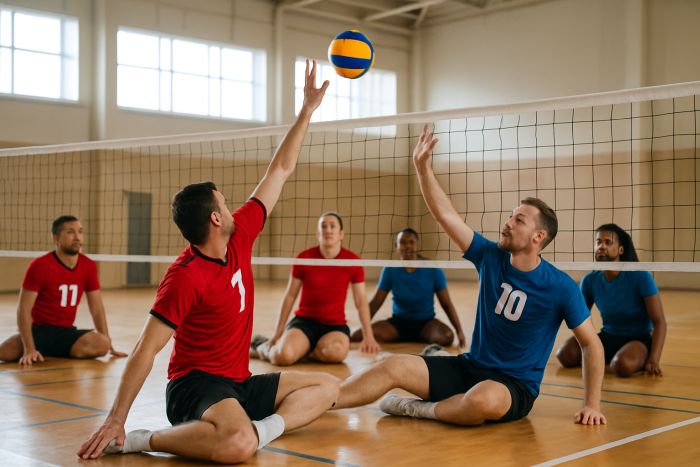
Two teams competing in Sitting Volley Ball

2. How is the game played?

Sitting Volleyball mirrors traditional volleyball in structure and scoring.

The court is slightly smaller and the net lower, which actually results in a faster paced game than traditional volleyball.
But the main differences is that players remain seated and move by sliding across the floor using their arms.

There are still six players a side and teams have three touches to score through digging, setting and spiking.

The smaller court and lowered net increase the pace and intensity, making the game remarkably fast and action-packed. The core skills — passing, setting, attacking, blocking, and serving — remain central to gameplay.

3. Who can play?

One of the greatest strengths of Sitting Volleyball is its inclusivity. Athletes with a wide range of disabilities — including lower-limb amputations, joint injuries, mobility limitations from diseases like polio, ACL injuries, or congenital limb differences — can participate successfully.
Upper-body mobility is the primary requirement for movement and gameplay.

At the national level, men, women, able-bodied players, and players with disabilities can participate together.
At the international level, teams are separated into male and female divisions, and only athletes who meet specific disability classifications may compete.

4. Benefits of Sitting Volleyball

The benefits of participation in sitting volleyball include:

Physical Fitness:
Sitting Volleyball provides an intense, full-body workout that strengthens the arms, core, and cardiovascular system.

Social Connection:
As one of the few structured team sports for athletes with disabilities, it fosters community, confidence, and camaraderie.

Competitive Opportunities:
Sitting Volleyball is a Paralympic sport with pathways to world, continental, and club competitions. South African athletes have strong opportunities for growth because the sport is still developing locally.

Rehabilitation:
Players can begin training soon after injury because no prosthetics or wheelchairs are required. Physiotherapists often recommend the sport for both physical and psychological recovery.

5. Sitting Volleyball in South Africa

Globally, Sitting Volleyball is governed by World ParaVolley, the official body overseeing competitions, rules, and athlete classifications across more than 55 countries. Their website provides comprehensive resources, international rankings, and information about global championships.

In South Africa, Sitting Volleyball is steadily gaining momentum.
Since its introduction in South Africa in 2014, Sitting Volleyball has made steady progress, but the biggest challenge remains awareness.
Many potential players — especially those living with disabilities — do not yet know that the sport exists or that they can join a team.
As awareness increases, participation grows, clubs expand, leagues strengthen, and the country becomes better positioned for international competition.

Active clubs are currently located in the Western Cape and Limpopo, with more regions developing interest.
For Western Cape enquiries, contact Tina: 084 553 4182
For Limpopo enquiries, contact Kedibone: 072 888 1769

ParaVolley South Africa runs a lively and informative Facebook page, offering news, match updates, training opportunities, and player stories.
Participation in South Africa is free, and newcomers of all abilities are warmly encouraged to join practices, try the sport, and become part of a supportive and active community.

Disclaimers and References

DiSA is committed to promoting the rights, dignity, and inclusion of persons with disabilities as outlined in the White Paper on the Rights of Persons with Disabilities. We strive to ensure that all content on our website reflects appropriate, respectful, and inclusive language in alignment with these principles.

However, we also provide a platform for companies and organisations to advertise their services and products. While we encourage advertisers to adhere to correct terminology and inclusive practices, DiSA cannot guarantee the accuracy or appropriateness of the language used by external parties in their content.

Please note: Any views, language, or terminology used in advertisements, promotional material, or external links do not necessarily represent the views of DiSA.

DiSA disclaims any responsibility for inaccuracies or language that may not align with the White Paper or best practices for disability terminology.

Should you however encounter language or content that you believe is inappropriate or offensive, we encourage you to contact us at info@disa.org.za, so that we can address the issue.

DiSA remains dedicated to fostering a respectful and inclusive environment for all individuals. We appreciate your understanding and collaboration in supporting our mission.


While we strive for accuracy and clarity, AI-generated visuals may not always reflect real-life conditions or representations.
In addition, we feature authentic images and videos of actual instances, events, circumstances that have occurred, as well as products and services supplied by companies who advertise with us.

These authentic visuals are intended to accurately depict our content or the offerings of our advertising partners.
If you have any questions or concerns about the content displayed on this site, please feel free to contact us.

DiSA provides a platform for companies and organisations to advertise their products and services to assist persons with disabilities and their families. While we make every effort to list reputable and credible service providers, the inclusion of any company, organisation, product, or service on our website does not constitute an endorsement or guarantee by DiSA.

Please note the following: DiSA is not involved in the delivery, quality control, or customer service of any product or service offered by advertisers listed on our platform.

Any agreements, purchases, or arrangements made between users of this website and advertisers are solely between those parties. DiSA is not responsible for the outcome of such interactions.

DiSA disclaims any liability for dissatisfaction, damages, or disputes arising from products or services supplied by companies or organisations listed on our website.

We encourage users to thoroughly research and verify any service provider or product before engaging with them. If you have concerns or encounter issues with an advertiser listed on our platform, please let us know at: info@disa.org.za. We value your feedback to help maintain the integrity of our platform.


While we strive for accuracy and clarity, AI-generated visuals may not always reflect real-life conditions or representations.
In addition, we feature authentic images and videos of actual instances, events, circumstances that have occurred, as well as products and services supplied by companies who advertise with us.

These authentic visuals are intended to accurately depict our content or the offerings of our advertising partners.
If you have any questions or concerns about the content displayed on this site, please feel free to contact us.

DiSA is committed to providing accurate and up-to-date information to assist persons with disabilities and their families. However, the nature of online content and external resources means that information can change frequently.

Please note the following: DiSA cannot guarantee the accuracy, completeness, or reliability of all information on our website, particularly information obtained from external sources or links to third-party websites.
External websites may update or remove content without notice, which can result in broken links or outdated information. DiSA is not responsible for the content, accessibility, or functionality of external websites.

While we make every effort to keep our information current, some content may become outdated over time.
We encourage users to verify information directly with the relevant third parties or organisations before making any decisions based on the information found on our platform.

If you encounter a broken link or outdated content, please notify us at: info@disa.org.za and we will address it as soon as possible.
Thank you for understanding and helping us maintain a reliable and accessible platform.


While we strive for accuracy and clarity, AI-generated visuals may not always reflect real-life conditions or representations.
In addition, we feature authentic images and videos of actual instances, events, circumstances that have occurred, as well as products and services supplied by companies who advertise with us.

These authentic visuals are intended to accurately depict our content or the offerings of our advertising partners.
If you have any questions or concerns about the content displayed on this site, please feel free to contact us.

The Information services and website that we offer free of charge, is privately run and funded and is not run or funded by the government. We rely on advertising, paid services and donations to supply and improve this Free information service that we do provide.

The Companies, Clubs, Schools and Organisations that are listed on this site, have advertised or made donations to the Website and have therefore assisted us be able to provide this free Service.
Please support them as they have supported Us and please contact us via info@disa.org.za, if you can advertise with us or would like to make a donation. Alternatively, visit our “Support Us” page to find out how you can support us or acquire our services. – Thank You.

If you encounter a broken link or outdated content, please notify us at: info@disa.org.za and we will address it as soon as possible.
Thank you for understanding and helping us maintain a reliable and accessible platform.

Please Note: We do assist with inquiries via email but may need to send or copy your details and inquiry to various other organisations, companies or government departments, that we sometimes consult, so that we can help you in the best way possible.
If you have any objection to us sharing your query or contact details, please notify us in your email. We will only share your information to assist you and will never sell or use your personal information for any other purposes.

DiSA waivers any liability for what happens if information is shared or used for marketing or other purposes by other organisations who do have consent to view such information.


While we strive for accuracy and clarity, AI-generated visuals may not always reflect real-life conditions or representations.
In addition, we feature authentic images and videos of actual instances, events, circumstances that have occurred, as well as products and services supplied by companies who advertise with us.

These authentic visuals are intended to accurately depict our content or the offerings of our advertising partners.
If you have any questions or concerns about the content displayed on this site, please feel free to contact us.

Please note that this website uses images and videos that are AI-generated and created to visually represent certain information, concepts or scenarios for illustrative purposes.


While we strive for accuracy and clarity, AI-generated visuals may not always reflect real-life conditions or representations.
In addition, we feature authentic images and videos of actual instances, events, circumstances that have occurred, as well as products and services supplied by companies who advertise with us.

These authentic visuals are intended to accurately depict our content or the offerings of our advertising partners.
If you have any questions or concerns about the content displayed on this site, please feel free to contact us.

Disability Info South Africa (DiSA) is committed to protecting your personal information in compliance with the Protection of Personal Information Act (POPIA), Act No. 4 of 2013. By using our free information service, you acknowledge and agree to the following:

Collection of Personal Information:
DiSA may collect and process your personal information (such as name, contact details, and inquiries) solely for the purpose of assisting you with your requests and providing relevant information or support.

Use and Storage:
Your personal information will only be used for the purpose it was collected for, we may need to send or copy your details and inquiry to various organisations, companies or government departments, that we sometimes consult, so that we can assist you in the best way possible.
If you have any objection to us sharing your query or contact details, please notify us in your email. We will only share your information to assist you and will never sell or use your personal information for any other purposes.
DiSA implements appropriate measures to secure your personal information against unauthorized access or loss.

Consent:
By submitting your details through our Contact Form, or contacting us via our email address, you consent to allow DiSA to process your information as outlined in this disclaimer. If you are not comfortable with DiSA sharing your information for the above purposes, please contact us directly at info@disa.org.za.

Access and Updates:
You have the right to request the deletion of your personal information at any time.
To do so, please contact us at: info@disa.org.za.

Third-Party Websites:
DiSA is not responsible for the privacy practices of external websites linked on our platform. Users are encouraged to review the privacy policies of third-party sites before sharing personal information.
For any queries or concerns regarding the handling of your personal information, please contact us at: info@disa.org.za.
Thank you for trusting DiSA to support you with accessible, inclusive, and reliable information.