


Home Automation Aids
Home Automation Aids, or Home Automation Technology, are assistive devices designed to make life easier at home for both people with and without disabilities, including those with mobility impairments.
These solutions often allow you to manage your home remotely, giving you the ability to monitor your property from anywhere in the world. They also enhance security by deterring intruders when you’re away.
Some products, such as the Vox I.C.E. Monitor Solution, can be used to check in on an elderly relative or a person with disabilities who lives alone. They also add convenience and support by reducing the need to constantly get up to switch on or off lights, fans, kettles, televisions, open or close curtains, or even answer the door. By automating these everyday tasks, home automation makes daily living safer and more manageable—especially for people who are blind, elderly, or living with mobility challenges.
Please read the page below to find out more about the Home Automation Aids and Systems available in South Africa today – and how they can make your life easier.
What Are You Looking For?
1. Home Automation Systems
– VoQol
2. Other Home Automation Systems
– VOX I.C.E Monitor Solutions
i) Voice Controlled TVs
ii) Automatic Door Openers
Other Useful Links:
These days, most people already use some form of automation in their daily lives.
Basic automation aids include stand-alone products such as voice-operated TVs, automatic doors, electric security gates, garage-door openers, timers on watering systems, and home security systems.
By contrast, home automation systems go a step further, allowing users to control a wide variety of devices in their homes—using voice commands or a mobile device from anywhere in the world. These systems are often packaged and promoted as “Smart Homes,” offering far greater capabilities than individual devices on their own.
Home Automation Systems
Some Home Automation Systems, or Smart Homes, integrate multiple sub-systems that are all managed by a Master Home Automation Controller. This central hub receives input from devices throughout the home and issues commands to control them. It can coordinate programmable devices such as thermostats and sprinkler systems, as well as lights, appliances, electrical outlets, heating and cooling systems, alarm systems, doors, windows, locks, smoke detectors, surveillance cameras, and other connected sensors.
Various types of Home Automation Systems are increasingly being adopted in the homes of older adults and people with disabilities to help maintain independence and safety. These systems enable people to remain in the comfort of their own home, rather than moving to a healthcare facility. They include emergency assistance systems, security features, fall-prevention equipment, automated timers, and alert functions. Other systems assist persons with disabilities to control essential equipment in their homes, such as a Fan, TV, Lights, Radio, etc., giving them the opportunity for independence, helping them gain confidence and reducing depression.
Together, these solutions provide peace of mind by ensuring that help is only minutes away while also allowing family members to monitor their loved ones remotely from anywhere with an internet connection.
In South Africa, there are several companies that specialize in Home Automation Systems, offering solutions that can either automate an entire home or focus on essential equipment in a specific room. One such company is VoQoL: Voice-activated Quality-of-Life – who specialise in voice-activation adaptions for persons with disabilities.
VoQoL
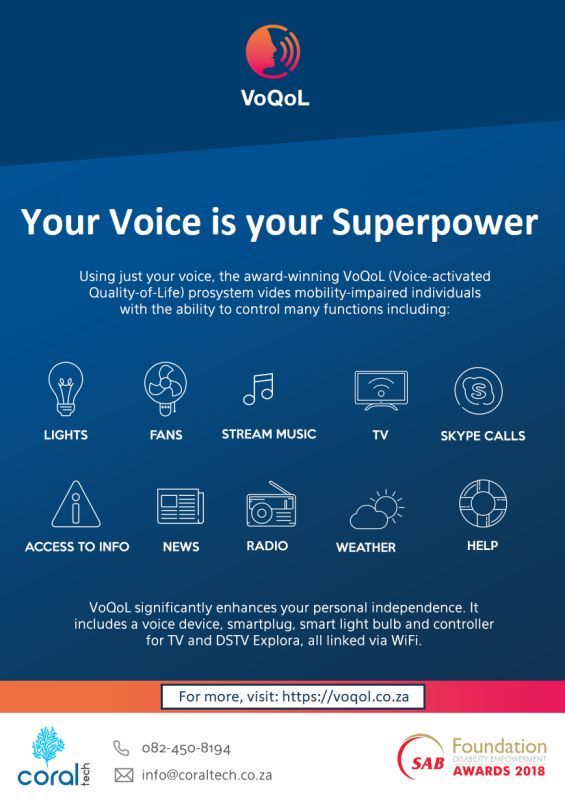
VoQoL is short for Voice-activated Quality-of-Life. VoQoL was developed by Coral Tech in Cape Town, South Africa and is essentially a collection of devices and software that allows persons with disabilities to control various functions in their living space, using just their voice.
VoQoL can be set up to control rooms lights, TV channels, fans, hot blankets, get information from the Internet, and much more. New services are constantly being added to the VoQol service offering, including most recently, the activation of local radio stations – and Users can now also ask it to send an SMS to a caregiver’s mobile phone when they need assistance.
VoQol was developed by Coral Tech, South Africa’s leading voice-activated technology company. The award-winning VoQoL (Voice-activated Quality-of-Life) system, enhances the personal independence of quadriplegic and paraplegic individuals by allowing them to control functions in their living environments, they were previously unable to complete, just by using their voice. VoQol not only increases independence, but also frees up the Care Givers by giving the more time to focus on other more essential jobs which the VoQoL System cannot assist with.
After winning third place in the SAB Foundation Social Innovations Awards in 2018, Coral Tech has expanded the reach of the VoQoL project, training local partners nationwide to provide support and future installations. Coral Tech thrives in providing specialised solutions – and are able to design, build and deploy custom electronics and other specialised devices to satisfy our clients precise requirements.
“Where my wheelchair is my legs, VoQoL is my hands”
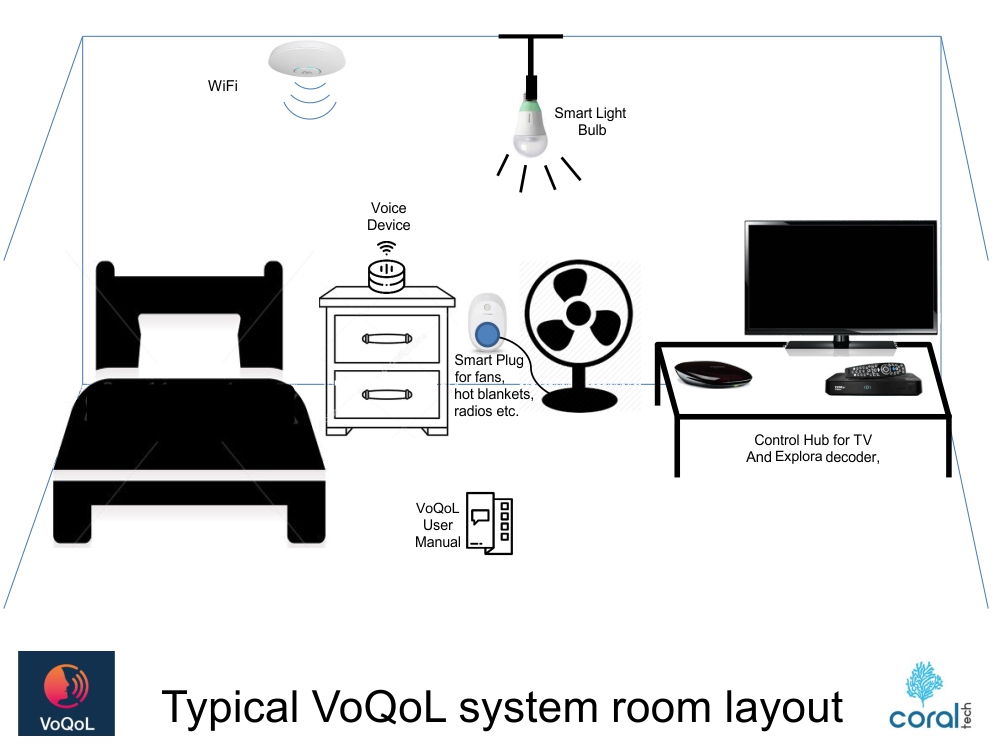
One of the items that the VoQoL System includes, is the Amazon Echo, which is a smart speaker that responds to voice commands using Alexa, which is its artificially intelligent personal assistant. The Echo can answer questions, research the internet, command smart home devices, and stream music. Alexa responds to your voice, you can wake the Echo by saying “Alexa…” followed by a question
There are countless questions that you can ask the Echo, in some cases, the device will respond verbally with the answer and at other times, it will send a link to more information on the internet. Echo is also optimized to respond to a large number of specific questions or commands.
A sample of the device’s capabilities and type of commands it recognizes includes:
– Alexa, tell me the news.
– Alexa, wake me at 7AM tomorrow.
– Alexa, what’s on my calendar today?
– Alexa, play the Beatles.
– Alexa, what’s the weather?
– Alexa, tell me a joke.
– Alexa sing a song
When combined with additional smart home devices and software, an Echo can also control other devices such as:
Lighting
– Turn on a single light, a group of lights or every light.
– Lights can be set to the desired level at each location.
– Smart switches/dimmers are available to control practically any kind of lighting load.
– Lighting control can be retrofitted into virtually any home.
Shades/Blinds
– Replace your existing manual shades with motorized models that can respond to commands from your automation system.
HVAC (Heating, Ventilation, Air Conditioning)
– Save energy by automatically raising or lowering temperature set points to avoid heating or cooling an empty home.
– HVAC control be retrofitted into virtually any home.
Irrigation & Pool/Spa
– Control your home’s landscape irrigation system.
– Pre-heat your pool or spa before you get home so that the water is ready when you arrive.
– Be notified if there is some failure in your pump system.
With a home automation system you can perform elaborate functions across your home from wherever you are – even from the other side of the world.
From your mobile device, one button press can disarm your alarm, lower the blinds, turn on the fireplace, dim the lights, heat the spa, and turn on your music.
If you are interested in purchasing the VoQol System or finding out more about it, contact Cliff Court from Coral Tech at: cliff@coraltech.co.za or 082 450 8194
or visit their website at: www.voqol.co.za.
Click here to learn more about the VoQoL System: VoQoL Project Impact Assessment
2. Other Home Automation Aids
There are a wide variety of other Home Automation products available on the market today, which can be used on a daily bases to assist persons with or without disabilities to control various functions in their homes and also their yards.
Most people, these days, rely on some form of automation on a daily bases.
Basic Automation Aids include Voice Operated TV’s, Automatic Doors, Electrical Security Gates, Garage-Door Openers, Timers on Watering Systems and Security Systems.
i. Vox I.C.E Monitor Solution
Advanced aging is sadly, usually accompanied by changes in mobility, mental capacity and health, this even applies to healthy seniors. Aging seniors want to remain independent – while their loved ones need peace of mind.
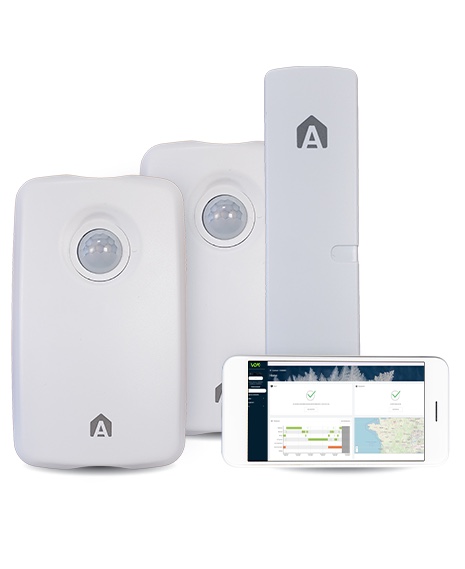
With the Vox I.C.E Monitor Solution, you get the best of both, this digital solution allows caregivers and loved ones to passively watch over independent seniors and proactively respond to emergencies. The system works with non-intrusive sensors that are installed in strategic places around the home.
The motion sensors allow Vox I.C.E to establish a normal behavioral pattern, as motion sensors monitor sleep patterns, movement, accidental falls and routine tasks.
If an abnormality occurs e.g. lack of movement or not locking a door, the system sends an alert to a predefined list of contacts. This self-contained solution with built-in battery power, is not affected by power failures and does not require existing internet connectivity onsite.
Vox I.C.E is customisable and easy to install. It offers a scalable solution to suit changing care requirements and give you peace of mind.
To find out more, contact Wheelchairs on the Run on 011 955 7007 or via info@wheelchairsontherun.co.za.
Voice Controlled TV’s
New sophisticated Smart Interaction technology enables you to operate your TV without pushing a button. You can easily control functions such as turning on/off your TV, changing channels, accessing apps & navigating the web by using simple voice commands such as:
– Change the channel and volume. “Channel Up”
– Simply say the name of services. “Smart Hub”
?
Automatic Door Openers
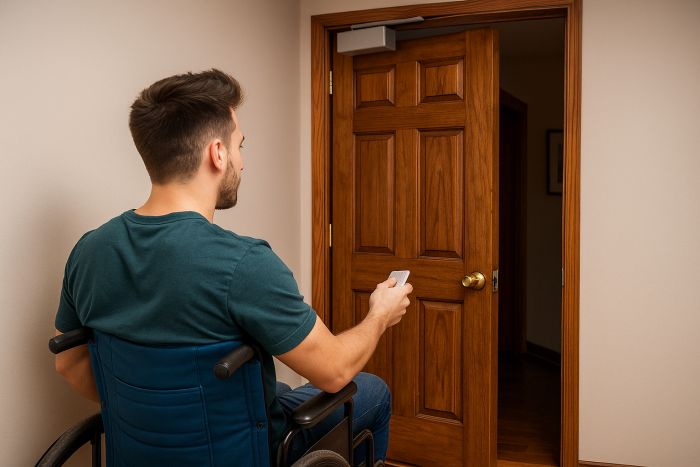
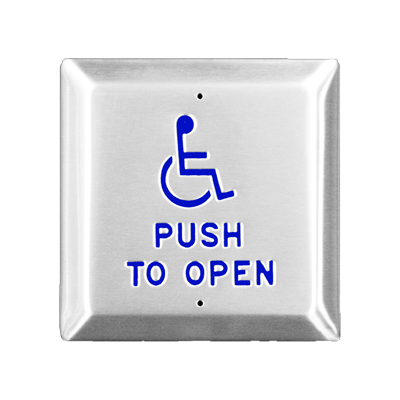
An Automatic Door or Gate Opener is a handy Assistive Device for persons who are Blind or have a Mobility Impairments that requires the use of an assistive device like a White Cane, Walker, Scooter or Wheelchair. These devices often prevent the user from getting close enough to the door or gate to open it and many of the persons who use these Assistive Devices don’t have the strength or sufficient use of their hands and arms to open the door using the door handle. These devices are therefore not only essential for some persons with disabilities to retain their independence, but are also useful in case of emergency.
There are a wide variety of different devices that can be used to open both gates and doors, depending on whether the door or gate slides open or swings open. A swing-door opener automatically operates a swing door for pedestrian use, it opens or helps open the door automatically, waits, then closes it.
Thanks to the companies that supply a variety of Home Automation Aids and systems in South Africa, you can now perform various functions from across your home or from the other side of the world via the Internet. If you have any question or are interested in purchasing any of these products discussed on this page the, please feel free to Contact Us and we will point you in the right direction