


Glasses and Eye Protection
Welcome to the Glasses and Eye Protection page for people with Visual Impairments where you can find various solutions to suite your needs.
Glasses play a vital role in supporting people with visual impairments by enhancing usable vision, improving comfort, and promoting greater independence in daily activities.
Unlike standard eyewear that focuses mainly on correcting refractive errors, glasses for people with visual impairments are often designed to maximise remaining vision, reduce visual strain, and adapt to specific functional needs such as reading, mobility, or working in varied lighting conditions.
These glasses can generally be grouped into three main types: corrective glasses that improve visual clarity, low vision and magnification glasses that enlarge or optimise visual detail when vision loss is more significant, and enhancement or protective glasses that manage glare, contrast, and light sensitivity.
Understanding these categories helps individuals, families, and professionals select the most appropriate solutions to support participation, safety, and quality of life.
What Are You Looking For?
Companies and Organisations That Can Assist
Types of Glasses and Eye Protection
1. Corrective Glasses
2. Safety & Protective Glasses
– Anti-Glare Wrap-Around & Fit Over Glasses
– Clip-On & Hook On Anti-Glare Glasses
– Polarising Anti-Glare Glasses
3. Smart Glasses & Wearable Magnifiers
– Smart Glasses
Max Glasses
MaxEvent Glasses
Power TV Glasses
AngelEye Smart Glasses
e-Sight Glasses
Wearable Magnifiers


Companies and Organisations That Can Assist
While standard eyewear that focuses on correcting refractive errors and maximises remaining vision is readily available via prescription from optometrists, Protective Glasses, Smart Glasses and Magnification Glasses are less readily available.
These solutions range from traditional lenses that sharpen vision to advanced wearable tech designed to help with reading, object recognition, and daily navigation and are provided by specialised companies working to improve accessibility and independence for people with low vision, including the organisations and companies listed below:

Edit Microsystems (Pty) Ltd is an award-winning company that is devoted to finding alternative and state-of-the-art technical solutions to improve curriculum delivery in educational institutions and effective communication in business with a focus on high-speed functional connectivity and on-going support.
They have a proud tradition of innovation and are on the cutting edge of technological advances in education. Many of their products are designed to enhance interactivity in a classroom or lecture theatre. Edit Microsystems are also a leader in finding and providing specially adapted hardware and software for Learners with Special Educational Needs throughout South Africa.
Contact: 086 111 3973
Head Office: 13 Boy De Goede Circle, Table View, Cape Town, 7441.
They also have branches in KwaZulu-Natal, Mpumalanga, Gauteng.
Website at: www.editmicro.co.za
Email them at: info@editmicro.co.za
Blind SA is a national disabled People’s Organisation (DPO) of the blind and for the blind. Established in 1946 as the South African Blind Workers Organisation (SABWO) and became Blind SA in 2004. Head office is situated at 5 Fuchs Street, Alrode, Alberton, however our services are rendered to blind and visually impaired in all provinces in South Africa.
The vision of Blind SA is to do whatever is necessary or conducive to empower visually impaired people to become economically self-supporting and to live a full and meaningful life as citizens of South Africa.
The biggest challenges faced in our communities are the shortage of financial resources to enable our blind and visually impaired beneficiaries to reach their full potential as independent members of society.
The impact that Blind SA has had on the community is a more informed, empowered and enabled blind and visually impaired community. Because we have so many such people who are in serious need of our assistance, we would welcome the opportunity and resources to be able to reach more people with the view of creating a self-supporting, independent and informed blind and visually impaired community throughout South Africa.
“Our Purpose is to end the cycle of poverty for Blind South Africans, empowering them with knowledge and information through education, braille and developmental services and to break down barriers, provide opportunities and create answers that improve the quality of life for the blind community so that they can live the life they choose.”
Blind SA also stock and sell a variety of Assistive Devices to assist persons who are Blind, these include the Mali-Bhala, Tatrapoint Mechanical Brailler and Braille-Me. For any other requirements, contact Blind SA on: Tel: +27 11 839 1793/4 or Email: ceo@blindsa.org.za, Jennine Pare – sales@blindsa.org.za, or visit us at: Address: 5 Fuchs Street, Alrode, Gauteng, South Africa. Website: www.blindsa.org.za.
Sensory Solutions: Sensory Solutions is a South African company with considerable experience in the field of accommodating persons who are visually impaired, blind or partially sighted. We specialise in the field of providing Access Technology solutions for individuals, schools, universities, government departments and more, in order to make the environment more accessible for the visually impaired.
Sensory Solutions is at the forefront of the world’s leading Access Technology products and are in some cases the exclusive distributors. Sensory Solutions is a responsible employer which employs people from previously disadvantaged backgrounds as well as those who are disabled. Part of our mission is to advise individuals and institutions on the best solutions available for particular environments, to design such solutions and finally to implement them on site. As such, we are approved African distributors for a wide range of Access Technology products selected specifically for their suitability to the African environment and our specific situation.
We are proud to be appointed exclusive and preferred dealerships for some of the world’s most leading Access Technology manufacturers. Our mission and ethos revolve around our fellow man, empowering them and making the playing fields level as far as we can make a difference.
Whether you are an individual, institution or company in need of information regarding Access Technology, we are ready to assist you. Please feel free to contact us at our Head Office on +27 12 664 7704 or at 226 Kruger Avenue, Lyttelton Manor, Centurion, 0157. Email: info@sensorysolutions.co.za, khan@sensorysolutions.co.za or visit our website at: www.sensorysolutions.co.za.
Types of Glasses and Eye Protection
In the page below, we provide the three categories of glasses available and the different products that fall under each category as well as the companies and organisations that supply them. Please read the information below to find out more about these options.

1. Corrective Glasses
Corrective glasses help many people with visual impairments see more clearly by improving focus, reducing blur, and enhancing contrast in everyday environments. By tailoring lenses to specific conditions such as myopia, hyperopia, or astigmatism, they support safer mobility, easier reading, and better visual recognition. With improved clarity and reduced eye strain, corrective glasses promote independence, comfort, and overall quality of life.
Click Here to Find out more about Corrective Glasses.

2. Safety & Protective Glasses
These Glasses are worn to protect your eyes while working in potentially hazardous jobs, such as Construction work, Factory work, or as Machinists and Lab Technicians. They are made from break proof plastic lenses to protect the eyes from flying debris or hazardous splatter and are styled like wraparound sunglasses, but with much darker lenses, while nylon frames are used for protection eye wear for sports, thus giving the Glasses lightweight and flexible properties.
Click Here to Find out more about Safety & Protective Glasses.

3. Smart Glasses & Wearable Magnifiers
Smart glasses and wearable magnifiers are assistive technologies designed to help people with visual impairments access visual information more independently. They use features such as digital magnification, contrast enhancement, text-to-speech, and object or face recognition to make everyday tasks like reading, navigation, and social interaction easier.
Various types of these glasses, are available in South Africa.
Click Here to find out about the Smart Glasses and Wearable Magnifiers available.
1. Corrective Glasses
Corrective Glasses or lenses are used to correct refractive errors by bending the light entering the eyes to alleviate the effects of conditions such as near-sightedness, farsightedness or astigmatism. As most people get older, they can develop a condition which makes it difficult for them to focus on objects close to the eyes. Corrective lenses bring the image back into focus on the retina.
Most persons that have these types of Visual Impairments can visit an Optometrist or Ophthalmologist for an examination which indicates what corrective lenses are appropriate for that patient. At the conclusion of the exam, the Optometrist or Ophthalmologist will order and/or assemble the frames and appropriate lenses, which are then dispensed and sold to the patient.
Corrective Glasses can significantly improve the quality of life of the wearer, as they not only enhance the wearer’s visual experience, but can also reduce problems that result from eye strain, such as headaches or squinting. If you feel that you may need Glasses, you should contact an Optometrist for an eye test.

2. Safety and Protective Glasses
Safety & Protective Glasses are worn to protect your eyes while working in potentially hazardous jobs, such as Construction work, Factory work, or as Machinists and as Lab Technicians. These Safety Glasses are made from break proof plastic lenses to protect the eyes from flying debris or hazardous splatter, such as blood or chemicals. Safety Glasses for welding are also used and are styled like wraparound sunglasses, but with much darker lenses, while nylon frames are used for protection eye wear for some sports, thus giving the Glasses lightweight and flexible properties. Some Safety Glasses include protection beside the eyes as well as in front of the eyes and can also be used to protect the eyes against visible and near-visible light or radiation, such as Anti-Glare Protection Glasses.
Anti-Glare Protection Glasses also be known as Anti-Reflective Glasses can reduce the reflection of light that enters our eyes, the lenses are given an anti-glare coating to prevent reflections of light under different lighting conditions, therefore reducing the amount of glare on your eyes and improving your vision. There are a variety of different types of these Anti-Glare Glasses, including Glasses that can fit over your prescription glasses or clip or hook onto them. The Anti-Glare also applies to the outer glass, thus allowing for better eye contact, they can also come with polarized lenses for extra protection against glare:
Anti-Glare Wrap-Around & Fit Over Glasses
There are a variety of different types of these Anti-Glare Wrap-Around Glasses and Fit Over Glasses which are available in South Africa, some of these are sold by Companies such as Edit Microsystems, who sell products such as the:
Deluxe Semi Wrap-Around Anti-Glare Glasses: These Anti-Glare Glasses are close fitting with adjustable arms to provide extra protection. There are 5 colour filters to choose from, and the glasses come in one standard size. They have infra-red (IR) protection for relief from eye fatigue and are designed to be worn alone and not over regular glasses.
These Anti-Glare Glasses are sold in South Africa by Edit Microsystems, click on the link to find out more about the colour filter options or to purchase this product. Deluxe Anti-Glare Fit Over Glasses

Deluxe Anti-Glare Fit Over Glasses: These Anti-Glare Glasses (pictured right) have additional infra-red (IR) protection for relief from eye fatigue, they are available in 4 colour filters to maximise functional vision, enhance contrast and provide comfort from a disabling glare. The frames are one size only but have adjustable side arms so that the glasses fit comfortably over the arms.
These Anti-Glare Glasses are sold in South Africa by Edit Microsystems, click on the link to find out more about the colour filter options or to purchase this product, or contact Edit Microsystems, to see what other types of these products they can supply.
Clip-On & Hook-On Anti-Glare Glasses
There are a wide variety of different types of Clip-ons” or “Hook-On Anti-Glare Glasses”, these Glasses clip on or hook on to your current prescription glasses, thus allowing for better eye contact. Some of these Glasses are available in South Africa and are sold by Companies such as Edit Microsystems, they include products such as the:

Clip-On with Flip-Up Style Anti-Glare Glasses: These Anti-Glare Glasses (pictured right) are designed to be used together with regular glasses. The glasses are easy to clip on and can be flipped up when not in use. There are four colour filters available, and the glasses come in small and large sizes. These Glasses are sold in South Africa by Edit Microsystems.
Click on the link to find out more or to purchase this product.
Please feel free to contact Edit Microsytems to find out more, or to receive a quote.
Hook On Style Anti-Glare Glasses can be used together with your regular glasses; they have the ability to improve your vision and help to eliminate the reflections of light from the front and back surface of eyeglass lenses. The glasses come in a variety of sizes and are available in four different tints.
These Glasses are sold in South Africa by Edit Microsystems, click on the link to find out more or to purchase this product.
Polarising Anti-Glare Glasses
There are a variety of different types of Polarising Anti-Glare Glasses which can assist Persons who are Blind or have Visual Impairments. These Glasses reduce the glare caused by bright light being reflected from particularly reflective surfaces such as glass, snow and water. Many of these types of Glasses are available in South Africa and are sold by Companies such as Edit Microsystems, they include products such as:
Polarising Anti-Glare Glasses: These Glasses have lenses which are made from a polarising material which reduces the glare caused by bright light being reflected from particularly reflective surfaces. The glasses come in a grey or amber colour filter and are available in a small or medium size. These Glasses are sold in South Africa by Edit Microsystems, click on the link to find out more or to purchase this product.
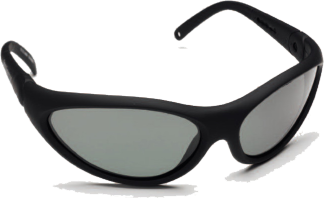
Deluxe Polarising Semi Wrap-Around Glasses: These Glasses (pictured right) have polarising lenses which helps to reduce glare from reflective surfaces. These Glasses are designed to be worn by themselves and not over regular glasses, they come in a single standard size and are available with a grey or amber tint. These Glasses are sold in South Africa by Edit Microsystems, click on the link to find out more or to purchase this product.
3. Smart Glasses & Wearable Magnifiers
There are a variety of different types of Smart glasses and wearable magnifiers which can assist Persons who are Blind or have Visual Impairments. Some of these Magnifying Glasses can assist people to view longer distance and can be used for watching TV or sporting events, while other Smart or Electronic Glasses can enhance the vision of a Person with Visual Impairments or help a Person who is Blind to perceive the world.
These products are available in South Africa and are sold by Organizations and Companies such as Sensory Solutions, the South African National Council for the Blind and Edit Microsystems and include:
Smart Glasses
There are a variety of different types of Smart glasses and wearable magnifiers which can assist Persons who are Blind or have Visual Impairments. Some of these Magnifying Glasses can assist people to view longer distance and can be used for watching TV or sporting events, while other Smart or Electronic Glasses can enhance the vision of a Person with Visual Impairments or help a Person who is Blind to perceive the world.
These products are available in South Africa and are sold by Organizations and Companies such as Sensory Solutions, the South African National Council for the Blind and Edit Microsystems and include:

The eSight Glasses: (pictured right) are electronic glasses that enhance the vision of a person who has low vision by using a high-speed camera, video processing software, a computer processor and high-quality video OLED screens to project a real-time image.
By using zoom in/zoom out, contrast and colour adjustments, edge enhancement and brightness control, the eSight Eyewear can enhance whatever the wearer is looking at, thus maximizing their remaining eyesight. eSight is a registered medical device, and it requires no surgery.
These eSight Glasses are sold in South Africa by Edit Microsystems. Click on the link to find out more or to purchase this product.
Magnification Glasses
Magnifying Glasses can assist people to view longer distance and can be used for watching TV or sporting events. These products are available in South Africa and are sold by Organizations and Companies such as Sensory Solutions and Edit Microsystems and include products such as:
The Max Glasses: are binocular telescopic glasses which are perfect for watching TV, sporting events, movies, theatre, bird watching, or any other distance viewing activity. These binocular telescope glasses will focus on objects from 10 feet to infinity.
The Max Glasses are sold in South Africa by the South African National Council for the Blind, click on the link to find out more or to purchase this product.
Please feel free to contact Edit Microsytems to find out more, or to receive a quote.

The MaxEvent glasses (pictured right) are perfect for seeing indoor and outdoor events with more crisp and clear vision and to ensure the feeling of positivity and close to action. They consist of a mirrored coating that has been applied to the lenses by a Maxievent Glasses process called vapor deposition which eliminates the glare of the sun and allows enlargement of the eyes of the person wearing the glasses, which is not visible to the external observer.
The glasses are hands free and is head mounted, they can be adjusted so that each eye lens can be focused separately, enabling a very adaptable system with flexible temples. The MaxEvent glasses are very comfortable and provide 2.1 x magnification.
The MaxEvent Glasses are sold in South Africa by Edit Microsytems, click on the link to find out more or to purchase this product.

Power TV Glasses are lightweight and adjustable TV Glasses (pictured right) which provide 2X magnification, ideal for distance viewing. These comfortable glasses are perfect for watching television, movies, sporting events or other activities.
Using a fully adjustable twin-lens design to set a desired viewing distance, the easy-to-use glasses will maximise the size of your television screen and provide complete enjoyment of multiple activities. The optimal focal distance is 1.2 m. It weighs only 71 g and includes a micro-fibre cleaning cloth and protective carrying case.
Power TV Glasses are sold in South Africa by Sensory Solutions, please click on the link to find out more or to purchase this product.
Wearable Magnifiers
Wearable magnifiers are devices designed to assist individuals with low vision by providing magnification of nearby objects. These devices are typically worn on the head or attached to eyeglasses, and can be helpful for tasks such as reading, writing, or performing other visually demanding tasks.
There are several types of wearable magnifiers, including head-mounted magnifiers (HMDs), which are worn on the head like a pair of goggles, and clip-on magnifiers, which can be attached to the user’s existing eyeglasses. HMDs can provide a wider field of view than clip-on magnifiers but may be bulkier and more cumbersome to wear.
Some wearable magnifiers are also equipped with additional features, such as LED lights to provide additional illumination for the user. These can be particularly useful in low-light environments, or for individuals with limited vision who require additional illumination to see clearly. Wearable magnifiers can be a useful tool for individuals with low vision, as they can provide additional magnification and help to make everyday tasks easier and more manageable.
Some of these Wearable Magnifiers are available in South Africa and are sold by Companies such as Sensory Solutions, they include products such as the:

The Acesight VR (pictured right) is the latest addition to the Acesight family of wearable devices. It is light and bright and uses powerful visual technology to help you regain your visual independence. Watch your favourite TV shows with an incredible smooth and bright image, without the lag. Acesight VR is cool in more ways than one. Best of all is the cool operating temperature, even after 1-2 hours of continuous use.
There is nothing complicated about Acesight VR. Sit down, put it on and enjoy what you see around you. The industry-leading resolution makes everything look and feel great. You will notice the image looks vivid and bright. Acesight VR is full of pleasant surprises, including an amazing 48 megapixels camera that is up to 4 times better than anything else. With an extra wide 65-degree field of view, this device lets you see more of the world around you.
At just under 450 g in weight, Acesight VR is lighter than most other wearable devices and feels comfortable to wear, even for extended periods of use.
Key Features: Virtual Reality (VR); Screen resolution: 2340 × 1080 full HD; Camera: 48 megapixels; Field of view: 65 degree; Refresh rate: 60 fps; Magnification: 1x – 16x; Wireless 3-button controller; Helpful functions – outline, high contrast, find, narrow display; 2.5+ h usage time, 1.5 h charging time a a Weight of 460 g.
The Acesight VR Glasses are sold in South Africa by Sensory Solutions, click on the link to find out more or to purchase this product.
The Acesight VR (pictured right) is the latest addition to the Acesight family of wearable devices. It is light and bright and uses powerful visual technology to help you regain your visual independence. Watch TV with an incredible smooth and bright image, without the lag. Acesight VR is cool in more ways than one. Best of all is the cool operating temperature, even after 1-2 hours of continuous use.
There is nothing complicated about Acesight VR. Sit down, put it on and enjoy what you see around you. The industry-leading resolution makes everything look and feel great. You will notice the image looks vivid and bright. Acesight VR is full of pleasant surprises, including an amazing 48 megapixels camera that is up to 4 times better than anything else. With an extra wide 65-degree field of view, this device lets you see more of the world around you.
At just under 450 g in weight, Acesight VR is lighter than most other wearable devices and feels comfortable to wear, even for extended periods of use. Key Features: Virtual Reality (VR); Screen resolution: 2340 × 1080 full HD; Camera: 48 megapixels; Field of view: 65 degree; Refresh rate: 60 fps; Magnification: 1x – 16x; Wireless 3-button controller; Helpful functions – outline, high contrast, find, narrow display; 2.5+ h usage time, 1.5 h charging time a a Weight of 460 g.
The Acesight VR Glasses are sold in South Africa by Sensory Solutions, click on the link to find out more or to purchase this product.
Power TV Glasses are lightweight and adjustable TV Glasses (pictured right) which provide 2X magnification, ideal for distance viewing. These comfortable glasses are perfect for watching television, movies, sporting events or other activities.
Using a fully adjustable twin-lens design to set a desired viewing distance, the easy-to-use glasses will maximise the size of your television screen and provide complete enjoyment of multiple activities. The optimal focal distance is 1.2 m. It weighs only 71 g and includes a micro-fibre cleaning cloth and protective carrying case.
Power TV Glasses are sold in South Africa by Sensory Solutions, please click on the link to find out more or to purchase this product.
The eSight Glasses: (pictured right) are electronic glasses that enhance the vision of a person who has low vision by using a high-speed camera, video processing software, a computer processor and high-quality video OLED screens to project a real-time image.
By using zoom in/zoom out, contrast and colour adjustments, edge enhancement and brightness control, the eSight Eyewear can enhance whatever the wearer is looking at, thus maximizing their remaining eyesight. eSight is a registered medical device, and it requires no surgery.
These eSight Glasses are sold in South Africa by Edit Microsystems. Click on the link to find out more or to purchase this product.
Disclaimers and References
Simplified Summary
Glasses and Eye Protection Page: This page introduces various types of glasses that can assist people with visual impairments. You can see what’s available in South Africa and click links to find the companies that sell them. Businesses can also share their products here and join our community.