


Alerting Devices
Alerting Devices for the Deaf or those with Hearing Impairments, are Assistive Devices that connect with doorbells, telephones, alarm systems and other devices, to let a person know that some condition is occurring, such as a smoke alarm, doorbell ringing or baby crying.
These alarming devices add a specific alarm based on one’s disability, such as a doorbell that blinks a light instead of a noise to indicate that someone is at the door. These Alert Devices above, mostly utilize innovative alerting technology to inform deaf or hearing-impaired individuals of phone calls, visitors, and emergency situations such as a fire or dangerous carbon monoxide levels within the home. This alerting technology includes Flashing Lights, Vibration or Extra Loud Alarms.
What Are You Looking For?
Companies and Organisations That Can Assist
Types of Alerting Devices
1. Alarm Clock and Telephone Alerting Devices
2. Doorbell, Knock and Intercom Alerting Devices
3. Smoke and Carbon Monoxide Alerting Devices
4. Alarm Clock, Timer and Watch
5. Complete Alerting Systems
6. Hearing Dogs




Companies and Organisations That Can Assist
The availability of these Alerting Devices is increasing thanks to various Organizations and Companies such as Edit Microsystems who have made concerted efforts to make sure that this equipment is easily available for persons who are Deaf or have Hearing Impairments, as well as variety of other equipment is available to purchase from the various organisations and companies that specialise in the training of Hearing Alert Dogs in South Africa, such as Smart Service Dog, Honey’s Garden For Medical Alert Dogs SA, Paws4Purpose and Paws4life Training Academy.

Edit Microsystems (Pty) Ltd is an award-winning company that is devoted to finding alternative and state-of-the-art technical solutions to improve curriculum delivery in educational institutions and effective communication in business with a focus on high-speed functional connectivity and on-going support.
They have a proud tradition of innovation and are on the cutting edge of technological advances in education. Many of their products are designed to enhance interactivity in a classroom or lecture theatre. Edit Microsystems are also a leader in finding and providing specially adapted hardware and software for Learners with Special Educational Needs throughout South Africa.
Contact: 086 111 3973
Head Office: 13 Boy De Goede Circle, Table View, Cape Town, 7441.
They also have branches in KwaZulu-Natal, Mpumalanga, Gauteng.
Website at: www.editmicro.co.za
Email them at: info@editmicro.co.za

Honeys Garden is a nonprofit organisation (2016/387235/08 ) whose mission is to place quality service dogs with people within South Africa who are under-privileged, fighting with disabilities or diseases, and veterans who have lost use of limbs or hearing.
Honeys Garden also assist with animal rescue and educate the public regarding the use of service dogs in public places. Enriching the lives of children and adults with medical disabilities and diseases by matching them with task trained service dogs.
Honeys Garden supplies and utilizes specifically trained TheraPets for working professionals and individuals.
They were the first company to train Medical Service Dogs in South Africa!
All their Service Dogs and Therapets undergo stringent testing, including the KUSA Canine Good Citizen Award.
Honey’s Garden for Medical Alert Dogs SA is run by Lucy Breytenbach (Director/Founder). Their purpose, to enrich the lives of families across the country by providing quality task trained service dogs.
‘We aim to increase the confidence and independence of those in need, and their families. We have successfully introduced medical service dogs, and Therapets for working facilities into South Africa. Our dogs save and change lives daily.’
The dogs that we are currently able to provide include but are in no way limited to:
Please feel free to or contact Honey’s Garden via Lucy Breytenbach on Mobile: +27 72 250 0336, via Email: honeysgardensa@gmail.com, or through their website at: www.medicalalertdogs.co.za
Alternatively you can join our local classes in Leadville Dog Park, Leadville Way Sunningdale, Cape Town, 7441.
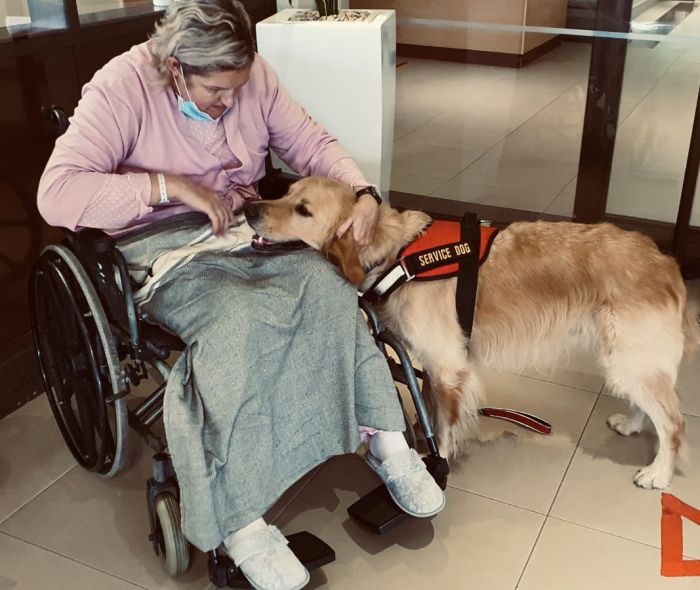

The Paws4life Training Academy is a specialised K9 training facility based in Cape Town and started in 2015. They live by the motto: “Your dog is not just a dog”. They not only train puppies and dogs but aim to create an everlasting bond between human and dog.
Through education, Paws4Life strives to improve the lives of animals and in turn improve the lives of their people – cementing the bond between humans and canines. They aim to provide affordable dog training that provides for the needs of all dog owners.
Paws4life sees it as their social responsibility to ensure that the dogs they train are safe around children, not a danger or a nuisance to their owners or the public – and that the animals rights are upheld and considered at all times.
Paws4Life are committed to:
– Consistent, reliable and the optimal educational quality
– An atmosphere of understanding, learning and fun
– Friendly and caring staff and management
– Meeting the needs and exceeding the expectations of all our stakeholders, suppliers and clients
– Creating a better life for dogs and their people through usability of our training in the home environment
– That all training offered reflects our philosophies of trust, honesty, honour, virtue and integrity in all contacts with Paws4life.
What is our business philosophy?
– Delivery of quality in all encounters
– Trust through long-term relationship development
– Nurturing a learning environment
– Fun for person and pooch alike
Hearing Assistance Service Dogs – Alert individuals who are deaf or those who have Hearing Impairments about noise that warns against potential harm, or if someone is calling them.
The Paws4life Training Academy also assist with the training of: Psychiatric Service Dogs; Seizure Alert Dogs; Diabetic Alert Dogs; Mobility Assistance Service Dogs; Multipurpose Service Dogs and Autism Assistance Service Dogs.
All Service Dogs will go through assessments as they qualify through all the various training levels, they need to go through a KUSA Good Citizen testing bronze level and will only be able to qualify when they pass all the testing and assessments.
If you require any more information or are interested in Service Dog Training, please contact Calika Morries from Paws4life Training Academy on:
Cell: +27 72 445 4310; Email: paws4lifetraining@gmail.com or visit our website at: www.paws4life.co.za

Paws4Purpose is a Professional Service and Therapy dog Training facility situated in Johannesburg that focuses on training for owner-trained service dog teams and program-supported training pathways.
Our Training Services Include:
– KUSA Canine Good Citizen (CGC)
– KUSA standard obedience
– Therapy Dog Training
– Service Dog Puppy Classes
– Service Dog Training
– Emotional Support dog Training
At Paws4Purpose, we believe that every individual deserves the opportunity to benefit from a well-trained Assistance Dog and the life-changing partnership they provide. Paws4Purpose is run by Diane Redelinghuys who focuses on Service Dog Trainer, CGC and Obedience and Dominique Kirsten who specialises in Therapy Dog trainer, CGC and Obedience.
The dogs that we are currently able to provide include but are not limited to:
Please feel free to or contact Paws4Purpose via Diane Redelinghuys on: 076 525 0886 (WhatsApp only) for Service Dog Trainer, CGC and Obedience enquiries, or Dominique Kirsten on: 071 897 2030 (WhatsApp only) for Therapy Dog trainer, CGC and Obedience.
Alternatively contact us via Email: info@Paws4Purpose.net, or through our website at: www.paws4purpose.net (Currently under Construction)
Vitozol Dog Park | 362 Valley Road | North Riding | Johannesburg
Paws4Purpose – Training Dogs with Purpose
Types of Alerting Devices
Alerting devices for Deaf and hard-of-hearing people use visual cues, vibrations, or tactile signals to notify users of important sounds like doorbells, alarms, phones, or a baby crying. These devices improve safety, independence, and peace of mind at home, work, and in public spaces and include products such as:
1. Alarm Clock and Telephone Alerting Devices
The ability to hear a telephone ring will depend on a number of factors such as the severity of the hearing loss, the frequency of the telephone ring and the distance from the telephone to the person. If the individual does not respond to the sound of the typical telephone ring, there are telephone ringers available which have adjustable volume, pitch, and ring patterns. Very often, a lower pitch ring can make it easier to hear. If the hearing loss is severe, there are devices that will cause a light to flash, a body worn unit to vibrate, or a bed-shaker to vibrate when sleeping. Most amplified telephones have options for volume, pitch and pattern as well as a small flashing light to indicate the phone ringing. Different types of Alarm Clock and Telephone Alerting Devices are available to purchase in South Africa from companies and organizations such as Edit Microsystems, they include:.
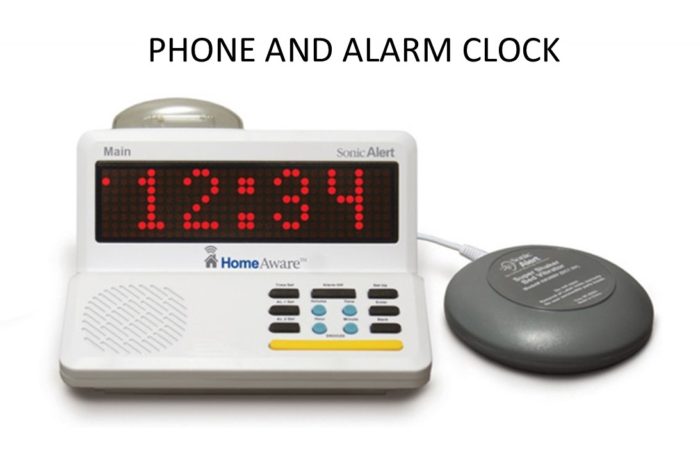
The HomeAware Telephone Ring Signal System With Bed Shaker Package signal system makes things much easier for you by offering both a dual alarm clock and alert system for your landline telephone calls.
All you have to do is connect yourHomeAware Telephone Ring Signaler With Bed Shaker Package telephone to the signal system. The HomeAware is able to alert you to your alarm clock or telephone, it warns you by way of a flashing strobe, bed shaker, and 105 dB alert.
The HomeAware will show who exactly is trying to reach you on caller ID and a two inch, easy to read display. Designed for the deaf and hard of hearing, it is designed to show important alerts that keep you safe. The signaler can also alert you to babies crying, doorbells, mobile phone calls, text messages, emails, dogs barking, and much more. Additional accessories include the HomeAware Deluxe Remote Receiver, the HomeAware Basic Receiver, the Smoke and CO (carbon monoxide) detection transmitters, the Baby Cry monitoring transmitter, the SonicBridge, and the HomeAware smartphone application.
Features Include:
• Flashing strobe with scrolling alert messages on a bright red large, two-inch display
• Powerful bed shaker and adjustable alarm up to 105 dB
• Dual alarm clock with alarm and snooze duration
• Compatible with all traditional and new HomeAware receivers
• Monitoring of low batteries and broken links between the main unit and transmitters
• Caller ID for landline and video phone calls
• Range up to 1,000 feet! Extendable range with additional receivers
• USB plug charges your cell phone while you sleep
• Full battery backup
These products are available to be purchase from companies such as Edit Microsytems, contact them to find out more or to receive a quote.
2. Doorbell, Knock and Intercom Alerting Devices
There are a variety of different types of Doorbells, Knock and Intercom Alerting Devices that can assist you if the doorbell, a knock on the door or intercom cannot be easily heard. These include various wireless extra loud doorbells that are currently on the market. The doorbell is installed outside the door of the house or apartment, and the receiver (bell) is plugged in to an electrical outlet located inside the home. Additional receivers can be added as required.
Other units that are available will cause a remote receiver to either make a sound, flash a strobe light or lamp when the doorbell is pushed. In addition, some units can be made to operate with the type of intercom system often found in apartments. When the intercom buzzer is pushed at the main door of an apartment building, the sensor inside the apartment will “hear” the sound and send a signal to receivers.
Generally, these types of doorbells are part of a complete alerting system and are usually wireless making installation easy. Another type of device is one that is attached to the inside of the door and will respond to someone knocking by flashing a light. This type of device is best used in a small apartment or hotel room. Some of these Intercom; Doorbell and KnockSenso Door Alerting Devices are available to purchase in South Africa from companies and organizations such as Edit Microsystems, they include:

The Senso Door works as a doorbell and has advanced functionality, it sends signals to a receiver of a hearing-impaired person. It has an integrated LED light indicator of doorbell activation and a large size button area, to facilitate use by people with limited mobility of fingers. It is protected against raindrops and water splashing, so it can be mounted out of doors.
Specifications include:
– Operates from battery or AC 220V
– 100 m reception radius
– In a box: Senso Door transmitter; Battery and Operating instructions, Quick guide (DK, SW, FIN, EN)
These products are available to be purchase from companies such as Edit Microsystems, contact them to find out more or to receive a quote.
3. Smoke and Carbon Monoxide Alerting Devices
There are two options for smoke and carbon monoxide safety. Both options can be used as part of a complete alerting system and are usually wireless making installation easy.
The first would be to make existing traditional smoke and Carbon Monoxide (CO) detectors accessible by installing a sound monitoring device mounted close to the detector(s). When the detector alarm goes off, the sound monitor “hears” the sound and then sends a signal to a receiver in order to signal a bed shaker or flash a strobe light or lamp. The second option is to use specific smoke and Carbon Monoxide (CO) detectors for deaf and hard of hearing individuals. These detectors send a signal to a receiver in order to signal a bed shaker or flash a strobe light or lamp. Different types of Smoke and Carbon Monoxide Detectors are available to purchase in South Africa from companies and organizations such as Edit Microsystems, they include:
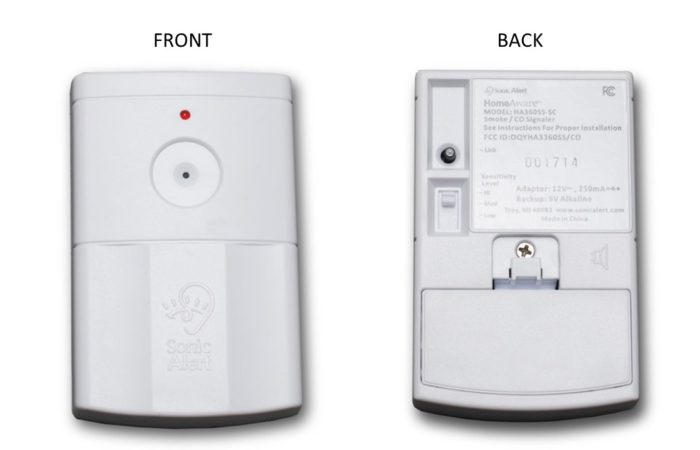
HomeAware Smoke/CO Sound Transmitter: The HomeAware Smoke/CO Sound Transmitter is ideal if you have trouble hearing your smoke and carbon monoxide alarm. Through the HomeAware main unit and remote receivers, this sound HomeAware Smoke/CO Sound Transmitter transmitter will detect a smoke and carbon monoxide alarm sound and send a signal. Following that, the red LED light will start flashing. Should it detect a loud smoke detector sound that meets the T3 standard used for smoke detectors, the word “SMOKE” will be displayed on your HomeAware main unit. Alternatively, if it detects a loud sound from a carbon monoxide (CO) detector meeting the T4 standard, “CO” will display on your HomeAware main unit.
“ALERT” will scroll across your HomeAware main unit should it detect a loud sound not meeting the T3 or T4 standard. The sensitivity of the “ALERT” can be controlled via a back switch. You can choose from three levels, which include the HI setting that alerts you to more sounds and is most sensitive, the MED setting, which alerts you to less sound and is less sensitive, and the LO setting that is least sensitive of all. Should you not be able to pick up the sound you wish to be alerted to, move the sensitivity to a setting higher. You can also attempt to move the transmitter closer to the source sound.
These products are available to be purchase from companies such as Edit Microsytems, contact them to find out more or to receive a quote.
4. Alarm Clock, Timer and Watch
There are many alarm clocks and timers available with adjustable volume and pitch, flashing light, or vibration. There are both electrically powered and battery powered alarm clocks. Some alarms clocks are part of a complete alerting system. Generally, the electrically powered clocks are louder, a lamp can be plugged into them and tend to have stronger vibration. However, battery powered alarms can be useful when traveling. There are small timers available that use sound, flashing light, or vibration as an alert. These are good for cooking or as a medication reminder.
Sonic Alert Bomb Blue Alarm Clock with Super Shaker: The Sonic Alert Bomb Blue Alarm Clock with Super Shaker will start your day off the right way. The blue clock will help you never feel sad again. It can wake you up with a noisy alarm. However, should you not wish to be disturbing others in the room, you could just use the bed shaker. The blue sonic clock is great for any person who wants to be woken up on-time. This blue sonic clock continues to help many people and carries with it an outstanding reputation. Stop feeling sad and wake up on-time today!
The Sonic Alert Bomb Blue Alarm Clock FEATURES:
• 113 dB extra-loud dual alarm (with adjustable tone & volume control)
• Packaged with our most powerful 12-volt bed shaker
• Built-in red flashing alert lights
• 5-level dimmer function
• User selectable snooze time 1-30 minutes your choice
• User selectable alarm duration from 1-59 minutes
• Improved battery backup, will back up the time and alarm settings up to one week
• New green power technology now uses 60% less energy
• Alarm & Bed Shaker Test Mode
• Dual time (12 / 24 hour time formats)
• One-year warranty
These products are available to be purchase from companies such as Edit Microsytems, contact them to find out more or to receive a quote.
There are several wrist watches available that use vibration as an alarm, on the hour alert, medication reminder or countdown timer.
5. Complete Alerting Systems
There are many complete alerting systems on the market today and it is important to understand how they operate.
There is usually a base unit that has its own outlets in which you can plug in a lamp and a bed shaker. The electrical outlet of this self-contained base unit would normally be dead but becomes live (turned on) when the alarm condition occurs. For example, a base unit that also doubles as an alarm clock has both an outlet for a lamp and an outlet for a bed shaker.
The lamp that is plugged into the unit should remain on and is switched on and off using a switch on the base unit, and not on the lamp itself. When the base unit is triggered by either receiving a signal from a transmitter such as a doorbell, baby cry signaller or simply using an alarm for waking, the lamp will flash, bed shaker will shake, or the unit will emit a sound in a specific pattern according to the condition. On some systems the lights will flash or can be adjusted to flash in different patterns so that you can easily tell the difference between one condition and another. While other systems show on their base unit, indicator lights that will let you know exactly what the condition is. If a lamp is used for alerting, it can be used for regular lighting as well and will flash regardless of if the light appears on or off.
A few points of interests: some systems use their own special lamps or strobe lights, while others require the use of the individual’s own lamps.
Some units communicate with each other by using radio transmission, while others communicate with a remote device by sending a signal over the existing electrical wiring. When using alerting devises, each transmitter and receiver should be made by the same manufacturer to ensure compatibility. Various types of Complete Alerting Systems are available to purchase in South Africa from companies and organizations such as Edit Microsystems, they include:
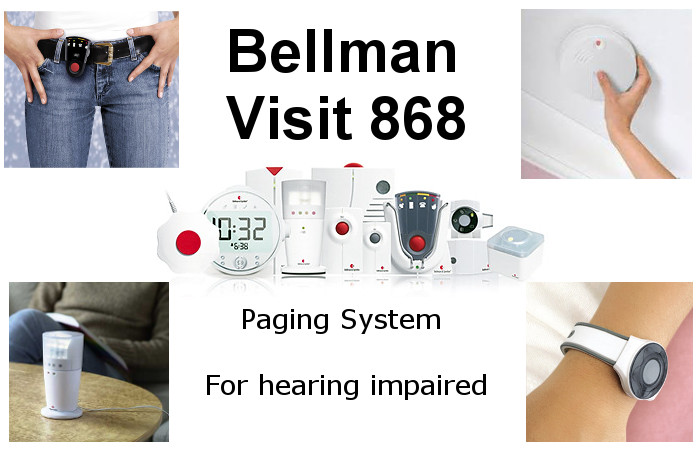
Bellman Visit 868 Paging System for Hearing Impaired and Deaf: The Bellman Visit 868 is a customizable system of transmitters and receivers designed to allow someone with a hearing impairment to be alerted to various events in their home, such as a doorbell,smoke alarm or even a baby crying.
The Bellman Visit 868 System consists of a number of radio transmitters and receivers. The transmitters detect different events in the surrounding area and transmit a radio signal to the receivers. The receivers pick up this signal and provide indications using light, sound and/or vibration. Instead of lugging round several different flashing and vibrating receivers for each alert, the Bellman system will alert you to everything, via one simple device that you choose.Bellman Visit 868 Paging System for Hearing Impaired and Deaf
Choice of Receivers: The receiver is the method of alerting the user, various types of receivers are available.
– Flash Receiver – for indoor use, attracts attention with a flashing light, light signal, and also by vibration if a Bellman Bed-shaker (accessory) is connected.
– Portable Receiver – for indoor use, attracts attention user using sound, light and also vibration if a Bellman Bed-shaker (accessory) is connected.
Portable Audio Receiver – for indoor use, attracts attention using sound and light.
Pager – for indoor use, attracts attention using light and vibrations. Connects to a Charger, charging for up to 8 hours, and can connect to a Bellman Bed-shaker (accessory).
Alarm Clock – for indoor use, attracts attention using sound and light signals and also vibration if a Bellman Bed-shaker (accessory) is connected.
Portable Flash Receiver – for indoor use, attracts attention with a flashing light, light signal, and also by vibration if a Bellman Bed Shaker (accessory) is connected.
Wrist Receiver and Charger – for indoor use, attracts attention using light and vibrations.
Guard Receiver -The Guard Receiver is the central unit in a Smoke Alarm System. The Guard receiver works like a normal receiver and provides indications using flashing lights, LEDs and vibration. In addition, it monitors whether there are faults or problems with the vibrator, radio contact with the smoke alarms or whether the batteries are becoming flat. If there is a fault, the Guard Receiver will give a warning.
Choice of Transmitters:
Door Transmitter – recognises the sound emitted by a doorbell.
Pushbutton Transmitter -for indoor use and outdoor use in sheltered locations, transmits signals to the receiverswhen the Pushbutton is pressed.
Telephone Transmitter – for indoor use, recognises ring signals from an analogue telephone system via a plug, which is inserted into the telephone socket. In addition to using the telephone input, the telephone transmitter can also operate as a multifunction transmitter, either via a pushbutton or via 2 connectors for an external trigger. All inputs can be detected separately and transmit different signal patterns to the receivers in the Bellman Visit 868 system depending on which has activated thetelephone transmitter. There is a range of options for connecting the telephone transmitter to various applications.
Smoke Alarm – for indoor use, detects smoke and heat. Most effective as part of the Fire Alarm System.
Baby Cry Transmitter – for indoor use, recognises the sound from a crying baby.
Repeater -for indoor use, receives a radio signal from a transmitter in the Bellman Visit 868 System and transmits this radio signal to the receivers in the system.
Bridge – for indoor use and operates as an interpreter, which conveys radio signals between the Bellman Visit and Bellman Visit 868 systems.
Smoke Alarm Transmitter – indoor use, detects smoke. When smoke is detected, the Smoke Alarm will transmit a fire alarm signal to all Bellman Visit 868 receivers which are within its range.
A Bellman Visit 868 Fire Alarm System consists of:
1 Bellman Visit 868 Guard Receiver BE1465.
1 Bellman Bed Shaker BE1270.
1 Bellman Visit 868 Smoke Alarm BE1480 (a maximum of 8 can be used).
These products are available to be purchase from companies such as Edit Microsytems, contact them if you would like to assess your venue, or to receive a quote.
6. Hearing Dogs
A Hearing Dog or Alert Dog is an Assistance Animal which assists persons who are Deaf or those who have Hearing Impairments by alerting them to important sounds, such as doorbells, smoke alarms, ringing telephones, or alarm clocks.
Hearing Dogs can replace the need for other Alerting Devices used in the home and may also work outside the home, alerting their handler to sounds such as sirens, forklifts and a person calling the handler’s name.
Service Dog training facilities may differ in the type of training they provide, in what provinces they provide the training and the cost. Visit our Assistance and Service Dogs section to find Training Facilities in South Africa that can assist you, or contact the companies and organisations listed below:
– Smart Service Dog,
– Paws4life Training Academy,
– Honey’s Garden For Medical Alert Dogs SA
– Paws4Purpose Service and Therapy Dog Training
