


Martial Arts and Judo
Martial arts and judo are structured combat sports that are accessible to children and adults with intellectual impairments, with opportunities to participate at social, club, provincial, and international levels. Both sports can be adapted to suit different abilities, ensuring safe and meaningful participation for a wide range of athletes.
Beyond physical exercise, martial arts and judo focus strongly on discipline, self-control, respect, and personal development. Training helps participants improve balance, coordination, strength, and focus, while also building confidence and resilience. The structured nature of these sports provides clear routines and goals, which can be especially beneficial for individuals with intellectual impairments.
Martial arts and judo are also highly social activities. Training and competition encourage interaction, teamwork, and mutual respect, providing opportunities to meet new people, form friendships, and become part of a supportive sporting community. Above all, these sports offer a positive, challenging, and enjoyable pathway for physical activity and personal growth.
What assistance are you looking for?
A. Martial Arts
1. About Martial Arts
2. MASA
3. Benefits of MMA for Specific Support Needs
4. MASA Structure and Governance
5. Get Involved
B. Judo
1. About Judo
2. Special Olympics Judo Pathway
3. Special Olympics Judo
4. Judo Benefits for Intellectual Impairments
5. Get Involved
Martial Arts
Martial arts provides far more than physical activity. It promotes discipline, respect, self-control, confidence, and resilience, while also offering practical self-defence skills. Importantly, martial arts are adaptable and inclusive — training can be modified to suit individual ability, learning style, and support needs.
Modern martial arts are built on the principle that martial arts are for everyone, regardless of physical, sensory, or intellectual ability. Instruction focuses on adapting techniques to the individual, rather than forcing individuals to fit rigid training models.
For persons with intellectual impairments, martial arts offer:
– Structured routines and clear expectations
– Improved coordination, balance, and strength
– Development of focus and emotional regulation
– Increased self-confidence and independence
– Social interaction and a sense of belonging
The life skills taught through martial arts — such as perseverance, respect, and responsibility — are transferable to everyday life, education, and work environments.

2. Martial Arts and Games Committee of South Africa (MASA)
The Martial Arts and Games Committee of South Africa (MASA) is the official governing body for martial arts in South Africa, recognised and sanctioned by the South African Sports Confederation and Olympic Committee (SASCOC).
MASA governs a wide range of martial arts disciplines and actively accommodates persons with disabilities, including persons with intellectual impairments. Martial arts participation under MASA structures is available at social, club, provincial, and national levels, with pathways to international participation where applicable.
Martial arts provide far more than physical activity. They promote discipline, respect, self-control, confidence, and resilience, while also offering practical self-defence skills. Importantly, martial arts are adaptable and inclusive — training can be modified to suit individual ability, learning style, and support needs.
3. Benefits of MMA for Specific Support Needs
Martial arts have been shown to be particularly beneficial for individuals with a range of developmental and cognitive challenges, including:
For Autism Spectrum Conditions
Martial arts training can support:
– Emotional regulation and self-control
– Improved communication and social interaction
– Confidence and body awareness
Some international martial arts organisations, such as those affiliated with specialised training programmes, offer instructor certification focused on teaching students with autism. Availability of specially trained instructors varies by school, and families are encouraged to enquire directly about instructor experience and support structures.
For ADD / ADHD
Research indicates that structured physical activities like martial arts can help individuals with ADD or ADHD to:
– Improve focus and attention
– Develop motor control and coordination
– Channel energy in a positive, disciplined way
The consistency, routines, and goal-setting inherent in martial arts training can be particularly calming and grounding.
For Down Syndrome
Martial arts instructors typically adapt techniques to suit the individual’s physical and cognitive ability. For individuals with Down syndrome, participation can:
– Improve muscle strength and coordination
– Support balance and posture
– Build confidence and independence
Exercise plays an important role in overall health and wellbeing, and martial arts provide a supportive and motivating environment.
4. MASA Structure and Governance
MASA was established in 1994, with guidance from the South African Government. Its primary objective was the unification of South Africa’s diverse martial arts disciplines under a single, inclusive governing body.
Today it is a multi-coded sports organisation, meaning it governs multiple martial arts disciplines under one umbrella structure.
To ensure fairness and inclusivity, MASA operates a block representation system, rather than traditional provincial structures.
This approach ensures:
– Equal representation for both large and small martial arts organisations
– Democratic participation in decision-making
– Protection against dominance by any single style or discipline
Affiliated organisations are grouped into discipline-specific blocks, each of which elects representatives annually. These representatives form part of both: The Block Executive Committees, and The National Executive Council (NEC) of MASA.
Current blocks include:
– Japanese Weapons
– Japanese Throwing Arts
– Korean Martial Arts
– Mixed Martial Arts
– Sports Martial Arts
– Pankration
– Amateur Kickboxing
MASA works closely with SASCOC to ensure that all affiliated organisations meet governance, selection, and compliance requirements.
Any application for National Colours are evaluated according to the selection criteria, as well as the compliance to the set overall criteria.
5. Get Involved
To get involved contact:-
– MMA South Africa (Mixed Martial Arts): https://mma-sa.co.za/ | Secretary: Lauren Rudolph: secretary@mma-sa.co.za
– Karate South Africa: https://karate-sa.org/ | Tel: 083 781 7004
– Taekwon-Do South Africa: https://www.taekwondosouthafrica.co.za/ | taekwondosouthafrica@gmail.com
– South African Kickboxing Association: https://www.kickboxers.co.za/ Visit their Contact page for more information
When Contacting these Clubs be sure to :-
– Ask whether instructors have experience teaching persons with intellectual impairments.
– Enquire about adaptive training options or support within classes.
– Ask about trial sessions or observation, to gauge suitability and comfort.
Alternatively, Contact Us directly if you have any questions about the Clubs, Organizations, Products and Services listed on this page and we will point you in the right direction.
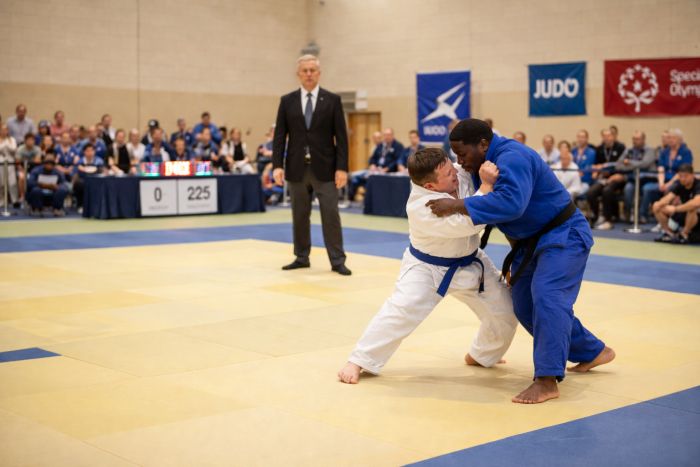
Judo is a modern martial art, combat sport, and competitive discipline that was developed in Japan in 1882. It was originally designed as a physical, mental, and moral pedagogy, and has evolved into one of the world’s most widely practiced martial arts and an Olympic sport.
In judo competition, athletes aim to:
– Throw or takedown an opponent to the ground,
– Pin an opponent for a defined period and/ or
– Use grappling techniques to gain advantage
Although judo includes strikes, thrusts, and weapons defence within traditional training, these are not permitted in competition or free practice (randori) under modern rules. The philosophy of judo emphasises balance, control, mutual respect, discipline, and perseverance, making it a valuable activity for physical development, character building, and community participation.
Judo is accessible to people of many different ability levels, including individuals with intellectual impairments. The sport’s emphasis on discipline, structure, repetitious skill development, and coached progression creates a supportive environment where athletes can grow physically, mentally, and socially.
Although Paralympic judo is offered only for visually impaired athletes at the Paralympic Games, judo is a popular and inclusive sport in the Special Olympics movement, where athletes of differing abilities and experiences are welcomed and supported.
2. Special Olympics Judo Pathway
The Special Olympics provides structured training, competition, and support for athletes with intellectual disabilities, including in judo. The focus is on individual development, skill improvement, and achievement, rather than solely on competition results.
Special Olympics judo emphasises:
– Participation and enjoyment of the sport
– Development of physical fitness and coordination
– Building confidence, discipline, and self-esteem
– Supporting athletes in structured, inclusive training environments
Coaching materials and rules are adapted with the needs of athletes with intellectual impairments in mind. Coaches receive additional resources to help them work effectively with Special Olympics judoka, while still using standard judo techniques and principles.
3. Special Olympics Judo
In Special Olympics judo:
– Athletes compete in standing and ground positions
– Throws and takedowns are central to scoring
– Groundwork (ne-waza) is allowed with pins and controlled holds
– Certain techniques (e.g., chokes and some joint locks) are not permitted for safety in Special Olympics competition
The rules aim to ensure fair, safe, and enjoyable competition while allowing athletes to apply judo techniques in a structured sports environment.
View the Special Olympics Rules here
4. Judo Benefits for Intellectual Impairments
Judo offers a wide range of benefits, including:
These benefits make judo a sport that supports lifelong participation and personal growth.
Physical Benefits
– Improved coordination and balance
– Increased strength and flexibility
– Enhanced cardiovascular health
– Body awareness and control
Mental and Personal Development
– Discipline and self-regulation
– Goal-setting and achievement
– Confidence and self-esteem
– Respect and sportsmanship
Social Benefits
– Team training and peer support
– Sense of community and belonging
– Accessible, structured interaction
5. Get Involved
To get involved: Contact the South African Judo Federation on www.sajudo.co.za | info@sajudo.co.za | 011 440 5583
SAJF can provide referrals to affiliated clubs in each province.
How to get started in Judo: To begin judo training:
– Contact your nearest SAJF-affiliated judo club
– Ask about inclusive training options for athletes with intellectual impairments
– Attend a trial training session
– Discuss coach experience with adaptive support and additional instruction needs
DiSA can also assist with guidance or referrals based on location and participation goals — contact us if you need support connecting to a judo club or programme.