


Basketball and Netball
Basketball and netball are inclusive, team-based sports that play an important role in promoting physical activity, social participation, and personal development for persons with intellectual impairments.
These sports emphasise structure, routine, repetition, and teamwork, which support learning, confidence-building, and meaningful engagement.
Basketball is one of the most established and widely participated sports within Special Olympics South Africa. Netball is not – but itts benefits remain the same.
Both sports offer adapted Programmes to accommodate different ability levels, ensuring participation is based on individual capacity and support needs rather than competitive performance alone.
What assistance are you looking for?
A. Basketball
i. About Basketball
ii. Paralympic pathways
iii. Eligibility
iv. Events
v. Rules
B. Netball
i. About Netball
ii. Pathways to Participation
iii. Rules
Basketball
Basketball is one of the most established and widely participated sports within Special Olympics South Africa. It is accessible to children, youth, and adults with intellectual impairments across a broad range of abilities.
Basketball for persons with intellectual impairments is not part of the Paralympic Games. But, competitive opportunities are provided through Special Olympics South Africa, which offers structured, national and international competition specifically designed for athletes with intellectual impairments.
Basketball is in fact the cornerstone of the Special Olympics Unified Sports programme, where athletes with and without intellectual impairments train and compete together on the same teams. This inclusive model promotes social integration, mutual respect, and shared sporting experiences in a structured and supportive environment.
Basketball is available to all players, of all ages and at all abilities.
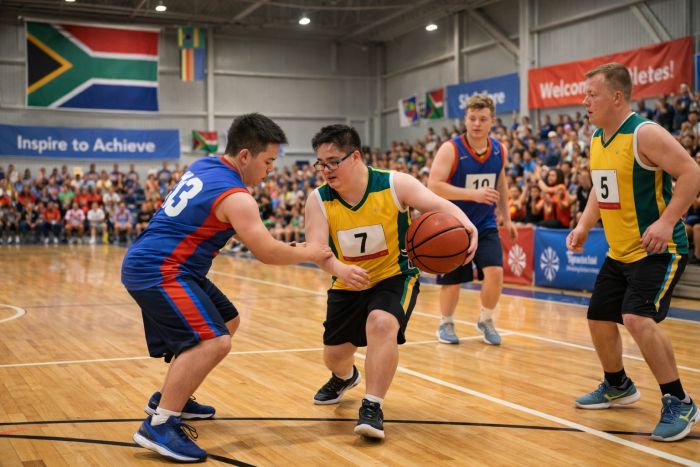
Paralympic pathways
Basketball programmes on a recreational level introduce beginners to fundamental skills such as ball handling, dribbling, passing, shooting, and spatial awareness. As athletes develop, they progress to more structured team play, learning game strategy, communication, and teamwork within competitive environments offered through Special Olympics South Africa and inclusive leagues.
While basketball is not a Paralympic sport for persons with intellectual impairments, it is one of the flagship sports within the Special Olympics movement, offering meaningful competition from local level through to the Special Olympics World Games.
Paralympic Basketball
Basketball is one of the core sports of Special Olympics South Africa, which provides local, provincial, national, and international competition for athletes with intellectual impairments. Athletes compete in Local and regional tournaments first, upskilling to Provincial competitions – National Games , and at the highest level of competition, the Special Olympics World Games.
Although the World Games are not the Paralympics, they are international, elite-level competitions within the Special Olympics framework.
Some athletes also compete in Unified Sports, where players with and without intellectual impairments play together on the same team.
This pathway focuses on inclusion and teamwork rather than elite performance, but still includes structured competition.
Eligibility
To participate in basketball through Special Olympics South Africa, an athlete must:
– Have an intellectual impairment (as defined by Special Olympics criteria)
– Be registered with Special Olympics South Africa
– Be 8 years or older for competition (younger athletes may participate in training programmes)
– As a stepping stone to progression, participants must first join a local club, school programme, or community training group –
– There is no IQ testing or formal classification system like the Paralympics. Athletes are grouped by: Age, Ability level or Experience
This ensures fair and meaningful competition while keeping the focus on development, participation, and enjoyment.
Events and Competition
Basketball competitions for athletes with intellectual impairments are typically organised through Special Olympics South Africa and inclusive community programmes. Events range from skills-based activities for beginners to full-team competitions for more advanced athletes.
Competition formats include:
– Individual and team skills challenges
– Half-court and full-court games
– Unified basketball competitions
Athletes are grouped by age, ability level, and experience to ensure fair, safe, and enjoyable participation.
Rules
Basketball for persons with intellectual impairments follows standard basketball rules, with adaptations made where necessary to support learning and safety. These may include simplified rules, modified game durations, reduced court size, smaller team numbers, or additional coaching support.
The emphasis is placed on fair play, skill development, participation, and enjoyment rather than winning alone.
To learn more: Official IWBF Rule Links (Used in South Africa) > IWBF Official Wheelchair Basketball Rules 2024 (PDF) or IWBF Rules Overview (Online)
Netball is a fast-paced, skill-focused team sport that is widely played across South Africa and increasingly offered in adapted and inclusive formats for persons with intellectual impairments. Netball programmes are commonly delivered at school, community, and developmental levels – with adaptations to ensure accessibility for athletes with varying learning and coordination abilities.
While netball is not currently a Paralympic sport, it provides valuable opportunities for structured physical activity and team participation for persons with intellectual impairments.
Through regular training and competition, netball contributes significantly to physical well-being, emotional resilience, social inclusion, and an enhanced sense of belonging, empowering athletes with intellectual impairments to participate fully in sport and community life.
Games are played on a rectangular court with raised goal rings at each end. Each team attempts to score by passing the ball down the court and shooting it through the ring to score. Players are assigned specific positions, these positions define their roles within the team and restrict their movement to certain areas of the court. During general play, a player with the ball can only hold onto the ball for three seconds before passing or shooting for a goal. The winning team is the one that scores the most goals. Netball games are 60 minutes long.
Because of its pace, and team dynamic, netball supports the development of balance, agility, hand-eye coordination, spatial awareness, and cardiovascular fitness. Promoting communication, cooperation, rule-following, and teamwork. The participation of persons with intellectual impairments in team sports like netball also improves self-esteem, building independence, and confidence, while offering athletes a positive and enjoyable way to stay active.
Pathways to Participation
Participation in netball for persons with intellectual impairments is primarily facilitated through Special Olympics South Africa, inclusive school sport programmes, community clubs, and non-profit organisations. Opportunities exist at recreational, club, provincial, and national levels, allowing athletes to progress according to their interests, abilities, and readiness for competition.
Netball participation for persons with intellectual impairments is primarily recreational and developmental, with friendly matches, league play, and skills-based activities organised by schools, clubs, and community organisations. Competitions are generally non-elite and focus on participation, skill progression, and social inclusion rather than high-performance outcomes.
Rules
For players with intellectual impairments, netball may be adapted at community, school, or developmental levels.
Adapted netball uses modified rules to suit the needs of players with intellectual impairments. Adaptations may include simplified positional roles, flexible time limits, smaller teams, adjusted scoring systems, and increased instructional support from coaches and facilitators. These modifications help athletes understand the game, participate confidently, and enjoy the experience in a safe and supportive setting.
There is no separate official adaptive rulebook endorsed by World Netball, but many programmes use locally agreed modifications to support participation, safety, and enjoyment. To learn more about World Netball – Official Rules: Click here https://netball.sport/the-official-rules