


Cricket and Soccer
Cricket and soccer are team sports available to people with intellectual impairments in South Africa. Athletes can take part at club and provincial level, with opportunities to progress to international competition.
As team-based sports, both cricket and soccer encourage participation, teamwork, and a strong sense of belonging.
Beyond physical fitness, they help children and adults improve movement and coordination, develop communication and social skills, and learn how to work with others.
Participation also supports confidence, independence, and personal growth, both on and off the field.
At an international level, sport for athletes with intellectual impairments is governed by the global body for Learning Disability Sport, INAS-FID. In line with INAS rules, athletes wishing to compete internationally must be able to demonstrate an IQ of 75 or below.
What assistance are you looking for?
A. Cricket
1. About Cricket
2. Governance
3. Cricket South Africa
4. Eligibility
5. Paralympic Pathways
6. Rules
7. Get Involved
B. Soccer
i. About Soccer
2. Governance
3. Paralympic Pathways
4. Special Olympics
5. Eligibility
6. Get Involved
Cricket
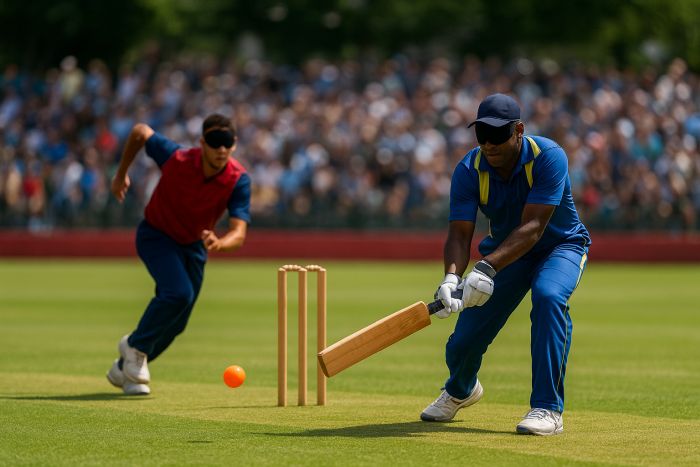
Cricket is a popular team sport that is accessible to people with intellectual impairments, including athletes with learning disabilities.
It can be played at a recreational club level, in a supportive and structured environment that allows athletes to develop skills at their own pace while enjoying teamwork and competition.
As a sport cricket helps improve physical fitness, coordination, concentration, and decision-making. As a team sport, it also supports communication, social interaction, and confidence, making it beneficial for both children and adults with intellectual impairments.
In South Africa, athletes can participate at community, club, and provincial level, with opportunities to progress to international competition.
2. Governance
The International Cricket Council (ICC) is the global governing body of cricket. It was founded as the Imperial Cricket Conference in 1909 by representatives from Australia, England and South Africa. It was renamed as the International Cricket Conference in 1965, and took up its current name in 1989.
The ICC has 104 members: 12 Full Members that play Test matches and 92 Associate Members. The ICC is responsible for the organisation and governance of cricket’s major international tournaments, most notably the Cricket World Cup. It also appoints the umpires and referees that officiate at all sanctioned Test matches, One Day International and Twenty20 Internationals. It promulgates the ICC Code of Conduct, which sets professional standards of discipline for international cricket, and also co-ordinates action against corruption and match-fixing through its Anti-Corruption and Security Unit (ACSU).
The ICC does not control bilateral fixtures between member countries (which include all Test matches),
it does not govern domestic cricket in member countries, and
it does not make the laws of the game, which remain under the control of the Marylebone Cricket Club. Read More: ….
3. Cricket South Africa
Cricket South Africa (CSA) has three Disability entities affiliated to the organisation, namely Blind Cricket South Africa (BCSA); South African Deaf Cricket Association (SADCA) and South African Sports Association for the Intellectually Impaired (SASA-II).
Cricket South Africa’s vision is to make cricket a truly national sport of winners. This has two elements to it:
– To ensure that cricket is supported by the majority of South Africans, and available to all who want to play it.
– To pursue excellence at all levels of the game.
To get involved Contact Johan Weyers at johanw@cricket.co.za | Tel: 012 484 1835
4. Eligibility
To compete in cricket as an athlete with an intellectual impairment, eligibility must meet national and international criteria.
Learning Disability Sport is overseen by the world governing body INAS-FID. INAS rules state that to play sport as an athlete with an Intellectual Disability you must be able to demonstrate that you have an IQ of 75 or less. To demonstrate this, players undergo an assessment by an Educational Psychologist to ascertain their IQ level.
Once confirmed, the player must then registered with INAS as being able to participate in international sport. The advantage of this system is that it is standard and accepted globally. At tournaments the documentation of all participants is checked by representatives of both INAS and other participating countries to ensure the system is transparent. Read More: ….
At international level, INAS eligibility requires:
– A formal diagnosis of an intellectual impairment
– An IQ of 75 or below
– Evidence that the impairment occurred before the age of 18
– Functional limitations in adaptive behaviour (such as communication, social, or daily living skills)
Athletes must complete the required eligibility and classification processes before competing internationally.
5. Paralympic Pathways
Cricket is not currently included in the Paralympic Games programme. However, athletes with intellectual impairments can compete at an international level through Learning Disability Cricket, which is governed by the international body INAS (International Federation for Athletes with Intellectual Impairments).
Athletes may progress through:
– Club and school cricket
– Provincial representation
– National teams
– International competition sanctioned by INAS
These pathways provide high-performance opportunities comparable to other elite disability sport structures.
Intellectually Impaired Cricket has a formal agreement with Australia and England to partake in a Tri-Angular every second year.
Contact Eugene Jacobs @ EugeneJ@cricket.co.za to find out more
6. Rules
In disability cricket, there are a few rules and regulations that are specific to the different impairment groups. Where possible the game is played in accordance with the MCC Laws of Cricket but there are some differences
Athletes with intellectual impairments often follow the standard Laws of Cricket issued by the International Cricket Council (ICC), with adaptations as needed by organisers or governing bodies. These laws cover scoring, dismissals, fielding, equipment, match structure, etc. You can find the ICC Laws and related playing conditions on the ICC website.
Recommended adaptations for people with different abilities include: simplified rules, reduced match length, modified equipment, or coaching approaches that support participation
At higher levels, particularly national and international competition, rules closely align with mainstream cricket regulations under INAS governance.
7. Get Involved
In disability cricket, there are a few rules and regulations that are specific to the different impairment groups. Where possible the game is played in accordance with the MCC Laws of Cricket but there are some differences
Athletes with intellectual impairments often follow the standard Laws of Cricket issued by the International Cricket Council (ICC), with adaptations as needed by organisers or governing bodies. These laws cover scoring, dismissals, fielding, equipment, match structure, etc. You can find the ICC Laws and related playing conditions on the ICC website.
Recommended adaptations for people with different abilities include: simplified rules, reduced match length, modified equipment, or coaching approaches that support participation
At higher levels, particularly national and international competition, rules closely align with mainstream cricket regulations under INAS governance.
i. The Differently Abled Cricket Club
The Differently Abled Cricket Club (DACC) is an inclusive cricket club for athletes with disabilities, including players who are blind, deaf, intellectually impaired (SID and MID), and physically disabled. It is the only cricket club of its kind in South Africa.
In 2017, the club formally adopted the name Differently Abled Cricket Club, reflecting the principle of embracing identity and independence. This marked a shift toward increasing awareness and inclusion of LSEN (Learners with Special Educational Needs), including individuals who are blind, deaf, intellectually impaired, and physically disabled.
The club is based at FH Odendaal High School, which serves as its home venue through an established partnership with the school. Plans are underway to build a dedicated clubhouse on the school grounds, as well as a cricket academy specifically for differently abled players. The club is also actively developing junior teams, which form a critical pathway and feeder system for future growth.
Under its updated constitution, the Differently Abled Cricket Club focuses not only on the development of cricket skills, but also on broader skills development. This includes programmes aimed at equipping players with practical and workplace skills to support personal development beyond sport.
To support the Club – or for more information – please contact Christo Pelzer on +27 82 998 4568 or Email: admin@dacc.co.za
Address: 200 Baviaanspoort Road, Derdepoort, Pretoria, 0186 or visit their web site at: www.dacc.co.za
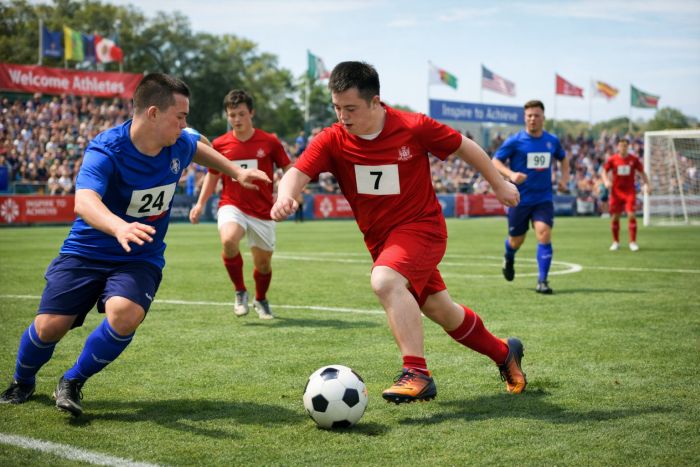
Soccer is one of the most widely played and accessible team sports for people with intellectual impairments, including athletes with learning disabilities.
In South Africa, soccer is offered in inclusive environments that allow players to develop skills at an appropriate pace while enjoying teamwork, physical activity, and competition.
As a physical activity, soccer supports fitness, balance, coordination, and endurance for persons with intellectual Impairments .
As a team sport, it also encourages communication, cooperation, and social interaction. Building confidence, independence, and a sense of belonging both on and off the field.
Opportunities to participate in soccer exist across different pathways, including the Paralympic movement and the Special Olympics, each serving different athlete profiles and levels of ability.
2. Governance
Soccer is overseen by the world governing body of Learning Disability Sport, INAS-FID.
INAS rules state that to play sport as an athlete with a Learning Disability you must be able to demonstrate that you have an IQ of 75 or less.
A number of tournaments are available soccer players with Intellectually Impairment’s including
– The INAS World Football Championship – Takes place every four years, typically in the country that also hosts the FIFA World Cup.
– The Paralympic Games.
– Special Olympics
3. Paralympic Pathways
The Paralympic Games are held alongside the Olympic Games and provide elite competition opportunities for athletes with recognised impairments. Intellectual Impairments, have been included in selected Paralympic sports.
Athletes with intellectual impairments competing within the Paralympic pathway must meet strict eligibility and classification criteria. This pathway is reserved for high-performance athletes who:
– Have a formally diagnosed intellectual impairment
– Were diagnosed before the age of 18
– Meet sport-specific classification requirements
Within this pathway, soccer is offered in the form of 5-a-side football, adapted to ensure fair and competitive participation at an elite level. Classification systems differ from sport to sport and are designed to ensure athletes compete against others with similar functional ability.
4. Special Olympics World Games Pathway
The Special Olympics World Games, recognised by the International Olympic Committee (IOC), provide an inclusive and widely accessible pathway for all persons with intellectual disabilities, regardless of skill level. Football (soccer) is the most popular team sport within the Special Olympics movement worldwide. Its success lies in its simplicity, accessibility, and universal appeal. It can be played by Individuals of varying physical abilities and experience levels.
The sport requires minimal specialised equipment and uses simple, easy-to-understand rules, making it ideal for broad participation and development.
A key feature of Special Olympics football is Unified Sports, where players with and without intellectual disabilities compete together on the same team. This model promotes inclusion, understanding, and social integration. In recognition of football’s importance, Special Olympics has made it a central focus of its global development initiatives, including international events such as the Special Olympics Unity Cup, first held alongside the FIFA World Cup in 2010.
5. Eligibility
To participate in soccer as an athlete with an intellectual impairment, eligibility requirements apply, particularly at national and international levels.
Learning Disability Sport is overseen by the world governing body INAS-FID. INAS rules state that to play sport as an athlete with an Intellectual Disability you must be able to demonstrate that you have an IQ of 75 or less. To demonstrate this, players undergo an assessment by an Educational Psychologist to ascertain their IQ level.
Once confirmed, the player must then registered with INAS as being able to participate in international sport. The advantage of this system is that it is standard and accepted globally. At tournaments the documentation of all participants is checked by representatives of both INAS and other participating countries to ensure the system is transparent. Read More: ….
For international competition under INAS, athletes must:
– Have a formal diagnosis of an intellectual impairment by an Educational Psychologist
– An IQ of 75 or below
– Evidence that the impairment occurred before the age of 18
– Functional limitations in adaptive behaviour (such as communication, social, or daily living skills)
Athletes must complete the required eligibility and classification processes before competing internationally.
6. Get Involved
Accessible Soccer Clubs and Organisations (South Africa)
– KNVB FC Lions – Inclusive Soccer (‘Soccer for All’)
An inclusive community soccer programme that welcomes young athletes with intellectual, developmental or physical special needs. The focus is on participation, skill development, social interaction and fun in a supportive environment, rather than competition.
Contact: soccerforall@knvbfc.com (programme director)
Sessions historically run regularly (e.g., monthly), and children participate in skills challenges and small-sided games
– Durban Africa Sports Club
A community sports club based in Durban with long-running soccer programmes that include children with special needs as part of broader youth participation initiatives. They host events and fun soccer activities open to those with diverse abilities.
Contact the club directly via their website for details on inclusive sport sessions.
If you would like to find a Sports Organization or Sports Club that is available near you, visit our Sports Search Facility Page.
Please feel free to Contact Us directly if you have any questions about the Clubs, Organizations, Products and Services listed on this page and we will point you in the right direction.