A Practical Guide to Choosing a Hoist
A Practical Guide to Choosing a Hoist:
Wall-Mounted, Wheeled, and Ceiling Lift Systems
As a quadriplegic of 31 years who have used various types of hoists over the years, I know from experience that selecting the right hoist is not just about lifting, it’s about safety, independence, space, and long-term value. The three most common options include wall-mounted, wheeled (mobile), and ceiling hoists. Each serve distinct needs depending on the user’s environment and level of mobility.
Wheeled (Mobile) Hoists
Wheeled hoists are typically the cheapest of the 3 types of hoists. These Mobile Patient Hoists are portable, castor-wheeled units for moving patients between beds, chairs, and bathrooms.
They require no installation and can be used across multiple rooms and to get in and out of a vehicle, making them ideal for short-term use or rental scenarios.
They do however require significant floor space and clear pathways and can be difficult to manoeuvre in smaller homes or on carpets. They also increase caregiver strain, or require more than one carer to assist, as more manual handling is required. Cost-wise, they are the most affordable option, starting with the Hydraulic Hoists which are manually operated by a caregiver, while Electric Hoists are slightly more expensive and battery-powered with hand controls.
These Wheeled Hoists also include Foldable Hoists, designed for easy home storage and transportation, Bariatric Hoists for heavy-duty lifts, and Sit-to-Stand Hoists used for standing transfers.
Wall-Mounted Hoists
Wall-mounted hoists sit between mobile and ceiling systems. They are generally fixed to a structural wall and often used in bathrooms or beside beds, but there are some that can also be used to transfer patients into a car, such as the Milford Lift.
While these mounted hoists are more stable than mobile hoists, they have a limited transfer range and still require careful structural assessment before installation. They are semi-permanent, making them suitable for predictable, repeated transfers in a specific area, but may be an issue for people who are renting a home or regularly move.
Ceiling Hoists
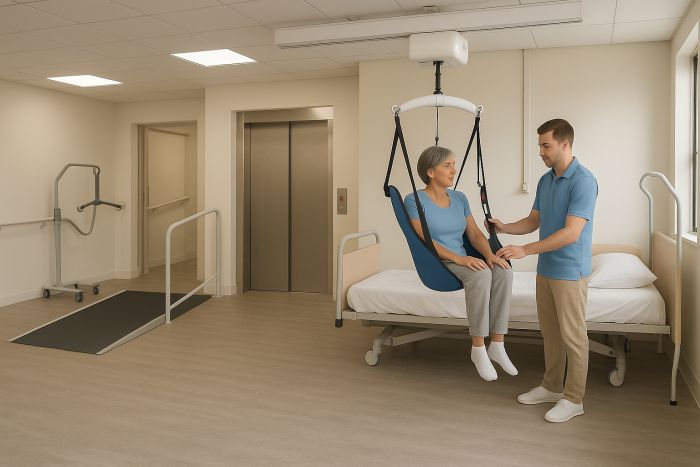
Ceiling hoists are the most advanced and supportive solution. Mounted on overhead tracks, they allow smooth transfers across a room, or between rooms, with minimal physical effort. They eliminate the need for larger floor space and reduce caregiver injury risk or the need for a second carer. With the assistance of this Ceiling Hoist, some patients are able to transfer themselves to the toilet or wheelchair independently, depending on their function.
Ceiling hoists do however require professional installation, possible ceiling reinforcement, and are generally believed to be the most expensive option due to structural modifications and track systems.
The Importance of Choosing the Right Sling
A critical component across all hoists is the sling. Slings vary widely and include general-purpose, toileting, full-body, specialised medical slings, and products such as the “Sure Hands Body Support.”
Whatever option is chosen, it must match the user’s condition. The incorrect sling choice can cause discomfort or unsafe positioning. Proper fit and support (especially for the head, neck, and spine) are essential for safe transfers.
Making the Right Choice
Ultimately, your decision should balance budget, available space, and long-term needs. For temporary or flexible use, a wheeled hoist may suffice. For consistent daily transfers in a fixed environment, wall-mounted or ceiling systems provide greater safety, dignity, and independence.
Additional Mobility Solutions
Also available to purchase are various types of bath lifts, pool lifts, and vehicle aids that can transfer a person and/or their mobility aid into a vehicle.
Learn More
For more information on the various types of hoists available and where you can purchase them, click the link: Hoists, Patient Lifters and Slings, or visit our Bath Lifts section to find out more about the various products and services available to ensure that you are seated correctly.
Alternatively, check out our blog on “Choosing the Correct Sling.”