Stair Access Solutions
Stair Access Solutions: The Key to Independence
Home Access Solutions
Navigating stairs can be one of the biggest daily challenges for people with mobility impairments. Over the years, I’ve seen how the right solution can completely change someone’s independence and confidence at home or in public spaces.
Home Lifts
Home lifts are often the most seamless option. They offer smooth, vertical travel up one or more flaws and are a long-term investment. The downside for many, is the cost and installation complexity—but for many, the comfort and dignity they provide outweigh this. There are however options such as the Lifta Trio from Lifta that does not require a shaft, pit room or motor room resulting in a substantial saving in construction costs and can be installed in just two days, which means it is a viable option for people in double storey houses.
Stair Lifts
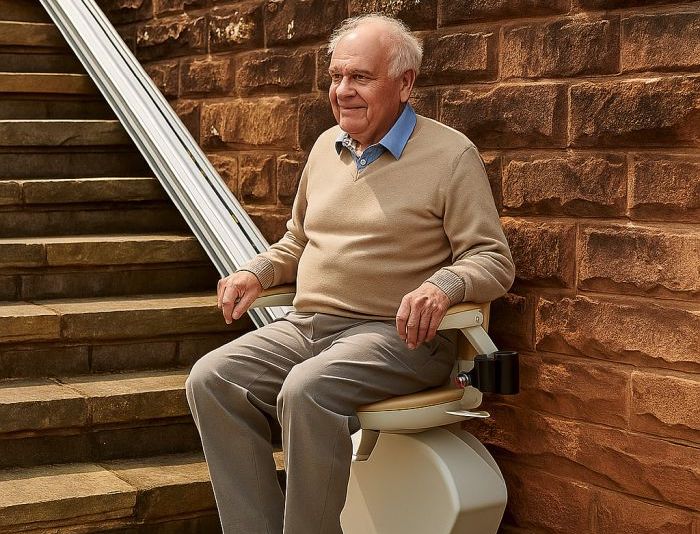
Stair lifts are a common choice for people in double storey house but have some mobility. They’re relatively affordable and easy to install. However, they require the user to transfer onto a seat, which is not ideal for everyone. These products are available from companies such as Sitwell and can be installed on both straight staircases and curved staircases.
Platform Stair Lifts
For wheelchair users, platform stair lifts are more practical, as they carry the wheelchair directly. The wheelchair user can wheel directly onto the platform which then moves along a track up or down the stairs. These products are available from companies such as Sitwell and can be installed on both straight staircases and curved staircases but can be bulky and slower and may obstruct stairs for others.
While Home Lifts; Stair Lifts and Platform Stair Lifts are the three main options when it comes to moving between floors in your home, various stair-climbing and evacuation equipment can also be used short term or in the case of an emergency.
Stair-Climbing And Evacuation Equipment
Over the years, I’ve found that stair-climbing and evacuation equipment such as the Liftkar PTR and Liftkar PT (Powered Stair Climbers from Sitwell) are invaluable in the case of emergencies.
They’re portable and essential for safety and can be used to go up or down both flights of stairs or just one level of three or four steps, however this stair-climbing and evacuation equipment does require assistance to operate, so is generally not a permanent access solution for your home, in the same way that Home Lifts; Stair Lifts and Platform Stair Lifts would be.
For those people that are looking to access a level in their home of three or four steps, look no further than the FlexStep Lift which is used in homes as a 2-in-1 space-saving solution to provide wheelchair or mobility-impaired access between split levels, low floors, or on outdoor steps.
The FlexStep Lift
The FlexStep Lift functions as a normal staircase but converts into a lifting platform at the push of a button to aid users in moving between levels, especially when space for a traditional ramp is limited.
It is ideal for accessing Split-Levels such as moving between rooms with a 2-6 step difference (240mm to 1295mm height) or overcoming steps leading into a house, basement, or garage.
It looks like ordinary stairs but converts into a lift at the push of a button. It’s space-saving and discreet, though it can be expensive. Contact Sitwell Technologies to find out more.
While The FlexStep is the best solution when accessing between 2 and 6 steps where space is limited, there are various pre-built ramps available to deal with fewer steps, as well as companies that can build custom made ramps to suite your needs.
Ramps
Ramps are simple and effective, especially for short rises. They promote independence but need sufficient space and a proper design to provide a safe and practical way for people with mobility challenges to move between different levels without using stairs.
Commonly found in homes, schools, public buildings, and transport spaces across South Africa, ramps support wheelchair users, people using crutches, parents with strollers, and anyone who may struggle with steps.
When designed correctly—with a gentle slope, non-slip surfaces, and sturdy handrails—ramps promote independence, dignity, and inclusion. They play a vital role in creating environments where everyone can participate fully in daily life, regardless of physical ability.
Visit our section on Hoist, Lifts and Transfer Aids to find out more the various types of Threshold Ramps and shorter ramps suitable for one, two to three steps or contact a universal access consultant via our Accessible features page to ensure that you get a well-designed ramp that is not only safe but also correctly designed to meet building regulations.
Ultimately, the best choice depends on your environment, budget, and level of independence.
The right solution isn’t just about access—it’s about freedom.