Quadraplegia | Tetraplegia

Quadriplegia is caused by damage to the cervical spinal cord segments at levels C1-C8. Damage to the spinal cord is usually secondary to an injury to the spinal vertebrae in the cervical section of the spinal column.

The injury to the cellular structure of the spinal cord is known as a lesion and may result in the loss of partial or total function in all four limbs, i.e. the arms and the legs.

Whatever  the cause of the disability, persons with disabilities require a different set of emotional and physical needs and may need to use some sort of equipment for assistance with mobility and for them to be able to fully participate in society.

There are also various organizations in South Africa that assist & support different disability groups with a wide variety of services.

1. About Quadraplegia

Man in wheelchair contacting DiSA for help

Quadriplegia is also termed Tetraplegia. Both terms mean “paralysis of four limbs. “Tetraplegia is more commonly used in Europe than in the United States.
In 1991, when the American Spinal Cord Injury Classification system was revised, it was recommended that the term tetraplegia be used to improve consistency (“tetra”, like “plegia”, has a Greek root, whereas “Quadra” has a Latin root).

It is possible to injure the spinal cord without fracturing the spine, such as when a ruptured disc or bony spur on the vertebra protrudes into the spinal column, but Quadriplegia can be caused from the damage to the spinal cord from: Trauma, such as a car crash, Sports and Recreation injuries, such as Rugby or Diving, Diseases such as polio and Congenital disorders, such as muscular dystrophy.

Whatever  the cause of the disability, persons with disabilities require a different set of emotional and physical needs & may need to use some sort of equipment for assistance with mobility & for them to be able to fully participate in society. There are also various organizations in South Africa that assist & support different disability groups with a wide variety of services.

2. Symptoms of Quadraplegia

Upon visual inspection of a quadriplegic patient, the first symptom of quadriplegia is of motor or sensory impairment to the arms & legs, this function is also impaired in the torso. The loss of function in the torso usually results in a loss or impairment in controlling the bowel & bladder, sexual function, digestion, breathing & other autonomic functions. Sensory loss can manifest itself as numbness, reduced sensation or sore burning, which is called neuropathic pain.

Quadriplegic symptoms vary depending on the level of damage to the spinal cord. The spinal column is divided into levels or segments of the spinal cord and its corresponding spinal nerve. The function below the level of spinal cord injury will be either lost or impaired. Quadriplegia will result in complete loss or impaired function below the following cervical levels of injury:

C1- C2 are the highest cervical vertebra, & are at the base of the skull. If your injury is at this level & your spinal cord is damaged, you will probably lose function from the neck down and require permanent assistance with breathing in the form of a machine called a ventilator.

C3-C4 Supply the diaphragm & the large muscle between the chest & the belly which we use to breath with, it also effects arm sensation and movement.
C5 also supplies the shoulder muscles (deltoid) & the muscle that we use to bend our elbow (biceps), it also includes loss of finger movement.
C6 Bends the wrist back (extension), and externally rotates the arm (supinates).
C7 Straightens the elbow and wrist (triceps and wrist flexors), straightens fingers and pronates wrist.
C8 spinal cord injury may lose function from the chest down, but still retain use of the arms and much of the fingers and can bend the fingers (flexion).

The degree of this loss of feeling and movement depends largely on the injury to the cellular structures of the spinal cord. A complete severing of the spinal cord will result in complete loss of function from below that spinal segment, while a partial severing, bruising or swelling of the spinal cord results in varying degrees of mixed function and paralysis.

In some cases, it is possible for a quadriplegic to have movement of their legs and arms or have control of their major bodily functions. Some quadriplegics can even walk and use their hands, while others may use wheelchairs but still have function in their arms and mild finger movement despite the level of the injury. The amount of movement is largely dependent on the degree of damage done to the spinal cord.

3. Secondary Complications

Due to a quadriplegic’s depressed physical functioning and immobility, quadriplegics are often more susceptible to a variety of Secondary Complications:

– Pressure sores
– Spasticity,
– Osteoporosis and fractures
– Frozen joints
– Pneumonia
– Respiratory complications and infections
– Kidney stones
– Autonomic Dysreflexia,
– Deep vein Thrombosis
– Cardiovascular disease
– Obesity

These problems can be prevented or kept under control through correct eating and drinking, exercise, regular physiotherapy and medication.
Visit our Health Care and Rehabilitation – Mobility Impairments Page to find out how these Secondary Complications can be prevented or kept under control.

B. Incomplete Spinal Cord Injuries

When an individual damages there spinal cord, which often happens if you break your neck, spinal cord syndromes may be either: complete or incomplete
In most clinical scenarios, physicians should use a best-fit model to classify the spinal cord injury syndrome.

A complete cord syndrome is characterized clinically as complete loss of motor and sensory function below the level of the traumatic lesion, while an incomplete injury means that you may regain some or all of the motor and sensory function below the level of the traumatic lesion .

1. Diagnosis of Incomplete Spinal Cord Injuries

In order to diagnose someone with an incomplete spinal cord injury, a thorough neurological examination must be performed upon admission to the hospital and re-evaluated on an on-going basis months after spinal shock and inflammation of the spinal cord has subsided.

Incomplete spinal cord injuries can present themselves in a multitude of ways. It only takes several nerve fibres within the spinal cord to be preserved to carry messages to or from the brain for someone to be classified with an incomplete spinal cord injury resulting in incomplete paraplegia or incomplete tetraplegia (quadriplegia).

If after an initial neurological examination of an individual 24 hours after the spinal cord injury the diagnosis is determined to be incomplete with preservation of motor or sensory function, the chances of recovery are greatly increased. Incomplete spinal cord injuries can present themselves generally in three ways:

– The damage to the spinal cord can be so mild that the muscle weakness or sensory impairment can be hardly noticeable.
– The damage to the spinal cord can be so severe that the muscle or sensory weakness or loss can resemble that of a complete injury.
– The symptom of the incomplete spinal cord injury can be somewhere between the two above examples.

2. Incomplete Spinal Cord Injury Classification

Incomplete spinal cord injuries are classified using the American Spinal Association (ASIA) Impairment scale. The examination to determine the ASIA classification is based on touch and pinprick sensations, tested at key dermatome levels. Motor (muscle) function is also tested at key points on each side of the body. The resultant evaluation is categorised into five different classifications of spinal cord injury.

– A indicates a “complete” spinal cord injury where no motor or sensory function is preserved in the sacral segments S4-S5.

– B indicates an “incomplete” spinal cord injury where sensory but not motor function is preserved below the neurological level and includes the sacral segments S4-S5. This is typically a transient phase and if the person recovers any motor function below the neurological level, that person essentially becomes a motor incomplete, i.e. ASIA C or D.

– C indicates an “incomplete” spinal cord injury where motor function is preserved below the neurological level and more than half of key muscles below the neurological level have a muscle grade of less than 3, which indicates active movement with full range of motion against gravity.

– D indicates an “incomplete” spinal cord injury where motor function is preserved below the neurological level and at least half of the key muscles below the neurological level have a muscle grade of 3 or more.

– E indicates “normal” where motor and sensory scores are normal. Note that it is possible to have spinal cord injury and neurological deficits with completely normal motor and sensory scores.

3. Statistics Upon Discharge From Hospitals

At the time of discharge neurologically incomplete tetraplegia ranked first for level of injury at time of discharge (30.9%), followed by neurologically complete paraplegia (25.1%),neurologically complete tetraplegia (19.8%), and neurologically incomplete paraplegia (18.6%). Source: 2011 NSCISC Annual Statistical Report.

The degree of incompleteness is unique from person to person, and may or may not be an indicator to full recovery from a spinal cord injury.

4. Types of Incomplete Spinal Cord Injury

The symptoms of incomplete spinal cord lesions depend upon the area of the spinal cord (front, back, side, etc) damaged. The part of the cord affected depends on the direction and power of the forces involved during the initial injury.
There are four types of incomplete spinal cord injury:
– Anterior Cord Syndrome
– Posterior Cord Syndrome
– Central Cord Syndrome
– Brown-Séquard Syndrome
It is not uncommon for a spinal cord injury to result in a combination of the above injury types which result in incomplete paraplegia or incomplete tetraplegia.

C. Support Organisations

There are a wide range of these advocacy and self-help organization which exist in South Africa, they include organizations such as the overtly political Disabled People South Africa, aligned with the ruling African National Congress, the National Council of and for Persons with Disabilities (NCPD) and DiSA, as well as single-issue national organizations such as the QuadPara Association of South Africa to name just a few.
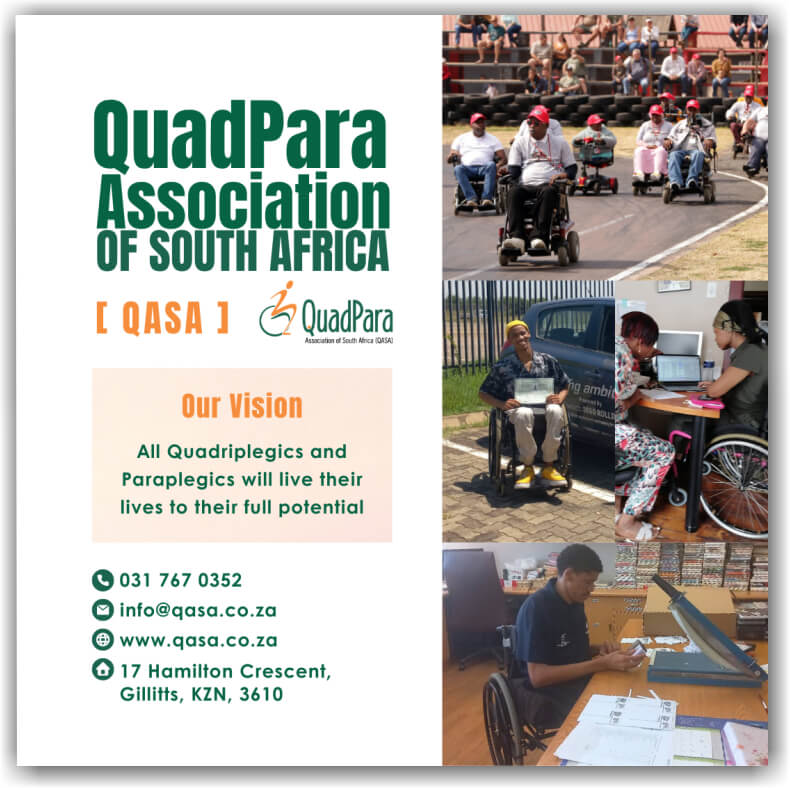
Advertisement for QuadPara - Association of South Africa (QASA) Logo

The QuadPara Association of South Africa (QASA) is a non-profit organisation (NPO 000-881) of Quadriplegics and Paraplegics in South Africa. QASA’s mission is “to improve lives by securing resources to advocate, educate, capacitate, support and mobilize”.  QASA’s vision is that “all quadriplegics and paraplegics will live their lives to their full potential”. QASA develops products, programmes and services for quadriplegic and paraplegic members to build their capacity and ensure opportunities for societal integration and empowerment.

These projects include but are not limited to the Disability Awareness & Sensitization Workshops/Sessions:
Disability Awareness & Sensitization is an ongoing programme to ensure the successful integration of persons with disabilities into society and the workplace. The aim of the programme is to equip employers and employees the skills and knowledge required to interact with persons with disabilities with confidence. This half-day training workshop will enable employers and employees have a better understanding of the variety of disabilities they may encounter and how to deal with this in a sensitive and practical manner; it will help them to overcome the natural fear we may have when we interact with a disabled person and give tips on awareness and etiquette in these situations.
The training defines and describes disability, unpacks many of the myths which are associated with disabilities, provides a list of some do’s and don’ts and touches on the language of disability.

QASA offers tailor-made sensitization training to suit the needs of the company or organization. Read More

1. Awareness Campaigns

Organisations around South Africa such as QASA conducts various Awareness Campaigns and prevention programmes which aim to prevent future injuries by simply making the public aware of simplest things, these prevention programmes include:

Spinal cord injury is one of the more devastating types of personal injury resulting in full or partial paralysis. Motor vehicle crashes are the leading cause of spinal cord injury in South Africa. In 2003, QASA initiated its “Road Safety Early Intervention & Prevention Campaign” to promote responsible road-user behaviour. The campaign has two focuses:
– Distracted Driving- aimed at reducing motor vehicle accidents
– ‘Buckle Up – We Don’t Want New Members!’ – aimed at reducing injury.

This campaign was awarded the SA Motoring Guild of Journalists award for the “Best Road Safety Project” and has been acknowledged by the United Nations (Global Road Safety Partnership) and the Road Accident Fund as ground-breaking and effective. Read More

Campaign rollout:
– Throughout the year – at taxi ranks, schools and companies
– Festive/Holiday Seasons -at petrol stations along national routes (N1, N2, N3 & N12)

Disclaimers and References

DiSA is committed to promoting the rights, dignity, and inclusion of persons with disabilities as outlined in the White Paper on the Rights of Persons with Disabilities. We strive to ensure that all content on our website reflects appropriate, respectful, and inclusive language in alignment with these principles.

However, we also provide a platform for companies and organisations to advertise their services and products. While we encourage advertisers to adhere to correct terminology and inclusive practices, DiSA cannot guarantee the accuracy or appropriateness of the language used by external parties in their content.

Please note: Any views, language, or terminology used in advertisements, promotional material, or external links do not necessarily represent the views of DiSA.

DiSA disclaims any responsibility for inaccuracies or language that may not align with the White Paper or best practices for disability terminology.

Should you however encounter language or content that you believe is inappropriate or offensive, we encourage you to contact us at info@disa.org.za, so that we can address the issue.

DiSA remains dedicated to fostering a respectful and inclusive environment for all individuals. We appreciate your understanding and collaboration in supporting our mission.


While we strive for accuracy and clarity, AI-generated visuals may not always reflect real-life conditions or representations.
In addition, we feature authentic images and videos of actual instances, events, circumstances that have occurred, as well as products and services supplied by companies who advertise with us.

These authentic visuals are intended to accurately depict our content or the offerings of our advertising partners.
If you have any questions or concerns about the content displayed on this site, please feel free to contact us.

DiSA provides a platform for companies and organisations to advertise their products and services to assist persons with disabilities and their families. While we make every effort to list reputable and credible service providers, the inclusion of any company, organisation, product, or service on our website does not constitute an endorsement or guarantee by DiSA.

Please note the following: DiSA is not involved in the delivery, quality control, or customer service of any product or service offered by advertisers listed on our platform.

Any agreements, purchases, or arrangements made between users of this website and advertisers are solely between those parties. DiSA is not responsible for the outcome of such interactions.

DiSA disclaims any liability for dissatisfaction, damages, or disputes arising from products or services supplied by companies or organisations listed on our website.

We encourage users to thoroughly research and verify any service provider or product before engaging with them. If you have concerns or encounter issues with an advertiser listed on our platform, please let us know at: info@disa.org.za. We value your feedback to help maintain the integrity of our platform.


While we strive for accuracy and clarity, AI-generated visuals may not always reflect real-life conditions or representations.
In addition, we feature authentic images and videos of actual instances, events, circumstances that have occurred, as well as products and services supplied by companies who advertise with us.

These authentic visuals are intended to accurately depict our content or the offerings of our advertising partners.
If you have any questions or concerns about the content displayed on this site, please feel free to contact us.

DiSA is committed to providing accurate and up-to-date information to assist persons with disabilities and their families. However, the nature of online content and external resources means that information can change frequently.

Please note the following: DiSA cannot guarantee the accuracy, completeness, or reliability of all information on our website, particularly information obtained from external sources or links to third-party websites.
External websites may update or remove content without notice, which can result in broken links or outdated information. DiSA is not responsible for the content, accessibility, or functionality of external websites.

While we make every effort to keep our information current, some content may become outdated over time.
We encourage users to verify information directly with the relevant third parties or organisations before making any decisions based on the information found on our platform.

If you encounter a broken link or outdated content, please notify us at: info@disa.org.za and we will address it as soon as possible.
Thank you for understanding and helping us maintain a reliable and accessible platform.


While we strive for accuracy and clarity, AI-generated visuals may not always reflect real-life conditions or representations.
In addition, we feature authentic images and videos of actual instances, events, circumstances that have occurred, as well as products and services supplied by companies who advertise with us.

These authentic visuals are intended to accurately depict our content or the offerings of our advertising partners.
If you have any questions or concerns about the content displayed on this site, please feel free to contact us.

The Information services and website that we offer free of charge, is privately run and funded and is not run or funded by the government. We rely on advertising, paid services and donations to supply and improve this Free information service that we do provide.

The Companies, Clubs, Schools and Organisations that are listed on this site, have advertised or made donations to the Website and have therefore assisted us be able to provide this free Service.
Please support them as they have supported Us and please contact us via info@disa.org.za, if you can advertise with us or would like to make a donation. Alternatively, visit our “Support Us” page to find out how you can support us or acquire our services. – Thank You.

If you encounter a broken link or outdated content, please notify us at: info@disa.org.za and we will address it as soon as possible.
Thank you for understanding and helping us maintain a reliable and accessible platform.

Please Note: We do assist with inquiries via email but may need to send or copy your details and inquiry to various other organisations, companies or government departments, that we sometimes consult, so that we can help you in the best way possible.
If you have any objection to us sharing your query or contact details, please notify us in your email. We will only share your information to assist you and will never sell or use your personal information for any other purposes.

DiSA waivers any liability for what happens if information is shared or used for marketing or other purposes by other organisations who do have consent to view such information.


While we strive for accuracy and clarity, AI-generated visuals may not always reflect real-life conditions or representations.
In addition, we feature authentic images and videos of actual instances, events, circumstances that have occurred, as well as products and services supplied by companies who advertise with us.

These authentic visuals are intended to accurately depict our content or the offerings of our advertising partners.
If you have any questions or concerns about the content displayed on this site, please feel free to contact us.

Please note that this website uses images and videos that are AI-generated and created to visually represent certain information, concepts or scenarios for illustrative purposes.


While we strive for accuracy and clarity, AI-generated visuals may not always reflect real-life conditions or representations.
In addition, we feature authentic images and videos of actual instances, events, circumstances that have occurred, as well as products and services supplied by companies who advertise with us.

These authentic visuals are intended to accurately depict our content or the offerings of our advertising partners.
If you have any questions or concerns about the content displayed on this site, please feel free to contact us.

Disability Info South Africa (DiSA) is committed to protecting your personal information in compliance with the Protection of Personal Information Act (POPIA), Act No. 4 of 2013. By using our free information service, you acknowledge and agree to the following:

Collection of Personal Information:
DiSA may collect and process your personal information (such as name, contact details, and inquiries) solely for the purpose of assisting you with your requests and providing relevant information or support.

Use and Storage:
Your personal information will only be used for the purpose it was collected for, we may need to send or copy your details and inquiry to various organisations, companies or government departments, that we sometimes consult, so that we can assist you in the best way possible.
If you have any objection to us sharing your query or contact details, please notify us in your email. We will only share your information to assist you and will never sell or use your personal information for any other purposes.
DiSA implements appropriate measures to secure your personal information against unauthorized access or loss.

Consent:
By submitting your details through our Contact Form, or contacting us via our email address, you consent to allow DiSA to process your information as outlined in this disclaimer. If you are not comfortable with DiSA sharing your information for the above purposes, please contact us directly at info@disa.org.za.

Access and Updates:
You have the right to request the deletion of your personal information at any time.
To do so, please contact us at: info@disa.org.za.

Third-Party Websites:
DiSA is not responsible for the privacy practices of external websites linked on our platform. Users are encouraged to review the privacy policies of third-party sites before sharing personal information.
For any queries or concerns regarding the handling of your personal information, please contact us at: info@disa.org.za.
Thank you for trusting DiSA to support you with accessible, inclusive, and reliable information.