


Paraplegia
Paraplegia is an injury to the spinal cord at the thoracic level and below resulting in an impairment in motor or sensory function of the lower half of the body.
This condition occurs due to damage to the cellular structure of the spinal cord within the spinal canal. The area of the spinal cord which is affected in paraplegia is either the thoracic, lumbar, or sacral regions of the spinal column. The person retains full use of their arms and hands, but have poor trunk control and balance due to the lack of abdominal muscle control.
Whatever the cause of the disability, persons with disabilities require a different set of emotional and physical needs and may need to use some sort of equipment for assistance with mobility and for them to be able to fully participate in society.
There are also various organizations in South Africa that assist and support different disability groups with a wide variety of services.
What Are You Looking For?
Paraplegia
1. About Paraplegia
2. Spinal Nerves and Levels
3. Secondary Medical Complications
4. Support Organisations
– QASA
5. Awareness Campaigns


Paraplegia is an injury to the spinal cord at the thoracic level & below resulting in an impairment in motor or sensory function of the lower half of the body. This condition occurs due to damage to the cellular structure of the spinal cord within the spinal canal.
Lower thoracic injuries (T-9 to T-12) retain good truck control & good abdominal muscle control, the sitting balance of people with lower spinal cord injuries is usually very good. Injuries to the Lumbar & sacral injuries result in decreased control of the hip flexors and legs.
Although paraplegia occurs below L2, the correct terminology for injury to these lower spinal nerves is called “Cauda Equine Syndrome”. If the arms are also affected by paralysis, Quadriplegia/Tetraplegia is the correct terminology.
Each part of the body is supplied by a particular level or segment of the spinal cord and its corresponding spinal nerve.
Function below the level of spinal cord injury will be either lost or impaired
Function of the spinal nerves in the cervical section of the spinal cord are usually unaffected by paraplegia and remain fully functional in someone with paraplegia.
Function of the spinal nerves below the cervical sections of the spinal cord are usually impaired due to damage in either the thoracic, lumbar or sacral areas, resulting in paraplegia.
Secondary medical complications of paraplegia include:
– Pressure sores (decubitus)
– Thrombosis (blood clots)
– Low blood pressure
– Autonomic Dysreflexia
– Pneumonia.
– Dysfunction of the bowel & bladder.
– Sexual functioning is frequently impaired or lost.
– Men may have their fertility affected.
– Women’s fertility is generally not affected.
4. Support Organizations
There are a wide range of these advocacy and self-help organization which exist in South Africa, they include organizations such as the overtly political Disabled People South Africa, aligned with the ruling African National Congress, the National Council of and for Persons with Disabilities (NCPD) and DiSA, as well as single-issue national organizations such as the QuadPara Association of South Africa to name just a few.
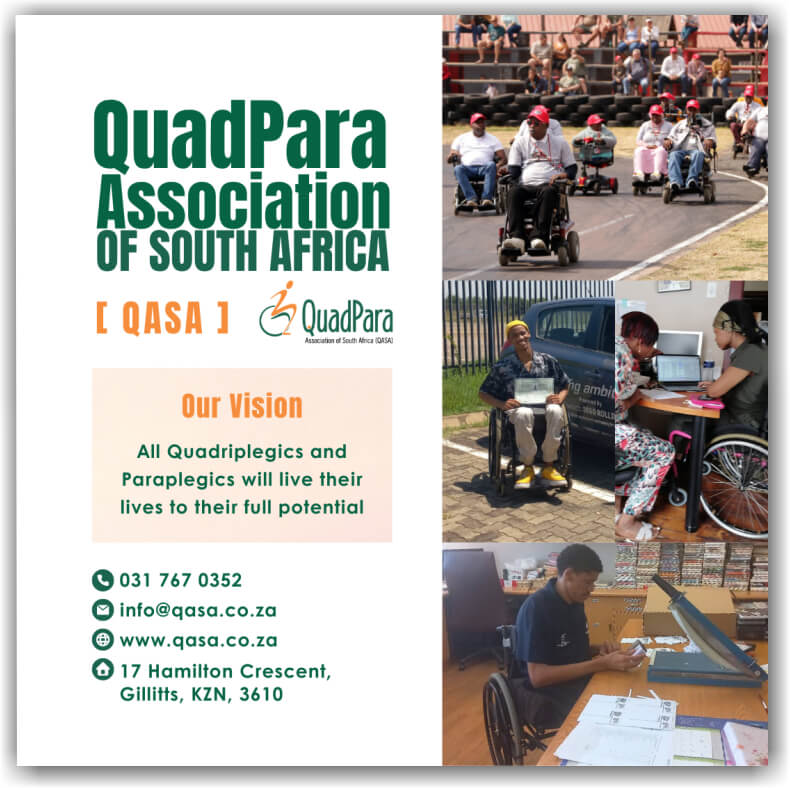
The QuadPara Association of South Africa (QASA) is a non-profit organisation (NPO 000-881) of Quadriplegics and Paraplegics in South Africa. QASA’s mission is “to improve lives by securing resources to advocate, educate, capacitate, support and mobilize”. QASA’s vision is that “all quadriplegics and paraplegics will live their lives to their full potential”. QASA develops products, programmes and services for quadriplegic and paraplegic members to build their capacity and ensure opportunities for societal integration and empowerment.
These projects include but are not limited to the Disability Awareness & Sensitization Workshops/Sessions:
Disability Awareness & Sensitization is an ongoing programme to ensure the successful integration of persons with disabilities into society and the workplace. The aim of the programme is to equip employers and employees the skills and knowledge required to interact with persons with disabilities with confidence. This half-day training workshop will enable employers and employees have a better understanding of the variety of disabilities they may encounter and how to deal with this in a sensitive and practical manner; it will help them to overcome the natural fear we may have when we interact with a disabled person and give tips on awareness and etiquette in these situations.
The training defines and describes disability, unpacks many of the myths which are associated with disabilities, provides a list of some do’s and don’ts and touches on the language of disability.
QASA offers tailor-made sensitization training to suit the needs of the company or organization. Read More
Organisations around South Africa such as QASA conducts various Awareness Campaigns and prevention programmes which aim to prevent future injuries by simply making the public aware of simplest things, these prevention programmes include: