Accessible Parking in South Africa
Accessible Parking in South Africa
Who It’s For, How to Apply, and Why It Matters…
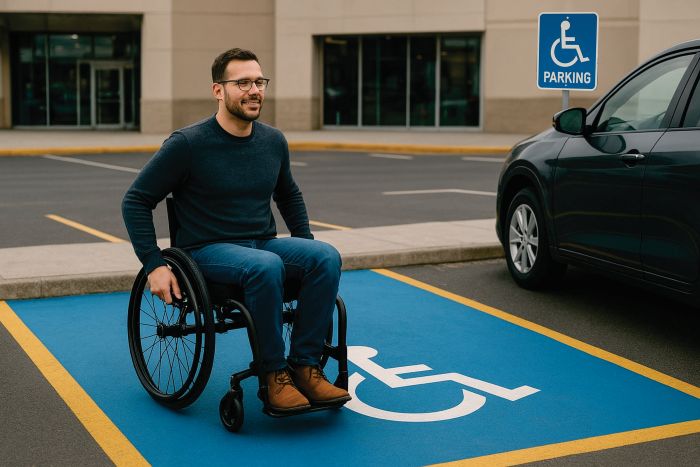
If you’ve visited a shopping centre in South Africa, you’ve likely seen wider parking bays near entrances marked with a wheelchair symbol.
These are commonly called “disabled” or “wheelchair” parking, but the correct term is accessible parking, as the symbol used is the International Symbol of Access
What Is So Special About Accessible Parking Bays?
Accessible Parking spaces are primarily designed to support people with a significant physical impairment which severely effects their mobility and endurance, e.g., someone who need the extra space (access aisle) to safely and conveniently enter and exit a vehicle, whether they drive themselves or being a passenger. (e.g. cannot walk far without rest or assistance), most often requiring the use of a wheelchair, walking aid, or an assistance dog.
Designated accessible parking bays (off-street) must, in line with SANS 10400 Part S:2025 (4th Edition) South Africa, be provided at a ratio of 1 per 25 standard bays, located within 25 m of an accessible main entrance, and on a level, slip-resistant surface. Each bay must be a minimum 3700 mm wide (including a 1200 mm access aisle) and 4500 mm long, forming part of a safe, continuous, and accessible path of travel to the entrance,
While many people misuse Accessible Parking bays because they are located close to building entrances, this is technically a crime and a huge inconvenience for those who do qualify to use them.
Who Can Legally Use Accessible Parking Bays?
The accessible parking bay is governed by a valid accessible parking permit which is linked to a qualifying person. Having a disability does not give you the right to park in an Accessible Parking Bay, especially when not everyone who needs access has a permit at every moment.
Guide Dogs and Assistance Dogs are not automatically entitled to use these parking bays but are linked to the person holding a valid permit. The person and no the car is linked to the permit.
The law sets the rules, but duty of care reminds us that someone else may need the space more.
The National Road Traffic Act, 1996 (Act No. 93 Of 1996) Amendment Of the National Road Traffic Regulations (October 2014), clause 71, regulation 305A, page 69-70, states that:
“Parking for person with disability: A person- (a) whose mobility is severely impaired by a chronic neurological or physiological condition; or (b) whose mobility is temporarily but severely impaired,
Parking in a designated disabled bay without a valid, accredited, and displayed permit is illegal and can lead to fines, clamping, or towing of the vehicle.
A valid disability parking permit must be (1) officially issued by a recognised authority (typically a municipality or provincial body), and (2) linked to a qualifying individual. A green or blue wheelchair sign bought from a shop does NOT give you legal permission to use an accessible parking bay.
Why Should You Not Use Accessible Parking Bays If You Do Not Qualify?
Accessible parking bays are legally reserved for people with valid disability permits. Misuse breaks the law (Regulation 305) and undermines independence and dignity.
Using these bays without a permit can lead to fines, clamping, or towing, and denies access to those who truly need them. Respecting accessible parking supports fairness, safety, and inclusion.
Accessible parking bays are legally protected spaces for people with valid accessible parking permits. Misuse contravenes Regulation 305 and may result in fines, clamping, or towing, while also restricting independence, dignity, and access for those who rely on them.
If you have a disability and need an accessible parking permit, visit our Parking Bays and Disks section to learn how to apply for a registered permit.
If you’re a business and need guidance on accessible parking or compliance, visit Design of Accessible Parking Bays – Who Can Help? to connect with Universal Access Consultants and ensure truly inclusive, compliant design.